


A recent analysis from the Survey Center on American Life highlighted a striking finding: 66 percent of Democratic women ages 18 to 29 said men’s behavior or actions contribute “a great deal” to the challenges women face in American society. Among Republican women the same age, the figure was 18 percent.
Here is the article’s original chart:
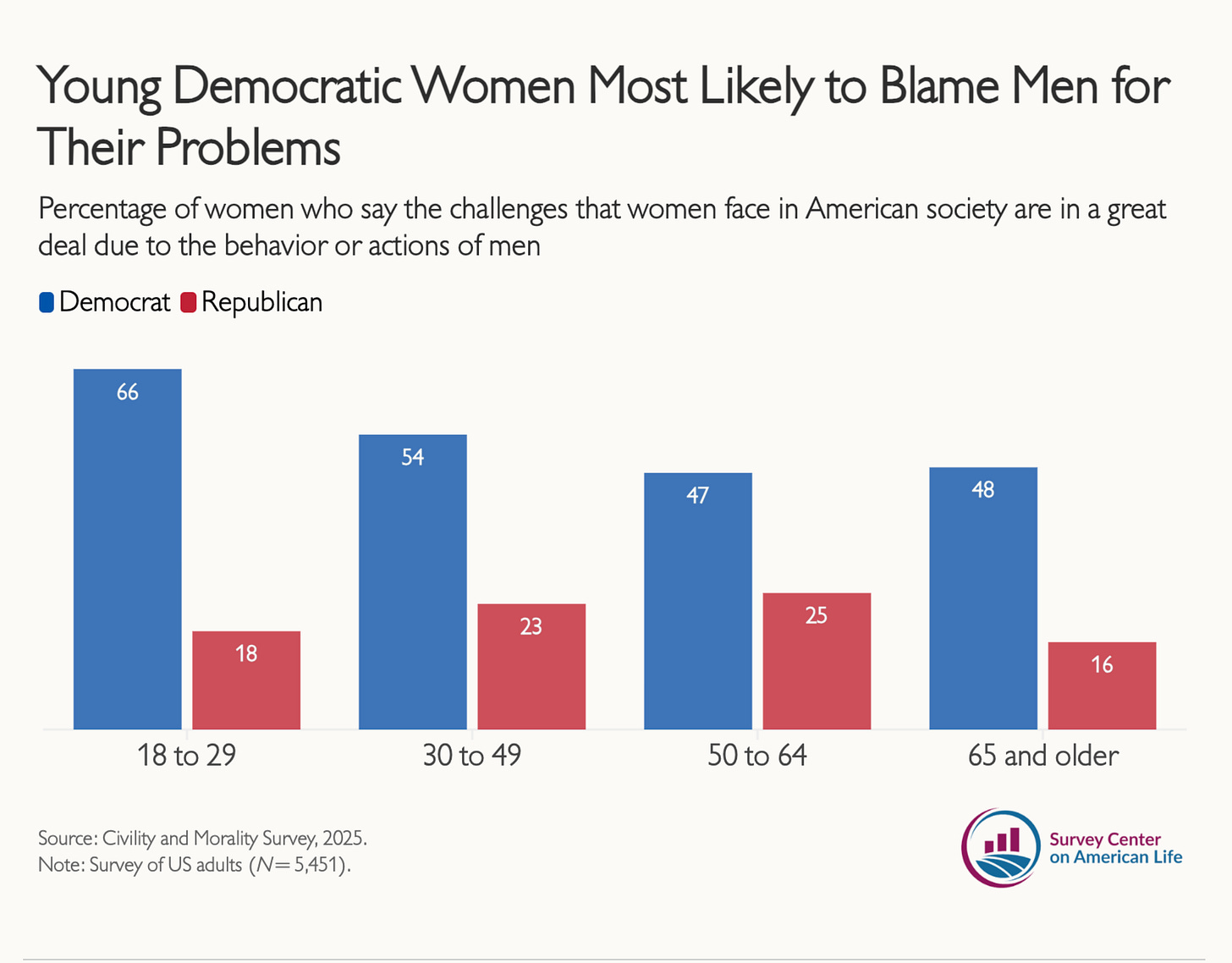
The contrast is dramatic. Young Democratic women were more than three times as likely as young Republican women to choose the strongest response. Across the age groups shown, democratic women were consistently more likely to answer this way.
The survey asked women how much the challenges facing women in American society were due to men’s behavior or actions. The available options were a great deal, a fair amount, hardly any, none at all, and unsure.
The original comparison tells us who selected the strongest answer. It does not tell us how many women attributed at least a fair amount of women’s challenges to men.
To examine that broader question, I looked at the survey’s underlying data using its main survey weight.
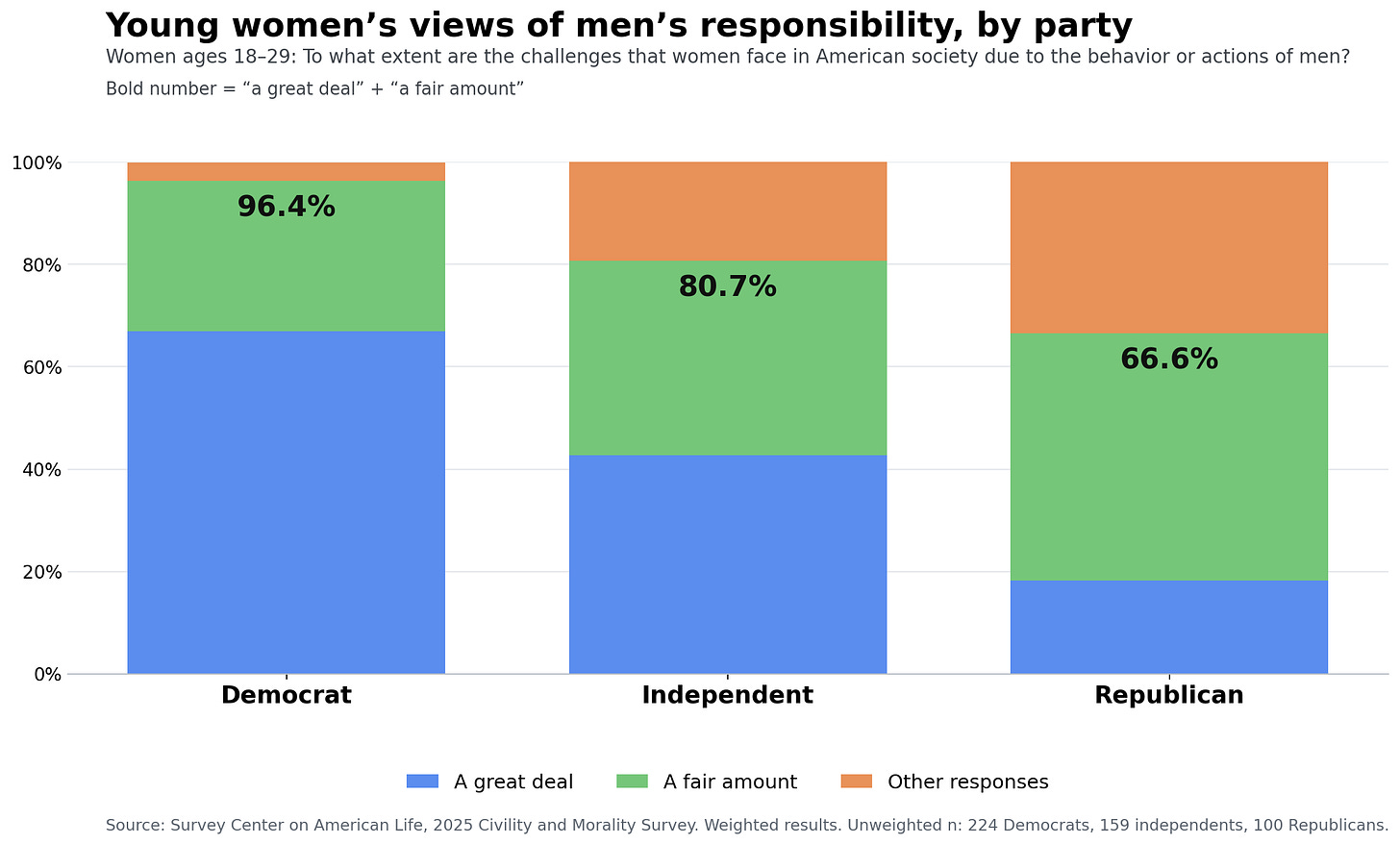
In this analysis, approximately 67 percent of young Democratic women chose a great deal, and another 29 percent chose a fair amount. Total those and you get 96.4 percent.
That is nearly every young Democratic woman in the sample. Nearly 100% of democratic women between the ages of 18-29 attributed at least a fair amount of women’s challenges to the behavior or actions of men.
The Republican result also looks very different once the second response is included. Approximately 18 percent chose a great deal, while 49 percent chose a fair amount. Together, that comes to about 67 percent—roughly two-thirds.
When we total “great deal “ and “fair amount“ it reveals something the original comparison obscures: attributing a substantial share of women’s societal challenges to men is widespread among young women in both parties.
Now let’s look beyond the youngest age group.
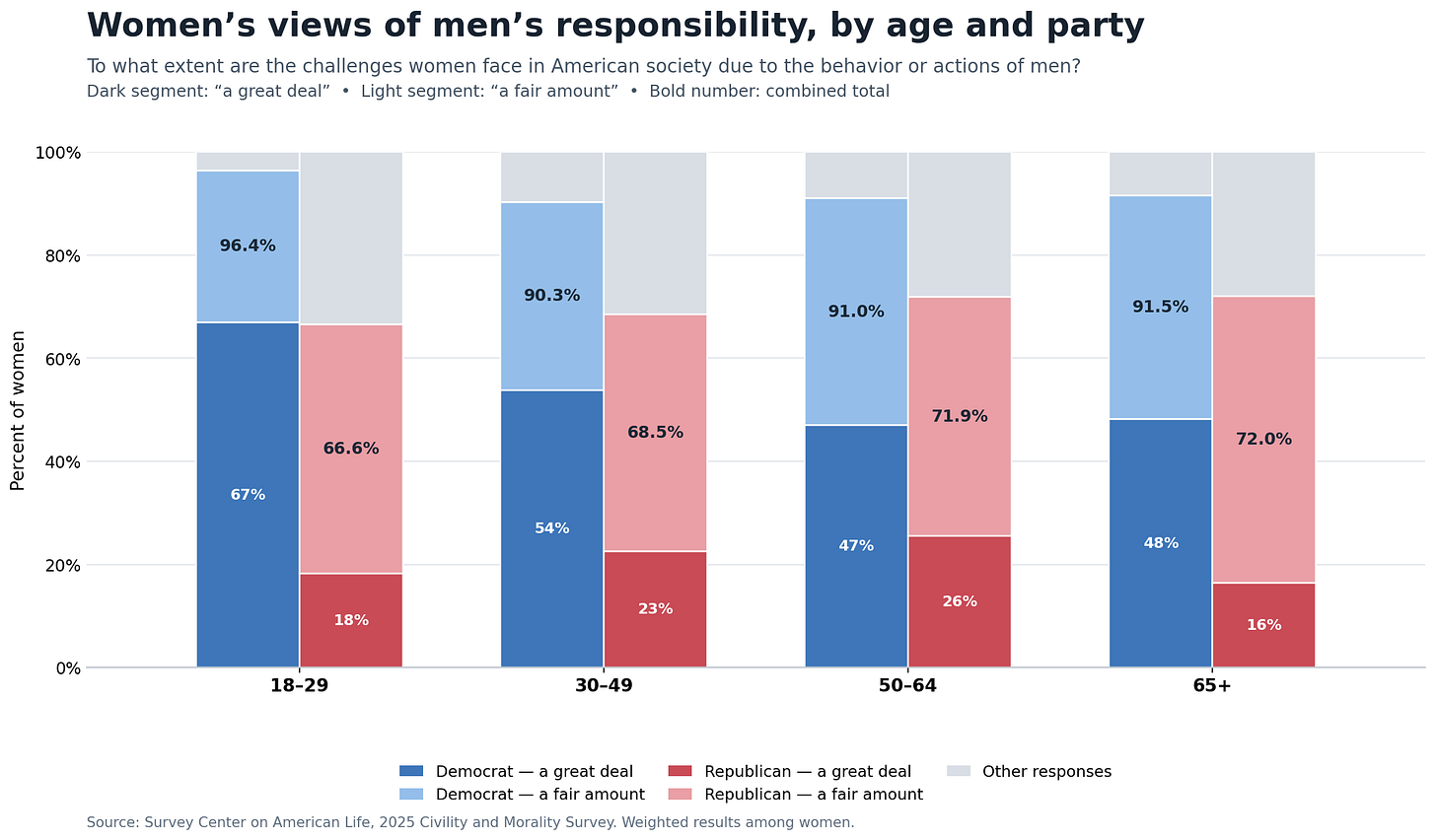
Among Democratic women, the combined total exceeds 90 percent in every age group shown.
The Republican pattern is also revealing. In this sample, the combined percentage is higher in the older age groups. Older Republican women are more likely than younger Republican women to attribute at least a fair amount of women’s challenges to men.
In every Democratic and Republican age group shown, roughly two-thirds or more of women attributed at least a fair amount of women’s societal challenges to men.
What began as a finding about young Democratic women has become a much broader finding about women across generations and party lines. Two thirds of women seem to attribute a fair amount of women’s challenges to men’s actions or behaviors. To me that is a stunning finding.
There is another dimension to consider: education.
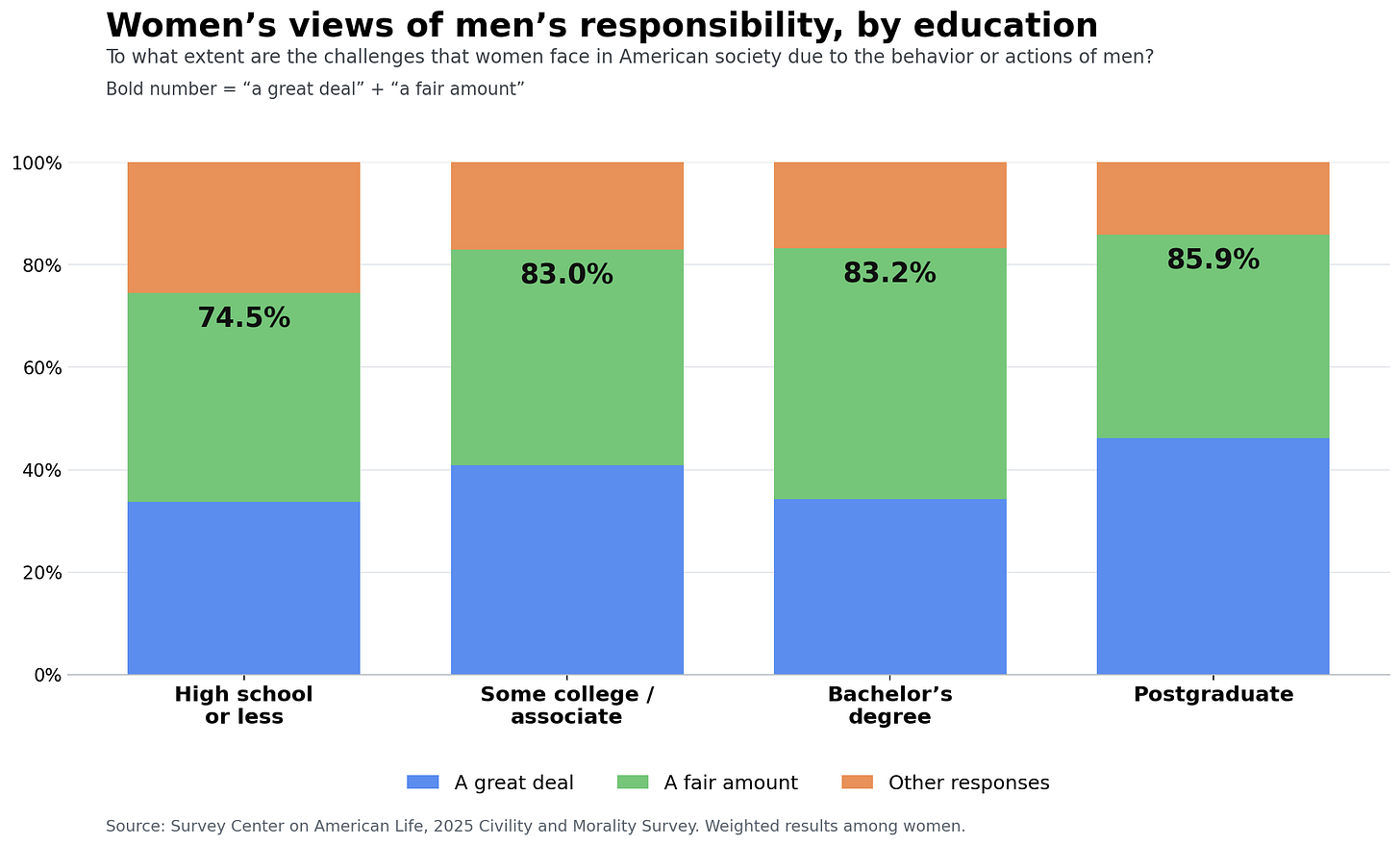
But once again, stopping at the strongest answer leaves out part of the picture.
Including a fair amount reveals the broader educational pattern shown in the chart. The combined responses suggest a stronger tendency to attribute women’s challenges to men at higher levels of education, even though the strongest response alone does not rise consistently across the categories.
So what do these findings mean?
Nearly universal agreement among young Democratic women, more than 90 percent across Democratic age groups, and substantial majorities among Republican women suggest that seeing men as a significant source of women’s difficulties has become a widely shared perspective.
I see these findings as a strong indication of how successfully the feminist narrative has encouraged women to blame men and male power for their difficulties. It seems clear to me that this message can encourage a victim mentality. The survey does not establish why women answered as they did, but the pattern is consistent with that narrative’s influence. And it extends well beyond young Democratic women: substantial majorities of women in every age group shown, in both parties, attributed at least a fair amount of women’s societal challenges to men.
One appeal of that narrative is the explanation it offers: the difficulties women face are not entirely their responsibility; a substantial share of the blame belongs to men. Recognizing some men being a problem is reasonable. Making men an explanation for women’s difficulties is ridiculous. Just imagine men claiming that their difficulties were due to women as a group. Laughable.
What do these findings tell us? What might the impact of these ideas be? We have had decades of feminists telling women that so many of the problems they face are not their fault, that they have been wronged at the hands of men, that they are victims. One of the obvious results of this massive psyop is to diminish women’s accountability. When you believe someone else is the reason for your troubles it relieves you of needing to seek responsibility. If you are not responsible then you are likely not going to be accountable. What might that do to her? What happens to people when their accountability drops? Here are a few ideas of what psychological costs can follow a victim mentality/lack of accountability:
Less self-examination. “How did I contribute?” gets replaced by “Who did this to me?” That makes it easier to repeat the same mistakes, and blame others.
More defensiveness. Feedback can feel like an unfair accusation rather than useful information.
Difficulty repairing relationships. Apologizing, acknowledging someone else’s pain, and changing behavior become harder if the person sees responsibility as entirely belonging to the other party.
A diminished sense of agency. If others are always the cause of your difficulties, you may also come to believe that improvement depends entirely on them. Your focus becomes changing them rather than changing yourself.
Growing mistrust and resentment. Expecting mistreatment can encourage defensive or uncooperative behavior, which may provoke responses that reinforce the original expectation. Research on sensitivity to being victimized supports that possible cycle.
Do you think these five may be related to women seeing others as being responsible for their challenges? Do you think they fit with a feminist narrative that repeatedly explains women’s difficulties through men’s behavior and male power? Does that narrative help women recognize both external obstacles and their own choices, or can it encourage blame at the expense of agency? Have you seen any of this in your family, relationships, or work?
Let me know what you think.
Men Are Good
Source: Survey Center on American Life, 2025 Civility and Morality Survey, a survey of 5,451 U.S. adults conducted through Ipsos KnowledgePanel. The original article reports 66 percent for young Democratic women selecting “a great deal”; the weighted analysis used for the additional charts gives approximately 67 percent. The 96.5 percent combined figure uses unrounded values. The additional charts and subgroup figures are from my analysis.
Original article: https://www.americansurveycenter.org/significant-figures/young-women-are-the-most-likely-to-believe-that-men-are-at-the-root-of-their-problems/
Survey topline and methodology: https://www.americansurveycenter.org/wp-content/uploads/2025/11/Civility-and-Morality-Survey-Topline-1.pdf