


A Landmark Report on Men and Boys—Let’s Help It Reach the People Who Need to Read It
ICMB has given us an important tool. Men and women everywhere can help put it to work.
Many of us have had the experience of trying to explain the problems facing men and boys, only to discover how little the person listening has heard about them. Boys struggling in school. Men dying by suicide. Fathers losing meaningful relationships with their children. Male victims of abuse finding few places to turn.
These conversations can be difficult, especially when we are expected to produce the research, explain the background, and answer every objection on the spot. Having a substantial report to share can make a real difference.
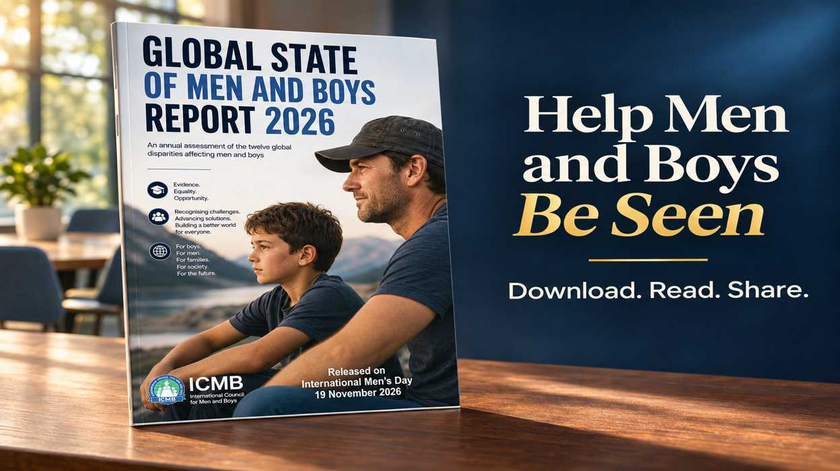
The International Council for Men and Boys has taken an important step with its inaugural Global State of Men and Boys Report 2026. Drawing on evidence from more than 50 countries and research from governments, international organizations, and universities, this 36-page report brings together twelve major areas of disadvantage affecting men and boys.
I want to congratulate ICMB and everyone who contributed to this effort. Bringing this material together, organizing it into an accessible report, and identifying practical priorities is valuable work. It deserves our appreciation—and our help getting it into circulation.
Download the Global State of Men and Boys Report 2026 here.
The report describes a troubling picture. Boys lag behind girls in literacy and educational attainment across much of the world. Men live shorter lives and face substantially higher suicide rates. Men and boys account for 81 percent of intentional homicide victims worldwide. Across the countries examined, men make up approximately three-quarters of people experiencing homelessness.
Its scope also includes fatherhood, partner abuse, criminal justice, workplace deaths, false allegations and parental alienation, adoption and reproductive issues, and the media.
Behind these categories are people we know: the boy who has begun to believe school has nothing for him, the father whose children are slipping out of his life, the abused man who doubts anyone will believe him, and the older man whose isolation goes unnoticed.
A report like this helps make their circumstances visible.
One of its most useful features is the effort to assess institutional responses alongside the problems themselves. ICMB asks about fairness, access to services, accountability, and demonstrated progress. These ratings are the council’s evidence-informed policy judgments, rather than purely statistical measurements. They provide a baseline against which future progress can be assessed.
The report also includes seven case studies of promising reforms and interventions. That matters. We need to document what is going wrong, and we need examples of what people can do about it.
For me, one of the central questions is whether our institutions can recognize male vulnerability and respond with compassion. When a boy falls behind, do we examine whether his school understands his needs? When a man seeks help, do services make room for the ways he experiences and expresses distress? When a father struggles to remain involved, do institutions recognize the importance of that relationship to his children?
These are questions that schools, healthcare providers, churches, governments, and community organizations should be asking.
ICMB’s recommendations give them somewhere to begin: improve boys’ educational outcomes; address male suicide and premature mortality with services responsive to men’s needs; support male victims of violence, abuse, and homelessness; strengthen fatherhood and family wellbeing; and establish measurable goals with public accountability.
Those priorities deserve serious consideration.
But publishing a report is only part of the work. Its influence will depend in part on whether people read it, discuss it, and place it before those who can respond.
That is where you and I come in.
Please download the report, read it, and send it to people within your own circle of influence. That might include:
Elected officials: your local council members, mayor, school board, state legislators, governor, members of Congress, or equivalent representatives outside the United States.
Churches and faith communities: clergy, ministry leaders, pastoral counselors, and people organizing family or community support.
Schools and colleges: teachers, principals, counselors, administrators, and those responsible for student wellbeing.
Health and social services: therapists, physicians, public health officials, domestic abuse services, and homelessness organizations.
Community and professional groups: charities, civic associations, employers, unions, veterans’ organizations, and professional bodies.
People who help shape public discussion: journalists, editors, podcasters, and other writers.
Your personal community: friends, relatives, neighbors, and colleagues.
Local TV and radio stations, and public libraries: send it to news directors, producers, talk-show hosts, and librarians. Suggest a news segment, an interview, a community discussion, or making the report available to library patrons.
I especially encourage women to participate. Mothers, wives, sisters, daughters, friends, and colleagues can all help bring these concerns into conversations where they have received too little attention. This effort needs men and women willing to speak up.
You do not need a large audience to contribute. Start with three people. Choose one public official, one person in a local institution, and one friend or family member. Add a sentence about why this matters to you, and ask them to read and share it.
If you write to an official or organization, ask for a response: Which of these findings relates to your work, and what practical action could you take? A courteous follow-up can help turn an email into a conversation.
ICMB has done something worth celebrating. It has given us a shared resource for making the needs of men and boys harder to overlook. Let’s help this work reach beyond those of us who already care about these issues.
Download the report, choose your first three recipients, and pass it on.
Below are two notes you can copy, paste, and adapt.
For public officials, churches, and organizations
I’m sharing the International Council for Men and Boys’ Global State of Men and Boys Report 2026. It brings together international evidence on twelve areas affecting male wellbeing, including education, health, suicide, violence, fatherhood, and homelessness, and offers practical priorities for action.
Please consider reviewing the report and sharing it with the relevant people in your office or organization. I would appreciate hearing which findings relate to your work and what steps you could take to address them.
The report is available here: https://www.menandboys.net/foundations/
Thank you for giving these concerns your attention.
For friends, family, and neighbors
I thought this report deserved a wider audience. ICMB’s Global State of Men and Boys Report 2026 brings together evidence about problems affecting men and boys, from difficulties in school to suicide, homelessness, abuse, and barriers facing fathers.
These issues touch families and communities, including people we know and love. Please take a look, and consider passing it along to someone who would benefit from reading it—or who is in a position to help.
You can download it here: https://www.menandboys.net/foundations/
Men Are Good.