MenAreGood
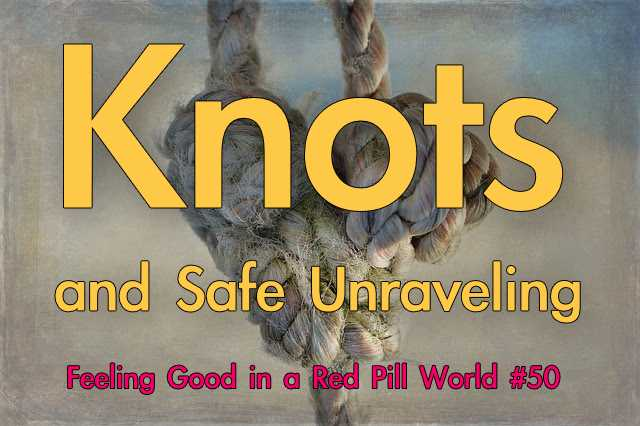
Feeling Good in a Red Pill World 50: Knots and Safe Unraveling
February 27, 2024


We know that there is likely a connection of our childhood trauma with present day depression and a host of other possible related problems.  Basically, the old unprocessed stories from our youth have the tendency to accumulate and disappear from our conscious awareness.  Even though we lack conscious awareness, the stories can still have an impact on different parts of our lives such as depression, alcohol abuse, relationship turmoil, suicide attempts and others. But what can be done about this?

Freud knew in the early 20th century that a trauma that is relived, felt on an emotional level, remembered visually and experienced in the body was a trauma likely to be decreased in its negative impact on our psyche.  He really did have the basics down.  We have learned a good deal since then and modern day therapy tries to put that to use.  Many forms of therapy are based on this general idea.       

One basic idea in therapy is to help the person tell their old stories and do this from a safe place.  Research has shown that simply remembering or reliving a trauma is not always a good thing. If old trauma are remembered during a panic attack that does not seem to have a similar therapeutic impact.  What has been found is that the remembering needs to be accomplished from a place of safety.  Good therapy helps in finding a safe way to relive the upsetting memories and untie those knots that we have in our hearts and minds.

TRY THIS

Safety is a critical element in healing old stories.  This calls on us to learn to relax and relax deeply.  Use your favorite relaxation technique and monitor your rate of breathing.  As we relax our breath slows down.  With practice you can slow it down more and more. When you think you are relaxed, count the number of breaths you take per minute.  You can use that number as a baseline.  You can probably get it lower!  Research has shown that when we can slow the breath down, and keep it down  for 15-20 minutes a day lots of good things happen.    Remember, this should not be a struggle.  Don't force the breath one way or the other, just focus on your relaxation and use the breath as a gauge. This can be a critical first step in relieving yourself of family of origin burdens.

See you next Tuesday for another look at feeling good in a red pill world.  Men are good.  As are you!

community logo
Join the MenAreGood Community
To read more articles like this, sign up and join my community today
0
What else you may like…
Videos
Podcasts
Posts
Articles
November 19, 2025
The Relentless War on Masculinity

Happy International Men's Day! It's a perfect day to acknowledge the relentless war on masculinity? Here we go!

In this video I sit down with four people I deeply respect to talk about a book I think is going to matter: The Relentless War on Masculinity: When Will It End? by David Maywald.

Joining me are:

Dr. Jim Nuzzo – health researcher from Perth and author of The Nuzzo Letter, who’s been quietly but steadily documenting how men’s health is sidelined.

Dr. Hannah Spier – an anti-feminist psychiatrist (yes, you heard that right) and creator of Psychobabble, who pulls no punches about female accountability and the mental-health system.

Lisa Britton – writer for Evie Magazine and other outlets, one of the few women bringing men’s issues into women’s media and mainstream conversation.

David Maywald – husband, father of a son and a daughter, long-time advocate for boys’ education and men’s wellbeing, and now author of The Relentless War on Masculinity.

We talk about why David wrote this book ...

01:05:19
November 17, 2025
Cancel Culture with a Vengeance

Universities and media love to brand themselves as champions of free speech and open debate. But what happens when those same institutions quietly use legal tools to gag and erase the very people who challenge their orthodoxies?

In this conversation, I’m joined by two of my favorite thinkers, Dr. Janice Fiamengo and Dr. Stephen Baskerville, to dig into a darker layer beneath “cancel culture.” We start from the case of Dr. James Nuzzo, whose FOIA request exposed a coordinated effort by colleagues and administrators to push him out rather than debate his research, and then go much deeper.

Stephen explains how non-disclosure agreements, non-disparagement clauses, and mandatory arbitration have become a hidden system of censorship in universities, Christian colleges, and even media outlets—silencing dissenters, shielding institutions from scrutiny, and quietly stripping people of their practical First Amendment rights. Janice adds her own experience with gag orders and human rights complaints, and ...

00:57:23
October 02, 2025
Father Custody: The Solution to Injustices Against Men?

In this conversation, I sit down with Stephen Baskerville and Rick Bradford to explore a provocative idea: could father custody be the key to addressing many of the injustices men face? Both men are leading experts in this area, and together they examine some fascinating angles. One insight is that the legal contract of marriage doesn’t just unite two people — it’s also the mechanism that legally creates fathers. Yet when that contract is dissolved through divorce, the law often strips fathers of their rights, reducing them to mere “visitors” in their children’s lives. This and much more is unpacked in our discussion.

We also point to Rick’s and Stephen’s books (linked below) and to AI tools that allow you to interact with their work directly. (also linked below)

If you’ve ever wondered why custody is such a defining issue — not just for fathers but for the future of men’s rights and well-being — this dialogue offers insights you won’t want to miss.

Men are good, as are you.

Books...

01:18:10
February 07, 2023
The Way Boys Play and the Biological Underpinnings

My apologies for the last empty post. My mistake. Let's hope this one works.

Tom takes a stab at using the podcast function. Let's see how it goes.

The Way Boys Play and the Biological Underpinnings
May 13, 2022
Boys and Rough Play

This is a short excerpt from Helping Mothers be Closer to their Sons. The book was meant for single mothers who really don't know much about boy's nature. They also don't have a man in the house who can stand up for the boy and his unique nature. It tries to give them some ideas about how boys and girls are different. This excerpt is about play behaviors.

Boys and Rough Play

She is a Dr Urologist. But her take and advice is better than anything the mental health industry has shown me so far. Every boy man young and old should see this. A 10 out of 10!!!

This guy is really laying it out. Great stuff.

This is just one example of the most toxic affects of gynocentrism,
It goes to approaching women, to shut up and sit down and shut up to you are taking up space and more women need to be in the jobs you are in.
Reality does not matter only women's feelings do. This message is so pervasive and so saturated in our modern society that if you are a kind and sensitive man it can feel crippling. Unfortunately sensitive boys often see the only way out as go full Andrew Tate or killthem selfs. To fully reject the whole of society and counter project back or exit. It's toxic and I and many others are more than a lot angry about it.

33 minutes ago
post photo preview
The Bias We Pretend Doesn't Hurt Boys - Part 2
The Double Standard: Why Girls Get Protection and Boys Get Silence


The Double Standard: Why Girls Get Protection and Boys Get Silence

Here is the contradiction at the heart of our culture’s approach to children:

When a stereotype harms girls, we mobilize.
When a stereotype harms boys, we rationalize.

Look again at the math example.
The message girls heard—“girls aren’t good at math”—was subtle and narrow, yet the response was sweeping. Grants, new curricula, teacher training, role-model initiatives, national campaigns. Entire systems shifted to make sure girls never internalized even a hint of inferiority.

Necessary? Yes.
But also revealing.

Because when the stereotypes aimed at boys are far harsher—“toxic,” “oppressor,” “privileged,” “dangerous,” “obsolete”—we do nothing. And this is where gynocentrism comes in.

Gynocentrism isn’t hatred of boys; it’s something quieter and harder to notice:
a cultural reflex that centers girls’ and women’s needs as moral priorities, while treating boys’ and men’s needs as less urgent, less sympathetic, or even suspect.

In a gynocentric culture, protecting girls is not just helpful — it feels virtuous.
And protecting boys often feels unnecessary, or worse, like a challenge to women’s advancement.

So when girls face a stereotype, no matter how small, the cultural machinery activates. When boys face a stereotype that attacks their whole identity, that same machinery goes quiet. Their pain doesn’t register with the same moral weight.

And most people don’t even notice this double standard because gynocentrism operates like the background music of the culture — always there, rarely questioned. It creates an environment where:

  • girls’ struggles evoke empathy

  • boys’ struggles evoke denial

  • girls are seen as vulnerable

  • boys are seen as responsible

  • girls are lifted

  • boys are lectured

This is not because people consciously dislike boys. It’s because we are swimming in a worldview that instinctively prioritizes female well-being.

So girls get interventions, reforms, resources, encouragement, and national concern.
And boys get silence, suspicion, or blame.

This is the unexamined engine driving the contradictions we see today. Until we name gynocentrism, we can’t make sense of why our culture protects one group’s identity and ignores the slow erosion of the other’s.

And that brings us to the most important question: What do we owe our boys in a culture that has forgotten how to see them?


What Our Culture Owes Its Boys

If Jane Elliott’s classroom taught us anything, it’s that children rise or fall based on the signals adults send. And right now, the signals sent to boys are filtered through a culture deeply shaped by gynocentrism — a once-natural instinct to protect women and children that, over the last fifty years, has been weaponized by modern feminism. What began as empathy has hardened into ideology — a cultural reflex that protects girls first, crowns them as the default victims, and brands boys as the problem, undeserving of equal compassion.

But boys are not just absorbing it.
They are being shaped by it.

If stereotype threat can affect a girl’s math performance, imagine the impact of a full cultural narrative that tells boys their very nature is worrisome. Imagine a boy growing up in a world where girls are framed as precious and in need of uplift, while boys are framed as problematic and in need of correction.

That’s not equality — it’s a gross misunderstanding of human development.

Because boys, like girls, are tender creatures. They feel disapproval deeply. They respond to expectations with the same sensitivity Jane Elliott witnessed in her classroom. A culture cannot shame half its children and expect them to grow into confident, healthy adults.

And yet gynocentrism blinds us to this. It tells us that helping girls is virtuous, but helping boys is unnecessary—or even suspect. It hides boys’ suffering behind the old myth that they’ll “be fine.” It excuses the neglect of their emotional lives. It makes male pain invisible and male discouragement seem normal.

Some of this bias is a natural product of our evolutionary history—a survival instinct to protect women and children first. But over the last fifty years, that instinct has been weaponized by modern feminism into an extreme moral hierarchy: one that automatically places female well-being above male well-being, and often demonizes men and boys in the process.

But boys are not fine under this shadow. They are quietly collapsing beneath messages no child should have to carry.

It’s time to remove the blindfold.

We owe boys the same compassion we give girls—not less, not someday, but the same.

We owe them:

  • a sense of belonging,

  • an affirmation of their goodness,

  • environments that honor their strengths,

  • teachers trained in non-feminist and authentic male psychology,

  • and a culture willing to say openly: Boys matter.

The world can support both girls and boys. This is not a zero-sum game. But it requires us to step outside the gynocentric reflex and see our sons clearly again.

Because if a culture cannot love its boys, it cannot love its future.

Men are good, as are you. And so are our boys.

Read full Article
November 29, 2025
post photo preview
Teen Violence — When Ideology Trumps Data
3 - Bias Against Men and Boys in Psychological Research

This post is part of an ongoing series originally published around 2010, examining the misandry embedded in mental health research. It’s the first of three research projects covered in that series. This one looks at a report from Great Britain’s NSPCC on teen violence — and it’s astonishingly misandrist. It’s worth reading just to see how deftly they twist language to push their narrative. I’ve included links at the end, along with images of media articles that dutifully echoed their claims. It’s remarkable how easily the media amplifies these lies and half-truths — and has been doing so for years. The remaining two posts in the series will be published over the next two Saturdays.
— Tom


Teen Violence — When Ideology Trumps Data


The first project we’ll look at is a study from Great Britain on teen relationship violence. The research included both a written survey and in-depth interviews with selected teens. The survey results were clear: both boys and girls experienced relationship violence.

Yet, the public ad campaign that followed told a very different story. It focused entirely on helping girls as victims and portrayed boys only as perpetrators. This stunning disregard for male victims — and for the girls identified as perpetrators — stood in sharp contrast to the study’s own data. Those numbers showed that many boys were victims of teen relationship violence, and that girls, too, could be perpetrators.

Let’s start at the beginning — with how this issue first caught my attention.

A friend emailed me a link a couple of months ago to an article from Great Britain about teen violence. The friend was worried that the article was biased against boys. Here’s how it started:

  • A new government campaign launched today urges teenage boys not to abuse their girlfriends.

  • TV, radio, internet, and poster ads will target boys aged 13 to 18, aiming to show the consequences of abusive relationships.

  • Officials describe it as part of a broader effort to reduce domestic violence against women and younger girls.'

The campaign was inspired by research published last year by the NSPCC, which reported that:

  • One in four teenage girls said they had been physically abused by a boyfriend.

  • One in six said they had been pressured into sex.

  • One in three said they had gone further sexually than they wanted to.


I was a bit taken aback by the article, especially given the recent research on teen relationship violence showing that it tends to be fairly symmetrical — with both boys and girls acting as perpetrators and victims. Yet this article presented a very different picture. It assumed from the outset that girls were the primary victims and boys the primary perpetrators, reflecting an outdated stereotype about domestic violence.

That disconnect made me wonder what was really going on. I read several more articles about the ad campaign mentioned in the piece, and was surprised — even shocked — to find that the campaign’s entire focus was on helping girls while “teaching” boys not to abuse their girlfriends.

Each of these articles cited the same research as the basis for the campaign. So I decided to go straight to the source and see what the original study actually found.

The original study was sponsored by the National Society for the Prevention of Cruelty to Children (NSPCC) of Great Britain and was in two parts. The first part was the “full report” and was a detailed 209 page research report explaining methodology, results, implications and conclusions. The next was the Executive Summary which was a 10 page summation of the findings of the full report. It was a quick read meant to give people the essence of the larger document. I read through the “full report” and then the executive summary. It was striking to me that the data in the full report actually showed that boys were victims of teen violence. The original news article I had read had mentioned that the research had found that 25% of girls said they had been physically abused by their boyfriends. What the news article omitted saying was that the same research had also found that 18% of boys had said that they had been physically abused by their girlfriends. This meant that this research found that almost half of the victims of teen relationship violence were boys! Somehow this important fact had been omitted from the news report.

There were plenty of other headlines that could have been drawn from the data of the full report that showed the boys to have been victims and the girls perpetrators but they were nowhere to be seen in any of the news articles. Here are a couple of examples of headlines that could be written from the data of the full report:

  • 25% of those reporting physically forcing their partners into having sexual intercourse were girls – Table 15 page 82 full report

  • Nearly three times as many girls reported using SEVERE violence in relationships. table 11 – page 75 full report

  • Over three times as many girls reported using partner violence in their relationships table 10 page 74 full report

  • Over 1/3 of those reporting being pressured into kissing, touching or something else were boys. table 6 page 66 full report–

  • Nearly half (42%) of the victims of teen relationship violence were boys 
Table 3 page 44 full report

  • Nearly one third of the victims of severe violence were boys
Table 4 page 45 full report

  • Twice as many girls reported physically forcing their partners into “kissing, touching, or something else” more than a few times. Table 13 page 82 full report


This is just a sampling of the findings from the full report. It’s clear that the survey showed teen relationship violence was not gender-based — both boys and girls were represented among the victims and perpetrators. However, after reading both the full report and the executive summary, I noticed a striking difference. The full report included data showing boys as victims and girls as perpetrators, but the executive summary contained far less information about male victims and female perpetrators. In fact, the executive summary seemed to focus almost entirely on female victims and male perpetrators.

I began to wonder how such a shift could occur. The original study had shown boys as victims — not as frequently as girls, but still in significant numbers. Boys accounted for roughly 25–42% of victims, certainly not the majority, but far too many to ignore. Yet ignore them they did.

The NSPCC introduced this research to the public through a press release, and once again, we can see the same pattern — a steady move away from acknowledging boys. What began as an apparently balanced investigation into teen relationship violence in the full report became less so in the executive summary, and by the time it reached the press release, the focus had shifted almost entirely to girls. Here’s the opening of that release. Note the “girls only” framing in both the headline and the opening paragraphs:

Teen girls abused by boyfriends warns NSPCC Press releases 01 September 2009 A third of teenage girls in a relationship suffer unwanted sexual acts and a quarter physical violence, reveals new research(1) launched today (01 September 2009) by the NSPCC(2) and the University of Bristol(3). The survey of 13 to 17-year-olds found that nearly nine out of ten girls had been in an intimate relationship. Of these, one in six said they had been pressured into sexual intercourse and 1 in 16 said they had been raped. Others had been pressured or forced to kiss or sexually touch. A quarter of girls had suffered physical violence such as being slapped, punched, or beaten by their boyfriends.

Girls are highlighted repeatedly in the press release. If one only read the press release you might assume that the boys were incidental and that the girls were clearly the identified victims of teen relationship violence. The boys actually did get mentioned in one paragraph (one out of 18 paragraphs, eleven of which were about girls). Here it is:

Nearly nine out of ten boys also said they had been in a relationship. A smaller number reported pressure or violence from girls. (Only one in seventeen boys in a relationship reported being pressured or forced into sexual activity and almost one in five suffered physical violence in a relationship).

Note how the boys victimization is minimized with words like “a smaller number” and “only one in seventeen.” Keep in mind that the “smaller number” referred to in the second sentence was 18% versus 25% which had been the figure for girls. While 18 is smaller than 25, it is not that much smaller. Another important difference is that the girls 25% stat was mentioned in the opening sentence of the document (and indirectly in the headline) while the boys 18% stat was mentioned as an afterthought in parentheses. Yes, the boys percentage was smaller but it seems very obvious that this press release is trying to marginalize the victimization of boys.

Note that the press release mentions that one in 17 girls had been raped. This works out to about 5.8% of the females surveyed. What they don’t mention is that the same table in the full report that showed that 5.8% of girls were raped also showed that 3.3% of the boys were also raped. This stat never made it beyond the full report. The press release mentions the rape of girls but is completely silent on the shocking statistic that 3.3% of the boys were raped. The fact is that their data from the full report shows boys comprised over one third of the rape victims. Not a word about this.

It now seems easy to understand how the media articles focused so exclusively on girls and ignored the needs of boys. They likely only read the press release and maybe a part of the executive summary. The press release might very well have been the only document they read about the study and it clearly focused almost exclusively on girls while ignoring the needs of boys. How bad did it get in focusing on just girls? Here is a sampling of typical headlines from actual news articles on this research and ad campaign: Many Girls’ Abused by Boyfriends
Third of teenage girls forced into sex,
NSPCC survey finds

1 in 3 Teenage Girls Tell of Sexual Abuse by Their Boyfriends
  
Teen Girls Abused by Boyfriends Warns NSPCC


Almost every headline I found focused on girls as victims. Not one centered on boys. The articles occasionally mentioned that boys could also be vulnerable, but the main narrative was always about girls’ vulnerability and victimhood.

The ad campaign represented the real-world application of this research — TV, radio, internet, and poster ads aimed at changing teen relationship behaviors. It marked the point where theory ended and where public messaging — and taxpayer funding — began.

Inexplicably, the campaign’s focus was entirely on girls as victims of relationship violence, while boys were portrayed as the problem and instructed not to abuse their girlfriends. Somehow, the original research had shown that both boys and girls experienced relationship violence, yet by the time the findings reached the media — and then the public through the ad campaign — the data on male victims had all but disappeared.

How did this happen?

The Full Report and then boys disappear

The full report offers an abundance of data that shows that boys are victims of teen partner violence but somehow the recommendations of both the full report and the executive summary seem to focus primarily on girls. Here’s a quick summary extrapolated from the full report:

According to their survey:

*** 72% girls reported experiencing emotional violence 51% of boys reported emotional violence BOYS WERE 41% of the victims of emotional violence in teen relationships

*** 25% of girls experienced physical partner violence 18% of the boys experienced physical partner violence BOYS WERE 42% of the victims of physical partner violence in teen relationships

*** 31% of girls experienced sexual partner violence 16% of boys experienced sexual partner violence BOYS WERE 34% of the victims of sexual partner violence in teen relationships.

According to the survey, boys made up between 34% and 42% of the victims. The full report stated this clearly in the data. Yet, as the findings moved from the full report to the executive summary and then to the press release, boys seemed to vanish. Why could that be?

The researchers never directly explained this omission, but reading between the lines, two possible reasons emerge.

The first is that the survey results suggested girls were more “impacted” by relationship violence than boys. One question on the survey asked about emotional reactions to the violence. Girls were far more likely to select responses indicating they felt scared, upset, or humiliated. Boys, on the other hand, were more likely to report feeling angry, annoyed, or unaffected.

The researchers appear to have interpreted these emotional differences to mean that girls suffered more deeply from relationship violence — and therefore should be the primary focus of attention and services. This assumption is implied in several places throughout the full report. Here’s one example:

This research has demonstrated that a fundamental divide exists in relation to how girls and boys are affected by partner violence, and this divide needs to be a central component in the development of professional responses to this issue.


What exactly does “professional responses to this issue” mean? The authors never explain, but it seems reasonable to assume they’re suggesting that girls should receive more attention and services because they were more emotionally affected by the violence. Given that the report’s recommendations focus almost exclusively on girls while ignoring the needs of boys, this interpretation seems well-founded — though I’d be happy to be corrected if that assumption is wrong.

The researchers appear willing to overlook their own substantial evidence that boys were also victims of relationship violence — simply because girls reported stronger emotional reactions. Here’s another example:

These findings are further elaborated on in the interview data where girls consistently described the harmful impact that the violence had on their welfare, often long term, while boy victims routinely stated they were unaffected or, at the very worst, annoyed. These results provide the wider context in which teenage partner violence needs to be viewed.

It’s important to remember that the interview data quoted above — which we’ll examine in more detail later — included only 62 hand-selected girls and 29 similarly chosen boys. Notably, only one of those 29 boys was a victim of non-reciprocal violence. That makes it highly questionable to draw broad conclusions from such a small and uneven sample, especially when the survey itself included over 1,300 teens.

Also worth noting is the phrase “the wider context in which teenage partner violence needs to be viewed.” We can reasonably assume the researchers are again implying that girls should receive priority in services and support. What’s clear, however, is that the data on violence against boys is ignored — both in the recommendation sections and in the resulting ad campaign. The following quote offers further insight into the researchers’ perspective:

Intervention programmes need to reflect this fundamental difference by ensuring that the significant impact of violence on girls’ wellbeing is recognised and responded to, while enabling boys to recognise the implications of partner violence for their partners and themselves.

This statement clearly shows that the researchers believe that the girls should be treated differently and intervention programs need to “reflect” the difference that girls are more impacted by the violence.

But are girls more impacted? I am not so sure. Let’s start by looking at the actual question on the survey:

3 How did it make you feel when force was used against you? 

scared/frightened 
angry/annoyed 
humiliated 
upset/unhappy 
loved/protected 
thought it was funny 
no effect

The researchers noted that boys and girls gave markedly different responses when asked how the violence had affected them. However, they didn’t provide the raw data — no breakdown of how many boys or girls chose each option — only a summary stating that girls were much more “impacted.”

There are good reasons for this difference. The question itself was flawed — practically designed to produce a gender gap. Boys and girls are socialized, and often biologically inclined, to respond to emotional threat differently. The creators of this survey question seemed unaware of boys’ deep-seated reluctance to show vulnerability or dependence — a reflection of their hierarchical nature and their drive for independence.

For a boy to check boxes like “scared/frightened,” “humiliated,” or “upset/unhappy” would mean admitting weakness, something most boys instinctively avoid. Instead, they are far more likely to select “angry/annoyed” or even “no effect” to maintain an image of strength. As Warren Farrell aptly said, “The weakness of men is the facade of strength; the strength of women is the facade of weakness.” Boys and men are far more likely to choose responses that convey control and toughness.

If this is true, then boys’ responses in the survey may not accurately reflect their true emotional impact. It’s entirely possible that those who checked “no effect” were just as hurt or disturbed as their female counterparts. With questions framed this way, we’re left not knowing the real story. Basing future services on such data would be risky — and likely lead to deeply flawed conclusions.

Consider this: would the researchers dismiss a rape victim who said she felt “no impact” and decide she didn’t need support? Of course not. Would clinicians ignore domestic violence victims who claimed they were unaffected? Hardly. So why dismiss the pain of boys simply because they reported fewer signs of distress on a survey? Emotional reactions vary widely from person to person, and not showing immediate or visible distress doesn’t mean the trauma isn’t real.

Having worked with trauma victims for many years, I know that emotional impact often emerges slowly — sometimes months or even years after the event. To deny services based on someone’s initial emotional response, or apparent lack thereof, is one of the most misguided ideas imaginable. And to deny those services to an entire group — in this case, boys — on that basis isn’t just poor reasoning. It’s prejudice, plain and simple.

Are the researchers biased against boys?

There are numerous indications, in addition to what has already been described, that the researchers have an anti-boy bias. There are the obvious dismissals of the survey data that shows boys to be victims of partner violence and the complete focus on girls as victims. But there are a number of more subtle clues in the study that seem to indicate a disdain for boys.

When they did mention boys as victims the report tended to minimize their experience. Here is a quote:

Boys’ experiences of violence - Little evidence existed to support the possibility that boys, although they were negatively affected by their partner’s violence, felt unable either to voice or to recognise their vulnerability. Boys minimised their own use of violence as “messing around”. Boys also reported the violence as mutual, although they often used disproportionate force compared to their female partners.

Rather than addressing boys’ actual experiences of violence, the researchers focused on whether the boys could “give voice” to the negative effects of their partners’ aggression. This seems like a weak attempt to suggest that boys were able to articulate their experiences — and therefore must not have been “held back” by traditional masculinity from expressing vulnerability. The unspoken implication is that because boys could talk about their victimization, they must not have been deeply affected by it. In other words, it didn’t really matter for them — whereas for girls, it did.

This framing distracts from the central reality: the boys were victims of violence. Reading the researchers’ words makes it clear how differently boys were treated in this study. Their pain was minimized and rationalized away, reduced to the notion that they simply weren’t as impacted. The underlying message was that yes, boys experience violence from their female partners, but they don’t suffer from it in the same way.

That conclusion runs counter to everything we know about male psychology. It’s well established that men and boys often minimize their pain, hide their injuries, and strive to maintain an appearance of independence. This doesn’t mean they’re unaffected — it means they’re reluctant to show it. Precisely because of this tendency, we need a different approach when addressing victimization among boys.

Unfortunately, this study chose another route: it largely ignored boys’ pain and focused its empathy and attention almost exclusively on girls.


Messing Around

The quote above states that “boys minimised their own use of violence as ‘messing around.’” According to the full report, boys described their behavior this way 56% of the time. This finding is later cited in the recommendations section as justification for teaching boys to recognize and take responsibility for their violence. (See below.)

But what about the girls? You might assume that since boys were singled out for this attitude, girls must have responded differently. Not so — at least not in the curious, upside-down logic of this study. By the researchers’ own data, girls described their own violence as “messing around” 43% of the time — only 13 percentage points less than the boys.

Given that both sexes minimized their aggression in similar ways, it would make sense that both boys and girls should be encouraged to recognize and take responsibility for their actions. Yet the recommendations focus solely on boys. That’s not sound reasoning — it’s bias. Specifically, an anti-boy bias.

Here is the quote:

“However, although intervention programmes should ensure that the needs of both girls and boys are recognised, it is important that the wider experiences of girls remain a focus. In addition, boys’ minimisation of their own use of violence – by dismissing it as “messing around” and justifications based on mutual aggression – needs to be challenged.”

Why would the boys need to be challenged about this and the girls not? The boys said their violence was “messing around” 56% of the time and the girls said their violence was a slightly lower “messing around” 43% of the time. Clearly a strong bias in favor of girls and against the boys.

The researchers went a step farther than just recommending that girls victimization should be the focus. The researchers made the claim that boys lower scores on the impact question actually made them more dangerous to their female partners. Here is a quote:

If boys view the impact of their victimisation as negligible, they may also apply this understanding to their own actions. Thus, they may believe that their partners are also unaffected by their use of violence.

The implication here is that boys’ supposed insensitivity to the violence done to them makes them less sensitive to the violence they might commit. I find that hard to believe — especially considering that nearly every boy grows up hearing, over and over, that he must never hit a girl.

Let’s apply the same reasoning to girls. According to the survey, girls reported being far more emotionally affected by relationship violence than boys. Yet those same girls also admitted to using violence three times more often than boys did. If we follow the researchers’ logic, this would suggest that girls are well aware of how hurtful violence can be — and still choose to use it far more frequently. That hardly paints them in a positive light, does it?

The researchers conclude:

Thus, from these findings it seems conclusive that partner sexual violence represents a problem for girls, while boys report being unaffected.

That sums it up rather neatly — and disturbingly.


Boys are More Violent? When the Subjective Trumps the Objective

While the survey was supposed to be the main source of data, the researchers seemed to place far more weight on the subjective material gathered through interviews. The full report’s survey data clearly showed that girls were three times more likely to report using violence in relationships. Yet, somehow, the researchers claim there was “a clear consensus” among the girls that boys were more physically violent toward their partners than girls were.

Here’s the quote:

“There was a clear consensus within girls’ accounts that boys used physical violence in relationships more often than girls. This common understanding regarding the gendered nature of physical violence was reported by almost all girls, whether they themselves had experienced violence or not.”

This excerpt from page 94 of the full report summarizes the researchers’ evaluation of the girls’ interviews. The most striking aspect is the sharp contradiction between the survey data and the interview findings. The survey clearly showed that girls were three to six times more likely than boys to report being violent in relationships. Yet the subjective data from the interviews claimed that there was a “common understanding regarding the gendered nature of physical violence” — that “almost all girls” believed “boys used physical violence in relationships more often than girls.”

That’s a major discrepancy. One half of the study shows girls admitting to much higher rates of violence, while the other half asserts that boys are the primary aggressors. Such a contradiction demands an explanation, but the report offers little. The closest the researchers come is to suggest that girls’ higher rates of reported violence were due to acts of self-defense — an all-too-familiar claim.

However, the numbers tell a different story. According to the data, 25% of girls and 8% of boys reported being violent in relationships. When we subtract the portion attributed to self-defense — 44% for girls and 30% for boys — we find that 14% of girls and 5.6% of boys used violence for reasons other than self-defense. That means girls were nearly three times more likely than boys to commit non–self-defense violence.

This difference is substantial and should have been a central point in the report. Instead, it was ignored. The researchers’ conclusion — that girls viewed boys as more violent and therefore girls need services while boys need behavior correction — is baffling. It defies their own data and reveals a clear bias. In short, this isn’t just poor analysis. It’s misandry disguised as research.

One partial explanation of this is shown in the following quote:

Only 6 per cent of boys, compared to a third of girls, claimed that they were negatively affected by the emotional violence they experienced. This gendered impact disparity upholds Stark’s (2007) contention that coercive control, which many of our components of emotional violence reflect, is made meaningful only when placed within a gendered power understanding of intimate violence. Thus, although girls had used emotional violence, without it being underpinned by other forms of inequality and power, their attempts were rendered largely ineffectual.

Incredibly, this section seems to be giving girls a pass for their emotional violence. The pattern continues: When girls are perpetrators they are given excuses, when boys are victims they are ignored and minimized.

Reporting oddities

When you look closely at the section about girls reporting more frequent perpetration of violence in relationship you notice something very odd.  Look at the following paragraph and note the researchers choice of words.  Note that girls “report” and boys “admit” (emphasis mine):

Page 74 More girls reported using physical violence against their partner than did boys; this represented a significant difference (x2 (1) = 60.804, p<.001). A quarter (n=148) of girls compared to 8 per cent (n=44) of boys stated that they had used some form of physical violence against their partner. Looking first at less severe physical violence (see table 10), the vast majority of girls (89 per cent) reporting the use of physical violence had used it once or a few times. Only a few (11 per cent) used it more frequently. Similarly, the small proportion of boys who admitted using physical violence also generally used it infrequently (83 per cent).

Perhaps the words “report” and “admit” have different meanings in Great Britain but here in the US they aren’t usually the same.  Report generally means to make a statement or announcement.  The word admit however has a different spin.  Often it has more to do with conceding or confessing.  One assumption from the wording the researchers  have chosen would be to think that they simply didn’t believe what the boys reported.  In other words they would only concede or admit to a certain amount of violence.  Basically, implying that they are not telling the entire story. This is of course conjecture on my part but it simply seems like more anti-boy bias.

The Interview Section

As was previously explained the research had both a quantitative section and qualitative section. The qualitative section consisted of semi-structured interviews which included the utilization of five vignettes. The vignettes were stories that were told to the participant and then the stories relevance was discussed as a part of the interview. The stated goals of the researchers was to use the quantitative survey to gain data and use the interviews to enhance their understanding.

The researchers claimed that they had problems in getting participants for the interviews in the manner they had originally planned so they switched mid-stream to a different approach described below:

“We therefore moved to a system whereby researchers observed which young people seemed to be engaging with the survey. They then asked those young people if they would like to take part in the interview stage.”

So they hand picked the interview participants based on their own subjective impression of whether the young person was “engaging with the survey.” This sounds to me to be a direct invitation to a very biased sample.  Then you find out that the choices they made of those who were “engaging in the survey” were 62 girls but only 29 boys.  You also find that of the 29 boys only one had experienced being a victim of non reciprocal violence in relationship! Makes you wonder about their ideas of “engaging in the survey.” Needless to say the boys section describing the interviews was only 22 pages long while the section about the girls was over 60 pages.  Even with such a short section for the boys, most of the writing was about boys violence not their reaction to being victims of violence. Girls victimization was highlighted as was boys violence. Even in the section on boys as victims.


The Vignettes

When I first began examining this survey, I emailed the NSPCC to request copies of the original questionnaire and the vignettes used in the study. To their credit, they kindly sent both. I had suspected that the vignettes would be biased toward portraying girls as victims — and I wasn’t disappointed.

Of the five vignettes, most centered on boys’ possessiveness, shouting, name-calling, violence, or sexual pressuring. Only one story depicted a girl as the perpetrator, and even then, her behavior was relatively mild: she and her friends stole a boy’s cell phone, made unkind comments, and the next day apologized. In contrast, the other four stories featured boys engaging in clearly abusive or coercive behavior, including physical aggression and unwanted sexual advances. In one case, a girl used violence — but only in self-defense.

To the researchers’ credit, the first three vignettes included a follow-up question asking whether similar behavior might also occur with the opposite sex. But inexplicably, that question was omitted from the final two vignettes — the ones dealing with sexual pressure. This omission is telling. It suggests a possible ideological bias that prevented the researchers from viewing boys as potential sexual victims or girls as possible perpetrators. This is especially puzzling since the full report’s own data showed that many girls freely admitted to sexually pressuring their boyfriends. So why exclude the question in the interview phase?

Imagine if the situation were reversed — if 80% of the perpetrators in the vignettes had been female, and the only male perpetrator had merely stolen a cell phone and apologized. There would no doubt be loud outcries about bias, marginalization, and the lack of inclusivity — and rightly so. Yet this imbalance seems to have gone unnoticed. These vignettes marginalized the boys in the study, likely leaving them feeling misunderstood and excluded, since their experiences were neither portrayed nor acknowledged.

It wouldn’t have been difficult to design a more balanced approach. The researchers could have kept the same five stories but reversed the genders for half the participants — telling the same scenarios from both male and female perspectives. That small change alone would have ensured that both boys and girls saw their realities reflected. Alternatively, they could have used gender-neutral names for all participants, leaving the sex of the offender and victim unspecified, or created six vignettes — three with male perpetrators and three with female perpetrators — each covering different types of violence.

Any of these approaches would have been far superior to what was used.

The fact that four out of five vignettes portrayed girls primarily as victims and boys as perpetrators — and that any mention of girls as sexual aggressors was entirely absent — is further evidence of ideological bias. This project clearly reflects a worldview that insists on seeing women and girls as victims and men and boys as oppressors. Allowing such bias to persist does a disservice to everyone. It fails our boys by denying their experiences — and fails our girls by teaching them a distorted view of reality. If this kind of bias is allowed to continue in the social sciences, the credibility of the field itself is at risk.


Recommendation Section

Here’s a brief look at the recommendations section of the executive summary.  There is only one paragraph in the recommendation section that mentions boys.  Here it is:

Impact of teenage partner violence – the gender divide The impact of partner violence is indisputably differentiated by gender; girl victims report much higher levels of negative impact than do boys. This is not to imply that boys’ experiences of victimisation should be ignored. It may be that boys minimise the impact of the violence due to the need to portray a certain form of masculinity. However, although intervention programmes should ensure that the needs of both girls and boys are recognised, it is important that the wider experiences of girls remain a focus. In addition, boys’ minimisation of their own use of violence – by dismissing it as “messing around” and justifications based on mutual aggression – needs to be challenged.

This paragraph is baffling. Let’s break it down. Here is the first section:

The impact of partner violence is indisputably differentiated by gender; girl victims report much higher levels of negative impact than do boys. This is not to imply that boys’ experiences of victimization should be ignored.

It first makes a claim that partner violence is differentiated by gender and that girls experience more negative impact, implying that boys should be ignored. Then they deny that they mean to ignore boys.

It may be that boys minimise the impact of the violence due to the need to portray a certain form of masculinity.

They offer a possibility for an explanation.

However, although intervention programmes should ensure that the needs of both girls and boys are recognised, it is important that the wider experiences of girls remain a focus

Then they ignore their own explanation and aver that the “wider experiences of girls” (whatever that means) should take precedence.

In addition, boys’ minimization of their own use of violence – by dismissing it as “messing around” and justifications based on mutual aggression – needs to be challenged.

The researchers conclude by emphasizing that the focus should be on boys — specifically, their use of violence and their tendency to minimize it, as discussed earlier.

I find this paragraph deliberately vague. My guess is that the ambiguity is intentional. They can’t quite say what they mean — that girls are seen as worthy victims and boys are not — because putting that bias into words would make it too obvious. Vagueness, then, becomes a safer strategy: it conceals the prejudice while still advancing it. What’s clear after reading is that, for whatever reason, girls are portrayed as deserving the lion’s share of help and services, while boys are told to “shape up.”

Is Ideology Driving the Research?

Viewed purely from a marketing standpoint, these researchers achieved something remarkable. They managed to produce a document labeled as a “study,” gather objective data, then draw conclusions that contradicted their own findings — and still have those conclusions echoed across major media outlets. The result: millions of people were presented with half-truths packaged as scientific fact. That’s quite an accomplishment, if one’s goal is persuasion rather than truth.

It’s hard to escape the impression that the researchers are clinging to a dated feminist narrative — one that insists domestic violence is a story of male perpetrators and female victims. Yet as Murray Straus and many others have shown, that model has long been disproven. The persistence of this bias shows how far some are willing to go to preserve a comforting ideology rather than face complex realities.

Science, at its best, collects data and adjusts theory based on what is discovered. But in this case, ideology appears to be steering the science. The researchers seem to have decided in advance that girls were the victims and boys the aggressors. When their data failed to confirm that assumption, they reinterpreted it to fit the narrative. Their central claim — that girls should be the focus of attention because they are “more impacted” — is a hollow one. Emotional distress does not determine moral worth or entitlement to support. No ethical researcher would argue that some victims deserve less services simply because they express less visible pain.

Many parts of this study struck me as blatantly misandrist — so much so that I could easily write another twenty or thirty pages dissecting them. I’ll spare the reader that, but suffice it to say this study stands as a cautionary example of what happens when ideology guides research, shapes public policy, and filters what the public is told.

This is precisely the danger of allowing ideological zealots to shape public opinion under the banner of “science.” We need to be far more discerning about what qualifies as legitimate research, and far quicker to expose studies compromised by bias. Any high school science student could point out the flaws in this one — yet our media and governments either can’t, or won’t. That failure has consequences for everyone who depends on honest science, balanced reporting, and fair treatment of all victims.

Men Are Good.


____________________________

Link to the full study https://www.researchgate.net/publication/265245739_Partner_Exploitation_and_Violence_in_Teenage_Intimate_Relationships

Some old news stories that show how they hyped the narrative:

https://www.bristol.ac.uk/news/2009/6524.html

http://news.bbc.co.uk/2/hi/8230844.stm

https://www.theguardian.com/society/2009/sep/01/teenage-sexual-abuse-nspcc-report

https://www.independent.co.uk/news/uk/home-news/third-of-teenage-girls-suffer-abuse-from-boyfriends-1779988.html

https://www.dailymail.co.uk/news/article-1210375/One-teenage-girls-physically-abused-boyfriend.html

Here’s a partial screen shot of the press release. The links for both the executive summary and the press release are now gone.

 
Read full Article
November 27, 2025
post photo preview
Happy Thanksgiving: Gratitude - The Quiet Strength That Grounds Us


Gratitude: The Quiet Strength That Grounds Us

Thanksgiving gives us a reason to pause. We stop, we gather, we notice what’s good. But gratitude isn’t just for a holiday — it’s one of the most grounding forces we can experience, especially for men.

While many emotions pull us into the past or the future, gratitude brings us home to the present. Depression lives in the past — the regrets, the losses, the “if onlys.” Fear and anxiety live in the future — the “what ifs.” But gratitude? Gratitude lives in the now. It opens our eyes to what is still right, still working, still worthy of thanks.

In that sense, gratitude isn’t soft. It’s strong. It steadies the mind and slows the heartbeat. It’s one of the few emotions that can stop our racing thoughts and remind us that, for this moment, we are safe enough to notice the good.


Men’s Quiet Language of Gratitude

Men often express gratitude differently. Many don’t talk about it much, but they live it. You see it in a father fixing a leaky faucet before anyone wakes up. You see it in a husband warming the car on a cold morning. You see it in the man who takes the time to teach his son how to change a tire. You see it in the neighbor who quietly mows the lawn for someone recovering from surgery. They show thanks not in words, but through small acts that say: I’m here, I care, and you matter.

Where women might share their feelings through words, men often express theirs through action. Gratitude, for many men, is a verb — something done rather than said. It’s built into service, protection, provision, and care.

That difference isn’t a deficiency; it’s a different language. When a man says little but does much, that’s gratitude in motion. It’s a form of love that asks for no credit.


Gratitude as the Antidote to Fear and Regret

Modern life pulls men toward two poles — regret for what’s behind and fear for what’s ahead. Gratitude interrupts both.

When we take time to feel thankful, we’re forced to stop scanning for what’s wrong and notice what’s right. Our attention shifts from scarcity to sufficiency. From threat to trust.

Psychologically, that shift is powerful. The brain can’t hold gratitude and fear in full strength at the same time. When one rises, the other fades. Gratitude quiets the amygdala — the brain’s alarm system — and activates the prefrontal cortex, the part responsible for calm focus and good judgment.

For men, who are often wired and trained to stay alert, to fix, to anticipate, gratitude gives permission to pause. It doesn’t remove responsibility, but it lets the nervous system rest for a moment in appreciation rather than vigilance.

Gratitude says: You don’t have to solve everything right now. Some things are already okay.


Transforming Pain Into Meaning

Gratitude isn’t denial. It doesn’t mean pretending everything’s fine. It means seeing what’s still worth cherishing even when life hurts.

When a man looks back on a loss and says, “I wish it hadn’t happened, but I’m grateful for what it taught me,” that’s not sentimentality — it’s transformation. It’s the same movement described in The Way Men Heal — the act of turning pain into purpose, of transforming ashes into wisdom.

Gratitude becomes the bridge between grief and growth. It allows men to integrate their suffering into a larger story — one that includes both loss and meaning. That’s how gratitude strengthens the soul.


The Daily Practice of Gratitude

We often think of gratitude as something spontaneous — something that happens when life feels good. But the truth is, gratitude grows strongest when it’s practiced deliberately, even on ordinary or difficult days.

Psychologist Martin Seligman’s famous “Three Good Things” exercise is a perfect example. Each night before bed, you simply write down three things that went well that day — and why they went well. It might be a small kindness, a quiet walk, or the way the sunlight hit the trees.

Research shows that after just a week of doing this, people report higher happiness and lower stress — benefits that can last for months. It’s not magic; it’s training the mind to notice goodness instead of danger.

You might say it’s rewiring the brain for appreciation — something men can do as naturally as fixing what’s broken. It’s a kind of inner craftsmanship.

And maybe that’s the message of Thanksgiving itself: gratitude doesn’t belong to one Thursday in November. It’s a daily practice, a quiet rebellion against cynicism and complaint.


Gratitude as a Rebellion of the Heart

In a culture that tells men they’re the problem, gratitude can be an act of defiance.
To stay grateful in a world that often shames or misunderstands men is to say, “I still see the good. I still know what matters.”

Gratitude grounds a man in meaning. It restores moral agency — the sense that he can still give, still love, still appreciate the gift of being alive.

Maybe that’s why gratitude feels so steady: it reminds us who we are beneath the noise.


A Thanksgiving Reflection

So this Thanksgiving, maybe we can remember that gratitude doesn’t need to be loud.
It can be quiet, steady, and strong — like the men who practice it through their actions every day.

Gratitude doesn’t erase hardship, but it reveals the light still shining through the cracks. It draws us out of the past, away from fear of the future, and into this very moment — the only place where love and goodness can be lived.

Try ending each day this week by writing down three things you’re grateful for. They don’t have to be big. Just real. Let your mind begin to look for what’s right.

Because men are good. And gratitude reminds us that the world, for all its flaws, still is too.

Men are good, as are you.

Read full Article
See More
Available on mobile and TV devices
google store google store app store app store
google store google store app tv store app tv store amazon store amazon store roku store roku store
Powered by Locals