A very Merry Christmas to you all. And a joyous time to those who celebrate other traditions. I am very grateful for your presence here.
Men are good!


A very Merry Christmas to you all. And a joyous time to those who celebrate other traditions. I am very grateful for your presence here.
Men are good!
We are getting a head start on International Falsely Accused day on Sept 9th!
How many false allegations of sexual abuse are there? We are often told they are extremely rare—perhaps only one to three percent. But those numbers depend on an extraordinarily narrow definition of what qualifies as a false allegation. They usually count only allegations proven to have been deliberately fabricated. Mistaken identity, contaminated memories, misunderstandings, suggestive interviewing, unsupported accusations and even recanted allegations may not be included.
In this conversation, Janice Fiamengo and I speak with Dr. Felicity Goodyear Smith, a physician, forensic medical examiner and professor at the University of Auckland who has studied wrongful allegations for more than three decades. Felicity explains the many different ways an innocent person can be accused, separating deliberate fabrications from allegations that are sincerely believed but untrue.
We also examine how “believe the victim” has ...
What if one of the most common claims in health policy simply isn’t true?
We’ve all heard the refrain: women are underfunded, under-researched, and left behind by the medical establishment. It’s repeated so often that most people never stop to ask for the evidence.
In this roundtable, Jack Kammer, Ed Bartlett, Ed Stephens, Jim Nuzzo, and I compare that narrative with the available data. We examine research funding, clinical trial participation, life expectancy, and the unintended consequences of policies that consistently prioritize one sex while neglecting the other.
This isn’t an argument against women’s health. It’s an argument for evidence, fairness, and a healthier future for everyone.
Link to the Feminist pdf that calls for 20 Billion dollars for women’s health!
https://drive.google.com/file/d/1IKEEZMGXtRNxU4n5K_M1d6k2w-ZP_wVT/view
Jim Nuzzo
The Nuzzo Newsletter on Substack http//jameslnuzzo.Substack.com
X: https://x.com/JamesLNuzzo
Jack Kammer
Jacks Substack Men’s ...
It seems that one famous plaster body of mother and child was wrong. The “mother” is actually a man and the child is not related to him.
For years the famous image of a mother protecting a child was projection. The DNA shows a man protecting a child that is not related to him.
As I stated before women who actually see men’s rights and general fairness as valid, tend to be the mothers of boys. This video is a great example of them pushing back and it is great to see.
Janice Fiamengo’s new book is out, and this excerpt from the Foreword gives you a pretty good idea of what to expect. Janice goes straight to the heart of feminism and gives ample reasons for its demolition.
This is an important book. I hope you’ll get a copy for yourself—and maybe send one to someone who is even a little bit open to seeing the reality of feminism rather than the equality mask presented by feminists and so much of the media.
https://fiamengofile.substack.com/p/feminism-cannot-be-reformed
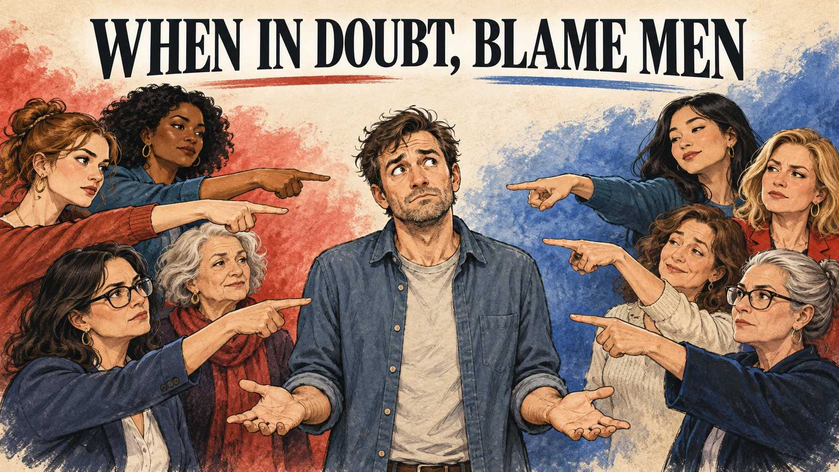
A recent analysis from the Survey Center on American Life highlighted a striking finding: 66 percent of Democratic women ages 18 to 29 said men’s behavior or actions contribute “a great deal” to the challenges women face in American society. Among Republican women the same age, the figure was 18 percent.
Here is the article’s original chart:
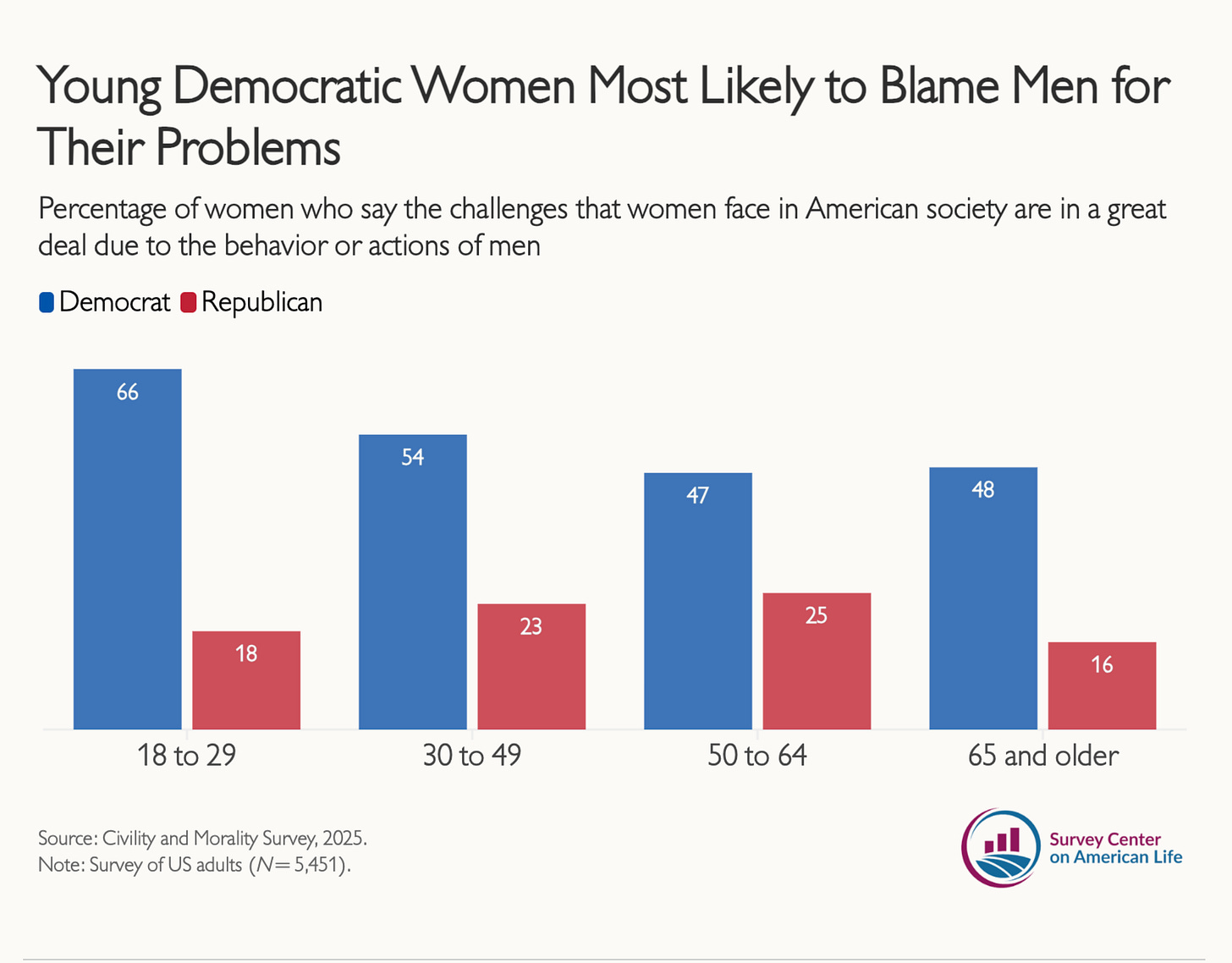
The contrast is dramatic. Young Democratic women were more than three times as likely as young Republican women to choose the strongest response. Across the age groups shown, democratic women were consistently more likely to answer this way.
The survey asked women how much the challenges facing women in American society were due to men’s behavior or actions. The available options were a great deal, a fair amount, hardly any, none at all, and unsure.
The original comparison tells us who selected the strongest answer. It does not tell us how many women attributed at least a fair amount of women’s challenges to men.
To examine that broader question, I looked at the survey’s underlying data using its main survey weight.
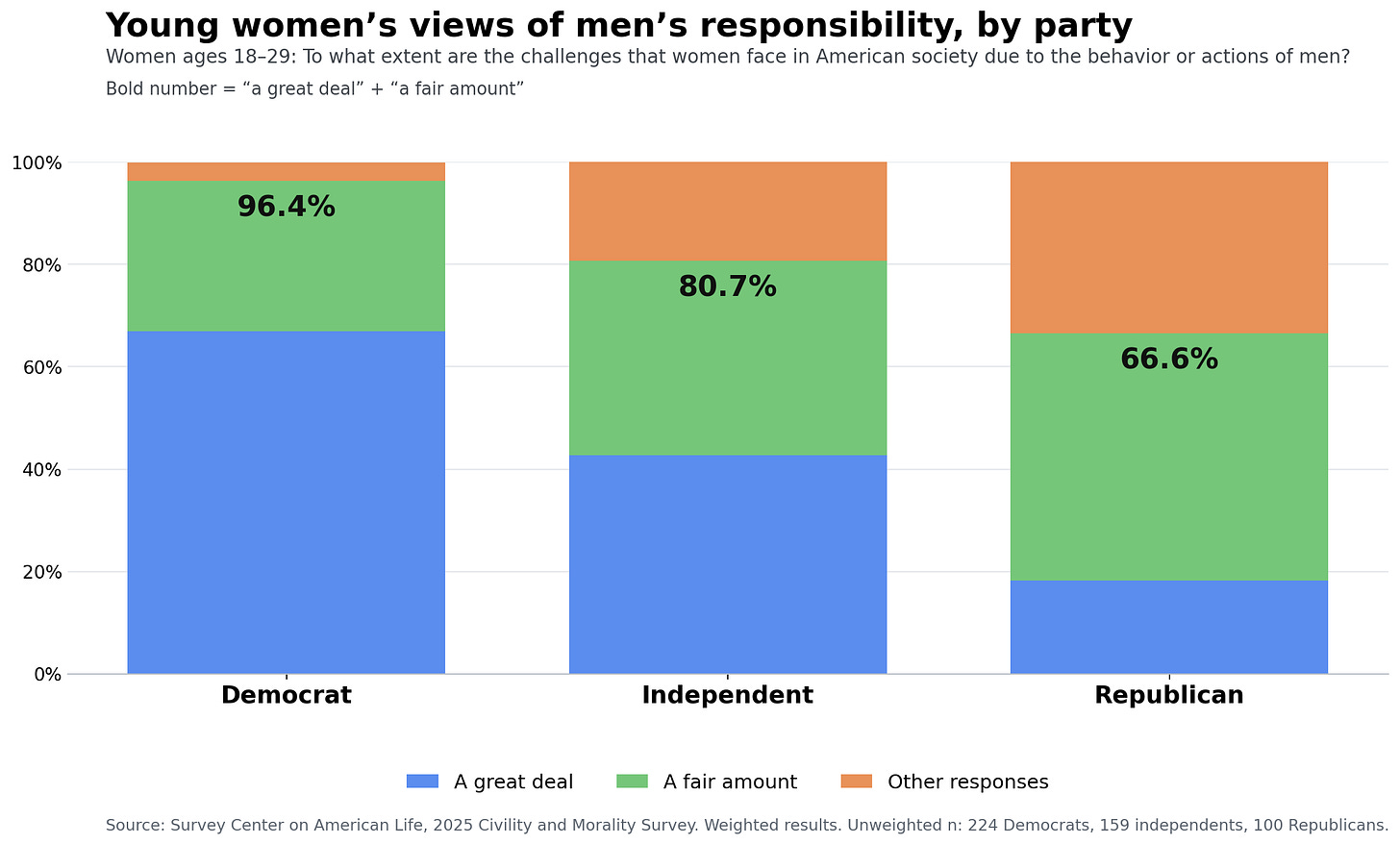
In this analysis, approximately 67 percent of young Democratic women chose a great deal, and another 29 percent chose a fair amount. Total those and you get 96.4 percent.
That is nearly every young Democratic woman in the sample. Nearly 100% of democratic women between the ages of 18-29 attributed at least a fair amount of women’s challenges to the behavior or actions of men.
The Republican result also looks very different once the second response is included. Approximately 18 percent chose a great deal, while 49 percent chose a fair amount. Together, that comes to about 67 percent—roughly two-thirds.
When we total “great deal “ and “fair amount“ it reveals something the original comparison obscures: attributing a substantial share of women’s societal challenges to men is widespread among young women in both parties.
Now let’s look beyond the youngest age group.
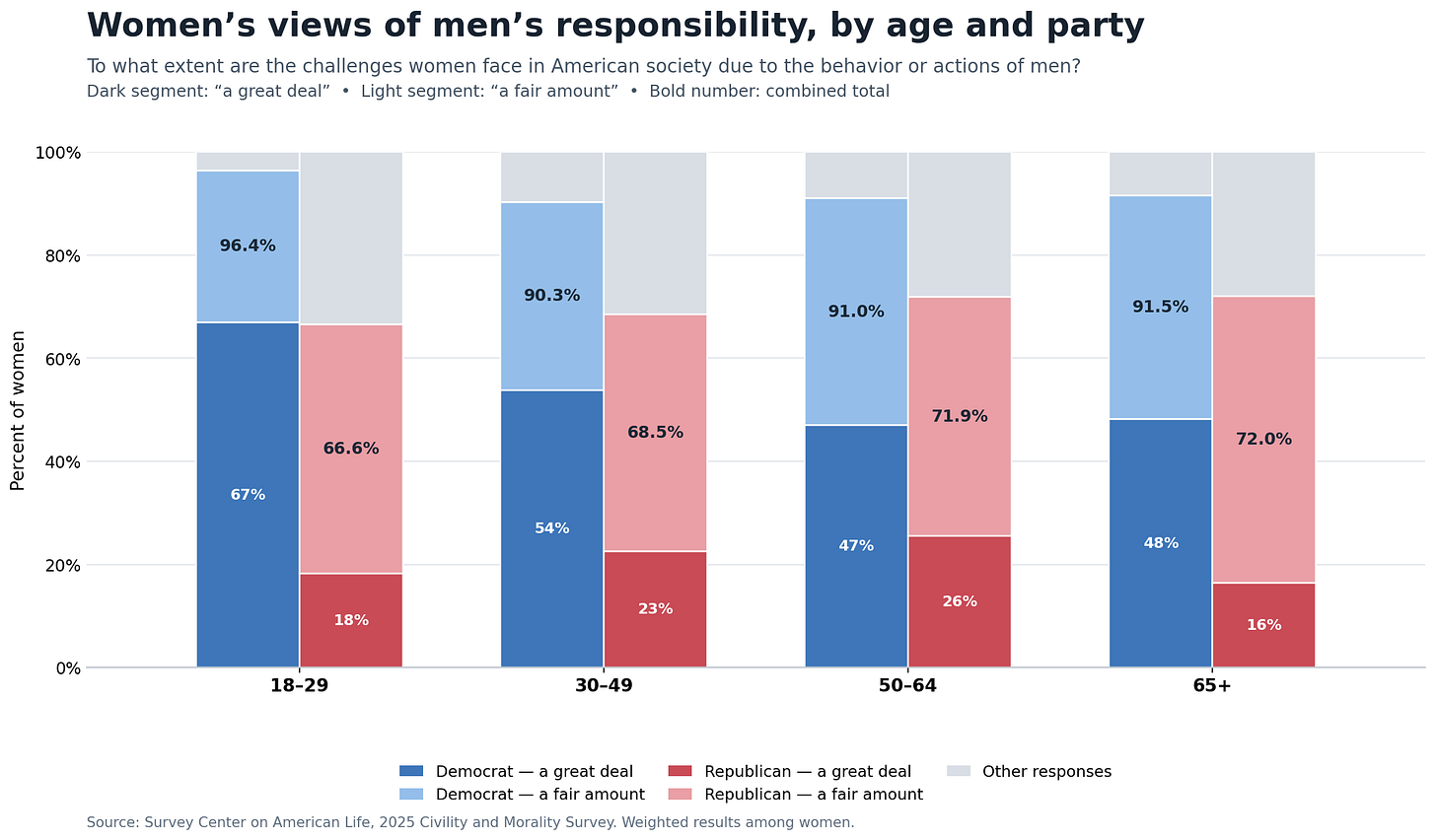
Among Democratic women, the combined total exceeds 90 percent in every age group shown.
The Republican pattern is also revealing. In this sample, the combined percentage is higher in the older age groups. Older Republican women are more likely than younger Republican women to attribute at least a fair amount of women’s challenges to men.
In every Democratic and Republican age group shown, roughly two-thirds or more of women attributed at least a fair amount of women’s societal challenges to men.
What began as a finding about young Democratic women has become a much broader finding about women across generations and party lines. Two thirds of women seem to attribute a fair amount of women’s challenges to men’s actions or behaviors. To me that is a stunning finding.
There is another dimension to consider: education.
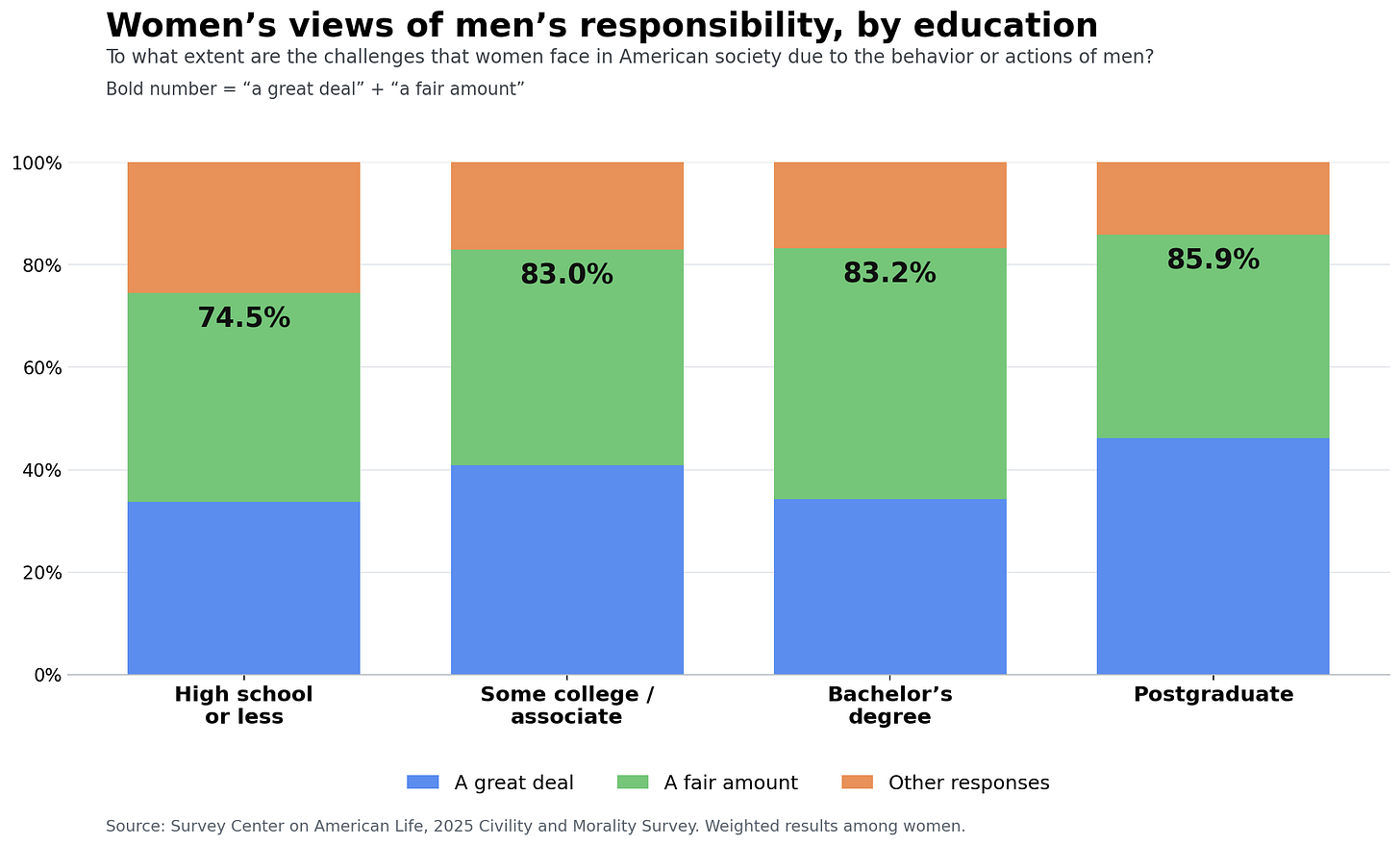
But once again, stopping at the strongest answer leaves out part of the picture.
Including a fair amount reveals the broader educational pattern shown in the chart. The combined responses suggest a stronger tendency to attribute women’s challenges to men at higher levels of education, even though the strongest response alone does not rise consistently across the categories.
So what do these findings mean?
Nearly universal agreement among young Democratic women, more than 90 percent across Democratic age groups, and substantial majorities among Republican women suggest that seeing men as a significant source of women’s difficulties has become a widely shared perspective.
I see these findings as a strong indication of how successfully the feminist narrative has encouraged women to blame men and male power for their difficulties. It seems clear to me that this message can encourage a victim mentality. The survey does not establish why women answered as they did, but the pattern is consistent with that narrative’s influence. And it extends well beyond young Democratic women: substantial majorities of women in every age group shown, in both parties, attributed at least a fair amount of women’s societal challenges to men.
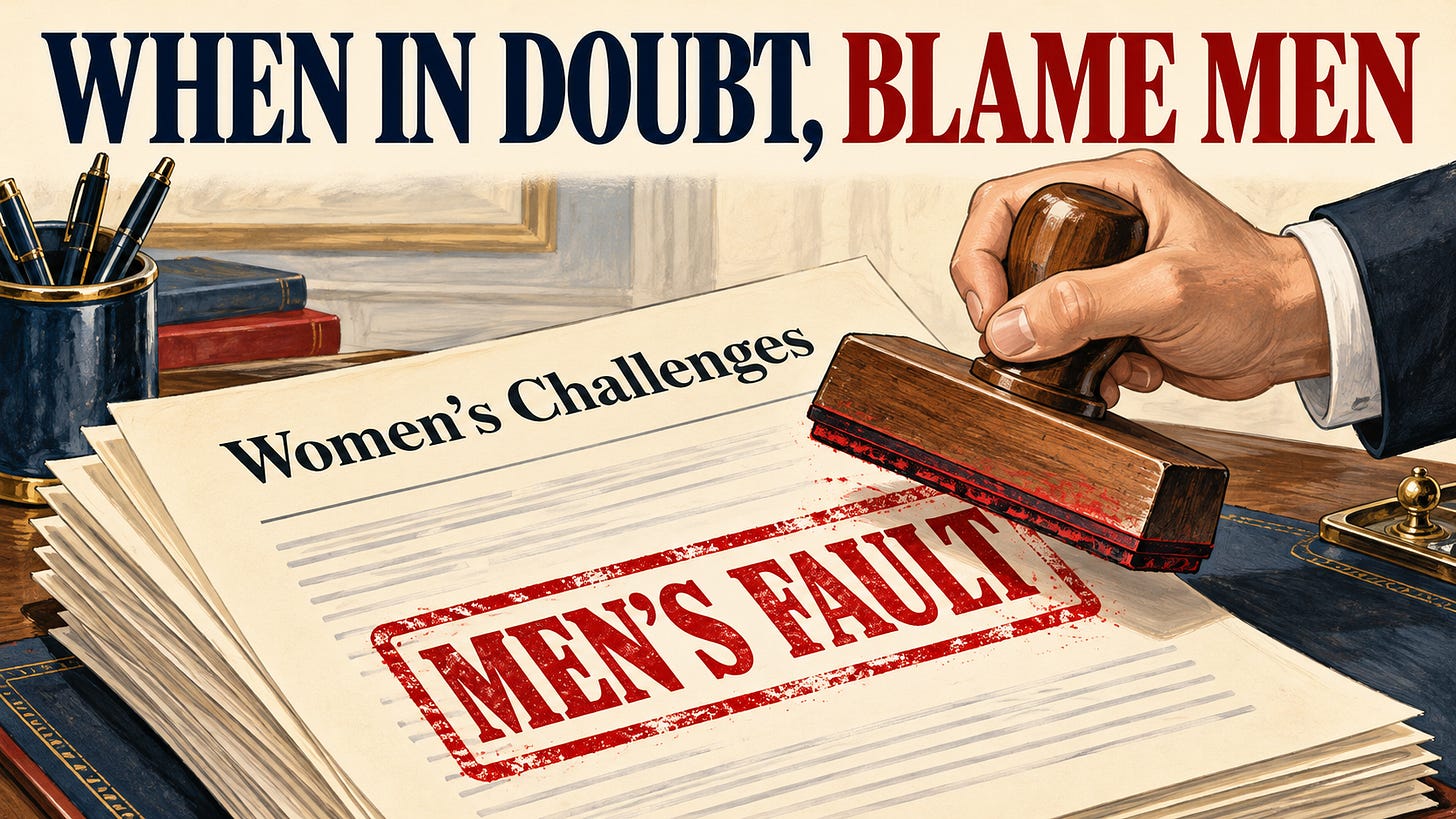
One appeal of that narrative is the explanation it offers: the difficulties women face are not entirely their responsibility; a substantial share of the blame belongs to men. Recognizing some men being a problem is reasonable. Making men an explanation for women’s difficulties is ridiculous. Just imagine men claiming that their difficulties were due to women as a group. Laughable.
What do these findings tell us? What might the impact of these ideas be? We have had decades of feminists telling women that so many of the problems they face are not their fault, that they have been wronged at the hands of men, that they are victims. One of the obvious results of this massive psyop is to diminish women’s accountability. When you believe someone else is the reason for your troubles it relieves you of needing to seek responsibility. If you are not responsible then you are likely not going to be accountable. What might that do to her? What happens to people when their accountability drops? Here are a few ideas of what psychological costs can follow a victim mentality/lack of accountability:
Less self-examination. “How did I contribute?” gets replaced by “Who did this to me?” That makes it easier to repeat the same mistakes, and blame others.
More defensiveness. Feedback can feel like an unfair accusation rather than useful information.
Difficulty repairing relationships. Apologizing, acknowledging someone else’s pain, and changing behavior become harder if the person sees responsibility as entirely belonging to the other party.
A diminished sense of agency. If others are always the cause of your difficulties, you may also come to believe that improvement depends entirely on them. Your focus becomes changing them rather than changing yourself.
Growing mistrust and resentment. Expecting mistreatment can encourage defensive or uncooperative behavior, which may provoke responses that reinforce the original expectation. Research on sensitivity to being victimized supports that possible cycle.
Do you think these five may be related to women seeing others as being responsible for their challenges? Do you think they fit with a feminist narrative that repeatedly explains women’s difficulties through men’s behavior and male power? Does that narrative help women recognize both external obstacles and their own choices, or can it encourage blame at the expense of agency? Have you seen any of this in your family, relationships, or work?
Let me know what you think.
Men Are Good
Source: Survey Center on American Life, 2025 Civility and Morality Survey, a survey of 5,451 U.S. adults conducted through Ipsos KnowledgePanel. The original article reports 66 percent for young Democratic women selecting “a great deal”; the weighted analysis used for the additional charts gives approximately 67 percent. The 96.5 percent combined figure uses unrounded values. The additional charts and subgroup figures are from my analysis.
Original article: https://www.americansurveycenter.org/significant-figures/young-women-are-the-most-likely-to-believe-that-men-are-at-the-root-of-their-problems/
Survey topline and methodology: https://www.americansurveycenter.org/wp-content/uploads/2025/11/Civility-and-Morality-Survey-Topline-1.pdf
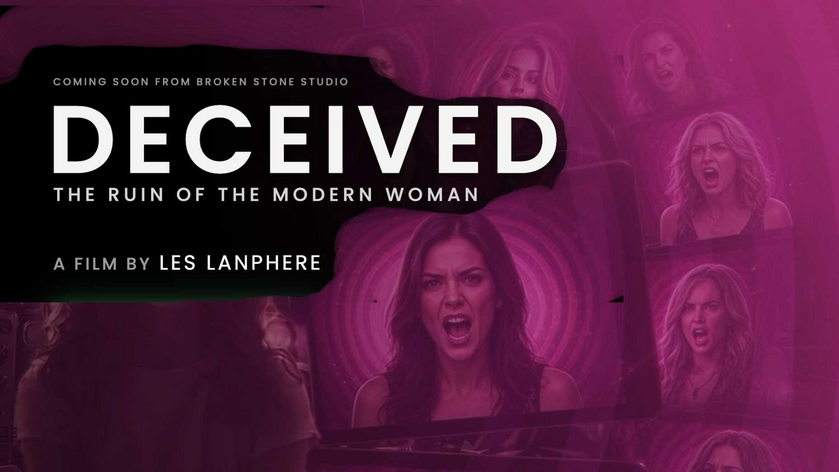
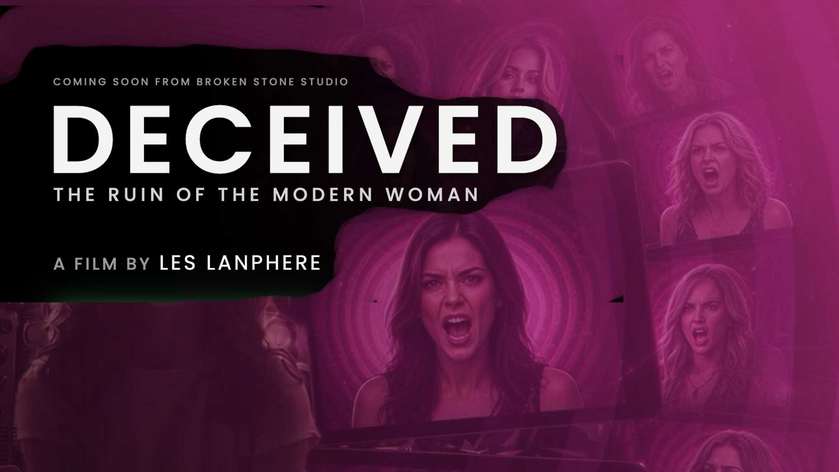
I had a great conversation today with filmmaker Les Lanphere, who is working on a provocative new documentary called Deceived: The Ruin of the Modern Woman.
Les is an experienced documentary filmmaker whose previous work includes Calvinist, Spirit & Truth, and Cessationist. In addition to his independent documentaries, he has worked on major, large-budget film productions, bringing valuable experience from the broader film industry to his own projects. His newest documentary takes on a very different subject: feminism and its impact on women, men, families, and society.
What particularly interests me about this project is its willingness to challenge one of our culture’s most deeply entrenched assumptions: that feminism has been a force for good in women’s lives. Les takes a much more provocative position. His film sets out to expose the consequences of a movement that claims to liberate women but has often left them worse off.
The film approaches these questions from a Christian perspective, examining how feminism has reshaped our understanding of women, men, marriage, and family life. Les is asking important questions that deserve far more attention than they typically receive, and I’m delighted to see a filmmaker willing to tackle them so directly.
Here’s the trailer for the upcoming film:
The project’s crowdfunding campaign has already reached its original fundraising goal, which is wonderful news. But producing a documentary is an expensive undertaking, and additional contributions are still welcome and appreciated.
If you believe that feminism deserves serious scrutiny and that alternative perspectives should have an opportunity to be heard, consider supporting the project.
Support Deceived: The Ruin of the Modern Woman on Kickstarter
I’ll be interviewing Les soon for Men Are Good, and I’m looking forward to exploring his plans for the film, what motivated him to make it, and what he hopes audiences will take away.
Stay tuned. I think this will be a fascinating conversation.
Men Are Good.

A note from Tom - Moore’s work is especially important today because so much contemporary discussion of masculinity begins—and often ends—with its shadow side. Feminist theories have given us an increasingly thin picture of men, rich in criticism but poor in any understanding of mature masculine strength. Moore never denied masculinity’s capacity for violence, domination, and destructiveness; he simply understood that these distortions cannot be comprehended without also recognizing the healthy power from which they have fallen.

Of Robert Moore’s four masculine archetypes, the Warrior may be the easiest to not understand.
We hear the word and think of violence. We picture a soldier, a prizefighter, an action hero, or perhaps a swaggering man eager to prove that he is tougher than everyone around him. In our current culture, the Warrior is often treated as the embarrassing remnant of an earlier masculinity—something primitive that civilized men should learn to suppress.
Moore believed that this was a serious mistake.
The Warrior is not simply the part of a man that can fight. It is the capacity to act, to endure, to remain loyal, to protect a boundary, to organize resources, to distinguish what matters from what does not, and to place one’s strength in service to something larger than oneself.
Violence is one possible expression of Warrior energy, but it is not its essence. In fact, the man most eager to use force may be possessed by the Warrior rather than mature in it. And the man who insists that he has no aggression may be no safer. His sword has not disappeared. It has simply gone underground.
Moore’s central insight could be put this way:
The mature Warrior is not the violent man. He is the man who has acknowledged his capacity for force, brought it under conscious discipline, and placed it in service to something beyond himself.
The dangerous man is often the one who either worships the sword or insists he has no sword at all.
In a previous post, I explored Moore’s understanding of the King. The King creates order, accepts responsibility, blesses life, and establishes the values of the realm.
The Warrior serves that order.
That relationship is crucial. Warrior energy by itself does not know whether a cause is just. It knows how to identify an enemy, formulate a strategy, accept hardship, mobilize resources, and attack an objective. Those capacities can protect a child or terrorize one. They can defend a community or destroy it. The Warrior supplies power, but it cannot by itself decide what that power should serve.
That is the King’s task.
Moore said that there can be mercenaries without a King, but there can be no true Warriors. The mercenary may be highly skilled. He may be brave, disciplined, and effective. But he fights for money, status, excitement, or whoever happens to be paying. The mature Warrior serves a moral order: a community, a sacred obligation, the vulnerable, the future, or a vision of justice larger than his own appetite.
This is one reason Warrior energy cannot be understood simply as aggression. The mature Warrior does not ask only, “Can I win?” He asks, “Whom do I serve? What am I protecting? Under what authority do I act? What will I refuse to do, even to an enemy?”
Power becomes mature when it kneels.

Moore spent considerable time discussing the symbolism of the sword.
The sword represents potency, discrimination, and the ability to cut through confusion. It separates one thing from another. It says yes to this and no to that. It establishes a boundary and makes action possible.
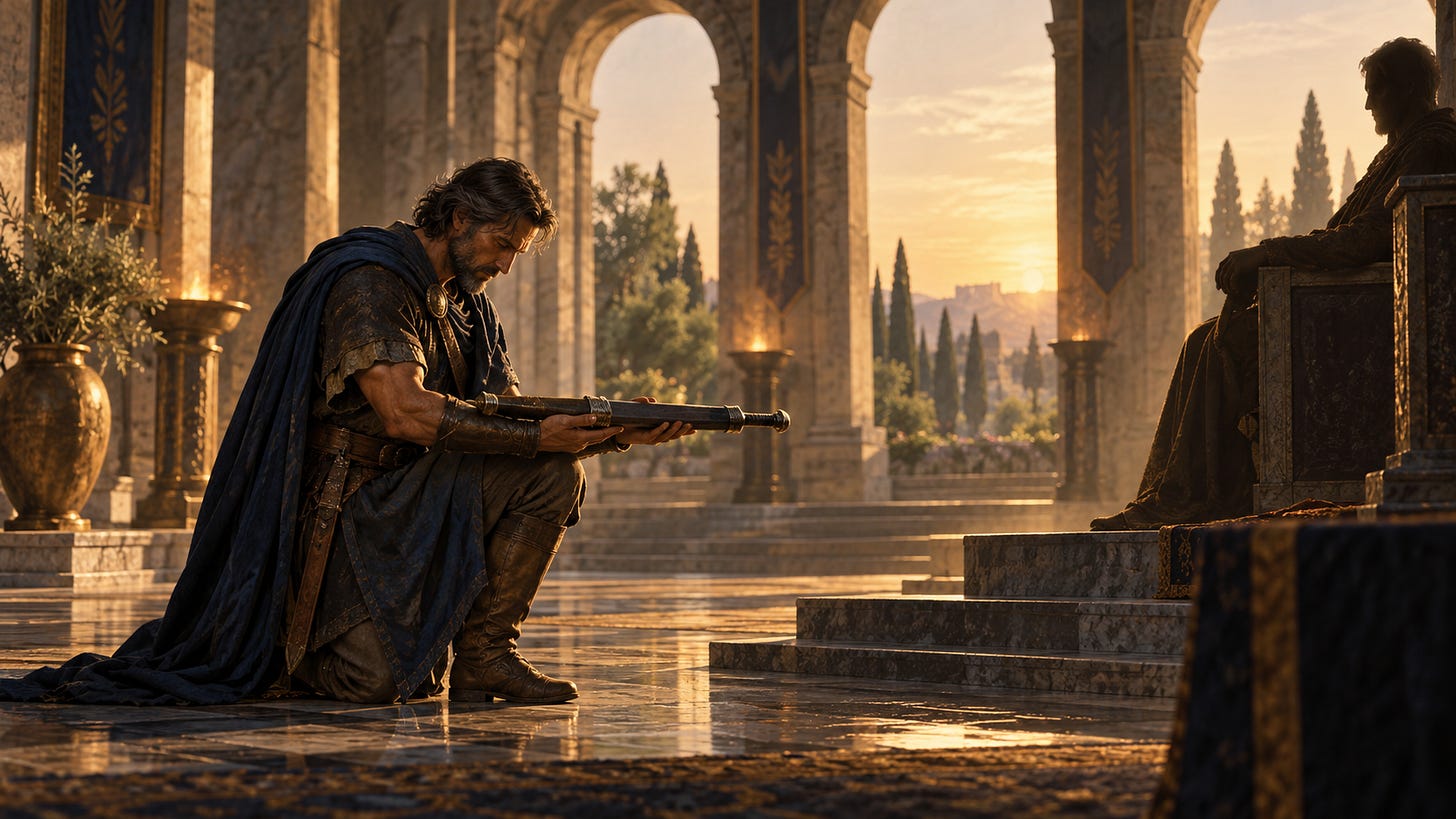
But in the traditional ceremony of knighthood, the candidate does not merely seize the sword and begin swinging it. He kneels beneath it. The sword touches him before he carries it.
This means that the Warrior comes under the authority of the sword. His power is governed by a code. He accepts responsibility for how it will be used and what must never be done with it.
The mature Warrior knows that he can cause harm. He does not pretend to be harmless, nor does he advertise his dangerousness in order to frighten others. His power is acknowledged, visible, disciplined, and accountable.
Moore contrasted the sword with the dagger. The sword is openly carried. The dagger is concealed.
The dagger belongs to the person who says, “I am not angry. I would never hurt anyone. I have no interest in power.” Yet the blade appears through sarcasm, procrastination, chronic criticism, manipulation, helplessness, gossip, obstruction, or the perfectly timed wound delivered from behind.
Just because a person does not show a sword does not mean there is no blade.
Denied aggression does not become love. It becomes unconscious aggression.
For a boy to develop a healthy relationship with his strength, he needs more than warnings about what not to do. He needs permission to be powerful.
That permission does not mean, “Do whatever you want.” It means, “Your strength is real. It is welcome. It has a place. Let us help you learn what it is for.”
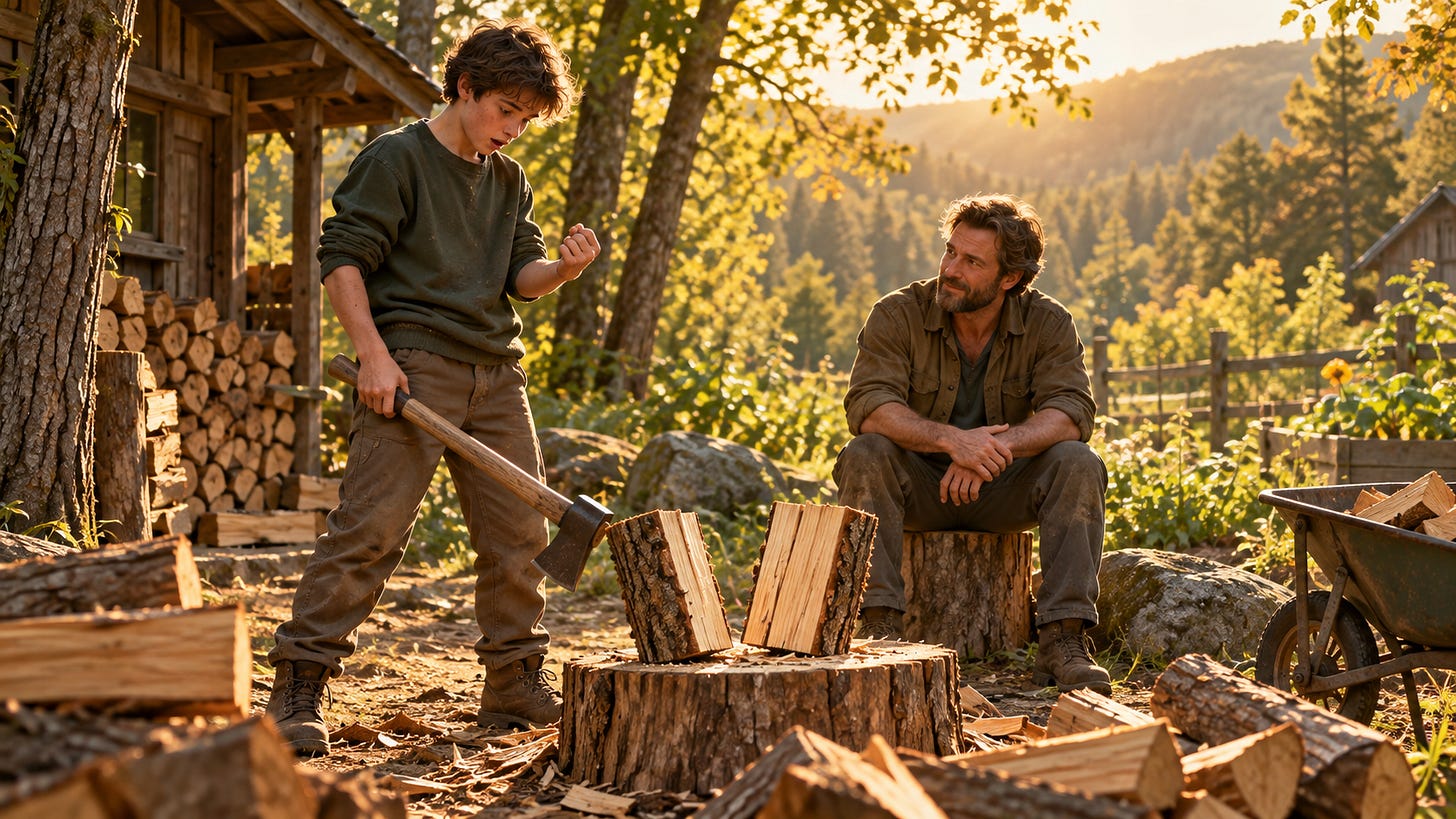
Moore saw the father’s response to the son’s growing power as enormously important. The mature father does not shame the boy for his energy or become threatened when the boy begins to surpass him. He is pleased by the son’s increasing strength. He draws him close, lets him admire, and eventually helps him place that power under discipline and moral purpose.
The shadow father does something very different. He mocks the boy’s awkwardness, treats his energy as dangerous, competes with him, or crushes him before his adult capacities have had time to form. Moore told of a shy, thin adolescent whose father ridiculed his emerging masculinity. The boy later grew into an impressive man, but the wound remained. The father had attacked the unfinished form of something that needed encouragement and time.
Moore pointed to Bull Meechum, the domineering Marine father in Pat Conroy’s The Great Santini, as a vivid portrait of this shadow father. Meechum is a formidable military man—competent and commanding—but emotionally he remains a boy. He can drill, compete, and dominate, but he cannot welcome his son’s emerging strength or bless him as he comes into manhood. What appears to be mature masculinity is largely an impressive uniform wrapped around an uninitiated personality.
A boy who never receives permission to be powerful may grow into a man who fears his own strength. He may become excessively compliant, wait for others to decide, or apologize whenever he takes up space. He may also be vulnerable to sudden eruptions of rage because the Warrior, excluded from ordinary consciousness, returns in a primitive form.
Or he may find someone else to carry his Warrior for him.
Moore was particularly good at showing how disowned power becomes projection.
A person who cannot say no may attach himself to someone who says no cruelly. A man who cannot act may idolize a strongman who promises to act for him. A dependent person may wait for a rescuer. A rescuer may go looking for a helpless person and an abusive villain so he can play Sir Galahad. A grandiose leader may surround himself with loyal knights willing to sacrifice themselves for his cause.
In each case, Warrior energy is present. It simply has not been claimed consciously.
This is why Moore refused to define Warrior pathology only as “too much aggression.” Too little conscious Warrior can be equally destructive.
The person who continually says “I can’t” may be projecting agency onto everyone around him. The compulsively nice person may secretly admire people who intimidate and dominate. The chronic complainer has enough Warrior energy to carve at the world but not enough to do anything constructive about it.
Moore’s observation was delightfully blunt: people who complain a great deal often do very little.
Passive aggression is Warrior energy trying to enter through the basement. Procrastination, deliberate incompetence, obstruction, and overcompliance allow a person to attack while preserving the belief that he is innocent.
Imagine a therapist asking a compulsive client to bring in some dreams. The following week the client arrives with forty-two of them. He has obeyed perfectly—and buried the therapist beneath the obedience. The dagger has struck, but no one can accuse him of failing to cooperate.
The healing task is not to make such a man more aggressive. It is to help him become direct.
At its most ordinary and necessary, the Warrior is the part of us that gets things done.
It makes a plan. It identifies the next step. It organizes time and resources. It accepts discomfort. It gets out of bed, makes the telephone call, confronts the problem, keeps the appointment, protects the child, finishes the work, and stays faithful when novelty has disappeared.
The Lover may bring two people together, but the Warrior helps them keep their vows. Attraction is not fidelity. Feeling deeply is not the same as remaining present when a relationship becomes difficult.
The same is true of vocation. Many people can imagine, study, discuss, analyze, worry, and wait. The Warrior acts.
Moore described clients who could spend months exploring their dreams without ever asking what they should do. He began deliberately making room for that question. And he discovered something remarkably practical: people usually already knew.
They knew the conversation they needed to have, the habit they needed to stop, the application they needed to submit, the boundary they needed to set, or the task they had been avoiding. What they lacked was not information. They lacked access to the energy required to act upon it.
Therapy, at that point, could create a space in which the person named the action and received support for the Warrior as he began to do it.
That fits closely with what I have seen in working with men. Insight matters, but insight often needs somewhere to go. Many men begin to move when suffering can be translated into a task—not because action replaces feeling, but because meaningful action gives feeling a form.
Warrior energy carries its own anesthesia.
In battle, crisis, emergency, or sustained effort, that can be lifesaving. The Warrior allows a person to continue despite fear, pain, fatigue, and injury. A firefighter cannot stop in the burning building to process every emotion. A father protecting his family may need to act before he has time to feel. A surgeon, police officer, soldier, or trauma worker may temporarily set aside his own reactions in order to do what the situation requires.
But the Warrior does not know when enough is enough.
Moore joked about tanks advancing across the plain until they ran out of gasoline. It is a wonderful image of the workaholic life. The campaign is impressive, the objective is clear, and the forces keep moving—but no one has checked the fuel gauge.
When Warrior energy dominates a personality, a man may not feel tired when he is tired. He may not know he is wounded. He may continue working, fighting, producing, and enduring long after his body or relationships have begun to break down.
The Warrior is not designed to tend the wound. The Magician can recognize it. The Lover can feel it. The King can decide that the welfare of the realm requires rest, repair, or retreat. But the Warrior alone knows only the mission.
This is why Moore never intended any archetype to stand by itself. The pure Warrior is not a complete man. He is a magnificent and terrifying machine.
In Part Two, we will follow Moore’s Warrior through the white, red, and black knights—then examine the Warrior’s relationship to enemies, shadow, admiration, and the difficult passage from raw power to mature service.
Men Are Good.