MenAreGood
Domestic Violence Services in Wisconsin - Do They Serve Men?
January 13, 2025
post photo preview

This is a three part series written by an anonymous gentleman who is going under the name of Daniel Carver. Daniel uses his own experience and exposes the misandry of the Wisconsin Domestic Violence system.


Part 1 – Some of My Story and Where It Led Me

Here in Wisconsin, we have some laws that I was shocked to discover. Since then, I’ve learned that many other states have very similar state laws (statutes). I was telling that to Tom Golden, author of the podcast Men Are Good. Tom suggested I write up some of the things I learned here which he would publish for me as I remain anonymous.

Hopefully this will raise awareness and result in real actions of true justice (fairness). I hope we begin to see true child protection against domestic violence against them as well. We desperately need changes in the Wisconsin domestic violence (DV) government services network which is directly funded by all taxpayers via the federal Violence Against Women Act (VAWA). That federal funding comes to the state through the Governor’s Council on Domestic Abuse. Wisconsin Domestic Abuse Council (WI. Statute 49.165(3))

As a victim of domestic violence (DV), I was very fortunate to get to join a men’s support group hosted by a male DV advocate who was a part time employee at the local DV shelter. There were three of us in the men’s group. The fully taxpayer funded shelter did not allow men to shelter there or anywhere else, but at least they had a part time DV advocate that believed us men and understood. It was so good to be believed in this men’s group because my church sure didn’t believe me. They even blamed me for my wife being violent, rage filled, and they refused to ever discuss it again once my wife blew up in the pastor’s office. In Jesus’ name the “Christian Counselor” at our church told me that Matthew 18:15-20 does not apply to marriages! Ridiculous, non-sensical, self serving convenience for the church.

 

Within a month or so, our men’s group DV advocate told us that he would no longer be hosting the men’s group because his part time position had been eliminated. So I went to talk to the Director of the DV shelter and ask why this man was cut from their payroll. She told me that the grant money had been non-renewed.

I asked her how is it that you have approximately 18 to 20 female DV advocates on your payroll, one male, and when you cut staff you cut the only man on your payroll? She told me that grant money was different than other money. What? Public grant money allocated only to a specific gender? Note that there are labor laws that prevent discrimination in employment. This Director of the DV shelter was violating labor law; and yet had no accountability and no consequences what-so-ever.

I compiled a list of every DV shelter in Wisconsin and emailed each one individually. I asked them how many residents they average annually. They liked that question and quickly answered. Then I ask how many of those residents were men and how many of their DV advocates were men, that’s when they ghosted me and never responded again.

Many of the shelters I called told me that they do not allow men nor do they help men in any other way. However, they usually won’t put that in writing or put it on their website because they know their funding is technically supposed to be for both men and women. They know their discrimination against men is draconian, so they don’t like it in writing. However some taxpayer funded DV shelters in Wisconsin even have in their name that they are women only shelters and services (Kenosha , Waukesha, Racine, Milwaukee ).

Back when I was still married, it was 2am and I had locked myself in the bathroom to get away from her rage. She was kicking down the bathroom door to get to me. She was calculated and shrewd enough to never leave a bruise, cut, or mark on me. She was basically trying to force me to hit her, but I never did.
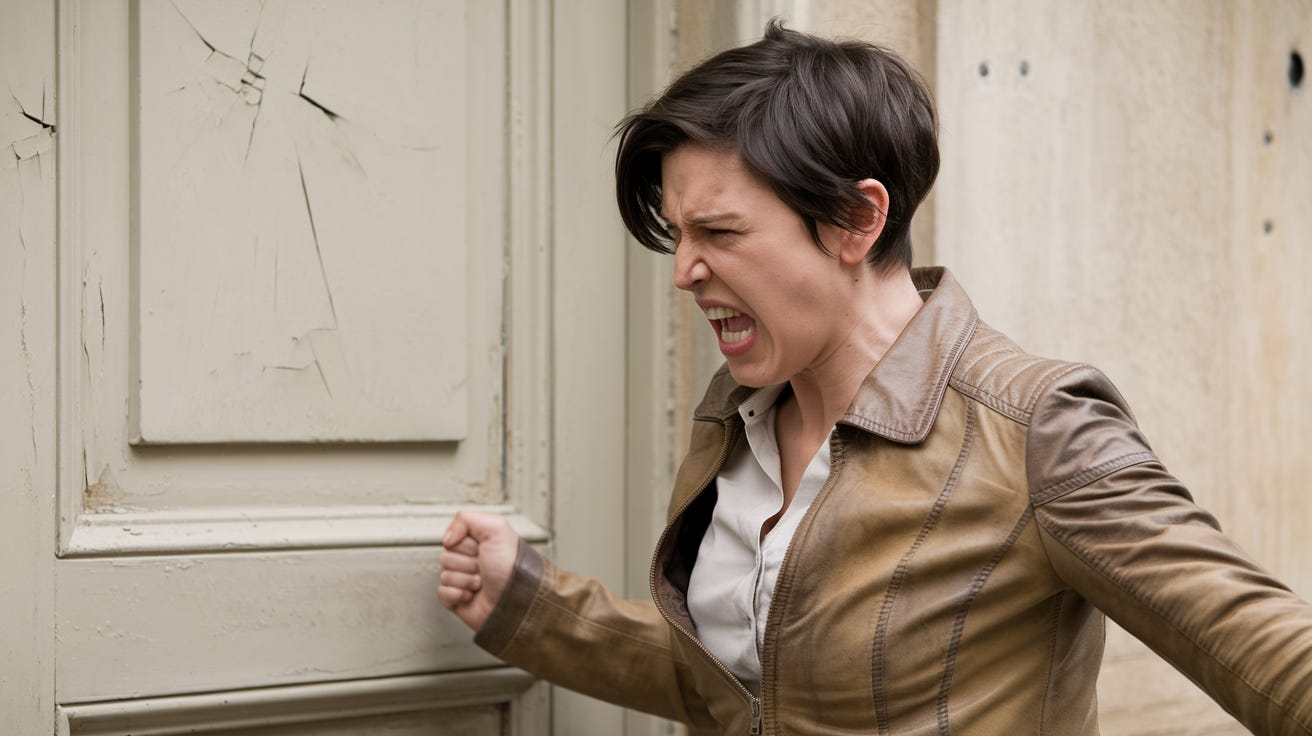
 

I knew that if I called 911 that the police would arrest me for what she was doing and I knew that would also mean I would be fired from my state job and likely lose my state pension. I did not understand why, but I knew the reality. I did not call the police and that incident was the last straw that precipitated our divorce. She of course told our kids that their dad was the one who kicked in the door, I found that out years later from one of our kids.

As an aside here, after the divorce, one of our kids (age 14 at the time) was living at my ex-wife’s house. My child whom I love dearly (all of them), asked me to help because there was no way to handle their mother when she went into her fits of violent rage. So I called our local child services office and ask them to go do a home evaluation and speak to the kids without their mother and ask them if they thought they were safe. The director emailed me back to tell me to buzz-off because I was just trying to get out of paying child support. No further action was ever taken. Later, my teen attempted suicide. After divorce and after the DV shelters would not admit to how few men they assisted; I decided to look up the state law (statutes). I’ll define and critique Wisconsin domestic violence law in Part 2 of this series.

Calling for reforms to achieve true justice for all, kids too,
Sincerely, Daniel Carver

community logo
Join the MenAreGood Community
To read more articles like this, sign up and join my community today
0
What else you may like…
Videos
Posts
Articles
December 20, 2025
Bias Against Men and Boys in Mental Health Research

This video is a summary of the three studies we have examined the last three Saturdays. It’s a brief and relaxed look at the high points of those articles. Here’s a summary:

This video examines a pattern I’ve seen repeatedly in psychological research: when data complicates the familiar story of men as perpetrators and women as victims, the data about boys and men often disappears. Using three real studies—on teen dating violence, reproductive coercion, and “masculine norms”—I walk through how boys’ suffering is minimized, misrepresented, or erased as research moves from full reports to media headlines and public policy. What emerges is not just sloppy science, but a troubling bias that shapes how we see boys, men, and masculinity itself.

00:10:31
August 07, 2025
Are Men Great of Good? Yes!

Time for a male-positive message. I created this video a while back, but its message remains as important and timeless as ever. I’d love for it to reach boys who’ve been told—explicitly or implicitly—that there’s something wrong with being male. After so much negativity about men and masculinity, they need to hear something different. They need to hear something true, strong, and affirming.

00:04:59
July 21, 2025
AI Books

We now have a new section that is accessible in the top navbar of the substack page titled AI Books. It contains links to numerous books on men's issues that each have an AI app that is able to answer detailed questions about the book. The above video gives some ideas of how to use these.

https://menaregood.substack.com/s/ai-books

The Myth of Male Power - Warren Farrell
Fiamengo File 2.0 Janice Fiamengo
Taken Into Custody - Stephen Baskerville
The Empathy Gap - William Collins
The Empathy Gap 2 - Williams Collins
The Destructivists - William Collins
Who Lost America - Stephen Baskerville
The New Politics of Sex -- Stephen Baskerville
Understanding Men and Boys: Healing Insights - Tom Golden
Boys' Muscle Strength and Performance - Jim Zuzzo PhD
Sex Bias in Domestic Violence Policies and Laws - Ed Bartlett (DAVIA)
The Hand That Rocks The World - David Shackleton

Links below

Myth of Male Power - Warren Farrell

The Myth of Male Power - documents how virtually every society that survived did so by persuading its sons to be disposable. This is one of the most powerful books...

00:11:44

Something men seem to do all the time that women seem to find extreamaly unlikely or impossible.

Made me laugh!!

https://www.facebook.com/share/v/1AKtUoYg8x/?mibextid=wwXIfr

https://www.facebook.com/share/r/1FwqtFuR2Z/?mibextid=wwXIfr

I have often made this connection. It’s a little too on point to not research and derstand better. I am fairly sure there is something to it.

This is a interesting show of male unity against a Person who thinks she represents others and thinks she as a member of her group is universally wanted. LOL!

post photo preview
Happy New Year!

As we close out 2025, I want to extend my heartfelt thanks to all the supporters at menaregood.locals.com. Your encouragement, engagement, and belief in this work have meant more than I can say. Whether you've joined discussions, supported financially, or simply taken the time to read and reflect, you've helped create a space where men’s issues can be explored with honesty and depth. I’m deeply grateful for your presence here, and I look forward to continuing this important work together in the year ahead.

Let's hope that 2026 is indeed the year of men!

Happy New Year!

Read full Article
December 29, 2025
post photo preview
2026 The Year of Men

This post is dedicated to my friend Mark Sherman, PhD., his sons, and his grandsons. Mark and I share a quiet hope — that we will live to see meaningful progress in the status of boys and men.


Every movement begins as an act of imagination. Before anything changes, someone has to picture what fairness would look like if we truly meant it. I wrote this piece to imagine that world — one where men are finally seen in full, with all their depth, strength, and vulnerability. Maybe we’re not there yet. But maybe 2026 could be the year we start to be.


2026 The Year of Men

Imagine that. 2026 becomes the year of men — a year when the conversation shifts from accusation to understanding. For the first time in half a century, men are discussed not as a problem to fix but as people to know. Their genius, their quirks, their flaws, and their quiet strengths are spoken of with the same nuance once reserved for others. College campuses devote programs to exploring men’s lives — their needs, their distinct ways of solving problems, their inner drives. Professors begin to ask questions that once felt off-limits: How have we misunderstood men? What happens when we stop pathologizing masculine traits and start appreciating them for what they are?

The change begins almost accidentally. A viral documentary follows several men through their daily lives — a father fighting for custody, a veteran mentoring fatherless boys, a young man navigating college under a cloud of suspicion.The film ignites something. People start talking about the thick wall of stereotype threat that has been built around men for the last fifty years, and how it quietly shapes everything — from the classroom to the courtroom. The wall doesn’t fall overnight, but it begins to crack.

Soon, the media joins in. Morning shows run thoughtful discussions about men’s emotional lives — how men experience feelings deeply but process them through action, purpose, and silence. Reporters highlight research showing that men’s stoicism, logic, and devotion to service are not deficiencies in empathy but expressions of it. Family court reforms begin to take shape; male victims of domestic violence are no longer turned away simply because they are male. It feels like a cultural exhale — the long-suppressed conversation finally given air.

At first, people are disoriented. After decades of being told that men’s pain doesn’t count, even fairness feels radical. But something shifts. Women, too, begin to see their fathers, husbands, sons, and brothers with fresh eyes. The conversation isn’t about blame anymore — it’s about balance. A new curiosity replaces old resentment. The year of men doesn’t erase anyone; it invites everyone to understand half of humanity that’s been caricatured for too long.

Could it happen? Could a culture so comfortable blaming men ever turn toward truly seeing them? Maybe not all at once. But every change in history begins the same way — with the simple act of imagining it.


What Changes During the Year of Men

The first signs of change come from the ground up. Teachers start noticing boys again — not as potential problems to manage, but as minds to cultivate. Schools experiment with programs that fit how boys learn best: movement, competition, hands-on projects, and purpose. Reading lists begin to include stories of male courage and vulnerability that go beyond superheroes or villains. Teachers are trained to see how boys’ energy isn’t disobedience — it’s engagement looking for direction. For the first time in decades, boys begin to feel that classrooms were made with them in mind.

On college campuses, the tone shifts from suspicion to curiosity. “Men’s Studies” — long a taboo phrase — finds a foothold. Seminars explore how fatherlessness, male shame, and status pressure shape young men’s mental health. Professors dare to say what was once unspeakable: that men have suffered, too. A handful of women’s studies professors even cross over, lending their voices to help create a balanced understanding of gender that includes both sides of the human story. The conversations are messy but alive — and that’s the point. Truth is finally allowed to be complicated again.

The media, too, begins to rediscover men. Documentaries appear about the quiet heroism of everyday fathers, about men mentoring boys in forgotten neighborhoods, about the millions of men who keep the world turning through labor, repair, and service. Morning talk shows, once filled with segments ridiculing male behavior, start inviting men to speak for themselves. The tone softens. People listen. A viral story circulates about a construction crew that raised money to send a coworker’s son to college after his dad’s death. “This,” one host says on air, “is masculinity too.”

Relationships begin to heal in small but powerful ways. Wives notice that when their husbands go quiet, it’s not distance but effort — a man trying to manage his emotions in the only way that feels safe. Sons start asking their fathers for advice again, and fathers rediscover how much they have to give. In counseling offices, therapists begin learning what clinicians have long said — that men process emotions through action, that their silence isn’t absence but presence in another form. Couples therapy starts to meet men halfway instead of treating them as defective women.

And then there’s mental health. The great unspoken epidemic of male despair finally becomes speakable. Instead of shaming men for not seeking help, society asks why the help offered has so little to do with how men heal. Clinics start experimenting with men’s groups centered around work, movement, humor, and camaraderie — not confession circles that make them feel judged. Suicide prevention campaigns stop using guilt and start using respect. The message shifts from “talk more” to “we see you.” And something remarkable happens: men begin to respond.


The Resistance

Of course, not everyone welcomes the Year of Men.
The early months bring a predictable storm. Certain media outlets call it a backlash. Activist groups issue statements warning that focusing on men will “set back progress.” Think pieces appear overnight insisting that “men already have enough,” as if empathy were a limited resource that must be rationed. A few universities cancel events after protests claim that discussing men’s needs “centers privilege.” But this time, something is different: the public doesn’t buy it. Ordinary people — men and women alike — begin asking simple, disarming questions: How is fairness a threat? How can caring for men possibly hurt women?

The resistance grows louder before it grows weaker. It feeds on fear — fear that empathy for men might expose hypocrisy, that the old narratives might not survive open scrutiny. For decades, the culture has run on a quiet formula: men are the problem, women the solution. Challenging that myth threatens a moral economy that has funded entire industries — from grievance studies to gender bureaucracies to the political machinery that profits from division. When men begin to speak, those who built careers speaking about men feel the ground shift beneath them.

In talk shows and social media debates, the same tired accusations resurface: that compassion for men means indifference to women, that noticing male pain is a form of denial. Yet the tone of the conversation has changed. This time, people have seen too much. They’ve seen fathers emotional pain outside family courts. They’ve seen male victims of abuse turned away from shelters. They’ve watched boys fall behind in schools that call them “toxic” for being active, assertive, or proud. The moral logic of exclusion begins to collapse under its own weight.

And then something unexpected happens: some of the loudest critics begin to soften. A few prominent feminists admit that they never intended for fairness to become a zero-sum game. Others, quietly at first, confess that they are mothers of sons — and they now see what men have endured through their children’s eyes. The resistance doesn’t disappear, but it loses its moral certainty. It becomes clear that opposing compassion for men requires something unnatural: denying reality itself.

The Year of Men doesn’t crush opposition; it transforms it. It doesn’t argue so much as invite. It reminds people that love of men isn’t hatred of women — it’s love of humanity. The movement doesn’t demand anyone’s permission to exist. It simply tells the truth with calm persistence until the shouting fades and listening begins again.


The Renewal

By the end of the Year of Men, something subtle yet profound has changed. The culture feels calmer, more honest, more whole. The anger that once filled every gender conversation has lost its fuel. People have begun to see men not as adversaries or caricatures but as essential parts of the human story — the builders, protectors, thinkers, and dreamers whose lives are as sacred as anyone’s.

The public learns what therapists have known for decades: that men’s silence is often love in disguise. That the man fixing the leaky faucet before anyone wakes is saying thank you in his own language. That the husband who works overtime, the son who restrains his tears at a funeral, the firefighter who risks his life for strangers — all are expressing something profoundly emotional, though the culture has lacked the ears to hear it.

In this new climate, men begin to relax their shoulders. They laugh more easily, reconnect with friends, and find meaning again in work, fatherhood, and service. Fathers feel free to be the masculine dad that they are, and boys no longer learn that masculinity is something to apologize for.

The walls that once separated men and women begin to crumble, replaced by curiosity, gratitude, and humor — the natural bonds of people who have finally stopped competing for moral high ground and started building a shared one.

Women, too, find a surprising sense of relief. Freed from the burden of constant grievance, they rediscover what they always loved about men — their steadiness, their generosity, their willingness to stand in harm’s way. The battle of the sexes gives way to partnership. In homes and classrooms and workplaces, people start asking a forgotten question: What are men for? And the answers are not defensive anymore. They are joyous.

By the time December arrives, commentators summarize 2026 as “the year empathy grew up.” It’s not the end of the story, only the beginning — the moment when society realized that healing half of humanity heals the whole. The Year of Men becomes not just a cultural milestone but a mirror, reminding us that progress isn’t about trading one group’s dignity for another’s. It’s about finally understanding that men are good — and always have been.

Men Are Good.

Read full Article
December 25, 2025
post photo preview
A Quiet Thank You to Men, Today
Merry Christmas!


A Quiet Thank You to Men, Today

Today isn’t a day for debate.
It’s a day for gratitude.

So I want to pause and offer a quiet thank you to men — especially the ones who are easy to overlook.

To the men who showed up quietly.
Who didn’t announce their presence or demand recognition.
Who simply did what needed to be done.

To the men who carried financial stress without complaint.
Who worried in silence about providing, about bills, about futures — and still tried to keep the mood light for everyone else.

To the men who fixed, drove, cooked, shoveled, assembled, paid, and planned.
Who solved problems behind the scenes so the day could feel smooth and warm for others.

To the men who swallowed loneliness so others could feel joy.
Who sat at the edge of gatherings, or weren’t invited at all, yet still sent gifts, made calls, or showed kindness where they could.

To the men who didn’t get thanked — and didn’t expect to.

And today, I also want to acknowledge men who carry heavier, quieter burdens.

Men who have been falsely accused, and discovered how quickly the world can turn away from them.
Men who have been divorced and still worked relentlessly to father their children in a hostile environment, where their love was questioned and their access was constrained.
Men who have felt dejected and misunderstood, not because they lacked care or effort, but because the story told about them left no room for their humanity.

Men who have been trying — sometimes desperately — to do the right thing in systems that seemed stacked against them.

Men whose goodness has gone unnamed.

Christmas has a way of highlighting what is visible — gifts, decorations, smiles — but it often misses what is held. The restraint. The responsibility. The endurance. The quiet decision to keep going.

So today, this is simply a thank you.

Thank you for the ways you show love through action.
Thank you for the strength that doesn’t ask to be admired.
Thank you for the steadiness that makes joy possible for others.

You matter. Your efforts count.

Men have always mattered — today is a good day to say it out loud.

Merry Christmas.  Men Matter. Men Are Good.

Read full Article
See More
Available on mobile and TV devices
google store google store app store app store
google store google store app tv store app tv store amazon store amazon store roku store roku store
Powered by Locals