MenAreGood
6 Things the Mental Health Industry Gets Wrong About Men
August 27, 2025
post photo preview

Preface: The Double Bind Men Face

In a previous post, we looked at how men are often excluded from help when they appear dependent. Our focus was on culture—how society expects men to remain independent, and how men who fail to meet that standard are judged as weak or less deserving of care. These judgments come from all directions—women, men, institutions, and even therapists.

It’s easy to see how this cultural default discourages men from seeking therapy. If help is only for those who admit weakness, and admitting weakness means you lose status, the path forward becomes nearly impossible. Most men learn early: always appear independent. Don’t ask. Don’t need.

Therapy, on the other hand, requires vulnerability. It asks men to reveal struggle, uncertainty, and emotional need. For many, that feels like walking directly into the line of fire—the very place they’ve been punished before. No wonder so many avoid it unless they absolutely have to.

What we’ll explore today is an added layer—one that comes from inside the man himself. Not just cultural messaging, but biological wiring. Men receive a double push: society tells them to be independent, and their biology—especially testosterone—echoes that same directive.

In the post below, we’ll take a closer look at how testosterone shapes men’s emotional behavior, especially in therapeutic settings. The more we understand what’s going on beneath the surface, the more compassion—and effectiveness—we can bring to the work of helping men heal.
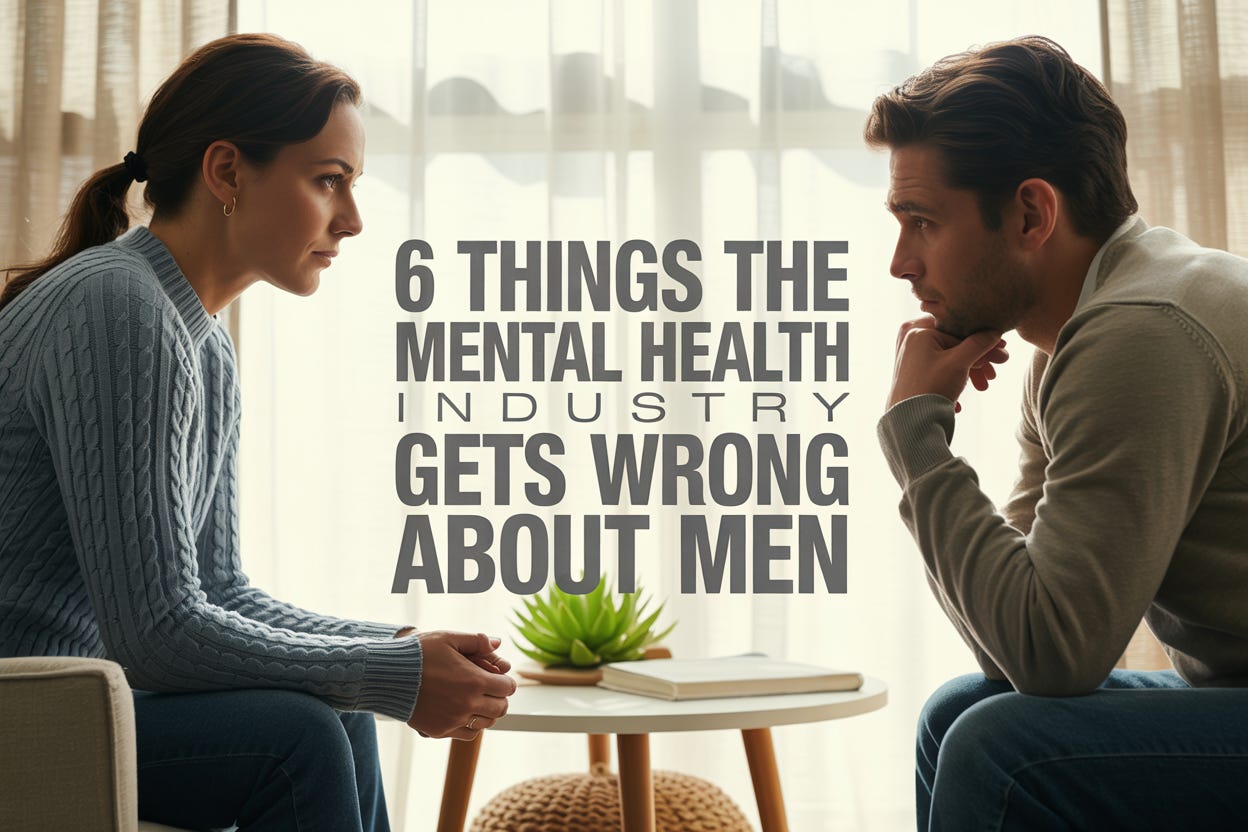


6 Things the Mental Health Industry Gets Wrong About Men


We’ve built a mental health system that often misunderstands men.
Not because therapists don’t care, or because the science isn’t out there—but because many of the core assumptions about men’s emotional lives are built on a framework that fits women better than men. And that misfit? It drives men away. It leaves them unseen. And it often shames them for responding in ways that are biologically and psychologically normal for males. A 2011 paper by Eisenegger, Haushofer, and Fehr—The Role of Testosterone in Social Interaction—offers a major insight: testosterone drives status sensitivity, motivation, risk-taking, and protective emotional strategies. When we understand that, a lot of “male resistance” to therapy starts making sense. Here are six key things the mental health field gets wrong about men—and how we can do better.


1. “Men avoid therapy because they fear vulnerability.”

The truth: Many men avoid therapy because it feels like a status threat—and testosterone reinforces that instinct.

Testosterone heightens a man’s sensitivity to social threats—especially those that signal a potential loss of standing, respect, or dominance. Angry facial expressions, emotional pressure, unclear expectations, or even intense eye contact can feel like status challenges rather than invitations to connect.

Layered on top of that biology is a lifetime of cultural training. Most men grow up learning that independence is strength—and dependence is weakness. They’re taught to solve problems alone, not reveal them. Testosterone supports this stance by motivating status-seeking, autonomy, and competitive positioning.

So when a man is invited into therapy and asked to reveal his inner world, he’s not just being asked to share—he’s being asked to violate both his biology and his conditioning. What’s called “resistance” is often a natural response to a situation that feels unfamiliar, disempowering, and loaded with risk.

In those moments, you might see him:

  • Break eye contact and look down or away

  • Sit back, go quiet, or shift posture to reduce tension

  • Use humor to deflect

  • Say very little—not because he doesn’t care, but because the wrong move could cost him

This isn’t fear of vulnerability. It’s a biologically wired instinct to protect status in uncertain environments—amplified by a lifetime of being told that asking for help means you’ve already failed.

2. “Men are emotionally disconnected.”

The truth: Men often process emotion differently—testosterone shifts how they engage empathy, especially in high-stakes or competitive situations.

Research shows that testosterone reduces automatic empathy responses—like facial mimicry or reading subtle emotional cues—particularly in contexts that might involve competition or threat. That doesn’t mean men don’t care or don’t feel. It means their emotional systems are tuned to assess, not absorb, especially when status or safety is on the line.

Culturally, boys are often discouraged from emotional openness early in life. They’re rewarded for composure, strength, and staying in control. Over time, they learn to internalize emotion, rather than externalize it.

So in adulthood, especially under pressure, men may not “mirror” emotion in familiar ways:

  • He doesn’t match a sad face with a sad face

  • He misses subtle emotional cues unless they’re made explicit

  • He stays logical or matter-of-fact during emotional conversations

  • He may look emotionally “flat” when he’s actually carefully regulating or analyzing what’s happening

This isn’t emotional disconnection—it’s emotional management, shaped by both biology and lifelong social feedback. When we stop expecting men to respond like women—and instead tune into how they do engage—we start to see that empathy is there. It just speaks a different language.

3. “Men don’t trust easily because they’re guarded or cynical.”

The truth: Testosterone lowers baseline trust in uncertain situations—especially when status or vulnerability is involved.

Testosterone has been shown to reduce generalized trust, particularly in high-stakes or competitive settings. This isn’t paranoia or dysfunction—it’s strategic. In evolutionary terms, misplaced trust could mean defeat, betrayal, or loss of position. Testosterone prepares men to assess before they invest.

Culturally, this gets reinforced by repeated experience. Many men have learned the hard way that opening up too quickly can backfire—especially if it exposes weakness, emotional need, or dependence.

So when a man enters a new environment like therapy—or even a relationship conflict—he’s not defaulting to cynicism. He’s scanning for clarity, fairness, and safety.

You might see him:

  • Hold back emotionally, even when invited to open up

  • Look for hidden motives or question the process

  • Rely on himself rather than ask for support

  • Be slow to believe reassurance, especially if things feel emotionally tense

This isn’t distrust in you personally. It’s the biological and social consequence of having been trained—internally and externally—to protect himself from being taken advantage of.

Trust, for many men, isn’t the starting point. It’s the result of consistent respect, clear expectations, and earned safety over time.

4. “Real healing happens when you express your emotions.”

The truth: For many men, healing happens through action—and testosterone supports that path.

Testosterone isn’t just about strength or competition—it’s about drive. It fuels goal-directed behavior, reward-seeking, and persistence. That’s why many men don’t process pain by sitting in it—they process it by moving through it.

Add to that the cultural message boys receive from early on: emotions are private, not public. While girls are often socialized to verbalize and share, boys are encouraged to channel, contain, or convert emotion into something productive.

So when a man loses someone, faces failure, or hits a life crisis, he often doesn’t head straight for a therapist’s office or a tearful conversation. He heads for action.

You’ll see it in the man who:

  • Rebuilds the deck after his father dies

  • Launches a scholarship fund in his son’s name

  • Pours himself into work after a breakup

  • Withdraws to plan, repair, or restore a sense of control

These aren’t distractions from emotion. They are emotional expressions—just in a different form. In fact, research suggests that testosterone supports action-based coping and suppresses affiliative, emotionally expressive tendencies in competitive or high-stress situations.

And here’s something crucial:
Men don’t just take action for action’s sake. They often do it in honor of someone or something. A man builds the bench his father always talked about. He organizes a tournament in his son’s name. He finishes the project his friend never got to complete.

When action is combined with honoring, it becomes something more than coping—it becomes a ritual of healing. The doing and the remembering work together. The movement carries meaning.

If we keep insisting that healing must look like emotional disclosure, we risk invalidating the very real ways men already process grief, loss, and pain—through effort, honor, and purpose.

5. “Men’s silence means they’re emotionally shut down.”

The truth: Men’s silence is often a protective response—shaped by testosterone, experience, and emotional strategy.

Silence in men is one of the most misunderstood behaviors in therapy, relationships, and even friendships. It’s often labeled as avoidance, stonewalling, or disconnection. But more often than not, it’s something very different.

Testosterone enhances status sensitivity and threat vigilance—especially in social situations where expectations are unclear or the stakes feel high. In those moments, going quiet isn’t about disengaging; it’s about managing risk. For many men, silence is a way to preserve dignity, reduce the chance of saying something regrettable, or buy time to process complex emotion.

Culturally, boys are also taught to be cautious about emotional exposure. If you speak too soon, or too openly, it can be used against you. So many men learn that staying quiet isn’t failure—it’s control.

In these moments, you might see a man:

  • Go quiet during conflict, not out of indifference, but to keep from escalating

  • Look away or physically retreat when overwhelmed, not to disconnect, but to recalibrate

  • Say “I don’t know” when he actually means “I’m not sure how to say this without getting it wrong”

This isn’t emotional shutdown. It’s strategic silence.

And here’s the key: when that silence is met with respect instead of pressure, many men will eventually speak. But only after they’ve had time to feel safe, oriented, and prepared to respond on their own terms.


6. “If men just opened up more, therapy would work better for them.”

The truth: Therapy needs to adapt to men—not the other way around.

The prevailing model of talk therapy often assumes that emotional expression, verbal processing, and vulnerability are the starting point of healing. But for many men, that’s the end point—something that only comes after safety, trust, and shared purpose have been firmly established.

Testosterone plays a key role here. It supports behaviors that protect autonomy, status, and goal-directed action. It doesn’t reward emotional exposure unless that exposure serves a larger mission—like protecting someone, honoring a loss, or building something meaningful.

Culturally, men have been conditioned to associate emotional openness with dependency, and dependency with shame or failure. From early on, they’ve been taught that independence equals strength—and strength equals worth.

So when therapy immediately asks men to "share their feelings," it can feel like a request to abandon everything they've been rewarded for their whole lives.

That’s not resistance. It’s identity conflict.

If we want therapy to work better for men, we have to start where they are:

  • Use structure, goals, and action as entry points

  • Build trust through consistency, not intensity

  • Offer dignity and choice, not pressure

  • Make room for silence, strategy, and movement

  • Respect independence, even while inviting connection

Men don’t need to become less male to heal. They need a therapeutic space that honors how they already process the world.

Final Thoughts: What Happens When We Get Men Wrong

🎯
 

Each of these six points challenges a core assumption in the mental health world—and offers a window into something deeper.

Men aren’t broken because they don’t fit the standard therapeutic mold.
They’re different. And that difference is both biological and cultural.

When we ignore testosterone’s role in shaping how men respond to trust, status, emotion, and healing, we don’t just miss the mark—we risk pushing men further away from the very support we say they need.

It’s not that men are avoiding healing. It’s that healing, as it’s often framed, doesn’t speak their language.

But when we build bridges—when we respect silence, honor action, adapt expectations, and treat men’s instincts as worthy of trust—something changes.

Men show up.

They engage.

Not by becoming less male. But by being deeply understood as men.

That’s when therapy starts to work.
And that’s when our culture begins to shift—one man, one truth, one act of respect at a time.


community logo
Join the MenAreGood Community
To read more articles like this, sign up and join my community today
0
What else you may like…
Videos
Podcasts
Posts
Articles
December 20, 2025
Bias Against Men and Boys in Mental Health Research

This video is a summary of the three studies we have examined the last three Saturdays. It’s a brief and relaxed look at the high points of those articles. Here’s a summary:

This video examines a pattern I’ve seen repeatedly in psychological research: when data complicates the familiar story of men as perpetrators and women as victims, the data about boys and men often disappears. Using three real studies—on teen dating violence, reproductive coercion, and “masculine norms”—I walk through how boys’ suffering is minimized, misrepresented, or erased as research moves from full reports to media headlines and public policy. What emerges is not just sloppy science, but a troubling bias that shapes how we see boys, men, and masculinity itself.

00:10:31
November 19, 2025
The Relentless War on Masculinity

Happy International Men's Day! It's a perfect day to acknowledge the relentless war on masculinity? Here we go!

In this video I sit down with four people I deeply respect to talk about a book I think is going to matter: The Relentless War on Masculinity: When Will It End? by David Maywald.

Joining me are:

Dr. Jim Nuzzo – health researcher from Perth and author of The Nuzzo Letter, who’s been quietly but steadily documenting how men’s health is sidelined.

Dr. Hannah Spier – an anti-feminist psychiatrist (yes, you heard that right) and creator of Psychobabble, who pulls no punches about female accountability and the mental-health system.

Lisa Britton – writer for Evie Magazine and other outlets, one of the few women bringing men’s issues into women’s media and mainstream conversation.

David Maywald – husband, father of a son and a daughter, long-time advocate for boys’ education and men’s wellbeing, and now author of The Relentless War on Masculinity.

We talk about why David wrote this book ...

01:05:19
November 17, 2025
Cancel Culture with a Vengeance

Universities and media love to brand themselves as champions of free speech and open debate. But what happens when those same institutions quietly use legal tools to gag and erase the very people who challenge their orthodoxies?

In this conversation, I’m joined by two of my favorite thinkers, Dr. Janice Fiamengo and Dr. Stephen Baskerville, to dig into a darker layer beneath “cancel culture.” We start from the case of Dr. James Nuzzo, whose FOIA request exposed a coordinated effort by colleagues and administrators to push him out rather than debate his research, and then go much deeper.

Stephen explains how non-disclosure agreements, non-disparagement clauses, and mandatory arbitration have become a hidden system of censorship in universities, Christian colleges, and even media outlets—silencing dissenters, shielding institutions from scrutiny, and quietly stripping people of their practical First Amendment rights. Janice adds her own experience with gag orders and human rights complaints, and ...

00:57:23
February 07, 2023
The Way Boys Play and the Biological Underpinnings

My apologies for the last empty post. My mistake. Let's hope this one works.

Tom takes a stab at using the podcast function. Let's see how it goes.

The Way Boys Play and the Biological Underpinnings
May 13, 2022
Boys and Rough Play

This is a short excerpt from Helping Mothers be Closer to their Sons. The book was meant for single mothers who really don't know much about boy's nature. They also don't have a man in the house who can stand up for the boy and his unique nature. It tries to give them some ideas about how boys and girls are different. This excerpt is about play behaviors.

Boys and Rough Play

Something men seem to do all the time that women seem to find extreamaly unlikely or impossible.

Made me laugh!!

https://www.facebook.com/share/v/1AKtUoYg8x/?mibextid=wwXIfr

https://www.facebook.com/share/r/1FwqtFuR2Z/?mibextid=wwXIfr

I have often made this connection. It’s a little too on point to not research and derstand better. I am fairly sure there is something to it.

This is a interesting show of male unity against a Person who thinks she represents others and thinks she as a member of her group is universally wanted. LOL!

December 29, 2025
post photo preview
2026 The Year of Men

This post is dedicated to my friend Mark Sherman, PhD., his sons, and his grandsons. Mark and I share a quiet hope — that we will live to see meaningful progress in the status of boys and men.


Every movement begins as an act of imagination. Before anything changes, someone has to picture what fairness would look like if we truly meant it. I wrote this piece to imagine that world — one where men are finally seen in full, with all their depth, strength, and vulnerability. Maybe we’re not there yet. But maybe 2026 could be the year we start to be.


2026 The Year of Men

Imagine that. 2026 becomes the year of men — a year when the conversation shifts from accusation to understanding. For the first time in half a century, men are discussed not as a problem to fix but as people to know. Their genius, their quirks, their flaws, and their quiet strengths are spoken of with the same nuance once reserved for others. College campuses devote programs to exploring men’s lives — their needs, their distinct ways of solving problems, their inner drives. Professors begin to ask questions that once felt off-limits: How have we misunderstood men? What happens when we stop pathologizing masculine traits and start appreciating them for what they are?

The change begins almost accidentally. A viral documentary follows several men through their daily lives — a father fighting for custody, a veteran mentoring fatherless boys, a young man navigating college under a cloud of suspicion.The film ignites something. People start talking about the thick wall of stereotype threat that has been built around men for the last fifty years, and how it quietly shapes everything — from the classroom to the courtroom. The wall doesn’t fall overnight, but it begins to crack.

Soon, the media joins in. Morning shows run thoughtful discussions about men’s emotional lives — how men experience feelings deeply but process them through action, purpose, and silence. Reporters highlight research showing that men’s stoicism, logic, and devotion to service are not deficiencies in empathy but expressions of it. Family court reforms begin to take shape; male victims of domestic violence are no longer turned away simply because they are male. It feels like a cultural exhale — the long-suppressed conversation finally given air.

At first, people are disoriented. After decades of being told that men’s pain doesn’t count, even fairness feels radical. But something shifts. Women, too, begin to see their fathers, husbands, sons, and brothers with fresh eyes. The conversation isn’t about blame anymore — it’s about balance. A new curiosity replaces old resentment. The year of men doesn’t erase anyone; it invites everyone to understand half of humanity that’s been caricatured for too long.

Could it happen? Could a culture so comfortable blaming men ever turn toward truly seeing them? Maybe not all at once. But every change in history begins the same way — with the simple act of imagining it.


What Changes During the Year of Men

The first signs of change come from the ground up. Teachers start noticing boys again — not as potential problems to manage, but as minds to cultivate. Schools experiment with programs that fit how boys learn best: movement, competition, hands-on projects, and purpose. Reading lists begin to include stories of male courage and vulnerability that go beyond superheroes or villains. Teachers are trained to see how boys’ energy isn’t disobedience — it’s engagement looking for direction. For the first time in decades, boys begin to feel that classrooms were made with them in mind.

On college campuses, the tone shifts from suspicion to curiosity. “Men’s Studies” — long a taboo phrase — finds a foothold. Seminars explore how fatherlessness, male shame, and status pressure shape young men’s mental health. Professors dare to say what was once unspeakable: that men have suffered, too. A handful of women’s studies professors even cross over, lending their voices to help create a balanced understanding of gender that includes both sides of the human story. The conversations are messy but alive — and that’s the point. Truth is finally allowed to be complicated again.

The media, too, begins to rediscover men. Documentaries appear about the quiet heroism of everyday fathers, about men mentoring boys in forgotten neighborhoods, about the millions of men who keep the world turning through labor, repair, and service. Morning talk shows, once filled with segments ridiculing male behavior, start inviting men to speak for themselves. The tone softens. People listen. A viral story circulates about a construction crew that raised money to send a coworker’s son to college after his dad’s death. “This,” one host says on air, “is masculinity too.”

Relationships begin to heal in small but powerful ways. Wives notice that when their husbands go quiet, it’s not distance but effort — a man trying to manage his emotions in the only way that feels safe. Sons start asking their fathers for advice again, and fathers rediscover how much they have to give. In counseling offices, therapists begin learning what clinicians have long said — that men process emotions through action, that their silence isn’t absence but presence in another form. Couples therapy starts to meet men halfway instead of treating them as defective women.

And then there’s mental health. The great unspoken epidemic of male despair finally becomes speakable. Instead of shaming men for not seeking help, society asks why the help offered has so little to do with how men heal. Clinics start experimenting with men’s groups centered around work, movement, humor, and camaraderie — not confession circles that make them feel judged. Suicide prevention campaigns stop using guilt and start using respect. The message shifts from “talk more” to “we see you.” And something remarkable happens: men begin to respond.


The Resistance

Of course, not everyone welcomes the Year of Men.
The early months bring a predictable storm. Certain media outlets call it a backlash. Activist groups issue statements warning that focusing on men will “set back progress.” Think pieces appear overnight insisting that “men already have enough,” as if empathy were a limited resource that must be rationed. A few universities cancel events after protests claim that discussing men’s needs “centers privilege.” But this time, something is different: the public doesn’t buy it. Ordinary people — men and women alike — begin asking simple, disarming questions: How is fairness a threat? How can caring for men possibly hurt women?

The resistance grows louder before it grows weaker. It feeds on fear — fear that empathy for men might expose hypocrisy, that the old narratives might not survive open scrutiny. For decades, the culture has run on a quiet formula: men are the problem, women the solution. Challenging that myth threatens a moral economy that has funded entire industries — from grievance studies to gender bureaucracies to the political machinery that profits from division. When men begin to speak, those who built careers speaking about men feel the ground shift beneath them.

In talk shows and social media debates, the same tired accusations resurface: that compassion for men means indifference to women, that noticing male pain is a form of denial. Yet the tone of the conversation has changed. This time, people have seen too much. They’ve seen fathers emotional pain outside family courts. They’ve seen male victims of abuse turned away from shelters. They’ve watched boys fall behind in schools that call them “toxic” for being active, assertive, or proud. The moral logic of exclusion begins to collapse under its own weight.

And then something unexpected happens: some of the loudest critics begin to soften. A few prominent feminists admit that they never intended for fairness to become a zero-sum game. Others, quietly at first, confess that they are mothers of sons — and they now see what men have endured through their children’s eyes. The resistance doesn’t disappear, but it loses its moral certainty. It becomes clear that opposing compassion for men requires something unnatural: denying reality itself.

The Year of Men doesn’t crush opposition; it transforms it. It doesn’t argue so much as invite. It reminds people that love of men isn’t hatred of women — it’s love of humanity. The movement doesn’t demand anyone’s permission to exist. It simply tells the truth with calm persistence until the shouting fades and listening begins again.


The Renewal

By the end of the Year of Men, something subtle yet profound has changed. The culture feels calmer, more honest, more whole. The anger that once filled every gender conversation has lost its fuel. People have begun to see men not as adversaries or caricatures but as essential parts of the human story — the builders, protectors, thinkers, and dreamers whose lives are as sacred as anyone’s.

The public learns what therapists have known for decades: that men’s silence is often love in disguise. That the man fixing the leaky faucet before anyone wakes is saying thank you in his own language. That the husband who works overtime, the son who restrains his tears at a funeral, the firefighter who risks his life for strangers — all are expressing something profoundly emotional, though the culture has lacked the ears to hear it.

In this new climate, men begin to relax their shoulders. They laugh more easily, reconnect with friends, and find meaning again in work, fatherhood, and service. Fathers feel free to be the masculine dad that they are, and boys no longer learn that masculinity is something to apologize for.

The walls that once separated men and women begin to crumble, replaced by curiosity, gratitude, and humor — the natural bonds of people who have finally stopped competing for moral high ground and started building a shared one.

Women, too, find a surprising sense of relief. Freed from the burden of constant grievance, they rediscover what they always loved about men — their steadiness, their generosity, their willingness to stand in harm’s way. The battle of the sexes gives way to partnership. In homes and classrooms and workplaces, people start asking a forgotten question: What are men for? And the answers are not defensive anymore. They are joyous.

By the time December arrives, commentators summarize 2026 as “the year empathy grew up.” It’s not the end of the story, only the beginning — the moment when society realized that healing half of humanity heals the whole. The Year of Men becomes not just a cultural milestone but a mirror, reminding us that progress isn’t about trading one group’s dignity for another’s. It’s about finally understanding that men are good — and always have been.

Men Are Good.

Read full Article
December 25, 2025
post photo preview
A Quiet Thank You to Men, Today
Merry Christmas!


A Quiet Thank You to Men, Today

Today isn’t a day for debate.
It’s a day for gratitude.

So I want to pause and offer a quiet thank you to men — especially the ones who are easy to overlook.

To the men who showed up quietly.
Who didn’t announce their presence or demand recognition.
Who simply did what needed to be done.

To the men who carried financial stress without complaint.
Who worried in silence about providing, about bills, about futures — and still tried to keep the mood light for everyone else.

To the men who fixed, drove, cooked, shoveled, assembled, paid, and planned.
Who solved problems behind the scenes so the day could feel smooth and warm for others.

To the men who swallowed loneliness so others could feel joy.
Who sat at the edge of gatherings, or weren’t invited at all, yet still sent gifts, made calls, or showed kindness where they could.

To the men who didn’t get thanked — and didn’t expect to.

And today, I also want to acknowledge men who carry heavier, quieter burdens.

Men who have been falsely accused, and discovered how quickly the world can turn away from them.
Men who have been divorced and still worked relentlessly to father their children in a hostile environment, where their love was questioned and their access was constrained.
Men who have felt dejected and misunderstood, not because they lacked care or effort, but because the story told about them left no room for their humanity.

Men who have been trying — sometimes desperately — to do the right thing in systems that seemed stacked against them.

Men whose goodness has gone unnamed.

Christmas has a way of highlighting what is visible — gifts, decorations, smiles — but it often misses what is held. The restraint. The responsibility. The endurance. The quiet decision to keep going.

So today, this is simply a thank you.

Thank you for the ways you show love through action.
Thank you for the strength that doesn’t ask to be admired.
Thank you for the steadiness that makes joy possible for others.

You matter. Your efforts count.

Men have always mattered — today is a good day to say it out loud.

Merry Christmas.  Men Matter. Men Are Good.

Read full Article
December 22, 2025
post photo preview
What Men Bring to Christmas


Women are often the heartbeat of the social side of Christmas — the cards, the gatherings, the baking, the presents, the details that make everything glow. But what men bring to Christmas is just as essential, even if it’s quieter and less visible.

Men bring structure. They’re the ones hauling the tree, hanging the lights, fixing what’s broken, driving through the weather, making sure there’s wood for the fire and fuel in the car. They create the framework that holds the celebration up — the unspoken foundation that allows everything else to happen.

They bring steadiness. When things get tense or chaotic — when someone’s late, or the kids are bouncing off the walls — it’s often the calm presence of a man that settles the moment. That quiet “it’s all right” energy grounds the room and restores a sense of safety and ease.

They bring tradition and meaning. Many men are the keepers of ritual: the same breakfast every Christmas morning, the drive to see the lights, the reading of ’Twas the Night Before Christmas. Their constancy ties the present to the past. It gives children a sense that they belong to something enduring.

And men bring humor — the kind that doesn’t just entertain but heals. When the wrapping paper piles up or the cookies burn, it’s a man’s grin or a playful remark that resets everyone’s mood. Men’s humor carries wisdom; it says, let’s not take ourselves too seriously. It reminds us that Christmas isn’t about perfection — it’s about joy.

Finally, men bring quiet joy. They find it not in the spotlight but in watching the people they love — a partner’s smile, a child’s laughter, the flicker of the tree in the dark. Their satisfaction is in knowing they helped create that warmth, often without needing credit for it.

When I worked as a therapist with the bereaved, I saw this again and again after a father’s death. Families would describe a subtle shift — not just grief, but a loss of containment. Without dad, things felt looser, more chaotic, less certain. The house might look the same, but the emotional gravity had changed. What they were missing was that quiet, stabilizing force men bring — the invisible boundary that holds the family together without needing to be named.

It’s one of the paradoxes of men’s contribution: you don’t notice it when it’s there, only when it’s gone.

Women make Christmas sparkle, but men make it stand. Together they form the harmony that makes the season whole — love expressed in different languages, both necessary, both beautiful.

Read full Article
See More
Available on mobile and TV devices
google store google store app store app store
google store google store app tv store app tv store amazon store amazon store roku store roku store
Powered by Locals