MenAreGood
Did CNN Lie About Boys?
The Study That Was Twisted: How CNN Turned “Exposure” Into “Toxic Masculinity”
December 15, 2025
post photo preview


The Study That Was Twisted: How CNN Turned “Exposure” Into “Toxic Masculinity”

In October, 2025, CNN ran a commentary by communication professor Kara Alaimo claiming that boys exposed to “digital masculinity” online have lower self-esteem, are lonelier, and that such content fuels offline violence against women. The problem? None of that is what the data actually show.

Alaimo based her argument on a Common Sense Media survey titled “Boys in the Digital Wild: Online Culture, Identity, and Well-Being.” After reading both the CNN piece and the full 88-page report, the contrast couldn’t be sharper. What she presented as a story of crisis looks, in the actual data, like a story of ordinary adolescent life — with a few predictable patterns and a lot of healthy boys.

What the Survey Really Found

The 2025 report surveyed 1,017 boys ages 11–17 across the U.S., asking about their online habits, exposure to “masculinity-related” content (posts about fighting, fitness, dating, or making money), and indicators of well-being such as self-esteem and loneliness.

Here are the key numbers:

  • 86 % of boys with “high exposure” ​to masculine themed content had normal self-esteem. Only 14 % showed low self-esteem — a small minority.

  • Over half reported feeling belonging and liking who they are online.

  • 68 % said this content “just appeared” in their feeds; they weren’t seeking it.

  • “Boys still embrace caring behaviors, with 62% believing in being friendly even to those who are unfriendly to them, 55% putting others’ needs before their own, and 51% caring about others’ feelings more than their own.”

  • Strong offline mentorship predicted the healthiest outcomes.

  • Fathers ranked highest as the most admired and trusted role models — more than celebrities, influencers, or athletes — showing that boys still look to their dads for guidance and identity.


In short, the majority of boys are fine. A small group shows some struggles. The strongest predictor of resilience isn’t censorship or re-education — it’s healthy offline relationships.

What the Survey Didn’t Measur​e

This part matters most: The survey never asked whether boys believed or endorsed the content they saw. It only asked if they had encountered it. Exposure does not equal endorsement.

Seeing a video about boxing, entrepreneurship, or dating advice says nothing about whether a boy admires or rejects it. Yet Alaimo’s article blurs that crucial distinction. She assumes that viewing equals internalizing — that the algorithm shows, and the boy obeys. That’s not science; it’s projection.

How CNN Distorted the Findings

Alaimo’s piece takes mild statistical associations and turns them into moral certainties. Here’s how:

  • What the report actually said: 86 % of high-exposure boys did not have low self-esteem.

  • What CNN claimed: “Boys with higher exposure have lower self-esteem and are lonelier.”

  • Why that’s misleading: It turns a small correlation into a blanket statement.

Here’s the image from the survey:
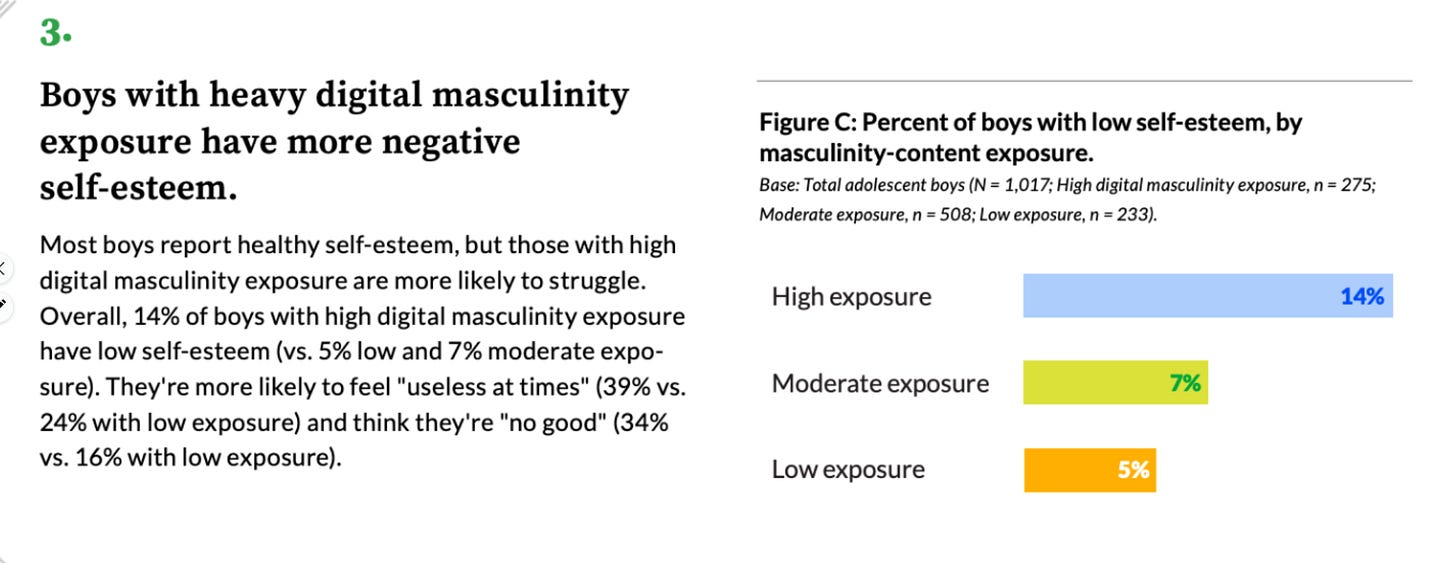
 

Note that the study itself said most boys had healthy self-esteem, and that 14% of high-exposure boys reported low self-esteem—which means 86% did not. Alaimo’s claim would have been accurate if she had written that a slightly higher percentage of high-exposure boys reported low self-esteem compared to moderate- and low-exposure groups. But she didn’t. Instead, she stated flatly that high-exposure boys have lower self-esteem. That isn’t honest reporting—it’s a distortion that misleads readers into believing the data showed something it didn’t. Here’s the quote from the CNN article:
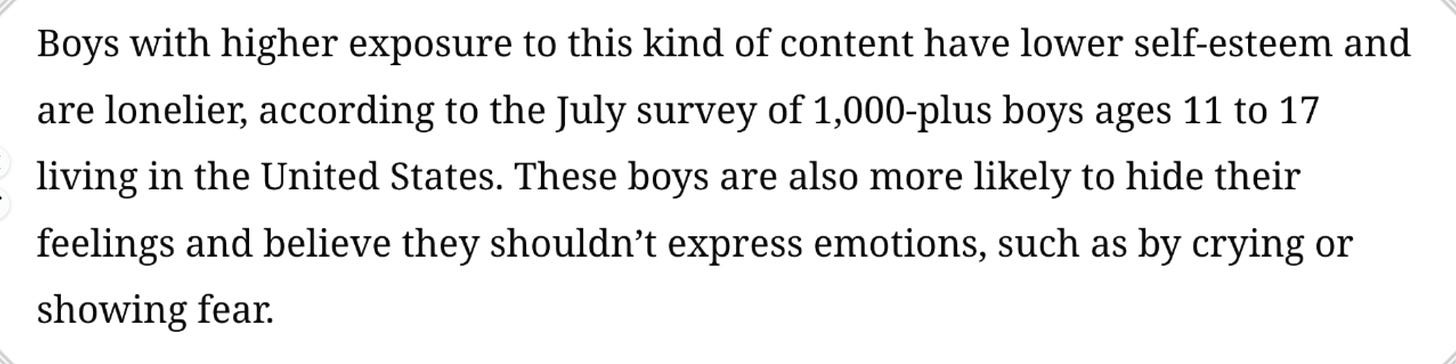
 

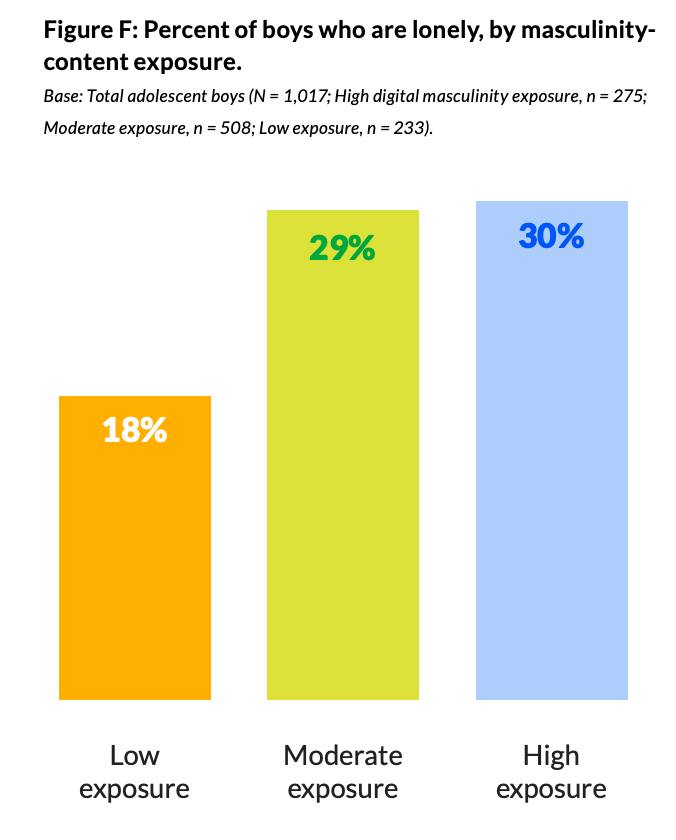
She did the same thing with the loneliness issue. The survey showed that 70% of high exposure boys were not shown to be lonely. But this didn’t keep Alaimo from claiming that higher exposure to masculine content made boys more lonely. Here’s the graphic from the survey:
 

In another part of the article Alaimo says the following:

 

When you follow the link she labels as “my research,” there’s no actual study showing that negative messages about women and girls cause offline violence. The link leads instead to another article summarizing her opinions on the topic. While she refers vaguely to a “wide body of research,” none of the studies she mentions establish a causal connection between online content and real-world violence against women. In fact, the evidence she cites is general research on media violence, not on misogyny or social media behavior.

Alaimo seems intent on frightening parents into believing that if their sons spend time online, they’ll absorb misogyny like secondhand smoke—emerging damaged, insecure, and primed for violence against women. It’s a manipulative narrative built on fear, not evidence. What parent wouldn’t feel alarmed by such a claim? And yet, that fear is precisely the tool being used to steer boys away from open spaces where they might think and speak freely.

Here are some more distortions:

• What the researchers cautioned: “The study cannot prove causation.”
→ What CNN implied: Digital masculinity causes low self-esteem—and even violence against women.
→ Why that’s misleading: It ignores the study’s explicit caveats.

• What the study measured: Exposure, not belief.
→ What CNN wrote: As though boys automatically absorbed misogynistic messages.
→ Why that’s misleading: It substitutes ideology for data.

• What the report also noted: Online spaces provide connection, belonging, and skill-building.
→ What CNN left out: The most positive findings.
→ Why that’s misleading: It works to create a one-sided moral panic.


What the Study Actually Emphasized

The Common Sense Media team didn’t call for censorship or surveillance. Their conclusion was strikingly balanced:

“With thoughtful intervention from parents, educators, policymakers, and industry, we can help boys navigate these digital environments while maintaining the human connections essential to their well-being.”

In other words, mentorship matters most. They recommend encouraging offline friendships, sports, robotics, and other group activities — spaces where boys can build confidence and identity without online distortion.

Alaimo’s takeaway? By the end of the article, she does encourage offline group activities—but the damage was already done. Readers were left with the clear impression that the manosphere is a dangerous place. This fits neatly with what appears to be her larger goal: to discourage parents from allowing boys to engage with those online spaces and to steer them back toward environments where the narrative is safely controlled.

A Pattern of Ideological Storytelling

This is not the first time feminist commentary has blurred the line between seeing and believing, between association and causation.

It’s part of a broader cultural reflex: assume that anything linked to masculinity must be toxic. When an adolescent boy shows interest in strength, competition, or success, the narrative pathologizes it as “hypermasculine.”

But strength, drive, and mastery are not dangerous traits. They are the same impulses that lead boys to protect, to build, and to grow — when guided by good mentors.


The Real Story: Boys Need Connection, Not Correction

What the data actually tell us is simple and deeply human:
Boys are online, yes. Some of what they see is rough, crude, or confusing. But most are fine. What they need most are adults — fathers, coaches, teachers, uncles, community leaders — who can talk with them about what they see, help them think critically, and model a balanced kind of strength.

When commentators like Kara Alaimo twist research into another attack on masculinity, they don’t protect boys — they alienate them further. They feed the very disconnection the data warn against.

Bottom Line

The Common Sense Media report offers a nuanced view of how boys navigate digital life. The CNN piece that claimed to summarize it turned that nuance into ideology.

The study: “Most boys are doing fine; let’s support them.”
The article: “Masculinity is toxic; it’s making boys and women unsafe.”

That’s not journalism. It’s advocacy in disguise — and it’s time readers started calling it what it is.


Why Feminist Commentators Fear the Manosphere

When CNN commentator Kara Alaimo warned that “digital masculinity” is harming boys, her real anxiety wasn’t about boys at all. It was about control.

The loss of gatekeeping power

For decades, feminist scholars and journalists held near-total control over how gender was discussed in mainstream culture. University departments, newsrooms, and social-media policy boards all spoke from the same script: masculinity is a problem to be corrected; feminism is the solution.

Then the internet happened. Podcasts, YouTube channels, Substack pages, and online forums created an uncontrolled space where men could speak to one another about purpose, rejection, fatherhood, meaning​ and a host of other topics that were forbidden in traditional places. Some of those voices are clumsy or angry, but many are thoughtful and compassionate—addressing needs the establishment had ignored.

To academics like Alaimo, that independence looks like rebellion. What she calls “the manosphere” isn’t a hate movement; it’s a marketplace of ideas she can’t supervise.

Shaming as a tool of control

When direct censorship fails, moral shaming becomes the fallback. The labels—toxic, dangerous, extremist—are meant to end the conversation before it starts.
Alaimo’s CNN piece is a textbook case: she takes a mild statistical correlation from a Common Sense Media survey and turns it into a moral warning that “masculinity online” makes boys lonely and violent.

This isn’t social science; it’s social conditioning. The goal is to make boys feel guilty for showing interest in strength, fitness, or ambition—traits that once defined healthy manhood. Curiosity becomes complicity. Click on a video about discipline, and you’re suddenly part of a “radicalization pipeline.” It also sends a message to parents that they need to control their boys online activity or face his loneliness, low self-esteem, and violence.

Projection and double standards

What often goes unnoticed is how these writers display the very hostility they accuse men of harboring. They generalize, moralize, and treat half the population as a threat in need of supervision. When men question feminist orthodoxy, it’s labeled hate. When women condemn men collectively, it’s celebrated as activism.

This double standard isn’t born of hatred so much as fear—the fear of losing moral authority. The manosphere’s unforgivable sin isn’t misogyny; it’s disobedience.

The real reason the manosphere exists

Men aren’t gathering online to plot against women. They’re doing it because they’ve been shut out of the cultural conversation. Schools tell them they’re privileged; therapy often tells them they’re defective; the media tells them they’re dangerous. The online world, for all its rough edges, at least lets them talk back.

The healthiest parts of that space offer something our institutions once did naturally: mentorship, brotherhood, challenge, and purpose. Those are not extremist ideas—they’re human needs.

What this panic reveals

When writers like Kara Alaimo insist that masculinity itself is the problem, they reveal more about their ideology than about boys. The panic over “digital masculinity” is the sound of a monopoly losing its grip. As soon as men can define themselves without approval from the establishment, the establishment cries harm.

But the truth is simpler: boys are searching for models of competence and belonging, and they have every right to look for them wherever they’re found.

The path forward

We don’t need another crusade against masculinity. We need more honest conversation—without the gatekeepers, without the shame, and without the moral panic. Let the data speak, let the boys speak, and let men continue the long-overdue work of reclaiming a healthy sense of who they are.

M​en and Boys are Good

community logo
Join the MenAreGood Community
To read more articles like this, sign up and join my community today
0
What else you may like…
Videos
Posts
Articles
January 22, 2026
Something Wicked

Today’s conversation is with three women who share something rare: they can see through the fraud of feminism—and they’re willing to say so out loud.

Hannah Spier, M.D. (a psychiatrist from the mental-health world) breaks down how feminist ideology has seeped into therapy culture and quietly turned “help” into a kind of self-worship—often at the expense of families and men.
https://hannahspier.substack.com/

Janice Fiamengo, Ph.D, brings the historical lens, showing that feminism has never really been about “equality,” but about power—and how the story has been rewritten so effectively that even critics sometimes repeat the mythology.
https://fiamengofile.substack.com/

And Carrie Gress, Ph.D., author of Something Wicked (releasing now), lays out the argument that feminism and Christianity aren’t compatible—because feminism functions like a shadow religion: its own moral framework, its own commandments, its own “sins,” and its own sacred cow (female autonomy). ...

01:13:49
December 20, 2025
Bias Against Men and Boys in Mental Health Research

This video is a summary of the three studies we have examined the last three Saturdays. It’s a brief and relaxed look at the high points of those articles. Here’s a summary:

This video examines a pattern I’ve seen repeatedly in psychological research: when data complicates the familiar story of men as perpetrators and women as victims, the data about boys and men often disappears. Using three real studies—on teen dating violence, reproductive coercion, and “masculine norms”—I walk through how boys’ suffering is minimized, misrepresented, or erased as research moves from full reports to media headlines and public policy. What emerges is not just sloppy science, but a troubling bias that shapes how we see boys, men, and masculinity itself.

00:10:31
August 07, 2025
Are Men Great of Good? Yes!

Time for a male-positive message. I created this video a while back, but its message remains as important and timeless as ever. I’d love for it to reach boys who’ve been told—explicitly or implicitly—that there’s something wrong with being male. After so much negativity about men and masculinity, they need to hear something different. They need to hear something true, strong, and affirming.

00:04:59

Something men seem to do all the time that women seem to find extreamaly unlikely or impossible.

Made me laugh!!

https://www.facebook.com/share/v/1AKtUoYg8x/?mibextid=wwXIfr

https://www.facebook.com/share/r/1FwqtFuR2Z/?mibextid=wwXIfr

I have often made this connection. It’s a little too on point to not research and derstand better. I am fairly sure there is something to it.

January 15, 2026
post photo preview
Why Would Boys Choose AI Over a Real Human?

It’s easy to blame technology. It’s harder to ask why a boy might feel safer talking to a machine than to a person.


Why Would Boys Choose AI Over a Real Human?

An article recently published by The Tyee raises alarms about boys and young men turning to AI companion chatbots for emotional support. The piece is framed as a thoughtful exploration of risk: misinformation, emotional dependency, radicalization, misogyny, and the danger of boys rehearsing their inner lives in the company of a machine rather than a human being.

On the surface, it sounds compassionate. Reasonable, even. Who wouldn’t want to protect young people from harm?

But when you slow the article down and look carefully at how boys are portrayed—what is assumed, what is omitted, and what is quietly feared—a different story begins to emerge. This is not really an article about boys’ needs. It is an article about adult discomfort with boys finding support outside approved channels.

And yes, there is misandry here—not loud, not crude, but woven into the framing itself.


Boys Are Being Explained, Not Heard

The article asks why boys and young men might be drawn to AI companions. That’s a fair question. But notice something immediately: no boy ever speaks.

There are no quotes from boys.
No first-person accounts.
No testimony that is treated as authoritative.

Instead, boys are interpreted through:

  • academic research

  • institutional language

  • risk models

  • public opinion polling

Boys are not subjects here. They are objects of concern.

This is a familiar pattern. When girls seek connection, we listen. When boys do, we analyze.


Male Emotional Life Is Treated as a Deficit

Early in the article, we’re told that boys face pressure to conform to emotional toughness, limiting their empathy and emotional literacy. This is a common trope, and it does important rhetorical work.

It subtly establishes that:

  • boys are emotionally underdeveloped

  • their distress is partly self-inflicted

  • their coping strategies are suspect

What’s missing is just as important.

There is no serious acknowledgment that boys:

  • are punished for vulnerability

  • are mocked or shamed for emotional honesty

  • quickly learn that expressing confusion or hurt can backfire socially

To me, it seems this omission matters. Boys don’t avoid emotional expression because they lack empathy. They avoid it because it is often unsafe.

AI doesn’t shame them.
AI doesn’t roll its eyes.
AI doesn’t correct their tone.
AI doesn’t imply that their feelings are dangerous.

That alone explains much of the appeal.


Male Pain Is Framed as a Threat

One of the most telling moves in the article is the escalation from loneliness to danger:

“Over time, isolation and loneliness may lead to depression, violence and even radicalization.”

This sentence does enormous cultural work.

Male suffering is not simply tragic—it is potentially menacing. The implication is clear: we must intervene, regulate, and monitor because these boys might become dangerous.

Notice how rarely female loneliness is framed this way. Women’s pain is treated as something to be soothed. Men’s pain is treated as something to be managed.

That asymmetry is not accidental. It reflects a long-standing cultural reflex: male distress is tolerated only insofar as it does not alarm us.


AI Is Cast as the Problem, Not the Symptom

The article repeatedly warns that AI companions provide a “frictionless illusion” of relationship. They affirm rather than challenge. They comfort without conflict. They validate rather than correct.

All of that may be true.

But the article never asks the most important question:

Why does a machine feel safer than a human being?

If boys are choosing AI over people, that tells us something uncomfortable about the human environments we’ve created:

  • schools where boys are disciplined more than understood

  • therapies that privilege verbal fluency and emotional disclosure

  • cultural narratives that frame masculinity as suspect

  • media portrayals that associate male grievance with moral danger

AI did not create these conditions. It simply exposed them.


The Misogyny Panic

At one point, the article imagines a boy frustrated in a relationship with a girl, and worries that a chatbot might echo his resentment and guide him toward misogynistic interpretations.

Pause there.

The boy’s frustration is immediately framed as a moral hazard.
His emotional pain is treated as something that must be challenged, corrected, or redirected. The girl’s role in the relational dynamic is never examined.

This is a familiar cultural rule:

  • men’s hurt must be monitored

  • women’s hurt must be believed

That is not equality. That is a hierarchy of empathy.


The Telltale Reassurance

The article includes this sentence:

“It is important to note that boys and young men are not inherently violent or hypermasculine.”

This kind of reassurance only appears when the reader has already been nudged toward suspicion. It functions less as a defense of boys and more as a rhetorical safety valve.

“We’re not saying boys are dangerous,” it implies.
“But we need to be careful.”

Careful of what, exactly?
Of boys speaking freely?
Of boys forming interpretations that haven’t been pre-approved?


What This Article Is Really About

Beneath the stated concern about AI is a deeper anxiety: boys are finding connection without adult mediation.

They are:

  • seeking reassurance without moral correction

  • exploring their inner lives without being pathologized

  • forming narratives without institutional oversight

That is unsettling to systems that have grown accustomed to managing male emotion rather than trusting it.

The solution offered, predictably, is not listening.
It is regulation.
Restriction.
Monitoring.
Expert oversight.

Boys are once again framed as problems to be handled, not people to be heard.


The Sentence That Cannot Be Written

There is one sentence the article cannot bring itself to say:

“Boys are turning to AI because they do not feel safe being honest with adults.”

If that were acknowledged, responsibility would shift.
Away from boys.
Away from technology.
And onto a culture that routinely treats male emotional life as suspect.


A Different Way to Read This Moment

From where I sit, boys turning to AI is not evidence of moral decay or technological danger. It is evidence of relational failure.

When a machine feels safer than a human being, the problem is not the machine.

The question we should be asking is not:
“How do we stop boys from using AI?”

But rather:
“What have we done that makes human connection feel so risky?”

Until we are willing to ask that question honestly, boys will continue to seek spaces—digital or otherwise—where their inner lives are not immediately judged.

And I can’t fault them for that.

Read full Article
January 12, 2026
post photo preview
How Gynocentrism Masquerades as Maturity, Empathy, and Love


How Gynocentrism Masquerades as Maturity, Empathy, and Love

One of the reasons gynocentrism is so difficult to challenge is that it rarely announces itself. It does not arrive as hostility toward men. It does not require anyone to say, “Men matter less.” In fact, it often appears wearing the language of virtue.

It looks like maturity.
It sounds like empathy.
It feels like love.

And that is precisely why so many decent, conscientious men live inside it without ever naming it.

1. Gynocentrism as “Emotional Maturity”

From a young age, boys are taught that maturity means emotional restraint. That part is not necessarily wrong. But somewhere along the way, restraint quietly turns into self-erasure.

A “mature” man is expected to:

  • De-escalate conflict, even when he didn’t start it

  • Absorb criticism without defensiveness

  • Yield when emotions run high

  • Take responsibility for relational tension

When a woman is upset, maturity means responding quickly and carefully. When a man is upset, maturity means questioning himself.

Over time, men learn a subtle rule:

If she is distressed, something must be wrong.
If he is distressed, he must be wrong.

This double standard is rarely stated outright, but it is widely enforced. Men who challenge it are described as immature, fragile, or emotionally stunted. Men who comply are praised for being “evolved.”

The result is not balance. It is a moral asymmetry.

2. Gynocentrism as Empathy

Empathy is meant to be mutual. But under gynocentrism, empathy becomes directional.

Men are encouraged—often relentlessly—to attune to women’s feelings:

  • to anticipate them

  • to prioritize them

  • to protect them

Meanwhile, men’s emotional experiences are treated as less legible and less urgent. A woman’s distress is seen as meaningful data. A man’s distress is treated as noise, defensiveness, or latent pathology.

Notice how often men are told:

  • “Listen to how she feels.”

  • “You need to understand the impact.”

  • “Her emotions are valid.”

And how rarely they hear:

  • “Your experience matters too.”

  • “You’re allowed to be affected.”

  • “Let’s be curious about what you feel.”

Men internalize the idea that empathy means placing themselves second. They become skilled at reading others while becoming strangers to themselves.

This is not empathy. It is emotional labor performed in one direction.

3. Gynocentrism as Love

Perhaps the most powerful disguise gynocentrism wears is love.

Many men come to believe that love means:

  • sacrificing without limit

  • suppressing their own needs

  • avoiding anything that might cause female discomfort

They learn that a good man protects the relationship by absorbing tension rather than expressing it. Harmony becomes the highest value—even when it comes at the cost of honesty.

What makes this especially insidious is that no one has to demand it.

Men assume it.

They assume that:

  • her needs are more fragile

  • her pain carries more moral weight

  • his endurance is part of the deal

So when a man goes quiet, he tells himself he is being loving. When he lets go of something that mattered to him, he calls it compromise. When he feels invisible, he frames it as strength.

Love, under gynocentrism, becomes a test of how much a man can endure without complaint.

4. Why It Feels “Normal”

Gynocentrism persists not because men are coerced, but because the assumptions feel reasonable.

After all:

  • Women do express distress more openly.

  • Men are often physically and emotionally stronger.

  • Conflict does escalate when men push back.

But reasonable observations quietly turn into unreasonable conclusions.

Strength becomes obligation.
Sensitivity becomes entitlement.
Peace becomes the man’s responsibility alone.

What began as care turns into hierarchy.

5. The Cost to Men—and to Relationships

The tragedy of gynocentrism is not just that men lose themselves. It’s that relationships lose honesty.

When men cannot safely express frustration, sadness, or fatigue, intimacy becomes one-sided. When men are praised for silence rather than truth, connection becomes performative.

Eventually, men either:

  • disappear emotionally

  • erupt unexpectedly

  • or leave quietly, confused about how love turned into loneliness

None of these outcomes serve women either.

6. Seeing It Is the First Step

The most important thing to understand is this:

Gynocentrism does not require bad intentions.
It thrives on good ones.

It feeds on men’s desire to be kind, fair, and loving—and quietly redirects those virtues into self-neglect.

Naming it is not about blame.
It is about restoring balance.

Because maturity includes self-respect.
Empathy includes the self.
And love that requires one person to disappear is not love—it is compliance.

Once men see this pattern, many feel something unexpected.

Not rage.

Relief.

Relief that the unease they felt had a name—and that fairness does not require their erasure.

Read full Article
January 08, 2026
post photo preview
The Reasonable Man


The Reasonable Man

Evan liked to think of himself as fair.

He listened. He adjusted. He didn’t raise his voice. When there was tension, he assumed he had missed something—some emotional nuance, some unspoken need. That, he believed, was maturity.

When his wife, Laura, came home upset from work, Evan canceled his plans without mentioning them. It seemed obvious that her day mattered more. When she criticized his tone, he apologized—even when he wasn’t sure what he had done wrong. If she was unhappy, the situation required fixing, and fixing required him.

This wasn’t resentment. It was love.

At least, that’s what Evan told himself.

When decisions came up—where to live, how to spend money, which friendships to maintain—Evan instinctively deferred. Laura had stronger feelings, clearer opinions. He told himself that intensity meant importance. If something mattered more to her, then it mattered more, period.

When his friend Mark complained about feeling sidelined in his own marriage, Evan felt embarrassed for him.

“You just have to be more emotionally aware,” Evan said. “Women carry more of that burden.”

Mark didn’t argue. He just looked tired.

At work, Evan was the same way. When female colleagues spoke, he nodded, encouraged, amplified. When men expressed frustration, Evan subtly distanced himself. He didn’t want to be that guy—the one who failed to notice women’s struggles. If there was a conflict, he assumed the woman had been wronged, even if the facts were unclear. Experience had taught him that neutrality was risky.

Better to err on the side of empathy.

At home, Evan grew quieter over the years. Not withdrawn—just careful. He edited himself mid-sentence. He learned which opinions created friction and which disappeared smoothly. He stopped bringing up his exhaustion. He told himself it wasn’t that bad. Other men had it worse.

When Laura once asked why he seemed distant, Evan froze. The question felt dangerous, like stepping onto thin ice. He reassured her quickly, explaining that he just needed to “work on himself.” She nodded, relieved. The conversation moved on.

Evan felt oddly proud of that moment. He had protected the relationship.

It wasn’t until much later—after a sleepless night, after rereading an old journal entry he barely remembered writing—that something shifted.

The entry was simple:

I don’t know where I went.

That sentence unsettled him.

He started paying attention—not to Laura’s emotions, but to his own patterns. He noticed how quickly he assumed women’s distress carried moral weight while men’s distress required explanation. How often he treated female discomfort as an emergency and male discomfort as a character flaw. How rarely he asked whether his needs were reasonable, and how often he assumed they were negotiable.

He realized something uncomfortable: none of this had been demanded outright.

He had assumed it.

He had assumed that women’s feelings were more fragile, more important, more deserving of protection. That men should absorb impact quietly. That harmony depended on male self-erasure. That good men yield first—and keep yielding.

Only then did Evan have a word for what he had lived by.

Not kindness.
Not empathy.
But a quiet, invisible prioritization—so ingrained it had felt like morality itself.

Gynocentrism.

He didn’t feel angry when he named it. He felt sad. Sad for how natural it had seemed. Sad for how reasonable it had felt to place himself last without ever calling it a choice.

For the first time, Evan wondered what fairness would look like if it included him.

And the question, once asked, refused to go away.

Read full Article
See More
Available on mobile and TV devices
google store google store app store app store
google store google store app tv store app tv store amazon store amazon store roku store roku store
Powered by Locals