Why the Masculine Way Keeps Getting Misunderstood
I’ve been thinking lately about men and the quiet burden they carry in today’s world.
Not just the obvious burdens — responsibility, provision, protection — but something deeper and harder to name.
It’s the burden of being misunderstood in the very places where men are strongest.
And I don’t mean misunderstood in a poetic way. I mean misinterpreted, pathologized, and often dismissed — simply because men do things differently than women.
You see this most clearly with emotions. Men have a distinct, consistent way of handling feelings. It’s not random, and it’s not a flaw — it’s a pattern rooted in biology, social roles, and testosterone. But rather than recognizing these differences, the modern lens tends to treat the male way as “deficient.”
Women talk to process.
Men act or withdraw to process.
Women regulate through expression.
Men regulate through doing.
Yet the male way is almost never acknowledged as legitimate. Instead, it’s measured against a female template — and found wanting.
And once you see this pattern, you start noticing it everywhere.
1. Emotional Life: Men as “Defective Women”
We tell men that their way of dealing with emotion is wrong. Not just different — wrong.
When men get quiet, we call it “shutting down.”
When they problem-solve as a way to soothe themselves, we call it “fixing instead of feeling.”
When they regulate through solitude, we call it “avoidance.”
In other words, men are told they’re unhealthy if they don’t process emotions like women.
The absurdity is breathtaking: the male way of processing emotion works — and has worked across millennia. But because it doesn’t resemble the female way, it’s treated as defective.
2. Fatherhood: The Strengths That No One Sees
The same pattern shows up in fatherhood.
Fathers do certain things instinctively:
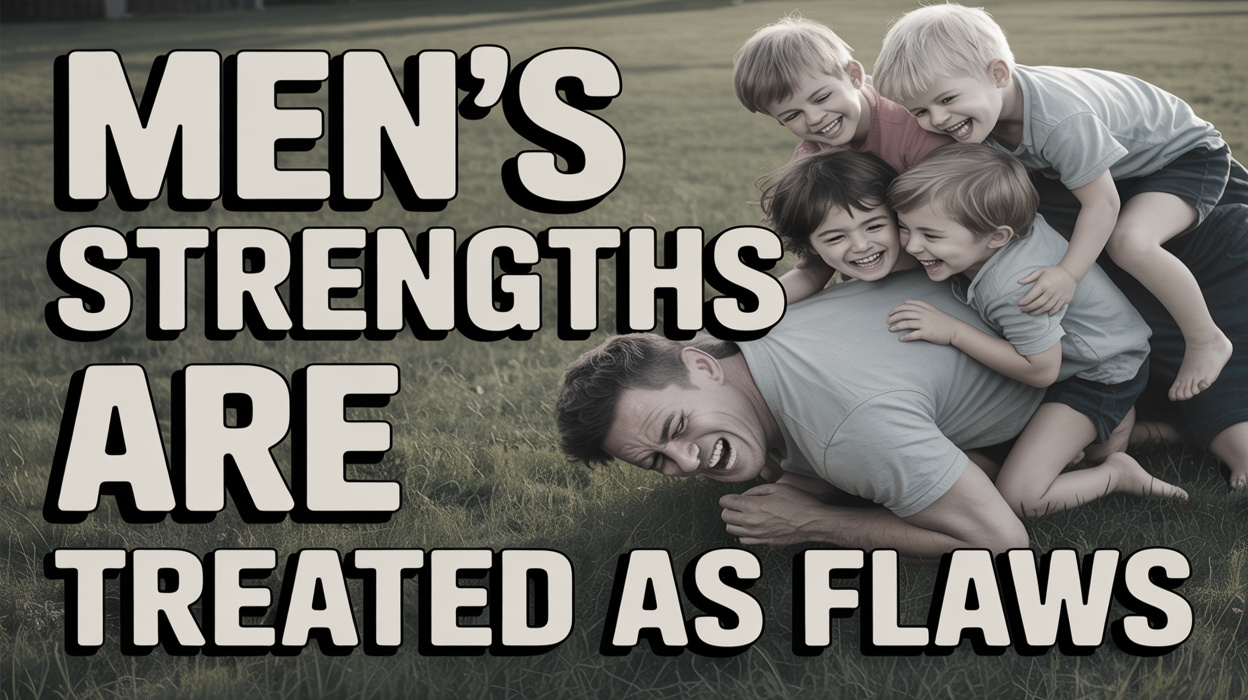
Rough-and-tumble play
Boundary-setting
Encouraging independence
Pushing challenge and risk in manageable doses
All of these have strong empirical backing as enormously beneficial for children, especially boys.
But fathers rarely get credit. Instead, their natural strengths are reframed as:
Too rough
Too distant
Not nurturing enough
Not “tuned in”
Toxic
Meanwhile the mothering style — relational, verbal, protective — becomes the default standard, and fathering is viewed as a flawed version of mothering.
But fathering isn’t “mom minus something.”
It’s a different, vital system.
3. Communication: Male Directness Pathologized
Men tend to speak more directly.
Shorter sentences.
Less emotional detail.
More focus on solutions, hierarchy, and efficiency.
This is not inferior communication — it’s optimized communication for male social structure and cooperation.
But in mixed-sex environments it’s often framed as:
Cold
Abrupt
Lacking empathy
Emotionally immature
Men’s communication works beautifully in the settings it evolved for — teams, tasks, crisis response, collaboration. But again, the female style becomes the gold standard, and the male style becomes the pathology.
4. Stress Responses: Women “Tend and Befriend,” Men “Fight, Focus, and Fix”
Shelly Taylor described how women handle stress: connect, talk, seek support.
Men, however, tend to:
Narrow their focus
Move toward action
Systemize
Get quiet
Scan for solutions
This is not emotional deficiency — it’s biology. Testosterone, competition, and precarious manhood all channel men toward action in the face of stress.
And these responses are what make men effective in crisis-intensive fields: firefighting, military, surgery, rescue work, engineering, construction.
But instead of recognizing this, the male stress response is labeled as repression.
Again: men measured by a female template.
5. Moral Psychology: Duty Recast as Toxicity
Men have a moral framework built around:
Duty
Sacrifice
Responsibility
Endurance
Protection
These are profoundly other-focused values — the moral foundation that keeps families and communities standing.
And yet today, we reframe these as:
Stoicism = unhealthy
Duty = patriarchy
Provision = control
Protection = toxic chivalry
The very virtues that once held society together have become targets.
6. Male Social Structure: Hierarchies Seen as Oppression
Male friendship and bonding grow out of:
Shared tasks
Friendly competition
Banter
Hierarchies based on competence
Cooperative shoulder to shoulder action
These are healthy, functional systems.
But modern culture calls them:
Bullying
Toxic
Aggressive
Immature
Exclusionary
Even hierarchies — which men rely on to keep group conflict down — are reframed as power structures that must be dismantled.
7. Male Sexuality: Normalized for Women, Pathologized for Men
Women’s sexuality is described as relational, emotional, expressive.
Men’s is described as:
Dangerous
Primitive
Immature
Objectifying
Men’s sexual wiring — visual, compartmentalized, spontaneous — is treated as a moral failing rather than a normal biological pattern.
Once again, the female pattern is the normative human pattern.
The male pattern is a deviation from health.
The Pattern Underneath It All
Here’s the core insight:
Any domain where men differ from women is reinterpreted as a domain where men are deficient.
If women communicate one way, that becomes the “healthy” style.
If women grieve one way, that becomes the “healthy” style.
If women bond one way, that becomes the “healthy” style.
If women parent one way, that becomes the “healthy” style.
Men become defective humans rather than fully developed men.
This is gynocentrism at its quietest but most powerful: the female mode becomes the normative template for being a good person, a good partner, a good parent, even a good human.
And anything that lies outside that template is viewed as suspect.
Why This Matters
Because men internalize it.
They feel awkward, confused and even ashamed of the very strengths that once grounded them.
The father who plays rough feels judged.
The man who gets quiet under stress feels broken.
The husband who solves problems instead of emoting feels scolded.
The young boy who competes or wrestles is told he’s aggressive.
The man who expresses duty is told he’s part of a system of oppression.
The message is everywhere:
“Be less of yourself.”
“Do it the women’s way.”
“Your instincts are suspect.”
“Your strengths are flaws.”
And the result?
Men stop trusting their nature.
And when men distrust their nature, they lose their anchor.
And we all lose something essential.
But Here’s the Truth
Men’s ways are not just legitimate.
They are necessary.
For families.
For communities.
For society.
For children.
For order and safety.
For stability.
For love.
We don’t need men to be more like women.
We need men to be fully and unapologetically men — and to be recognized for the good they bring.
And that starts with saying clearly and without hesitation:
Men’s ways aren’t deficiencies.
They’re strengths — and we should honor them.
Men Are Good!