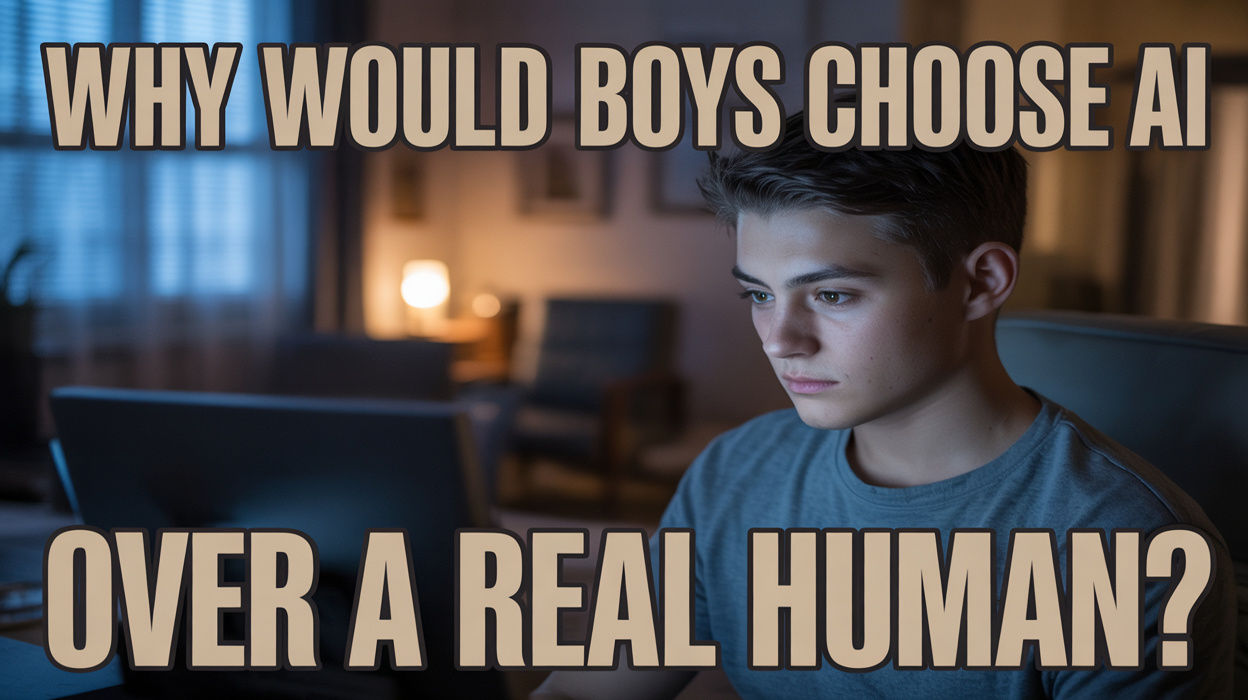
It’s easy to blame technology. It’s harder to ask why a boy might feel safer talking to a machine than to a person.
Why Would Boys Choose AI Over a Real Human?
An article recently published by The Tyee raises alarms about boys and young men turning to AI companion chatbots for emotional support. The piece is framed as a thoughtful exploration of risk: misinformation, emotional dependency, radicalization, misogyny, and the danger of boys rehearsing their inner lives in the company of a machine rather than a human being.
On the surface, it sounds compassionate. Reasonable, even. Who wouldn’t want to protect young people from harm?
But when you slow the article down and look carefully at how boys are portrayed—what is assumed, what is omitted, and what is quietly feared—a different story begins to emerge. This is not really an article about boys’ needs. It is an article about adult discomfort with boys finding support outside approved channels.
And yes, there is misandry here—not loud, not crude, but woven into the framing itself.
Boys Are Being Explained, Not Heard
The article asks why boys and young men might be drawn to AI companions. That’s a fair question. But notice something immediately: no boy ever speaks.
There are no quotes from boys.
No first-person accounts.
No testimony that is treated as authoritative.
Instead, boys are interpreted through:
academic research
institutional language
risk models
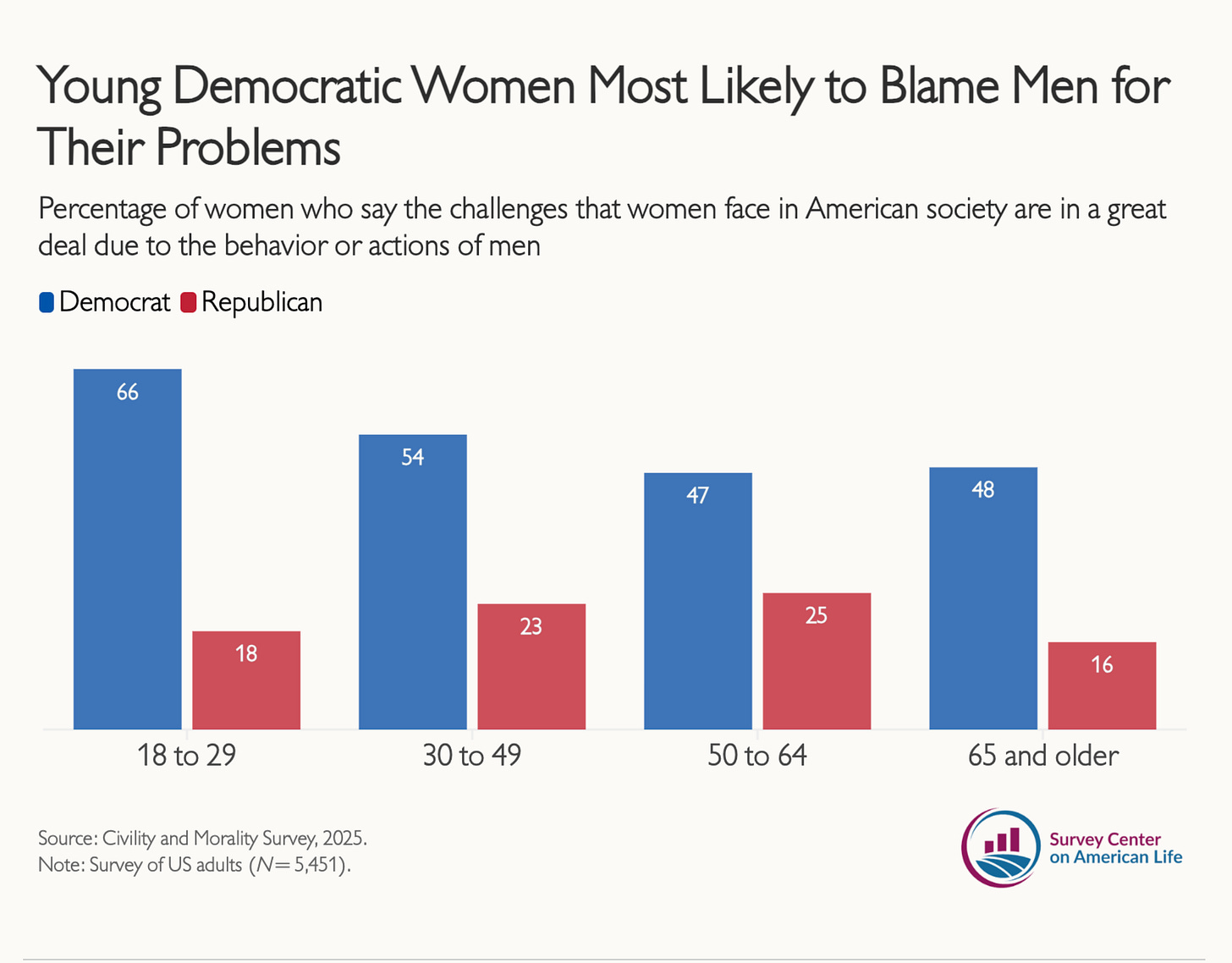
public opinion polling
Boys are not subjects here. They are objects of concern.
This is a familiar pattern. When girls seek connection, we listen. When boys do, we analyze.
Male Emotional Life Is Treated as a Deficit
Early in the article, we’re told that boys face pressure to conform to emotional toughness, limiting their empathy and emotional literacy. This is a common trope, and it does important rhetorical work.
It subtly establishes that:
boys are emotionally underdeveloped
their distress is partly self-inflicted
their coping strategies are suspect
What’s missing is just as important.
There is no serious acknowledgment that boys:
are punished for vulnerability
are mocked or shamed for emotional honesty
quickly learn that expressing confusion or hurt can backfire socially
To me, it seems this omission matters. Boys don’t avoid emotional expression because they lack empathy. They avoid it because it is often unsafe.
AI doesn’t shame them.
AI doesn’t roll its eyes.
AI doesn’t correct their tone.
AI doesn’t imply that their feelings are dangerous.
That alone explains much of the appeal.
Male Pain Is Framed as a Threat
One of the most telling moves in the article is the escalation from loneliness to danger:
“Over time, isolation and loneliness may lead to depression, violence and even radicalization.”
This sentence does enormous cultural work.
Male suffering is not simply tragic—it is potentially menacing. The implication is clear: we must intervene, regulate, and monitor because these boys might become dangerous.
Notice how rarely female loneliness is framed this way. Women’s pain is treated as something to be soothed. Men’s pain is treated as something to be managed.
That asymmetry is not accidental. It reflects a long-standing cultural reflex: male distress is tolerated only insofar as it does not alarm us.
AI Is Cast as the Problem, Not the Symptom
The article repeatedly warns that AI companions provide a “frictionless illusion” of relationship. They affirm rather than challenge. They comfort without conflict. They validate rather than correct.
All of that may be true.
But the article never asks the most important question:
Why does a machine feel safer than a human being?
If boys are choosing AI over people, that tells us something uncomfortable about the human environments we’ve created:
schools where boys are disciplined more than understood
therapies that privilege verbal fluency and emotional disclosure
cultural narratives that frame masculinity as suspect
media portrayals that associate male grievance with moral danger
AI did not create these conditions. It simply exposed them.
The Misogyny Panic
At one point, the article imagines a boy frustrated in a relationship with a girl, and worries that a chatbot might echo his resentment and guide him toward misogynistic interpretations.
Pause there.
The boy’s frustration is immediately framed as a moral hazard.
His emotional pain is treated as something that must be challenged, corrected, or redirected. The girl’s role in the relational dynamic is never examined.
This is a familiar cultural rule:
men’s hurt must be monitored
women’s hurt must be believed
That is not equality. That is a hierarchy of empathy.
The Telltale Reassurance
The article includes this sentence:
“It is important to note that boys and young men are not inherently violent or hypermasculine.”
This kind of reassurance only appears when the reader has already been nudged toward suspicion. It functions less as a defense of boys and more as a rhetorical safety valve.
“We’re not saying boys are dangerous,” it implies.
“But we need to be careful.”
Careful of what, exactly?
Of boys speaking freely?
Of boys forming interpretations that haven’t been pre-approved?
What This Article Is Really About
Beneath the stated concern about AI is a deeper anxiety: boys are finding connection without adult mediation.
They are:
seeking reassurance without moral correction
exploring their inner lives without being pathologized
forming narratives without institutional oversight
That is unsettling to systems that have grown accustomed to managing male emotion rather than trusting it.
The solution offered, predictably, is not listening.
It is regulation.
Restriction.
Monitoring.
Expert oversight.
Boys are once again framed as problems to be handled, not people to be heard.
The Sentence That Cannot Be Written
There is one sentence the article cannot bring itself to say:
“Boys are turning to AI because they do not feel safe being honest with adults.”
If that were acknowledged, responsibility would shift.
Away from boys.
Away from technology.
And onto a culture that routinely treats male emotional life as suspect.
A Different Way to Read This Moment
From where I sit, boys turning to AI is not evidence of moral decay or technological danger. It is evidence of relational failure.
When a machine feels safer than a human being, the problem is not the machine.
The question we should be asking is not:
“How do we stop boys from using AI?”
But rather:
“What have we done that makes human connection feel so risky?”
Until we are willing to ask that question honestly, boys will continue to seek spaces—digital or otherwise—where their inner lives are not immediately judged.
And I can’t fault them for that.