MenAreGood
What the Researchers Missed About Boys
The Boys Sounded Familiar
June 23, 2026
post photo preview


A recent Australian study examined masculinity attitudes among 650 boys attending an all-boys school. The researchers also surveyed parents and staff in an effort to understand how boys develop their views about masculinity.

The findings were fascinating.

The researchers concluded that many boys continue to embrace traditional masculine ideals. They found that boys valued strength, responsibility, resilience, achievement, protection, provision, and earning respect. They also found that many boys felt pressure to live up to these expectations and were influenced by peers and online voices.

Much of the discussion focused on concerns about “traditional masculinity” and the influence of the manosphere.

Yet as I read the boys’ actual responses, I found myself thinking something unexpected: the boys sounded remarkably familiar.

Many decades ago, when I was growing up, boys worried about many of the same things. They wanted to become strong. They wanted their fathers to be proud of them. They wanted to earn respect, succeed, protect the people they loved, and become dependable.

None of this sounded particularly new.

In fact, many of the boys sounded remarkably similar to the men I have worked with over the past thirty-five years as a therapist. They were wrestling with questions that generations of boys have wrestled with:

  • What does it mean to become a good man?

  • How do I earn respect?

  • What responsibilities do I have toward others?

  • How strong do I need to become?

These are ancient questions.

What struck me was not the boys’ answers. It was the researchers’ inability to hear what the boys were actually saying.

Again and again, boys spoke about responsibility, strength, sacrifice, protection, duty, and earning respect. They described wanting to become the sort of men their fathers and grandfathers would admire. They spoke about carrying burdens, protecting loved ones, and becoming dependable. Many readers will recognize these aspirations immediately. They have echoed through generations of boys and men.

Yet throughout the paper, these aspirations are repeatedly translated into the language of pathology:

  • Protection becomes paternalism.

  • Responsibility becomes hierarchy.

  • Strength becomes dominance.

  • Traditional masculine aspirations become evidence of manosphere influence.

Certainly, some boys expressed troubling ideas. Some comments reflected hostility, bullying, and immaturity, and those deserve criticism. What is remarkable, however, is how often the researchers appear unable to distinguish those attitudes from the far more common aspirations toward duty, courage, sacrifice, and responsibility.

The boys say, “I want to be strong.”

The researchers hear, “I want power.”

The boys say, “I want to protect my family.”

The researchers hear, “I endorse gender hierarchy.”

The boys say, “I want my father to be proud of me.”

The researchers hear, “I have internalized restrictive masculine norms.”

The tragedy is not that the researchers disagree with the boys. The tragedy is that they seem unable to see the beauty in what many of the boys are expressing.

The boys are describing a willingness to carry burdens. They are describing obligations, service to others, and sacrifice. Yet these qualities are so thoroughly filtered through the lens of “toxic masculinity” and “manosphere influence” that the researchers largely fail to recognize them as virtues at all.

This blind spot is revealing.

If members of almost any other group spoke about sacrifice, responsibility, service, and devotion, many academics would immediately recognize these qualities as admirable. When boys express these same aspirations, however, they are often viewed primarily as evidence of social conditioning, patriarchy, sexism, or dominance.

The burden disappears. The sacrifice becomes invisible. The obligation is transformed into power.

Perhaps this is one reason so many boys increasingly feel misunderstood.

One of the most revealing findings in the study was the growing gap between boys and the adults around them. Many boys felt that schools, teachers, and even parents did not understand their views. The researchers interpreted this primarily as evidence of peer influence and online influences.

There may be some truth in that. But there is another possibility worth considering.

Perhaps boys are searching for alternative voices because many institutions no longer speak convincingly to the questions they are asking.

The researchers repeatedly point toward the manosphere as an explanation for boys’ beliefs. Yet many of the beliefs they describe long predate Andrew Tate, social media, and the internet itself:

  • The desire to be strong.

  • The desire to protect.

  • The desire to provide.

  • The desire to earn respect.

  • The desire to become a man worthy of admiration.

These are not inventions of the manosphere. They are aspirations that have appeared in boys and men for generations.

The study may have been intended as an examination of modern masculinity, but what I saw was something far older. I saw boys wrestling with the same questions that many of us wrestled with decades ago.

The language surrounding masculinity may have changed. The questions have not.

And until our institutions learn to recognize both the burdens and the beauty that many boys associate with manhood, they will continue to misunderstand the very people they are trying to help.

Boys and Men are Good.

community logo
Join the MenAreGood Community
To read more articles like this, sign up and join my community today
0
What else you may like…
Videos
Posts
Articles
September 03, 2026
False Allegations - What the Numbers Don't Tell Us

We are getting a head start on International Falsely Accused day on Sept 9th!

How many false allegations of sexual abuse are there? We are often told they are extremely rare—perhaps only one to three percent. But those numbers depend on an extraordinarily narrow definition of what qualifies as a false allegation. They usually count only allegations proven to have been deliberately fabricated. Mistaken identity, contaminated memories, misunderstandings, suggestive interviewing, unsupported accusations and even recanted allegations may not be included.

In this conversation, Janice Fiamengo and I speak with Dr. Felicity Goodyear Smith, a physician, forensic medical examiner and professor at the University of Auckland who has studied wrongful allegations for more than three decades. Felicity explains the many different ways an innocent person can be accused, separating deliberate fabrications from allegations that are sincerely believed but untrue.

We also examine how “believe the victim” has ...

01:09:20
July 15, 2026
The Women's Health Narrative Meets the DATA

What if one of the most common claims in health policy simply isn’t true?

We’ve all heard the refrain: women are underfunded, under-researched, and left behind by the medical establishment. It’s repeated so often that most people never stop to ask for the evidence.

In this roundtable, Jack Kammer, Ed Bartlett, Ed Stephens, Jim Nuzzo, and I compare that narrative with the available data. We examine research funding, clinical trial participation, life expectancy, and the unintended consequences of policies that consistently prioritize one sex while neglecting the other.

This isn’t an argument against women’s health. It’s an argument for evidence, fairness, and a healthier future for everyone.

Link to the Feminist pdf that calls for 20 Billion dollars for women’s health!
https://drive.google.com/file/d/1IKEEZMGXtRNxU4n5K_M1d6k2w-ZP_wVT/view

Jim Nuzzo

The Nuzzo Newsletter on Substack http//jameslnuzzo.Substack.com
X: https://x.com/JamesLNuzzo

Jack Kammer

Jacks Substack Men’s ...

00:35:24
July 11, 2026
Mantoon: A Visit to the Doc

A visit to the Doc.

00:00:14

It seems that one famous plaster body of mother and child was wrong. The “mother” is actually a man and the child is not related to him.
For years the famous image of a mother protecting a child was projection. The DNA shows a man protecting a child that is not related to him.

As I stated before women who actually see men’s rights and general fairness as valid, tend to be the mothers of boys. This video is a great example of them pushing back and it is great to see.

August 10, 2026
Feminism Cannot Be Reformed: It Must Be Destroyed Root and Branch

Janice Fiamengo’s new book is out, and this excerpt from the Foreword gives you a pretty good idea of what to expect. Janice goes straight to the heart of feminism and gives ample reasons for its demolition.

This is an important book. I hope you’ll get a copy for yourself—and maybe send one to someone who is even a little bit open to seeing the reality of feminism rather than the equality mask presented by feminists and so much of the media.

https://fiamengofile.substack.com/p/feminism-cannot-be-reformed

October 19, 2026
post photo preview
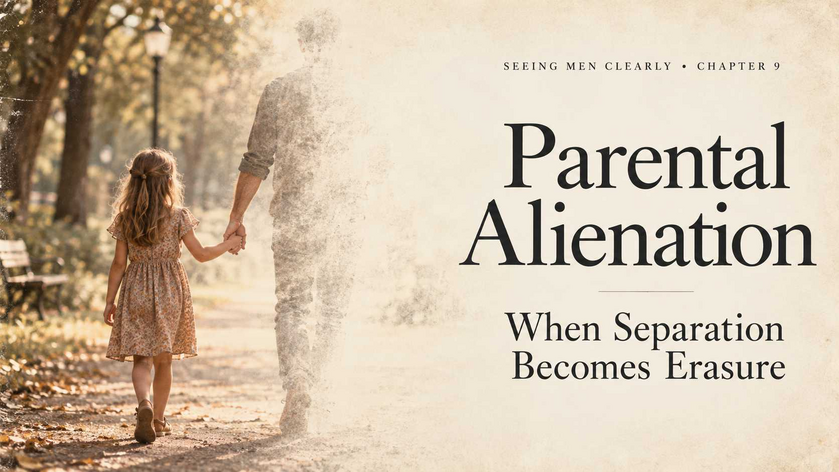
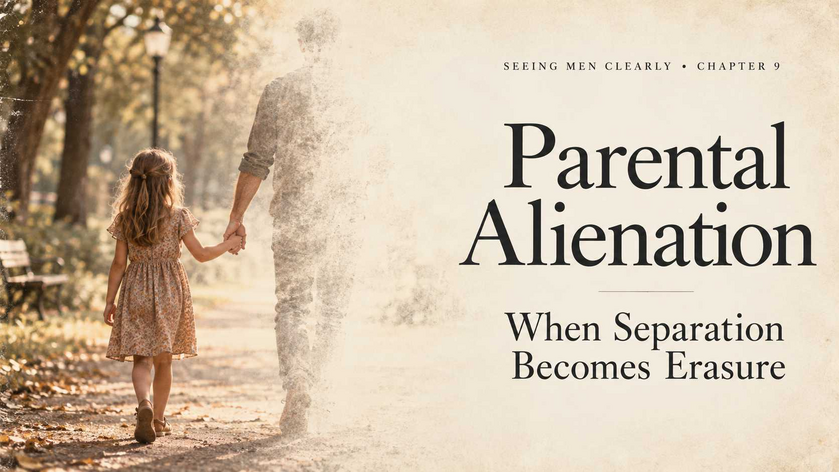
Parental Alienation: When Separation Becomes Erasure
Chapter 9 - Seeing Men Clearly


Chapter 9 - Seeing Men Clearly


Parental Alienation: When Separation Becomes Erasure

Losing daily contact with a parent is painful. Losing the relationship itself is something else entirely. Most custody disputes involve distance. Parental alienation involves something far more profound: the gradual disappearance of a parent from a child’s emotional world and, ultimately, from the child’s life, often reinforced by physical separation.

A child may still have access to a parent. Phone calls may be available. Visits may be scheduled. Court orders may remain in place. Yet over time the relationship begins to weaken, then fracture, and in some cases collapse. Affection gives way to suspicion. Familiarity gives way to distance. Love is gradually replaced by fear, anger, or indifference.


The Child Who Stops Calling

It often begins subtly. A child becomes reluctant to answer the phone. Conversations become shorter. Visits become strained. The rejected parent is bewildered. Nothing obvious has happened. No abuse. No abandonment. No dramatic betrayal. Yet the relationship appears to be dissolving.

The child begins speaking in language that sounds strangely adult. Old grievances are repeated. Minor mistakes become major offenses. Positive memories fade while negative interpretations multiply. The parent who was once loved becomes viewed almost entirely through a negative lens.


A Relationship Under Pressure

Children naturally want to love both parents. This is one of the most important realities to understand. Children generally do not enter the world looking for reasons to reject a mother or father. Their natural tendency is connection. They want both parents. They need both parents. They identify with both parents.

When children feel pressure to choose between parents, they often experience tremendous internal conflict. To reject a parent is, in some sense, to reject a part of themselves. This is why parental alienation can be so damaging. The child is not merely losing a relationship. The child is often losing a piece of his or her own identity.


The Research Begins to Notice

For many years, professionals paid little attention to the phenomenon. When fathers complained that children were being turned against them, they were often dismissed as bitter ex-spouses unwilling to accept divorce. Gradually, however, clinicians began observing patterns that were difficult to explain away.

Researchers and therapists noticed situations where children displayed extreme hostility toward a parent despite little evidence that the parent had done anything deserving such rejection. The child’s anger often seemed disproportionate, the accusations repetitive, and the thinking unusually rigid. The relationship appeared less like a normal response to parental shortcomings and more like the result of sustained influence.

Over time, the concept of parental alienation emerged as an attempt to describe these situations. Although professionals continue to debate definitions and terminology, few dispute that children can be influenced to fear, reject, or distance themselves from a parent. The question is not whether it happens. The question is how often. And what should be done when it does.


The Invisible Form of Family Violence

One way to understand parental alienation is to imagine a form of family violence that leaves no bruises. No broken bones. No emergency room visits. No police reports. Yet something precious is still being damaged: the bond between a parent and child.

A parent can recover from insults. A parent can recover from financial loss. Many parents never fully recover from losing a child. Not through death. Through rejection. The pain is difficult to describe. It is grief without a funeral. Loss without an end. Presence without relationship.


Why Children Are Vulnerable

Children trust the adults who care for them. That trust is necessary. Without it, childhood would be impossible. Yet the same trust that protects children can also make them vulnerable.

If a trusted adult repeatedly communicates that another parent is unsafe, uncaring, selfish, or unworthy, many children eventually absorb that message—not because they are foolish, but because they are children. The younger the child, the greater the vulnerability. A child has limited ability to independently evaluate competing claims. He relies heavily on the people he trusts. This is one reason parental alienation can be so powerful. It exploits one of childhood’s greatest strengths: trust.


The Father’s Voice

Although either parent can engage in alienating behavior, fathers often describe a particularly painful experience. Many enter court believing that if they remain calm, loving, and patient, the truth will eventually prevail. Instead, they sometimes discover that the relationship deteriorates while they wait.

Phone calls become less frequent. Visits become more tense. Years pass. Children grow older. The bond weakens. By the time anyone recognizes what has happened, much of the damage has already occurred.

One father described it this way: “I wasn’t losing a court case. I was losing my daughter.” That distinction captures the reality more accurately than any legal terminology. The issue is not primarily litigation. The issue is relationship.


The Child’s Loss

The greatest tragedy of parental alienation is often misunderstood. People assume the primary victim is the rejected parent. Certainly that parent suffers enormously. But a powerful and often unnoticed series of losses belongs to the child.

The child loses stories, memories, guidance, connection, identity, half of his history, and half of his family. Sometimes half of himself. Years later, many alienated children begin asking difficult questions. What really happened? Why did I stop seeing my father? Why did I believe those things? What did I miss?

Some find answers. Many do not. The lost years cannot be recovered.


Why We Didn’t Notice

Parental alienation reveals something important about the broader themes of this book. When a child loses contact with a father, many observers assume the father must have done something wrong. The possibility that the relationship itself might be under attack is often considered only much later.

This assumption flows from the same hidden layer we have seen repeatedly. Mothers are often viewed as natural caregivers. Fathers are often viewed as optional caregivers. When a child rejects a father, people frequently assume the father earned that rejection. When a child rejects a mother, people are more likely to ask what happened.

The difference is subtle. Yet it shapes perception. And perception shapes institutions. Just as it has throughout this book.

Men Are Good.

Read full Article
October 15, 2026
post photo preview
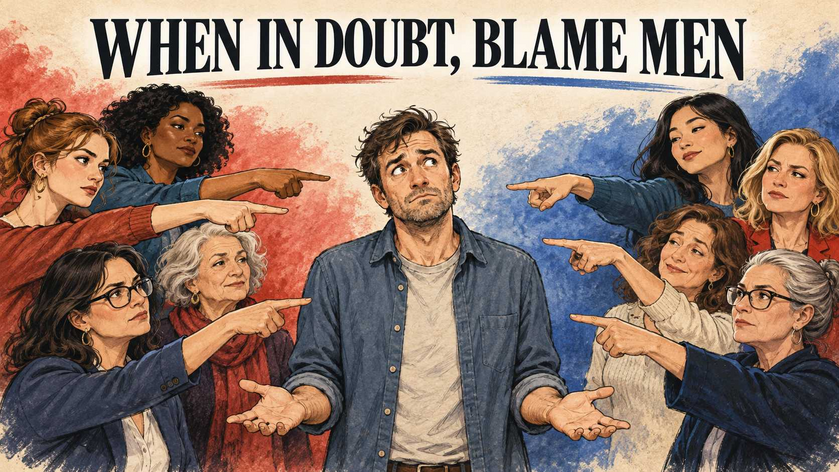
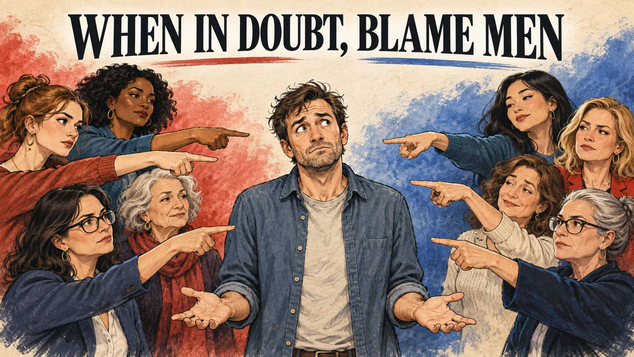
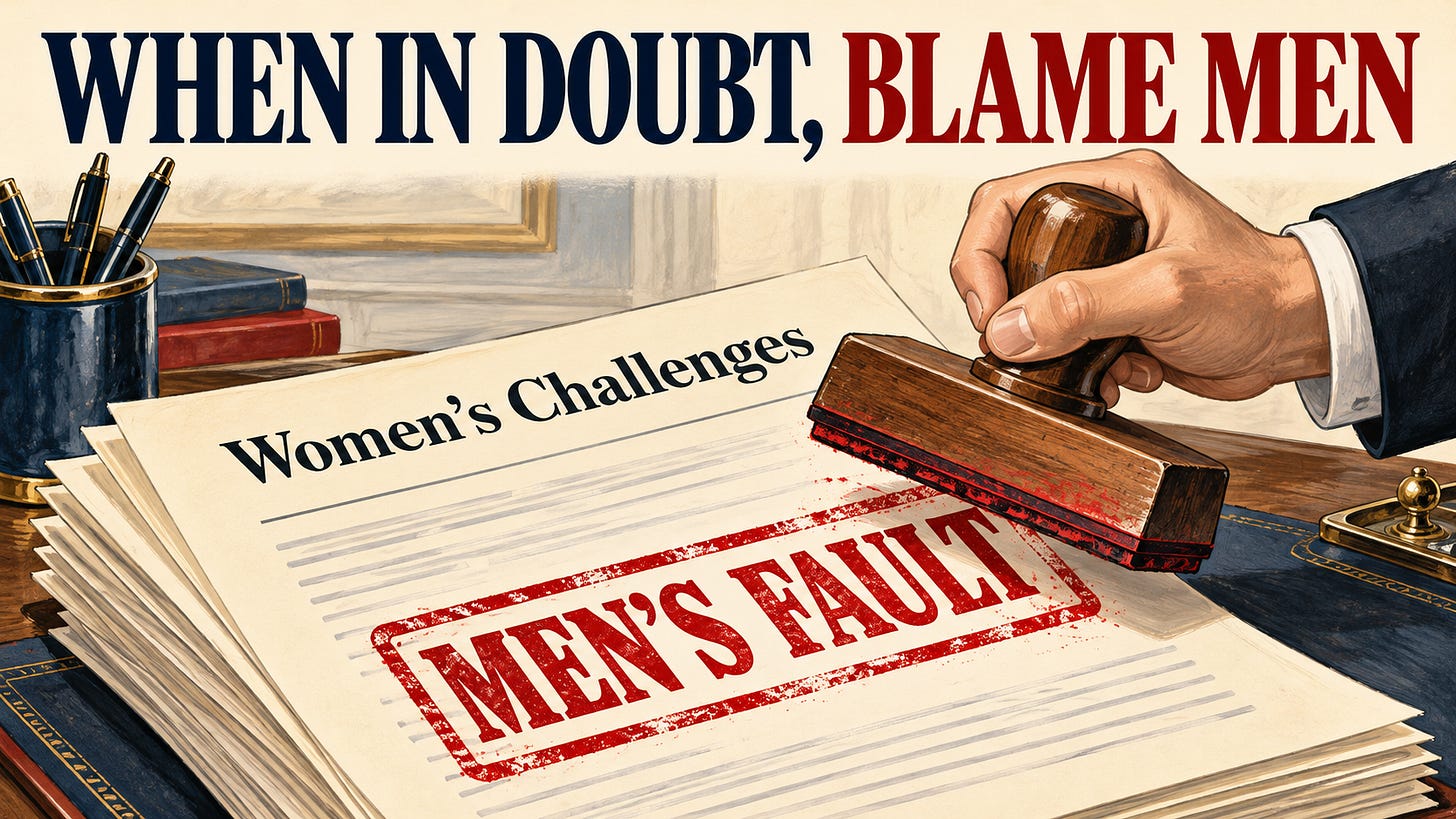
When in Doubt, Blame Men
How Widely Do Women Blame Men?
 

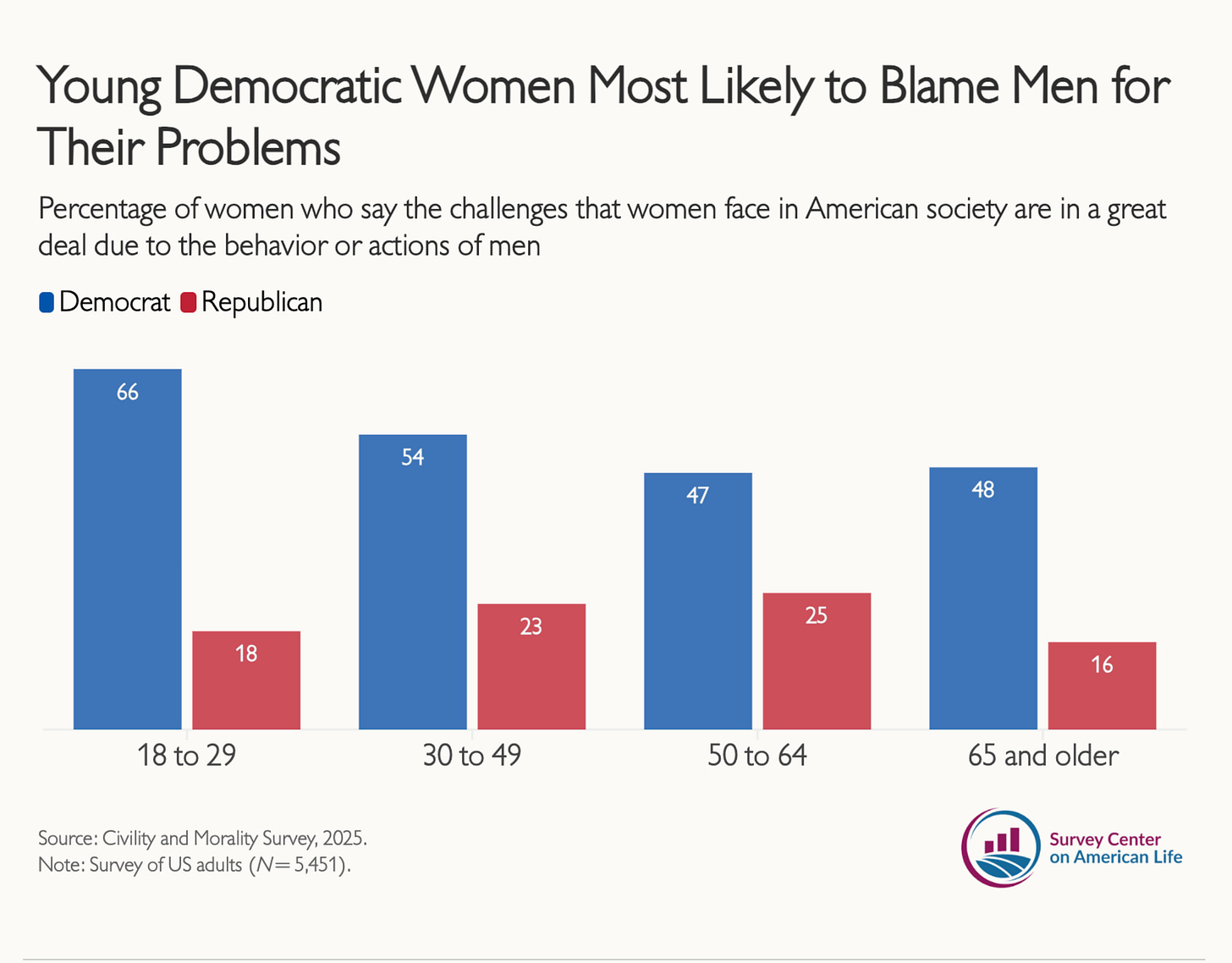
A recent analysis from the Survey Center on American Life highlighted a striking finding: 66 percent of Democratic women ages 18 to 29 said men’s behavior or actions contribute “a great deal” to the challenges women face in American society. Among Republican women the same age, the figure was 18 percent.

Here is the article’s original chart:


The contrast is dramatic. Young Democratic women were more than three times as likely as young Republican women to choose the strongest response. Across the age groups shown, democratic women were consistently more likely to answer this way.

The survey asked women how much the challenges facing women in American society were due to men’s behavior or actions. The available options were a great deal, a fair amount, hardly any, none at all, and unsure.

The original comparison tells us who selected the strongest answer. It does not tell us how many women attributed at least a fair amount of women’s challenges to men.

To examine that broader question, I looked at the survey’s underlying data using its main survey weight.


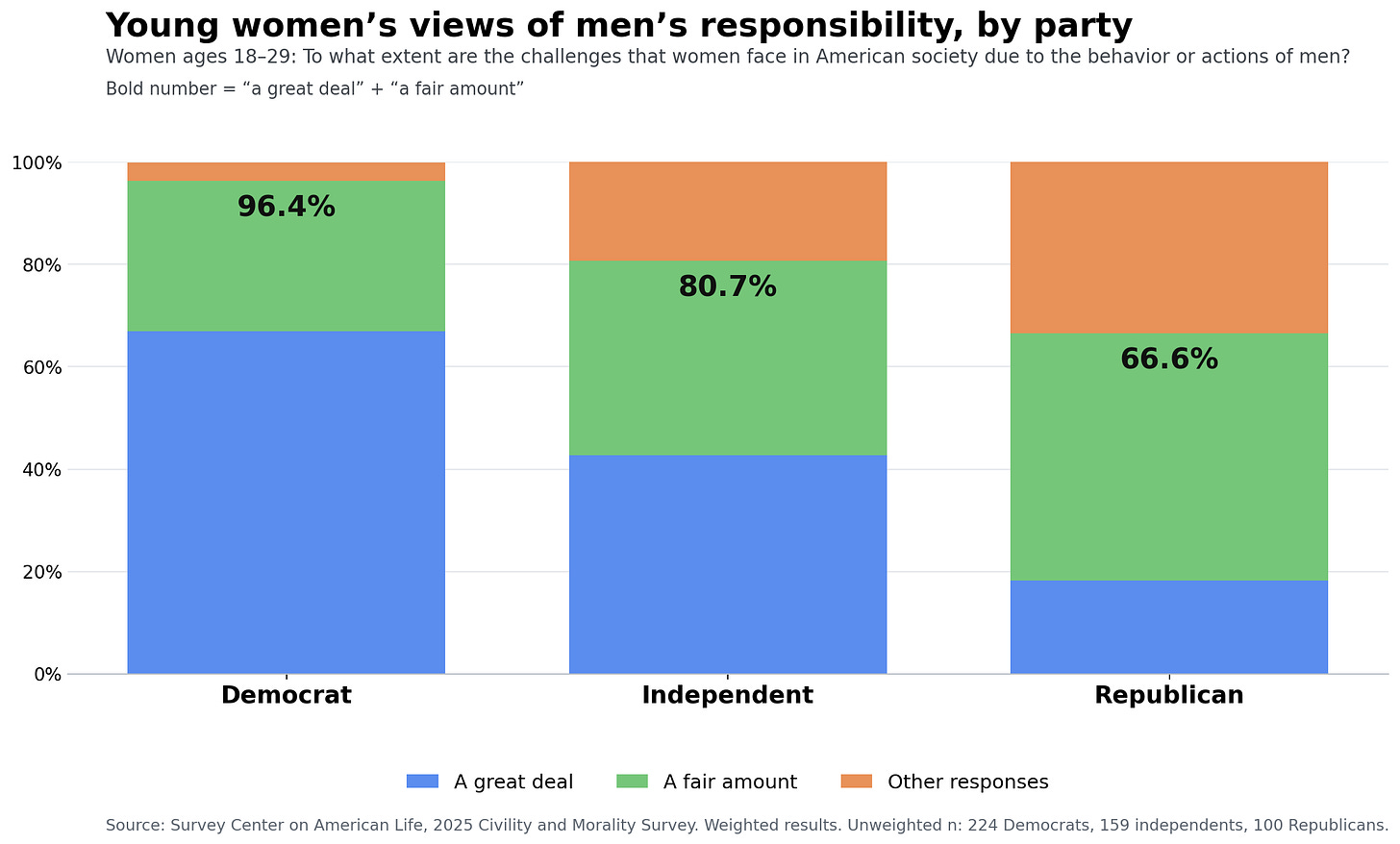
In this analysis, approximately 67 percent of young Democratic women chose a great deal, and another 29 percent chose a fair amount. Total those and you get 96.4 percent.

That is nearly every young Democratic woman in the sample. Nearly 100% of democratic women between the ages of 18-29 attributed at least a fair amount of women’s challenges to the behavior or actions of men.

The Republican result also looks very different once the second response is included. Approximately 18 percent chose a great deal, while 49 percent chose a fair amount. Together, that comes to about 67 percent—roughly two-thirds.

When we total “great deal “ and “fair amount“ it reveals something the original comparison obscures: attributing a substantial share of women’s societal challenges to men is widespread among young women in both parties.

Now let’s look beyond the youngest age group.


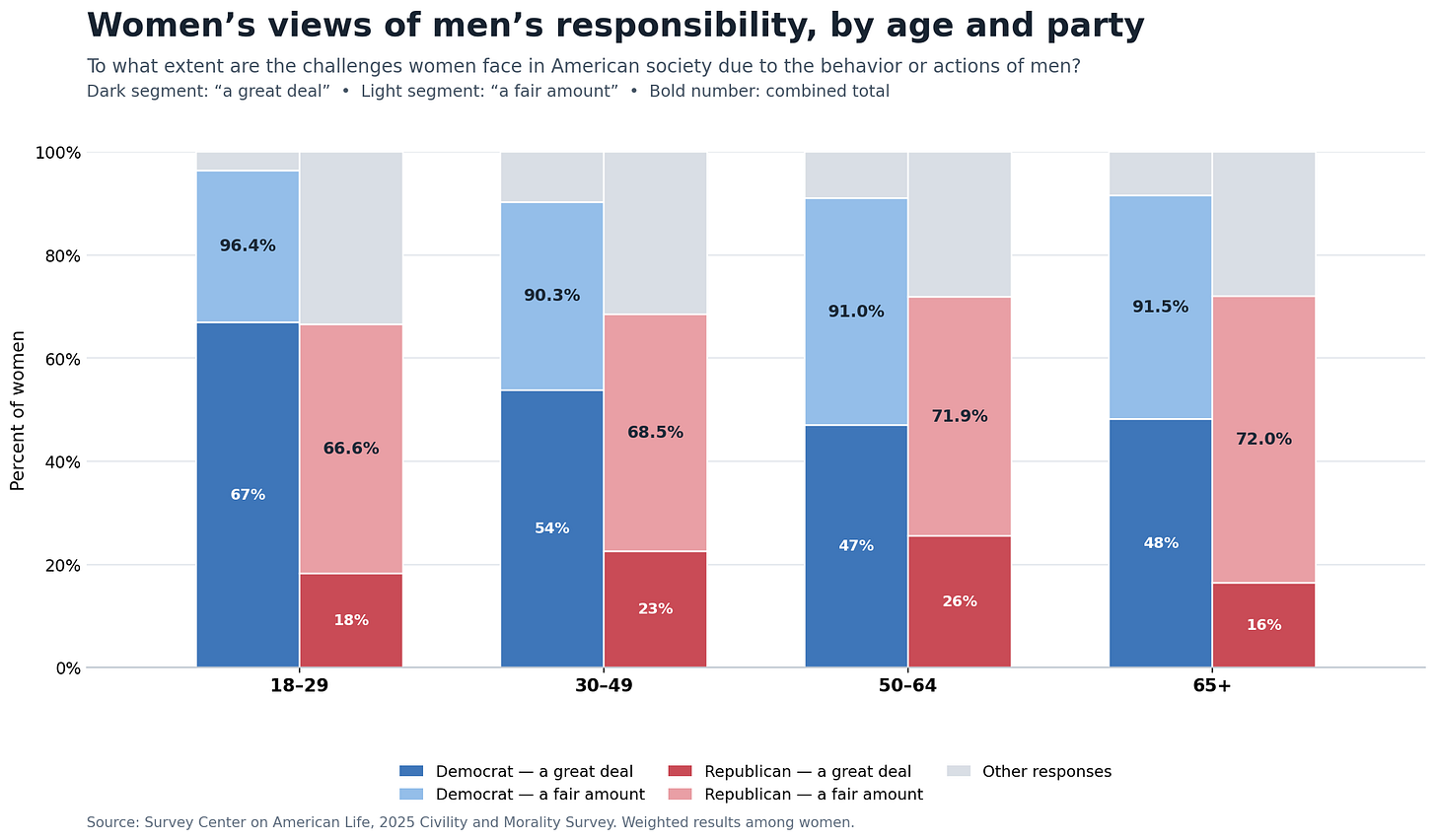
Among Democratic women, the combined total exceeds 90 percent in every age group shown.

The Republican pattern is also revealing. In this sample, the combined percentage is higher in the older age groups. Older Republican women are more likely than younger Republican women to attribute at least a fair amount of women’s challenges to men.

In every Democratic and Republican age group shown, roughly two-thirds or more of women attributed at least a fair amount of women’s societal challenges to men.

What began as a finding about young Democratic women has become a much broader finding about women across generations and party lines. Two thirds of women seem to attribute a fair amount of women’s challenges to men’s actions or behaviors. To me that is a stunning finding.

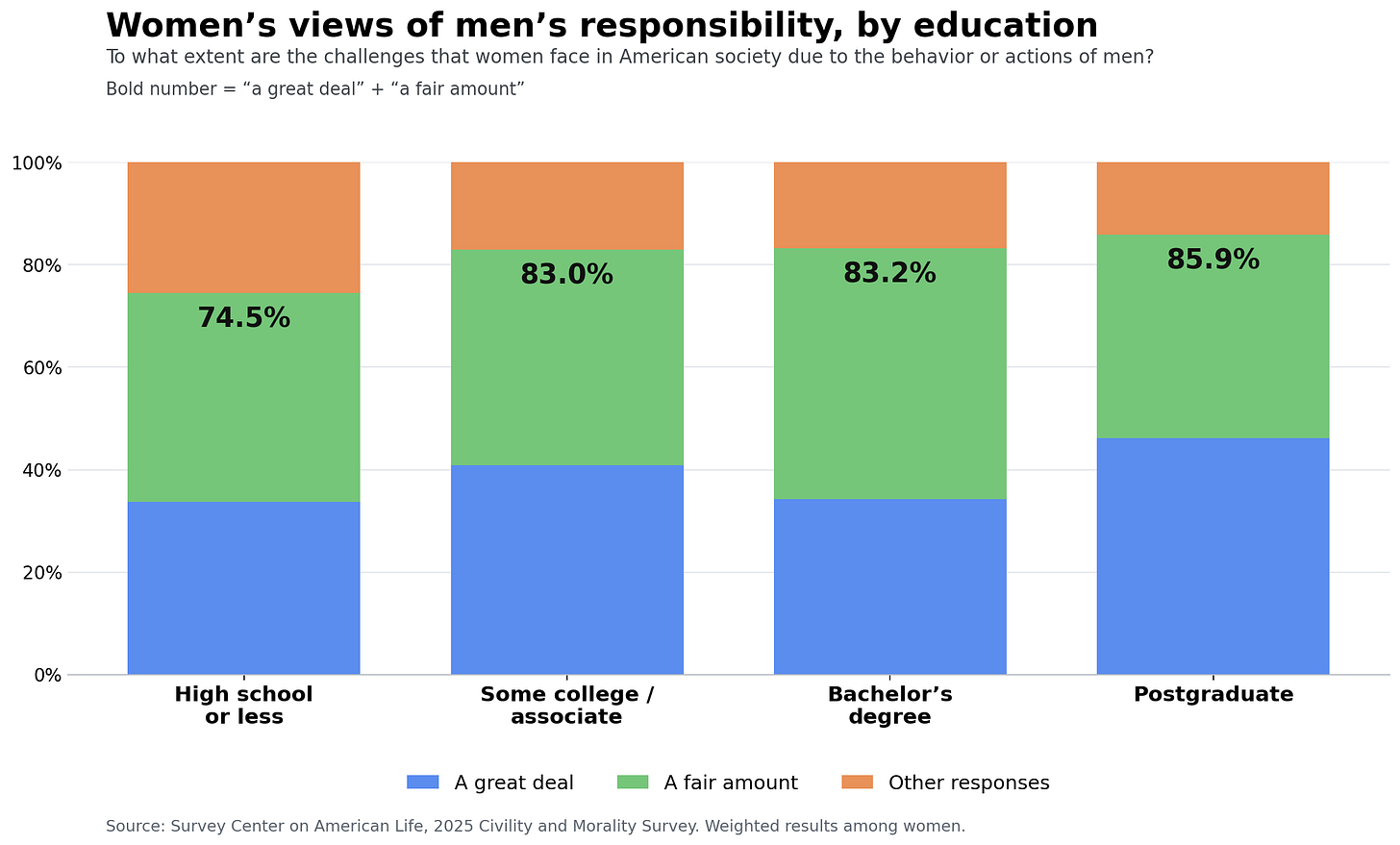
There is another dimension to consider: education.


But once again, stopping at the strongest answer leaves out part of the picture.

Including a fair amount reveals the broader educational pattern shown in the chart. The combined responses suggest a stronger tendency to attribute women’s challenges to men at higher levels of education, even though the strongest response alone does not rise consistently across the categories.

So what do these findings mean?

Nearly universal agreement among young Democratic women, more than 90 percent across Democratic age groups, and substantial majorities among Republican women suggest that seeing men as a significant source of women’s difficulties has become a widely shared perspective.

I see these findings as a strong indication of how successfully the feminist narrative has encouraged women to blame men and male power for their difficulties. It seems clear to me that this message can encourage a victim mentality. The survey does not establish why women answered as they did, but the pattern is consistent with that narrative’s influence. And it extends well beyond young Democratic women: substantial majorities of women in every age group shown, in both parties, attributed at least a fair amount of women’s societal challenges to men.


One appeal of that narrative is the explanation it offers: the difficulties women face are not entirely their responsibility; a substantial share of the blame belongs to men. Recognizing some men being a problem is reasonable. Making men an explanation for women’s difficulties is ridiculous. Just imagine men claiming that their difficulties were due to women as a group. Laughable.

What do these findings tell us? What might the impact of these ideas be? We have had decades of feminists telling women that so many of the problems they face are not their fault, that they have been wronged at the hands of men, that they are victims. One of the obvious results of this massive psyop is to diminish women’s accountability. When you believe someone else is the reason for your troubles it relieves you of needing to seek responsibility. If you are not responsible then you are likely not going to be accountable. What might that do to her? What happens to people when their accountability drops? Here are a few ideas of what psychological costs can follow a victim mentality/lack of accountability:

  1. Less self-examination. “How did I contribute?” gets replaced by “Who did this to me?” That makes it easier to repeat the same mistakes​, and blame others.

  2. More defensiveness. Feedback can feel like an unfair accusation rather than useful information.

  3. Difficulty repairing relationships. Apologizing, acknowledging someone else’s pain, and changing behavior become harder if the person sees responsibility as entirely belonging to the other party.

  4. A diminished sense of agency. If others are always the cause of your difficulties, you may also come to believe that improvement depends entirely on them. Your focus becomes changing them rather than changing yourself.

  5. Growing mistrust and resentment. Expecting mistreatment can encourage defensive or uncooperative behavior, which may provoke responses that reinforce the original expectation. Research on sensitivity to being victimized supports that possible cycle.

Do you think these five may be related to women seeing others as being responsible for their challenges? Do you think they fit with a feminist narrative that repeatedly explains women’s difficulties through men’s behavior and male power? Does that narrative help women recognize both external obstacles and their own choices, or can it encourage blame at the expense of agency?​ ​Have you seen any of this in your family, relationships, or work?

​Let me know what you think.

​Men Are Good


Source: Survey Center on American Life, 2025 Civility and Morality Survey, a survey of 5,451 U.S. adults conducted through Ipsos KnowledgePanel. The original article reports 66 percent for young Democratic women selecting “a great deal”; the weighted analysis used for the additional charts gives approximately 67 percent. The 96.5 percent combined figure uses unrounded values. The additional charts and subgroup figures are from my analysis.

Original article: https://www.americansurveycenter.org/significant-figures/young-women-are-the-most-likely-to-believe-that-men-are-at-the-root-of-their-problems/

Survey topline and methodology: https://www.americansurveycenter.org/wp-content/uploads/2025/11/Civility-and-Morality-Survey-Topline-1.pdf

Read full Article
October 13, 2026
post photo preview
A New Documentary Takes on Feminism
Meet filmmaker Les Lanphere and his upcoming film, Deceived: The Ruin of the Modern Woman.

I had a great conversation today with filmmaker Les Lanphere, who is working on a provocative new documentary called Deceived: The Ruin of the Modern Woman.

Les is an experienced documentary filmmaker whose previous work includes Calvinist, Spirit & Truth, and Cessationist. In addition to his independent documentaries, he has worked on major, large-budget film productions, bringing valuable experience from the broader film industry to his own projects. His newest documentary takes on a very different subject: feminism and its impact on women, men, families, and society.

What particularly interests me about this project is its willingness to challenge one of our culture’s most deeply entrenched assumptions: that feminism has been a force for good in women’s lives. Les takes a much more provocative position. His film sets out to expose the consequences of a movement that claims to liberate women but has often left them worse off.

The film approaches these questions from a Christian perspective, examining how feminism has reshaped our understanding of women, men, marriage, and family life. Les is asking important questions that deserve far more attention than they typically receive, and I’m delighted to see a filmmaker willing to tackle them so directly.

Here’s the trailer for the upcoming film:

Helping bring the film to life

The project’s crowdfunding campaign has already reached its original fundraising goal, which is wonderful news. But producing a documentary is an expensive undertaking, and additional contributions are still welcome and appreciated.

If you believe that feminism deserves serious scrutiny and that alternative perspectives should have an opportunity to be heard, consider supporting the project.

Support Deceived: The Ruin of the Modern Woman on Kickstarter

I’ll be interviewing Les soon for Men Are Good, and I’m looking forward to exploring his plans for the film, what motivated him to make it, and what he hopes audiences will take away.

Stay tuned. I think this will be a fascinating conversation.

Men Are Good.

Read full Article
See More
Available on mobile and TV devices
google store google store app store app store
google store google store app tv store app tv store amazon store amazon store roku store roku store
Powered by Locals