Part 3: Consent, the Only Sexual Norm Left
Follow the public argument over the Cornell case, or almost any campus sexual assault case, and you’ll notice something. It turns on a single question: was there consent? Other moral questions about the same night barely come up. When someone raises them, they’re usually heard as irrelevant, or as blaming the victim.
Why is consent the only question we can see?
Three ideas, briefly
The Family Archetype is the moral logic of a family: protect the vulnerable, care before proof. The Society Archetype is the moral logic of public life: fair procedure, evidence before judgment, individuals responsible for what they did. Matrisensus is the family’s logic taking over public life. It treats groups as victims or villains, and it keeps those it sees as vulnerable innocent by placing all the guilt elsewhere.
Consent, and one other
Consent isn’t quite alone. One other sexual norm still gets attention: power. Universities ban relationships between professors and students even when both consent, and #MeToo focused heavily on bosses and subordinates. But power and consent have the same shape. Both put all the moral responsibility on one person’s conduct toward the other: the one who initiated, the one with more power, the one who didn’t get a clear yes.
What disappeared
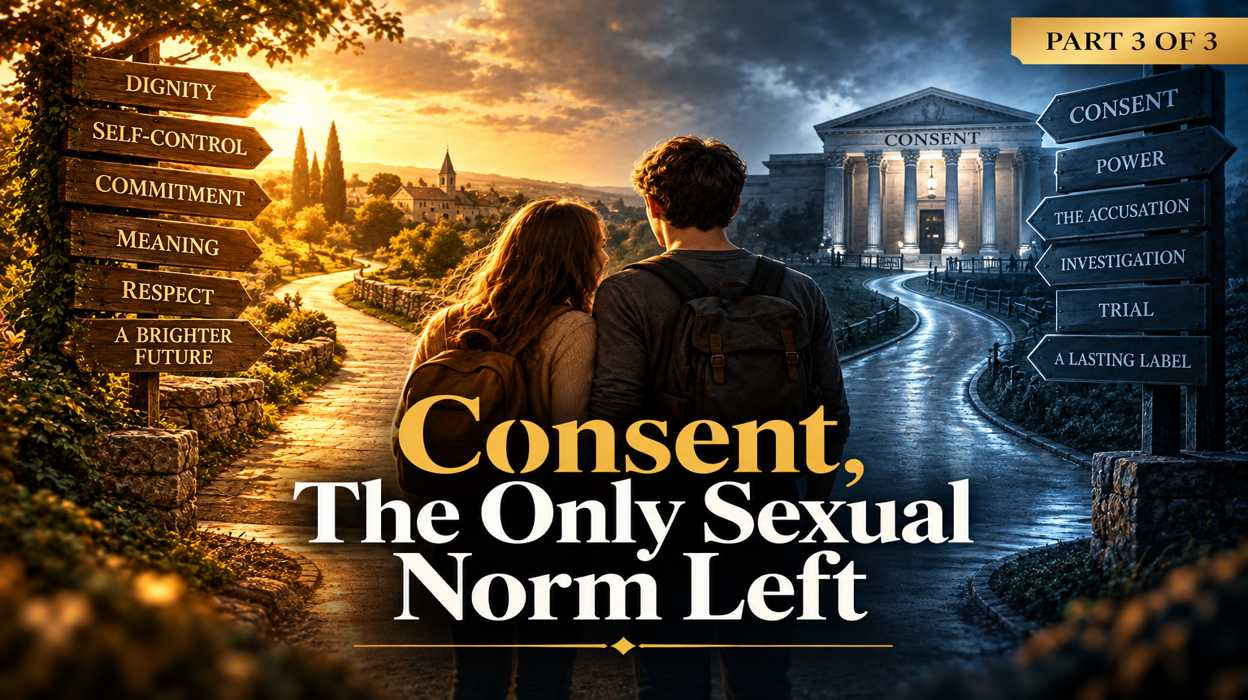
The norms that have faded have the opposite shape. Dignity, sobriety, modesty, fidelity, prudence and self-respect are norms of self-governance. They ask what each person owes to herself, as well as to the other: Did I keep my judgment clear? Does this honor what sex is meant to be? Am I protecting my own worth?
For most of history, these norms did most of the work of sexual morality, and they applied to both people. They didn’t wait for harm and then assign blame. They shaped behavior beforehand, so harm was less likely.
Why only consent survives
Here’s the key. Consent is the only sexual norm that fits Matrisensus, because it’s the only one that keeps the protected person completely innocent.
A norm like sobriety or dignity can’t do that. It looks at the choices of the person Matrisensus wants to protect: what she drank, what she risked, what she agreed to. Even mentioning such a norm puts some responsibility on her, so the norm simply stops being seen. Nobody argues against it. It just becomes invisible. Consent passes the test perfectly. Whatever happened, the moral question becomes what the other person did to her. An ethics of consent alone is the only sexual ethics in which innocence and guilt always belong to different people.
There’s a second reason. Consent is the only sexual norm decided by feeling. Sobriety and fidelity are about what you do, which others can see. Consent is about an inner state: did she want it? No one else can check that, and it can be reassessed afterward, as feelings about a night change. When consent is the only standard, what an encounter meant is no longer fixed by what happened. It depends on how one person later feels about it.
And there’s an irony. Consent actually comes from the Society Archetype. It’s a kind of contract: a mutual agreement between adults, judged by what each did and said at the time, with each responsible for their part. What Matrisensus keeps is a version stripped of what made it fair. The mutual agreement becomes one person’s inner state, the time of agreement becomes any later moment, and the shared responsibility falls on one person.
How we got here
This isn’t mysterious. The sexual revolution rejected marriage, chastity, modesty and courtship as tools of control. Consent was what was left, because both sides of the new culture could accept it. For those who wanted freedom, it was the limit: anything goes between consenting adults. For those who wanted protection, it was also the limit: no harm without consent. Consent is where “anything goes” and “protect the vulnerable” meet.
Three levels of desire
It helps to see desire as working on three levels, each meant to guide the one below it. The first is appetite: wanting pleasure, comfort, recognition. The second is self-control: the desire for order and mastery over ourselves. The third is meaning: the desire for purpose and for contributing to something beyond ourselves. A healthy life doesn’t abolish appetite. It puts appetite under self-control, and self-control in service of meaning.
Consent is permission between two appetites. It lives entirely on the first level. The older sexual morality guided that appetite from both levels above. Chastity, sobriety, modesty and prudence belong to the second level: they’re practices of self-control. Dignity, fidelity and the sense that sex is sacred belong to the third. They place sex inside something larger than one night: a committed relationship, the beginning of families and generations, the worth of a person and not just her pleasure.
An ethics built on consent alone has thrown out both upper levels at once. Self-control is dismissed as repression, and meaning as superstition. What’s left is appetite, with nothing above it but permission.
What this costs
The older norms protected in advance. Staying sober, taking time, staying among friends, all made harm less likely before any question of permission came up. Consent only protects after the fact, by judging what went wrong. Women lost protective norms and were given a courtroom norm in their place.
Harms that aren’t consent violations — degradation, being used with your agreement at the time, the emptiness of a night both people regret — no longer have any moral language. The only way to name them is to call them a consent violation. So ambiguous encounters get forced into two boxes: assault, or nothing. That’s why cases like Cornell become battlegrounds, and why the definition of consent keeps stretching to cover harms it was never built to carry.
This isn’t only a conservative argument. Christine Emba, in Rethinking Sex, argues that consent is necessary but not enough, and that a consent-only ethics has failed women. Louise Perry makes a similar case in The Case Against the Sexual Revolution.
To be clear: consent matters, and violating it is a serious wrong. The point isn’t that consent is unimportant. It’s that a culture that can see only consent has lost the norms that protected women before consent was ever in question, and has lost the language even to notice what that has cost.
One pattern
Across this series, the same thing has happened three times. Hard cases become battlegrounds because their meaning is open, and open meaning is where the fight between protective feeling and fair judgment gets fought. Juries falter in exactly those cases, because a shared moral story produces the shared blind spot that defeats the reason juries exist. And sexual morality has shrunk to consent, because consent is the one norm that keeps the protected person innocent.
Each time, feeling has moved from signal to verdict. The answer isn’t less feeling. A culture that stopped caring about the vulnerable would be worse than ours. The answer is putting feeling back where it belongs: the first word, not the last. Mercy after truth, not instead of it. And judgment that can still see a particular person and a particular act, rather than the story they seem to fit.
David Shackleton
____________________________
David Shackleton is a writer and cultural commentator whose work focuses on identity politics and gender. His books, Matrisensus, The Hand That Rocks the World: An Inquiry Into Truth, Power and Gender, and Daughters of Feminism: Women Supporting Men’s Equality, are available on Amazon. His website is genderhealing.com.
Sources for the series
Part 1
Charles G. Lord, Lee Ross, and Mark R. Lepper, “Biased Assimilation and Attitude Polarization,” Journal of Personality and Social Psychology 37, no. 11 (1979): 2098–2109.
Part 2
Marquis de Condorcet, Essai sur l’application de l’analyse à la probabilité des décisions rendues à la pluralité des voix (1785).
Franz Dietrich and Kai Spiekermann, “Jury Theorems,” Stanford Encyclopedia of Philosophy.
Christian List and Robert E. Goodin, “Epistemic Democracy: Generalizing the Condorcet Jury Theorem,” Journal of Political Philosophy 9, no. 3 (2001): 277–306.
Reporting on the Clancy jury by NBC10 Boston, CBS News, NBC News, and the Boston Globe, August–September 2026.
Part 3
Jesse Graham, Jonathan Haidt, and Brian A. Nosek, “Liberals and Conservatives Rely on Different Sets of Moral Foundations,” Journal of Personality and Social Psychology 96, no. 5 (2009): 1029–1046.
Nick Haslam, “Concept Creep,” Psychological Inquiry 27, no. 1 (2016): 1–17.
Christine Emba, Rethinking Sex: A Provocation (Sentinel, 2022).
Louise Perry, The Case Against the Sexual Revolution (Polity, 2022).