MenAreGood
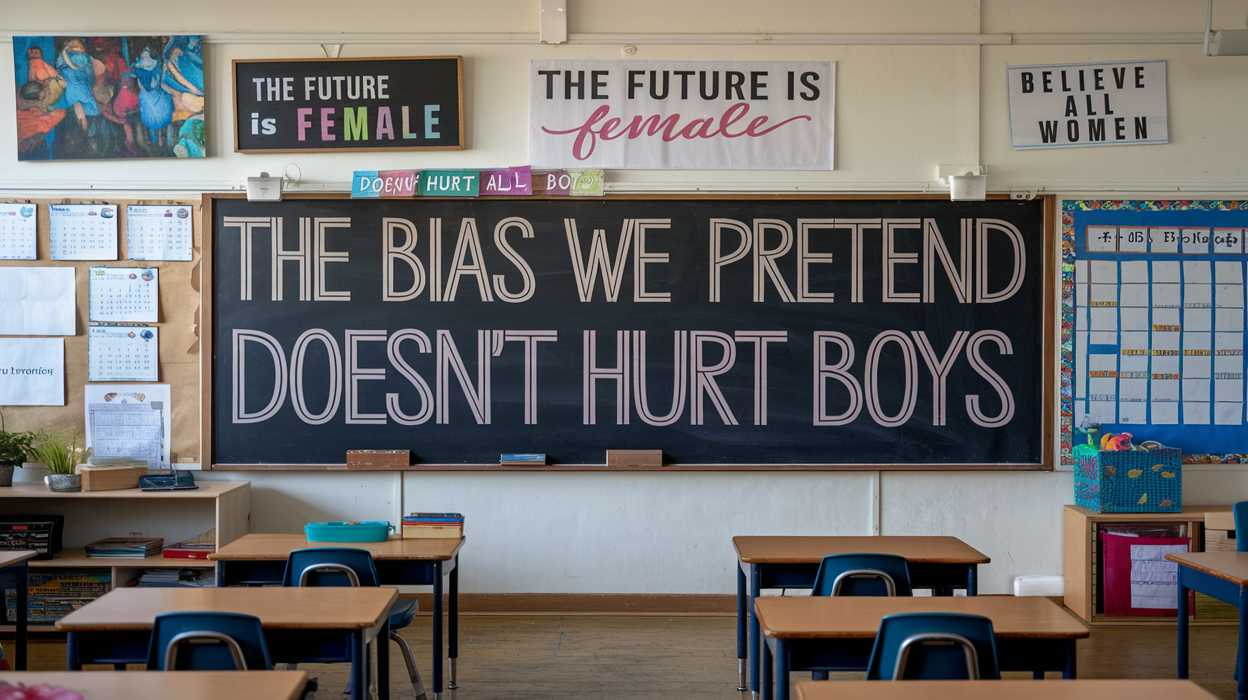
The Bias We Pretend Doesn't Hurt Boys
How a Culture Built to Protect Girls Leaves Boys Unseen and Unheard
November 24, 2025
post photo preview


Every now and then, a simple classroom exercise reveals something profound about human nature. Jane Elliott’s famous “blue-eyes/brown-eyes” experiment did exactly that. Many of you will remember it: the day after Martin Luther King Jr. was assassinated, Elliott, a third-grade teacher in Iowa, decided her students needed to understand prejudice in a way a lecture could never accomplish.

So she divided the children by eye color.

One group was told they were smarter, kinder, and better behaved. The other group — their own classmates and friends — were told they were not. Nothing about the children changed except the message they were given.

That was enough.

Within minutes, the “favored” students stood taller and spoke more confidently. They completed work more quickly and volunteered answers with pride. The disfavored group wilted. Their shoulders rounded. Their test scores dropped. Some withdrew, others grew angry. A few even began to believe the negative things said about them.

Elliott hadn’t created new children. She had created a new context — one in which the adults in power defined who deserved approval and who didn’t.

The experiment showed something we often forget: children are exquisitely sensitive to the attitudes and expectations of the people who guide them.

Even subtle cues from authority can become destiny. A raised eyebrow, a dismissive tone, a slogan on the wall — all of it shapes who children believe they are allowed to be.

Elliott’s students went through only a single day of being “favored” or “disfavored,” and it changed their behavior, confidence, and even cognitive performance.

Imagine, for a moment, what would happen if one group of children lived like this not for a day, but for years. Imagine if the message they heard — from teachers, media, curriculum, and culture — told them that something essential about them was wrong.

Imagine if they were boys.

That’s where we’re headed. But before we get there, we need one more piece of the puzzle.

Because psychologists later discovered that what Elliott demonstrated dramatically in a classroom is also happening quietly inside children every day. They even gave it a name.

It’s called stereotype threat.

And it explains far more about our boys’ struggles — and our cultural blind spots — than most people realize.


What We Learned From Girls and Math

Stereotype threat is a simple idea with enormous consequences.

It refers to what happens when a person fears confirming a negative stereotype about their group. That fear — often subtle, often unspoken — increases anxiety, reduces working memory, undermines confidence, and lowers performance.

It is not about ability.
It is about expectation.

And most people first learn about stereotype threat in one particular context: girls and math.

For decades, girls were surrounded by the quiet cultural rumor that “girls aren’t good at math.” Teachers didn’t always say it directly. They didn’t have to. It floated around in a thousand small ways: textbook examples, facial expression, who was called on in class, who was encouraged and who was consoled. Girls absorbed it the way plants absorb light.

Researchers found that when girls were subtly reminded of this stereotype—even by something as small as checking a gender box at the top of a math test—their scores dropped. Anxiety went up. They second-guessed themselves. They disengaged.

The story was not about intelligence.
It was about identity under pressure.

The response from the educational system was swift and well-funded. Millions of dollars flowed into programs designed to counteract the stereotype threat girls faced in math:

  • teacher trainings

  • new curricula

  • role model programs

  • classroom redesign

  • mindset interventions

  • special grants

  • girls-only STEM groups

  • national awareness campaigns

All created to make sure young girls never again felt that mathematics was “not for them.”

And let me say this clearly: I support that work completely. No child should carry the weight of a negative stereotype when they’re simply trying to learn.

But something interesting happened.

As we were rallying national resources to eliminate a relatively narrow, subject-specific stereotype affecting girls in one academic domain….we failed to notice a far larger, far more toxic stereotype spreading over boys.

A stereotype not about arithmetic or algebra, but about their very nature.

A stereotype not whispered quietly, but broadcast loudly.

And unlike the stereotype about girls and math, this one has no funding, no programs, no protections, and no advocates in the institutions that shape boys’ lives.

That brings us to the part of the story almost no one wants to discuss.

The Stereotype Threat No One Will Name: What Boys Hear Every Day

If stereotype threat can undermine a girl’s confidence in math, imagine what happens when the stereotype isn’t about a subject…but about who you are.

Unlike girls, boys today aren’t navigating a single academic stereotype. They are navigating a cultural identity stereotype — one that targets their character, their intentions, their value, and their future.

And it’s everywhere.

Walk into almost any school, turn on almost any youth-oriented media channel, look at the messaging in teacher trainings, HR seminars, political slogans, and popular entertainment. The language aimed at boys is unmistakable:

  • “Boys are toxic.”

  • “Masculinity is inherently dangerous.”

  • “Men are oppressors.”

  • “Patriarchy is your fault.”

  • “You are privileged, even when you’re struggling.”

  • “The future is female.”

  • “Believe all women”

  • “We need fewer men like you and more women in charge.”

  • “Boys don’t mature, they get socialized into violence.”

Imagine hearing messages like this from every angle: teachers, counselors, the news, college brochures, viral videos, and political speeches. Even prime-time awards shows repeat the same theme: something is wrong with boys and men.

This is not a stereotype about ability. This is a stereotype about identity, morality, and worth.

And boys absorb it​, like plants absorb the light.

Even the well-behaved ones.
The gentle ones.
The kind-hearted ones.
Perhaps especially the kind-hearted ones.

Because they are the ones who listen most closely to adult expectations. They care what adults think. And when every signal suggests there is something wrong with being male, boys begin to feel it in the same way Jane Elliott’s “less favored” children did:

  • some withdraw

  • some grow angry

  • some become depressed

  • some try desperately to prove they’re “safe”

  • some silence themselves around girls

  • some tune out and give up

Many learn to walk on eggshells.
Many learn to mask who they are.
Some feel ashamed before they even understand why.

This is stereotype threat on a scale our culture has never been willing to examine.
It undermines boys’ confidence not only in school, but in relationships, leadership, belonging, and moral value. It doesn’t hit one subject — it hits the entire self-concept.

And here’s the tragic irony:

When girls faced a stereotype affecting a single academic domain (math), our entire educational system mobilized. But when boys face a stereotype that frames their entire identity as suspect, dangerous, or defective…we look away.

Worse — we call it “progress.”

No grants.
No programs.
No protective messaging.
No teacher training on “encouraging healthy masculinity.”
No funding streams labeled “male resilience,” “male identity support,” or “boys’ psychological development.”

Nothing.

And yet we know from the psychology: stereotype threat doesn’t care which direction it flows. It hurts anyone subjected to it. Girls. Boys. Adults. Elders. Anyone.

The difference is that girls’ stereotype threat is treated as a national emergency, while boys’ stereotype threat is treated as an inconvenient truth best left unmentioned.

But the boys feel it.
They feel it deeply.
And it is reshaping an entire generation.

When you place a child in the “disfavored” group in Jane Elliott’s classroom, the effects show up almost immediately: withdrawn posture, lowered confidence, anger, sadness, and declining performance. Now imagine that same dynamic stretched across a childhood—not for a day or two, but for years.

That is what today’s boys are living through.

We’re watching the results play out right in front of us, but we rarely connect the dots. The signs are everywhere, yet hidden in plain sight:

Boys are falling behind academically.

Not by a little.
By a lot.

They earn:

  • lower grades,

  • fewer honors,

  • and far fewer college degrees.

Reading and writing gaps—never small—have now grown ​in size.

But we don’t ask whether constant negative messaging about male identity might be a factor. Instead, we say boys should “step up,” “apply themselves,” or “be less lazy,” as though shame has ever been a motivator.

Boys are disengaging from school.

Teachers say boys participate less. They’re more likely to tune out, act out, or withdraw. When a child believes he is viewed with suspicion, he stops coming forward.

This isn’t a mystery.
It’s textbook stereotype threat.

Boys are struggling socially.

A boy who believes his masculinity is problematic becomes hesitant. He won’t take risks socially. He won’t lead. He won’t assert himself. He won’t approach others. He is more likely to isolate or escape into online worlds where he is not judged simply for being male.

Boys are avoiding leadership roles.

They know one wrong move can be labeled “toxic,” “aggressive,” or “harmful.” So they hold back—especially in mixed-gender settings.
They self-limit long before anyone else has to.

Boys are losing their sense of belonging.

When you’re told repeatedly that your group is the source of society’s problems, you don’t imagine yourself as part of the community’s solution.
You imagine yourself on the outside.

Boys are suffering emotionally.

Rising rates of depression.
Rising rates of anxiety.
Rising suicide rates among adolescent boys.

And yet we never ask whether telling boys they’re dangerous or defective might be harming them psychologically. Just imagine telling any other group that the world would be better with less of them in it.

And then… boys stop asking for help.

Because why would you ask for help from a system that tells you that you’re the problem?

Boys, who already face the biological challenges of testosterone, the additional social push from precarious manhood, and the resulting male hierarchy, now carry an added layer of identity threat that undermines their confidence across every domain of life.

This isn’t subtle.
It isn’t accidental.
And it isn’t without consequences.

But here’s the part that should trouble us most:
We would never tolerate this treatment for girls. Ever.

If any institution—even unintentionally—sent girls negative messages about their identity, we would demand reform, new funding, and a national conversation.

But with boys?
We call it “accountability.”
We call it “progress.”
We call it “teaching them to be better.”

No.
It’s teaching them to disappear.

Part two will examine what creates and maintains this double standard.

Men Are Good.

community logo
Join the MenAreGood Community
To read more articles like this, sign up and join my community today
0
What else you may like…
Videos
Posts
Articles
December 20, 2025
Bias Against Men and Boys in Mental Health Research

This video is a summary of the three studies we have examined the last three Saturdays. It’s a brief and relaxed look at the high points of those articles. Here’s a summary:

This video examines a pattern I’ve seen repeatedly in psychological research: when data complicates the familiar story of men as perpetrators and women as victims, the data about boys and men often disappears. Using three real studies—on teen dating violence, reproductive coercion, and “masculine norms”—I walk through how boys’ suffering is minimized, misrepresented, or erased as research moves from full reports to media headlines and public policy. What emerges is not just sloppy science, but a troubling bias that shapes how we see boys, men, and masculinity itself.

00:10:31
August 07, 2025
Are Men Great of Good? Yes!

Time for a male-positive message. I created this video a while back, but its message remains as important and timeless as ever. I’d love for it to reach boys who’ve been told—explicitly or implicitly—that there’s something wrong with being male. After so much negativity about men and masculinity, they need to hear something different. They need to hear something true, strong, and affirming.

00:04:59
July 21, 2025
AI Books

We now have a new section that is accessible in the top navbar of the substack page titled AI Books. It contains links to numerous books on men's issues that each have an AI app that is able to answer detailed questions about the book. The above video gives some ideas of how to use these.

https://menaregood.substack.com/s/ai-books

The Myth of Male Power - Warren Farrell
Fiamengo File 2.0 Janice Fiamengo
Taken Into Custody - Stephen Baskerville
The Empathy Gap - William Collins
The Empathy Gap 2 - Williams Collins
The Destructivists - William Collins
Who Lost America - Stephen Baskerville
The New Politics of Sex -- Stephen Baskerville
Understanding Men and Boys: Healing Insights - Tom Golden
Boys' Muscle Strength and Performance - Jim Zuzzo PhD
Sex Bias in Domestic Violence Policies and Laws - Ed Bartlett (DAVIA)
The Hand That Rocks The World - David Shackleton

Links below

Myth of Male Power - Warren Farrell

The Myth of Male Power - documents how virtually every society that survived did so by persuading its sons to be disposable. This is one of the most powerful books...

00:11:44

Something men seem to do all the time that women seem to find extreamaly unlikely or impossible.

Made me laugh!!

https://www.facebook.com/share/v/1AKtUoYg8x/?mibextid=wwXIfr

https://www.facebook.com/share/r/1FwqtFuR2Z/?mibextid=wwXIfr

I have often made this connection. It’s a little too on point to not research and derstand better. I am fairly sure there is something to it.

post photo preview
The Quiet Lie Behind Male Loneliness


How Male Loneliness Is Commonly Explained


🔹 1. “Men Deserve the ‘Male Loneliness Epidemic’”

“The male loneliness epidemic exists because men want to control women instead of respecting them… Most of the single men I’ve seen complaining about how lonely they are don’t see women as someone to connect with, but rather as a ‘game’ they must win.”
— from Men Deserve the “Male Loneliness Epidemic” (Medium) Men Deserve the “Male Loneliness Epidemic” (Medium)


🔹 2. Her Campus: “Why the ‘Male Loneliness Epidemic’ Is Men’s Fault”

“…this epidemic is typically used to describe the recent increase in male isolation… There are many potential reasons — especially with the rise of social media — which can detract from human interaction.”
— from Why the “Male Loneliness Epidemic” Is Men’s Fault (Her Campus) Why the “Male Loneliness Epidemic” Is Men’s Fault (Her Campus)


🔹 3. Psychology Today: Framing Loneliness via Men’s Emotional Defense Patterns

“Men are often encouraged to be stoic instead of vulnerable, which makes it difficult for them to open up and form emotional connections…”
— from Is Male Loneliness a New Epidemic or an Age-Old Struggle? (Psychology Today) Is Male Loneliness a New Epidemic… (Psychology Today)


🔹 4. Elephant Journal: Blaming Choices for Loneliness

“The male loneliness epidemic isn’t an epidemic, it’s the consequence of poor choices. Companionship isn’t a right, it’s something you earn.”
— from The Male Loneliness Epidemic — Real Talk. (Elephant Journal) The Male Loneliness Epidemic — Real Talk. (Elephant Journal)


🔹 5. Salon: Explicit Mention of Blame in the Discourse

“…some may acknowledge male loneliness… but then insist it’s self-inflicted — a failure of men to take personal responsibility.”
— from Don’t Blame Women for Men’s Loneliness. Blame Capitalism. (Salon) Don’t Blame Women for Men’s Loneliness (Salon)


🔹 6. Medium: Claim that the “Male Loneliness Epidemic” Is a Myth

“Although researchers have been exploring loneliness as a societal epidemic… Stories abound about how men deserve to be lonely, while others contend that they’re not really lonely; they’re just wallowing…”
— from Is Male Loneliness a Sexist Myth (Medium) The Male Loneliness Epidemic Is a Sexist Myth (Medium)


The Quiet Lie Behind Male Loneliness


It Is the Predictable Result of a Culture That Eliminated Male Space


Before men were lonely, there were places.

Places where men showed up without an agenda. Where conversation happened sideways, not face-to-face. Where no one asked men to perform vulnerability, explain themselves, or justify their presence.

Those places didn’t disappear because men rejected connection. They disappeared because our culture decided male-only spaces were no longer acceptable. And once they were gone, men were told that their resulting loneliness was a personal failure.

There has been a noticeable shift in recent months. A growing number of articles now
acknowledge male loneliness and even gesture toward men’s emotional needs. On the surface, this looks like progress — and in one narrow sense, it is. For decades, male loneliness was either ignored or mocked.

But many of these pieces commit the same quiet betrayal.

After briefly acknowledging that men are lonely, many articles abandon subtlety altogether and place responsibility squarely on men themselves. Men don’t open up enough. Men don’t try hard enough. Men don’t build friendships properly. Men resist emotional growth.

What is missing is the most obvious factor of all: our culture systematically dismantled the spaces where men and boys once formed friendships.


Men Did Not “Forget” How to Connect,
They Lost the Places Where Connection Happened

Male friendships have never primarily formed through structured emotional disclosure. They formed through shoulder to shoulder shared activity, regular presence, and low-pressure companionship. Men bonded by working alongside one another, not by facing one another across a table and “processing.”

For generations, this happened naturally in male-only spaces:

  • Service clubs

  • Fraternal organizations

  • Trade guilds and apprenticeships

  • Male sports leagues

  • Scout troops

  • Men’s religious groups

  • Informal gathering places like barbershops and workshops

These environments weren’t about exclusion. They were containers — places where boys learned how to be men from men, and where adult men maintained connection without self-consciousness or surveillance.

Now consider what has happened.

  • Barbershops are co-ed and transactional.

  • Service clubs are now largely co-ed, and the informal freedoms that supported male bonding in male-only environments have largely disappeared.

  • Community sports are co-ed or heavily regulated.

  • Even the Boy Scouts are co-ed.

One by one, male spaces disappeared — not because men abandoned them, but because our culture increasingly viewed male-only environments as suspicious, outdated, or morally problematic.


The Asymmetry No One Wants to Name

At the same time male spaces were dismantled, female-only spaces proliferated.

Women-only gyms are accepted.
Women-only scholarships are celebrated.
Women-only commissions exist at every level of government.
Women-only networking events, parking, subway cars, retreats, and support groups are commonplace.

“Women-only” is understood as necessary, protective, and empowering.
“Men-only,” by contrast, is treated as exclusionary at best and dangerous at worst.

The result is an unspoken rule that everyone knows but few admit:

Women may gather without men. Men may not gather without women.

This is not equality. It is a double standard — and it has consequences.


Then Comes the Blame

Once the social infrastructure that supported male friendship is gone, men are told to adapt. To reinvent themselves emotionally. To “do the work.”

When they fail — when loneliness deepens — the problem is framed as internal. A defect of character. A failure of emotional literacy.

This is, by feminism’s own definition, blaming the victim: holding responsible the very people who have been placed at a disadvantage by cultural change.

Women’s suffering is explained structurally.
Men’s suffering is explained morally.

Layered onto this is something rarely acknowledged — the hostile cultural judgment directed at men and boys themselves. When boys grow up hearing that masculinity is “toxic,” that they are potential oppressors, that their instincts are suspect, it quietly erodes any sense that their sex is something to take pride in or even trust. Under those conditions, isolation is not just social — it is existential.

What often goes unnamed is that this pattern does more than misdiagnose the problem. It functions as a form of relational aggression.

Men’s suffering is acknowledged, but only in a way that subtly relocates responsibility back onto the man himself. No one (well, nearly no one) says outright that his loneliness is his fault, yet the implication is unmistakable: if he were more emotionally literate, more open, less defensive, less “toxic,” he would not be alone. Compassion is offered alongside correction; empathy is made conditional on change.

From a clinical perspective, this is precisely how relational aggression operates — through implication rather than accusation, through moral positioning rather than open attack. Shame is induced without being named. Validation is withheld without explanation. Social standing and legitimacy are quietly eroded. The result is not connection, but deeper isolation — all while those perpetuating the narrative retain a posture of concern and moral superiority.


This Is Not a Clinical Mystery

For many men, isolation is not just about having fewer friends. It is about losing a sense of place, purpose, and belonging. When the environments that once affirmed male identity disappear, men don’t just feel lonely — they feel unnecessary.

Men do not primarily heal through talk.

They heal through:

  • Shared purpose

  • Physical presence

  • Action

  • Solitude

  • Humor

  • Loyalty

  • Time spent together without scrutiny

Remove the environments that make this possible and replace them with verbal, emotionally performative models — then criticize men for not thriving — and you create an impossible bind.

Add to this a culture that repeatedly tells men their nature is dangerous or defective, and the bind tightens further. It is difficult to seek connection when one’s very maleness is framed as something that must be apologized for, corrected, or kept under supervision.

This is not men refusing connection. It is men being asked to connect in ways that violate how they naturally bond — after their native environments have been dismantled and their worth has been publicly questioned.


Anticipating the Pushback

“Men can still form friendships if they want to.”
Yes — just as plants can still grow in poor soil. The question is not whether it’s theoretically possible, but whether the conditions support it.

“Male-only spaces exclude women.”
So do female-only spaces — and no one pretends otherwise. The question is why exclusion is framed as protective when women do it and pathological when men do it.

“Some male spaces were unhealthy.”
Some families are unhealthy. We don’t abolish families. We improve them. Eliminating all male spaces because some were flawed is collective punishment disguised as progress.

“Men should just adapt.”
Adaptation is not a moral obligation when the environment itself has been intentionally stripped of what once made adaptation unnecessary.


The Real Question

If we are serious about addressing male loneliness, we have to stop blaming men for failing to thrive in conditions that were engineered to prevent male bonding.

Male loneliness is not a personal failure.
It is a cultural outcome.

Until we are willing to say that out loud — and rebuild spaces where men and boys can gather without apology — these articles will continue to sound compassionate while quietly reinforcing the very problem they claim to address.

Read full Article
December 31, 2025
post photo preview
Happy New Year!

As we close out 2025, I want to extend my heartfelt thanks to all the supporters at menaregood.locals.com. Your encouragement, engagement, and belief in this work have meant more than I can say. Whether you've joined discussions, supported financially, or simply taken the time to read and reflect, you've helped create a space where men’s issues can be explored with honesty and depth. I’m deeply grateful for your presence here, and I look forward to continuing this important work together in the year ahead.

Let's hope that 2026 is indeed the year of men!

Happy New Year!

Read full Article
December 29, 2025
post photo preview
2026 The Year of Men

This post is dedicated to my friend Mark Sherman, PhD., his sons, and his grandsons. Mark and I share a quiet hope — that we will live to see meaningful progress in the status of boys and men.


Every movement begins as an act of imagination. Before anything changes, someone has to picture what fairness would look like if we truly meant it. I wrote this piece to imagine that world — one where men are finally seen in full, with all their depth, strength, and vulnerability. Maybe we’re not there yet. But maybe 2026 could be the year we start to be.


2026 The Year of Men

Imagine that. 2026 becomes the year of men — a year when the conversation shifts from accusation to understanding. For the first time in half a century, men are discussed not as a problem to fix but as people to know. Their genius, their quirks, their flaws, and their quiet strengths are spoken of with the same nuance once reserved for others. College campuses devote programs to exploring men’s lives — their needs, their distinct ways of solving problems, their inner drives. Professors begin to ask questions that once felt off-limits: How have we misunderstood men? What happens when we stop pathologizing masculine traits and start appreciating them for what they are?

The change begins almost accidentally. A viral documentary follows several men through their daily lives — a father fighting for custody, a veteran mentoring fatherless boys, a young man navigating college under a cloud of suspicion.The film ignites something. People start talking about the thick wall of stereotype threat that has been built around men for the last fifty years, and how it quietly shapes everything — from the classroom to the courtroom. The wall doesn’t fall overnight, but it begins to crack.

Soon, the media joins in. Morning shows run thoughtful discussions about men’s emotional lives — how men experience feelings deeply but process them through action, purpose, and silence. Reporters highlight research showing that men’s stoicism, logic, and devotion to service are not deficiencies in empathy but expressions of it. Family court reforms begin to take shape; male victims of domestic violence are no longer turned away simply because they are male. It feels like a cultural exhale — the long-suppressed conversation finally given air.

At first, people are disoriented. After decades of being told that men’s pain doesn’t count, even fairness feels radical. But something shifts. Women, too, begin to see their fathers, husbands, sons, and brothers with fresh eyes. The conversation isn’t about blame anymore — it’s about balance. A new curiosity replaces old resentment. The year of men doesn’t erase anyone; it invites everyone to understand half of humanity that’s been caricatured for too long.

Could it happen? Could a culture so comfortable blaming men ever turn toward truly seeing them? Maybe not all at once. But every change in history begins the same way — with the simple act of imagining it.


What Changes During the Year of Men

The first signs of change come from the ground up. Teachers start noticing boys again — not as potential problems to manage, but as minds to cultivate. Schools experiment with programs that fit how boys learn best: movement, competition, hands-on projects, and purpose. Reading lists begin to include stories of male courage and vulnerability that go beyond superheroes or villains. Teachers are trained to see how boys’ energy isn’t disobedience — it’s engagement looking for direction. For the first time in decades, boys begin to feel that classrooms were made with them in mind.

On college campuses, the tone shifts from suspicion to curiosity. “Men’s Studies” — long a taboo phrase — finds a foothold. Seminars explore how fatherlessness, male shame, and status pressure shape young men’s mental health. Professors dare to say what was once unspeakable: that men have suffered, too. A handful of women’s studies professors even cross over, lending their voices to help create a balanced understanding of gender that includes both sides of the human story. The conversations are messy but alive — and that’s the point. Truth is finally allowed to be complicated again.

The media, too, begins to rediscover men. Documentaries appear about the quiet heroism of everyday fathers, about men mentoring boys in forgotten neighborhoods, about the millions of men who keep the world turning through labor, repair, and service. Morning talk shows, once filled with segments ridiculing male behavior, start inviting men to speak for themselves. The tone softens. People listen. A viral story circulates about a construction crew that raised money to send a coworker’s son to college after his dad’s death. “This,” one host says on air, “is masculinity too.”

Relationships begin to heal in small but powerful ways. Wives notice that when their husbands go quiet, it’s not distance but effort — a man trying to manage his emotions in the only way that feels safe. Sons start asking their fathers for advice again, and fathers rediscover how much they have to give. In counseling offices, therapists begin learning what clinicians have long said — that men process emotions through action, that their silence isn’t absence but presence in another form. Couples therapy starts to meet men halfway instead of treating them as defective women.

And then there’s mental health. The great unspoken epidemic of male despair finally becomes speakable. Instead of shaming men for not seeking help, society asks why the help offered has so little to do with how men heal. Clinics start experimenting with men’s groups centered around work, movement, humor, and camaraderie — not confession circles that make them feel judged. Suicide prevention campaigns stop using guilt and start using respect. The message shifts from “talk more” to “we see you.” And something remarkable happens: men begin to respond.


The Resistance

Of course, not everyone welcomes the Year of Men.
The early months bring a predictable storm. Certain media outlets call it a backlash. Activist groups issue statements warning that focusing on men will “set back progress.” Think pieces appear overnight insisting that “men already have enough,” as if empathy were a limited resource that must be rationed. A few universities cancel events after protests claim that discussing men’s needs “centers privilege.” But this time, something is different: the public doesn’t buy it. Ordinary people — men and women alike — begin asking simple, disarming questions: How is fairness a threat? How can caring for men possibly hurt women?

The resistance grows louder before it grows weaker. It feeds on fear — fear that empathy for men might expose hypocrisy, that the old narratives might not survive open scrutiny. For decades, the culture has run on a quiet formula: men are the problem, women the solution. Challenging that myth threatens a moral economy that has funded entire industries — from grievance studies to gender bureaucracies to the political machinery that profits from division. When men begin to speak, those who built careers speaking about men feel the ground shift beneath them.

In talk shows and social media debates, the same tired accusations resurface: that compassion for men means indifference to women, that noticing male pain is a form of denial. Yet the tone of the conversation has changed. This time, people have seen too much. They’ve seen fathers emotional pain outside family courts. They’ve seen male victims of abuse turned away from shelters. They’ve watched boys fall behind in schools that call them “toxic” for being active, assertive, or proud. The moral logic of exclusion begins to collapse under its own weight.

And then something unexpected happens: some of the loudest critics begin to soften. A few prominent feminists admit that they never intended for fairness to become a zero-sum game. Others, quietly at first, confess that they are mothers of sons — and they now see what men have endured through their children’s eyes. The resistance doesn’t disappear, but it loses its moral certainty. It becomes clear that opposing compassion for men requires something unnatural: denying reality itself.

The Year of Men doesn’t crush opposition; it transforms it. It doesn’t argue so much as invite. It reminds people that love of men isn’t hatred of women — it’s love of humanity. The movement doesn’t demand anyone’s permission to exist. It simply tells the truth with calm persistence until the shouting fades and listening begins again.


The Renewal

By the end of the Year of Men, something subtle yet profound has changed. The culture feels calmer, more honest, more whole. The anger that once filled every gender conversation has lost its fuel. People have begun to see men not as adversaries or caricatures but as essential parts of the human story — the builders, protectors, thinkers, and dreamers whose lives are as sacred as anyone’s.

The public learns what therapists have known for decades: that men’s silence is often love in disguise. That the man fixing the leaky faucet before anyone wakes is saying thank you in his own language. That the husband who works overtime, the son who restrains his tears at a funeral, the firefighter who risks his life for strangers — all are expressing something profoundly emotional, though the culture has lacked the ears to hear it.

In this new climate, men begin to relax their shoulders. They laugh more easily, reconnect with friends, and find meaning again in work, fatherhood, and service. Fathers feel free to be the masculine dad that they are, and boys no longer learn that masculinity is something to apologize for.

The walls that once separated men and women begin to crumble, replaced by curiosity, gratitude, and humor — the natural bonds of people who have finally stopped competing for moral high ground and started building a shared one.

Women, too, find a surprising sense of relief. Freed from the burden of constant grievance, they rediscover what they always loved about men — their steadiness, their generosity, their willingness to stand in harm’s way. The battle of the sexes gives way to partnership. In homes and classrooms and workplaces, people start asking a forgotten question: What are men for? And the answers are not defensive anymore. They are joyous.

By the time December arrives, commentators summarize 2026 as “the year empathy grew up.” It’s not the end of the story, only the beginning — the moment when society realized that healing half of humanity heals the whole. The Year of Men becomes not just a cultural milestone but a mirror, reminding us that progress isn’t about trading one group’s dignity for another’s. It’s about finally understanding that men are good — and always have been.

Men Are Good.

Read full Article
See More
Available on mobile and TV devices
google store google store app store app store
google store google store app tv store app tv store amazon store amazon store roku store roku store
Powered by Locals