MenAreGood
Reproductive Coercion and Research Omissions
4 – Bias Against Men and Boys in Psychological Research
December 06, 2025
post photo preview

This post is the second in a three-part series that followed How Feminist Researchers Lied. Although these pieces were written some time ago, they remain just as relevant today.

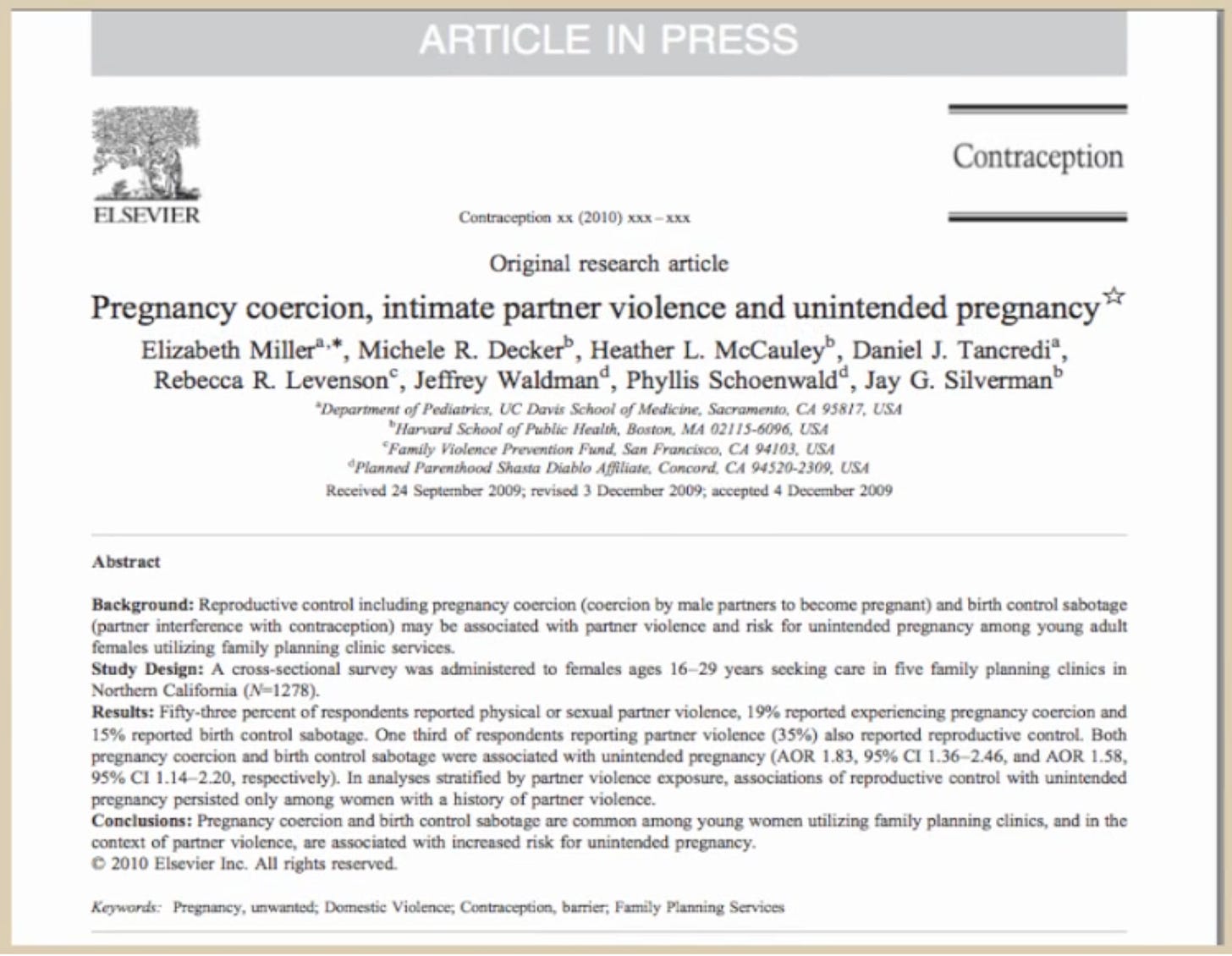
The study examined here focuses on “reproductive coercion” — and it’s a striking example of how researchers can deliberately mislead. Incredibly, it makes the preposterous claim that men are the ones “poking holes in condoms.” Despite its weak foundation, the study received massive coverage in the mainstream media and has undoubtedly shaped public perception, reinforcing yet another false narrative about men.

Read on to see how they managed to spin this.
______________________________________________



I was browsing on the web and happened to read an article about a study on “Reproductive Coercion.” As I read it I was amazed at the sorts of statistics that the study was quoting. One article said that 53% of women surveyed had experienced violence in her relationships. “Wow” I thought, thatʼs over half of the respondents. Thatʼs quite a few. I read on and other stats were quoted that were equally shocking. I began to wonder about how they got such alarming statistics.

My interest was stimulated and I started searching for articles on this research. There were plenty. One from Newsweek, one from Science News Daily, one from Medical News Today, one from EScience News, one from the LA Times and others. They all made similar claims about this study and often used the same quotes and the same statistics. I kept looking for more articles thinking that with statistics as strong as these that there must be something unusual here. I wondered if their sample was biased in some way or perhaps the way they had defined their terms had inflated the numbers. About the tenth article I found was one from the college newspaper of the lead researcher in the study. The publication was called “The Aggie” and was the student paper for the University of California, Davis. That article included something that the others had omitted. The Aggie article said that the survey was done on an “impoverished” population of African American and Hispanic females. It went on to say that the study should not be generalized:

“The five clinics surveyed were in impoverished neighborhoods with Latinas and African Americans comprising two-thirds of the respondents.

The results are expected to be applicable to reproductive health clinics in demographically poor areas. Researchers cannot estimate if surveys at private gynecologists would produce similar results.”

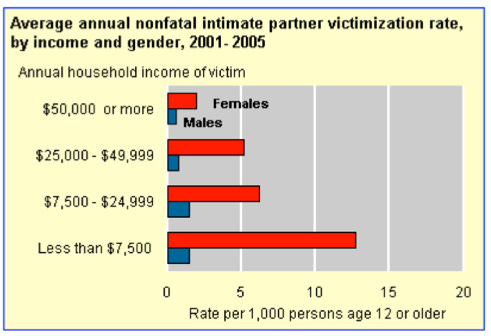
Suddenly the results started to make more sense. We know that lower socio-economic levels tend to show much higher levels of interpersonal violence (IPV). One DOJ report shows that women with lower income levels are almost three times more likely to experience relationship violence than those with higher incomes. We know that women in rental housing are also three times more likely to experience IPV than those in homes that they own. By studying a sample that was impoverished it dramatically increased the likelihood of finding higher rates of IPV.
 

Then I started to wonder. How was it that all of the national media articles which had obviously been seen by millions of people had missed the sample being of impoverished African American and Hispanic females? I started to think that the media was simply not doing their homework and that their readers were getting fed misinformation as a result.

I decided at that point to obtain a copy of the study. I went to the online site for the Journal Contraception which had published the original article and purchased a copy. I read it. By the end I was shocked. There was no mention in the journal article of the socio-economic status of the sample that had been surveyed. No mention of whether they were rich or poor. I had to catch myself because I had earlier assumed that it was the media not doing their homework and simply not reading the journal article. But now it was a completely different situation. The information had been omitted from the journal article. How could that be? This was an article that had 7 researchers named as co-authors. It had to have been read and edited over and over again. How could it be that something so basic would have been left out?

I decided to write to the lead researcher Dr Elizabeth Miller. I sent her an email and asked about the sample. I told her that I had read the article in the Aggie that had mentioned that the sample was “impoverished” African American and Hispanic females and I was interested to know if this was correct or if the Aggie had made a mistake. She wrote me back a very pleasant email in several days apologizing for taking so long to get back to me and saying that yes, the Aggie was correct that the sample was largely disadvantaged African American and Hispanic females. I wrote her back very quickly and asked why that information had not been mentioned in the journal article. I also asked if she was concerned about the national media articles that never mentioned the fact that the sample was impoverished and seemed to be erroneously implying that the study could generalize to the population at large. She wrote me back once but has never offered any answers to those questions.

MenAreGood Substack is a reader-supported publication. To receive new posts and support my work, consider becoming a free or paid subscriber.

At that point I contacted Gabrielle Grow, the author of the Aggie article and congratulated her on a job well done. I asked her how she had found out about the sample being “impoverished.” She told me that it was just one of the questions that she had asked the researchers in the interview. I wrote her back and congratulated her again and explained to her that all of the national articles including Newsweek, LA Times, Science News Daily, EScience News, Medical News Today and others had all missed that important bit of information. Ms Grow was the only reporter that asked the important question.

But why did the national news media not ask the same question? This is an important question and we really donʼt know the answer at this point. What we do know is the study issued a press release about the research findings and never mentioned the sample being largely a poor population. They also made no mention of the fact which is referenced in their study that this sort of population has higher reports of IPV thus creating inflated responses when compared to the general population. It made no mention that the study should be applicable only to other poor neighborhoods. Reading the press release one might easily assume that the study applied to everyone.

Here are just a few of the points the press release made:

1. Men use coercion and birth control sabotage to cause their partners to become pregnant against their wills.

2. Young women and teenage girls often face efforts by male partners to sabotage their birth control or coerce or pressure them to become pregnant – including by damaging condoms and destroying contraceptives.

3. Fifty-three percent of respondents said they had experienced physical or sexual violence from an intimate partner.

4. Male partners actively attempt to promote pregnancy against the will of their female partners.

With no mention in the press release that the studyʼs sample was largely indigent African American and Hispanic females one could get the impression from reading it that the study might apply to the general population. Even though the researchers when asked by Ms Grow, admitted that the study should only be applied to the poor. One can only assume that the researchers failed not only to mention this important information in the press release but also didnʼt offer this to the media in any of the interviews. Actually there was very little information offered that might have discouraged the media from playing this as a study about men and women in general.

This is obvious when you look at the headlines and quotes from various news articles. Here is a sampling:

NEWSWEEK

“What we’re seeing is that, in the larger scheme of violence against women and girls, it is another way to maintain control,” says Miller.”
“The man is taking away a woman’s power to decide she’s not going to have a child.”

LA Times

“Reproductive coercion is a factor in unintended pregnancies”
“Young women even report that their boyfriends sabotage birth control to get them pregnant.”

ScienceDaily

“Over half the respondents — 53 percent — said they had experienced physical or sexual violence from an intimate partner.”

“The study also highlights the importance of working with young men to prevent both violence against female partners and coercion around pregnancy.”

Physorg

“Approximately one in five young women said they experienced pregnancy coercion”

ESCIENCE NEWS

“Young women and teenage girls often face efforts by male partners to sabotage birth control or coerce pregnancy — including damaging condoms and destroying contraceptives”

INSCIENCES

“This study highlights an under-recognized phenomenon where male partners actively attempt to promote pregnancy against the will of their female partners,” said lead study author Elizabeth Miller, a

Medical News Today

Headline – Physical or Sexual Violence Often Accompanies Reproductive Coercion

End Abuse . org

“It finds that young women and teenage girls often face efforts by male partners to sabotage their birth control or coerce or pressure them to become pregnant – including by damaging condoms and destroying contraceptives.”

What do these quotes and headlines have in common? They all sound as if the study in question applies to the general population of men and women, boys and girls. The circulation of Newsweek is 2.7 million so just from that source alone a great many people have been given the impression that men in general will tend to coerce women in general to get pregnant.



The first level is the research paper itself. The Contraception Journal was obviously read by many, especially other researchers. Then the next level is the national media that wrote stories about the study. We saw above some of the sorts of misrepresentations that were common from the national media articles. But things go even further. Once the journal article is published and then the media articles follow there is a third wave that hits: the blogs. When end users hear this sort of thing they take it a step farther. Here are just a few examples of what happens:

Hereʼs a headline from a blog:

Crazy, Condom-Puncturing Control Freaks Are Often Men

So we have gone from omitting the nature of the sample to the printing of articles in the national media that implicate men in general and once this happens the end users at the blogs take that information and exaggerate it much farther. Hereʼs another example:

There is a new study which discusses a horribly prevalent but rarely discussed form of intimate partner violence: reproductive coercion.

So we have gone from low income Black and Hispanic females claiming to be coerced to making global pronouncements about reproductive coercion being “horribly prevalent.” Right. Those crazy condom puncturing control freaks are part of a horribly prevalent pattern.

It doesnʼt take much imagination to see the next step of a dinner table discussion of this issue. The daughter announces at the table that it is men who puncture condoms and force women into pregnancy. Mom tells her that that couldnʼt be and the daughter pulls up a link to the blog and then to the Newsweek article. Dad is still unimpressed until she pulls up a link to the study which partially verifies her false claim. All at the table are convinced now it is the men in general who are coercing women into pregnancy.

This is the way memes get started. A “research” article tells half the story and the partial data is misinterpreted unknowingly by the media who then pass on the half story as truth to unwitting millions who hear the medias version and their claim that it is research driven and the public is sold. It must be true! This is of course what happened with domestic violence. Early feminist researchers only told half the story, that women were victims of domestic violence and men were perpetrators. The media simply passed on the story to millions and the rest is history. We have a general public who is convinced that it is only women who are victims of domestic violence.

The scientific method is very clear. You create a hypothesis and find a way to test it. You then carefully sift though the test data and account for the data that affirms your hypothesis and importantly account for the data that conflicts with your hypothesis. What has happened over and over from feminist researchers is simply ignoring the data that conflicts with your hypothesis (male victims) and focusing solely on that data that confirms your ideology (female victims). Interestingly in this study the researchers failed to ask the subjects if they had also coerced their male partners. They only asked the questions that would provide them with the “acceptable” answers.

In the study examined in this article the researchers seem to have “forgotten” to remind the media of the limitations of their sample. In a similar fashion to the first study, the press release seems to have been used to steer the data. One could assume that leaving out the nature of the sample was an honest mistake. If so, I would have expected Dr Miller to respond to my email asking about the omission of the nature of the sample. But she did not. This leaves us not knowing if the mistake was or was not intentional.

Perhaps we will never know. I know what my guess is. Whatʼs yours?

Men Are Good


The Research https://pubmed.ncbi.nlm.nih.gov/20227548/

community logo
Join the MenAreGood Community
To read more articles like this, sign up and join my community today
0
What else you may like…
Videos
Posts
Articles
January 22, 2026
Something Wicked

Today’s conversation is with three women who share something rare: they can see through the fraud of feminism—and they’re willing to say so out loud.

Hannah Spier, M.D. (a psychiatrist from the mental-health world) breaks down how feminist ideology has seeped into therapy culture and quietly turned “help” into a kind of self-worship—often at the expense of families and men.
https://hannahspier.substack.com/

Janice Fiamengo, Ph.D, brings the historical lens, showing that feminism has never really been about “equality,” but about power—and how the story has been rewritten so effectively that even critics sometimes repeat the mythology.
https://fiamengofile.substack.com/

And Carrie Gress, Ph.D., author of Something Wicked (releasing now), lays out the argument that feminism and Christianity aren’t compatible—because feminism functions like a shadow religion: its own moral framework, its own commandments, its own “sins,” and its own sacred cow (female autonomy). ...

01:13:49
December 20, 2025
Bias Against Men and Boys in Mental Health Research

This video is a summary of the three studies we have examined the last three Saturdays. It’s a brief and relaxed look at the high points of those articles. Here’s a summary:

This video examines a pattern I’ve seen repeatedly in psychological research: when data complicates the familiar story of men as perpetrators and women as victims, the data about boys and men often disappears. Using three real studies—on teen dating violence, reproductive coercion, and “masculine norms”—I walk through how boys’ suffering is minimized, misrepresented, or erased as research moves from full reports to media headlines and public policy. What emerges is not just sloppy science, but a troubling bias that shapes how we see boys, men, and masculinity itself.

00:10:31
August 07, 2025
Are Men Great of Good? Yes!

Time for a male-positive message. I created this video a while back, but its message remains as important and timeless as ever. I’d love for it to reach boys who’ve been told—explicitly or implicitly—that there’s something wrong with being male. After so much negativity about men and masculinity, they need to hear something different. They need to hear something true, strong, and affirming.

00:04:59

If only if our society could just acknowledge this and celebrate it more it would be a hudge step in valuing men more!!

February 02, 2026
post photo preview
Manufacturing a Boy Crisis
Show me the data

Educators, journalists, and researchers say boys are becoming more aggressive. But when you look for the trend data, the evidence quietly disappears.


When “Concern” Replaces Evidence: A Look at Claims About Rising Aggressive Masculinity

Recently I read an article titled Reading how to be male: Boys’ literature reflects the rise of aggressive masculinity. The title alone makes a strong empirical claim: that aggressive masculinity is rising. Not perceived as rising. Not debated. Rising.

That’s a measurable claim. Which means it should be supported by measurable data.

Because I take these questions seriously — especially when they concern boys — I wrote to the author, who happened to be a Gender Studies professor, and asked a straightforward question:

What is the empirical evidence that masculine aggressiveness is increasing?

He kindly replied and sent two links — one a media report about educator concerns, and the other an article about a qualitative research project describing how some teachers perceive changes in boys’ attitudes and behavior.

But neither source provided what the title of the article clearly implies:
trend data showing that male aggressiveness is increasing over time.

In fact, the qualitative study he referenced was one my colleagues Janice Fiamengo, Hannah Spier, and I had previously examined in detail in a video discussion. We found it relied largely on interviews, interpretations, and ideological framing rather than measurable behavioral trends. The other link was simply journalism — anecdotes, opinions, and stories about educator worries.

Neither constitutes longitudinal evidence of an actual increase.


Concern Is Not Trend Data

We are living in an era of heightened cultural anxiety about boys and men. Teachers report concern. Journalists report concern. Researchers report concern. Administrators report concern.

But concern is not the same as longitudinal behavioral evidence.

If we are going to say aggression is rising, we should expect to see:

  • multi-year behavioral datasets

  • crime trend comparisons

  • school violence trend data

  • disciplinary pattern shifts

  • cross-regional replication

Instead, what we often see are:

  • perception reports

  • educator interviews

  • interpretive frameworks

  • ideological lenses applied to selected cases

Those can be useful — but they are not trend measurement.

When perception is presented as trajectory, readers are misled.


The Framing Problem

Notice how the framing works in pieces like this:

Step 1 — Start with a cultural fear
Step 2 — Gather qualitative impressions consistent with that fear
Step 3 — Interpret those impressions through a gender-ideological lens
Step 4 — Present the conclusion as a social pattern

No explicit falsification test appears anywhere in the process.

It’s not that the researchers are fabricating observations. It’s that the interpretive frame is doing most of the work.

When boys are already positioned culturally as a risk category, almost any troubling behavior becomes evidence of a broader male pattern — while contradictory evidence gets treated as an exception.

That’s not science. That’s narrative selection.


What Would Real Evidence Look Like?

If aggressive masculinity were truly rising, we would expect at least some of the following indicators to be trending upward:

  • male youth violent crime rates

  • school assault rates by sex

  • disciplinary removals for violent behavior

  • male-perpetrated injury incidents

  • cross-decade behavioral comparisons

But in many regions, long-term violent crime trends among youth have actually declined from historical peaks — not risen.

So if the claim is increase, the burden of proof belongs with the claimant.

Not with the skeptic.


Why This Matters for Boys

When cultural institutions repeatedly publish claims that boys are becoming more dangerous, more misogynistic, more aggressive — without strong trend evidence — boys absorb that message.

Teachers absorb it.
Parents absorb it.
Clinicians absorb it.
Policy absorbs it.

And boys are treated accordingly.

Suspicion becomes the baseline.
Interpretation becomes gendered.
Normal roughness becomes pathology.
Developmental conflict becomes ideology.

I have worked with boys and men for decades. They are not becoming monsters. They are becoming confused — and often very discouraged — under a steady stream of moral suspicion.

That distinction is critical.


My Exchange With the Author

To his credit, the author responded politely to my inquiry and shared his sources. I wrote back and clarified that my question was specifically about measured increase over time, since the article’s title clearly implies that trajectory.

I never heard back after that follow-up.

That silence doesn’t prove bad faith — but it does highlight something important:
The evidentiary foundation under these claims is often thinner than the confidence of the headlines.


A Better Standard

If we care about boys — truly care — we should insist on a higher evidentiary standard before declaring them socially dangerous.

We should:

  • separate perception from measurement

  • separate ideology from data

  • separate anxiety from trend

  • separate narrative from proof

And most importantly:

Assess harm by power and leverage, not gender.

Because when gender becomes the shortcut explanation, truth is usually the casualty.

And this is exactly where conversations like this often go wrong. Part of the disconnect may simply be methodological. The author comes from Gender Studies, a discipline that leans heavily on narrative interpretation, interviews, and thematic impressions rather than longitudinal behavioral measurement. Those tools can tell us how people feel about boys. They cannot tell us whether boys are actually becoming more aggressive over time. That requires hard trend data.

When interpretive methods are presented as empirical proof, perception quietly substitutes for evidence and ideology slips in wearing the costume of science. We’ve seen this pattern before — in inflated domestic violence narratives and other feminist boondoggles where worst-case anecdotes are treated as trends and fear is treated as fact. At that point, we’re no longer measuring reality; we’re constructing a story.

And once that story takes hold, boys aren’t studied — they’re blamed, regulated, and pathologized to solve a crisis the numbers never actually showed.

Men Are Good.

Read full Article
January 29, 2026
post photo preview
Accountability 2: What Equal Accountability Would Actually Look Like
Does Gynocentrism Masquerade as Justice?


What Equal Accountability Would Look Like in Practice

If accountability were truly equalized, several familiar institutions would begin to look—and behave—very differently.


Therapy Would Stop Pathologizing Male Restraint

Today, many men enter therapy already on the defensive.

A man who pauses before speaking, who thinks before he feels, who regulates himself under stress is often labeled avoidant, emotionally unavailable, or disconnected. His restraint is treated as pathology rather than capacity.

Meanwhile, emotional flooding, volatility, or verbal escalation—more often expressed by women—are framed as authenticity, trauma responses, or justified expressions of pain.

Equal accountability would mean: Therapy would stop trying to turn men into more emotionally verbal women—and start helping couples understand different but equally valid regulation styles.


Schools Would Begin to Recognize Female Aggression and Social Cruelty

In schools, aggression is still defined almost entirely in male terms.

Boys who shove, yell, or act out are disciplined.
Girls who exclude, humiliate, gossip, provoke, manipulate friendships, or orchestrate social punishment are often ignored—or worse, excused as “drama.”

Teachers routinely intervene in boys’ conflicts while dismissing girls’ relational aggression as normal social behavior.

Equal accountability would mean:

  • Recognizing ostracism, rumor-spreading, and reputational harm as real aggression

  • Intervening when girls weaponize friendships or authority

  • Teaching that cruelty doesn’t require physical force to be damaging

  • Holding girls to the same behavioral standards of fairness and restraint

This wouldn’t punish girls.
It would protect children—especially quieter boys who are often invisible victims.


Workplace Policies Would Acknowledge Relational Aggression

Most workplace harassment policies are built around overt misconduct: yelling, threats, sexual advances.

What they rarely address is relational aggression:

  • Undermining colleagues through insinuation

  • Using complaints as leverage

  • Social exclusion and coalition-building

  • Reputational sabotage framed as “concerns”

Men are often blindsided by HR actions because they don’t recognize these tactics as aggression until it’s too late.

Equal accountability would mean:

  • Scrutinizing patterns of complaint-making, not just the accused

  • Distinguishing harm from discomfort

  • Requiring evidence rather than emotional assertion

  • Acknowledging that social power can be weaponized quietly

A fair workplace doesn’t protect feelings at the expense of truth.
It protects process.


Media Narratives Would Stop Moral Typecasting

Our media runs on a familiar script:

Men are agents.
Women are victims.

When men do harm, it’s framed as character.
When women do harm, it’s framed as context, trauma, or reaction.

Female wrongdoing is softened.
Male wrongdoing is essentialized.

Equal accountability would mean:

  • Reporting women’s abuse, coercion, and manipulation without euphemism

  • Allowing men to be complex without default suspicion

  • Ending the reflexive framing of women as morally passive

  • Assess harm by power and leverage, not gender.

Only then could we speak honestly about female power—social, emotional, institutional—without pretending it doesn’t exist.


Why This Matters

A culture that refuses to hold women accountable does not elevate women.

It keeps them morally frozen—protected, but not respected.

And it leaves men carrying responsibility without authority, regulation without recognition, and restraint without credit.

Equal accountability wouldn’t erase difference.

It would finally allow truth to replace myth—and adulthood to replace ideology.

Where the Accountability Gap Becomes Impossible to Ignore

The absence of equal accountability isn’t just theoretical. It shows up most starkly in the places where power, fear, and consequences converge—domestic violence systems, family courts, and criminal sentencing.

These are not edge cases.
They are the places where unequal accountability changes lives.


Domestic Violence: When Relational Aggression Is Erased

Domestic violence is often framed as a simple morality play: violent men, endangered women.

But anyone who has worked clinically with couples—or listened carefully to men—knows the reality is more complex.

Relational aggression frequently plays a role in violent episodes:

  • Chronic shaming

  • Threats of abandonment or child loss

  • Provocation followed by moral reversal

  • Escalation without physical contact until a breaking point is reached

None of this excuses violence.
But ignoring it prevents understanding.

Yet domestic violence services are almost entirely gynocentric—built on the assumption that women are victims and men are perpetrators. Services for men are rare, underfunded, or nonexistent. Male pain is treated as either irrelevant or dangerous to acknowledge.

Equal accountability would mean:

  • Acknowledging relational aggression as part of the violence ecosystem

  • Offering services for male victims—not as an afterthought, but as a necessity

  • Providing off-ramps before desperation turns into catastrophe

  • Replacing ideology with reality

A system that cannot see male suffering cannot prevent violence.
It can only react after it’s too late.


Family Courts: Presumed Guilt, Invisible Loss

Family courts operate on one of the most damaging accountability asymmetries in modern life.

Men are routinely presumed responsible—even when they have done nothing wrong.

Fathers are:

  • Separated from their children without evidence of harm

  • Treated as risks rather than resources

  • Required to prove innocence rather than have wrongdoing proven

  • Held accountable for outcomes they do not control

Women, by contrast, are rarely held accountable for:

  • Gatekeeping

  • False or exaggerated allegations

  • Alienation behaviors

  • Using the system itself as leverage

Equal accountability would mean:

  • Evidence-based decisions rather than gendered assumptions

  • Consequences for false allegations

  • Recognition of children’s need for fathers as a developmental necessity

  • Treating parenting as a shared responsibility, not a maternal entitlement

When courts fail to hold women accountable, children lose fathers—not because those men are dangerous, but because the system cannot imagine female misuse of power.


Criminal Courts: The Sentencing Gap No One Wants to Discuss

In criminal courts, the accountability gap becomes numerical—and undeniable.

Women receive significantly lighter sentences than men for the same crimes. Judges routinely cite:

  • Caretaking roles

  • Emotional distress

  • Perceived vulnerability

  • Likelihood of rehabilitation

Men committing identical offenses are treated as more dangerous, more culpable, and more disposable.

Equal accountability would require:

  • Sentencing based on behavior, not gender

  • Acknowledging that harm caused matters more than who caused it

  • Ending the practice of moral leniency rooted in infantilization

Holding women accountable in criminal courts wouldn’t be anti-woman.
It would be pro-justice.


The Throughline

In each of these systems, the same pattern appears:

  • Male power is exaggerated

  • Female power is denied

  • Male suffering is moralized

  • Female suffering is absolutized

This isn’t compassion.
It’s gynocentrism masquerading as justice.

A culture that cannot hold women accountable must distort reality to survive.
And those distortions accumulate—until families break, violence escalates, and trust erodes.

Equal accountability wouldn’t solve every problem.

But it would finally allow us to see clearly—and act like adults in the places where it matters most.

Men Are Good.

Read full Article
January 26, 2026
post photo preview
What Would Happen If Women Were Held Accountable?


What Would Happen If Women Were Held Accountable?

It’s a provocative question, and one we’re usually not allowed to ask without being accused of hostility or resentment.

But it’s worth asking—not to attack women, and not to excuse men—but because accountability is not evenly distributed, and that imbalance quietly shapes modern culture, relationships, and institutions.

If women were suddenly held accountable in the same way men are, the world wouldn’t become harsher. In many ways, it would become more honest.


The Moral Language Would Change

Much of our moral language today is asymmetrical. Men are expected to explain themselves. Women are often allowed to feel their way out of responsibility.

Emotions matter—but in our current culture, women’s feelings frequently function as moral trump cards. “I felt unsafe.” “I was hurt.” “I was overwhelmed.” These statements don’t just describe an experience; they often end the discussion.

Equal accountability wouldn’t invalidate emotions. It would simply mean that feelings no longer substitute for responsibility. That shift alone would raise the level of adult discourse.


Relationships Would Become More Stable—and Initially More Difficult

Many modern relationships operate on an unspoken rule:

Men must regulate themselves; women must be accommodated.

Men are expected to stay calm, absorb escalation, de-escalate conflict, and tolerate shaming—all in the name of maturity. Women, meanwhile, are often excused from examining how they escalate, provoke, withdraw, or punish.

If women were held accountable for:

  • Escalation

  • Shaming

  • Relational Aggression

  • Double standards

  • Weaponized vulnerability

  • Using social or institutional power to avoid conflict

Relationships would feel more confrontational at first.

But over time, they would become more grounded and more real.

Intimacy requires mutual responsibility. Right now, many men experience intimacy as liability without authority.


Victimhood Would Lose Its Automatic Power

Accountability would force a distinction we currently blur:

Being harmed is not the same thing as being right.

Some women are victims—genuinely.
But victimhood would no longer function as a permanent moral exemption.

This would dramatically reduce:

  • False or exaggerated claims

  • Social pile-ons

  • Casual reputational destruction

  • The quiet fear men carry about being misunderstood or accused

Ironically, real victims would be taken more seriously, not less—because the category would no longer be diluted by misuse.


Institutions Would Have to Grow Up

Many of our institutions—education, therapy, HR, media—are structured around shielding women from accountability while demanding relentless self-examination from men.

If accountability were equalized:

  • Therapy would stop pathologizing male restraint

  • Schools would begin to recognize female aggression and social cruelty

  • Workplace policies would acknowledge relational aggression

  • Media narratives would stop moral typecasting

We would finally be able to talk about female power without pretending it doesn’t exist.


Women Would Become More Free—Not Less

This is the part almost no one acknowledges.

Lack of accountability infantilizes.

When women are shielded from consequences:

  • Growth slows

  • Self-awareness dulls

  • Agency is quietly undermined

Accountability is not punishment. It is recognition of moral adulthood.

Some women would initially resist it.
Many would later feel relieved by it.


Men Would No Longer Be Required to Absorb the Chaos

Men are often expected to:

  • Absorb emotional volatility

  • Take the blame to keep the peace

  • Stay calm while being provoked

  • Be strong without being heard

Equal accountability would mean men are no longer required to be the emotional shock absorbers of modern life.

That change alone would reduce male withdrawal, bitterness, and despair.


The Deeper Truth

A culture that cannot hold women accountable is not pro-woman.

It is gynocentric—and gynocentrism ultimately harms everyone.

Accountability isn’t about blame.
It’s about reality.

And when reality is finally allowed back into the room, it has a way of making everyone more human.


A Brief Vignette

Mark and Lisa come to couples therapy after yet another “blow-up.”

Mark admits he raised his voice during an argument. He’s remorseful, embarrassed, and quickly accepts responsibility. The therapist explores his anger, his triggers, his tone.

Lisa explains that before Mark raised his voice, she had stopped speaking to him for three days. No explanation. No response to his questions. When he tried to reconnect, she cried and told him he was “scaring her.” Later, she told friends she felt emotionally unsafe.

None of this is named as aggression.

The session centers on Mark’s reactivity. Lisa’s silence, tears, and withdrawal are treated as understandable responses to stress. Mark leaves with homework. Lisa leaves affirmed.

Both partners used pressure.
Only one was held accountable.


Relationships Would Acknowledge Female Relational Aggression

In intimate relationships, aggression is still defined almost entirely in male terms.

A man who raises his voice, postures physically, or shows overt anger is quickly flagged as threatening, abusive, or unsafe. His behavior is scrutinized, named, and often pathologized—sometimes appropriately, sometimes reflexively.

Meanwhile, a wide range of female relational tactics pass largely unnoticed, unquestioned, or morally sanitized:

Temper tantrums
Crying as leverage
Withholding affection or sex
The silent treatment
Emotional withdrawal as punishment
Threats of abandonment
Recruiting children, friends, or therapists as allies
Rewriting conflicts to preserve moral innocence

These behaviors are rarely labeled as aggressive at all. They are framed as emotional expression, vulnerability, distress, or simply “how women communicate.”

The result is a profound asymmetry:
Male aggression is visible and condemned.
Female aggression is invisible and normalized.

Equal accountability would mean:

Recognizing that passive and indirect tactics can be just as coercive as overt ones

Naming manipulation regardless of whether it is loud or quiet

Understanding that tears, silence, and withdrawal can be used strategically—not just sincerely

Holding both partners responsible for how they exert power under stress

Couples therapy would stop treating male reactivity as the problem while treating female tactics as background noise. It would help both partners see how each uses pressure, leverage, and avoidance when they feel threatened.

This wouldn’t excuse male intimidation.
It wouldn’t deny female vulnerability.

It would simply acknowledge a truth long avoided:
Healthy relationships require accountability for all forms of power, not just the ones that look masculine.

Men Are Good

Part 2 will be published on Thursday and will examine the accountablity issues in the workplace, the educational system, the media, the courts, the family courts, domestic violence and psychotherapy.

Read full Article
See More
Available on mobile and TV devices
google store google store app store app store
google store google store app tv store app tv store amazon store amazon store roku store roku store
Powered by Locals