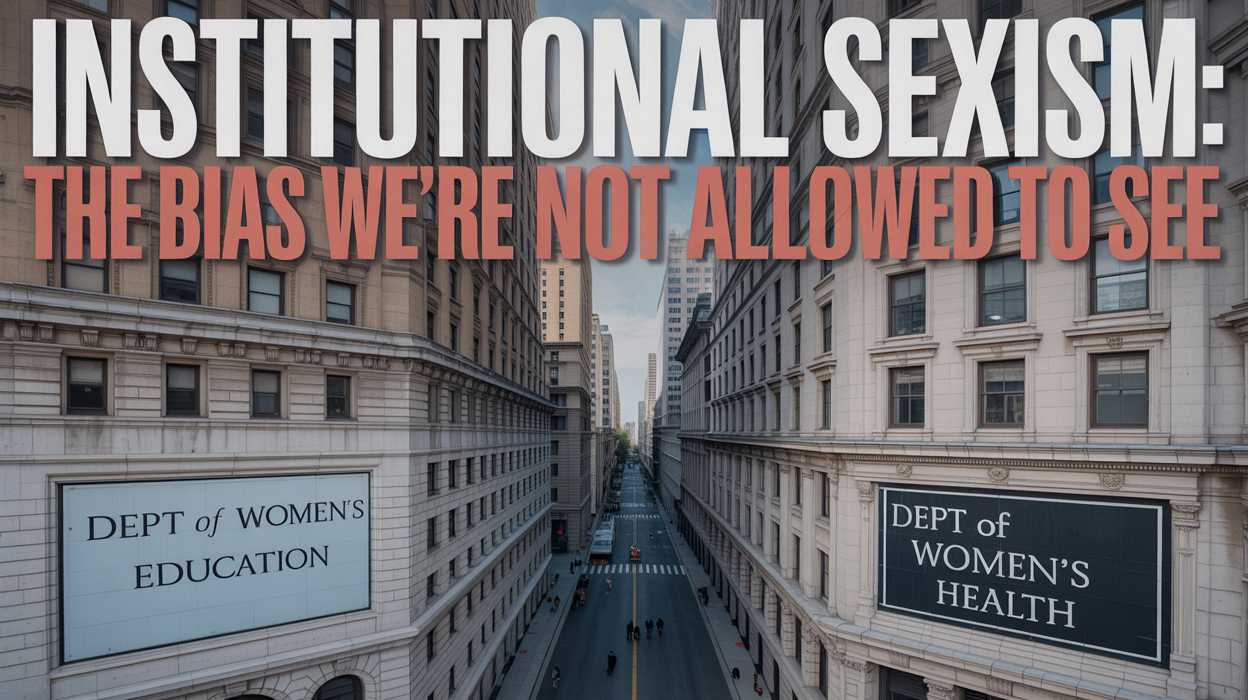
Institutional Sexism: The Bias We’re Not Allowed to See
For half a century, the term institutional sexism has been used as a club — a way to shame or reform male-dominated systems accused of disadvantaging women. Universities built entire departments around it. Governments shaped funding priorities by it. The media repeated it like a moral mantra: if women lag anywhere, it must be because the system is rigged against them.
But what if we’ve been looking in the wrong direction?
The deeper irony is that institutional sexism is real — just not the way we’ve been taught to see it. Across education, mental health, family courts, criminal justice, and even public health, there are consistent, measurable biases that disadvantage men and boys. Yet these are ignored or rationalized away under a powerful cultural assumption: that sexism only flows one way.
It’s a peculiar blindness, one that reveals how moral reflexes — not data — often shape our perception of fairness. The same academics and policymakers who tell us to “follow the evidence” become strangely incurious when the evidence points toward male disadvantage. The result is a quiet but pervasive structural bias, woven through the institutions that claim to serve us all.
We can see it most clearly in the places where boys and men come into early contact with those institutions: schools, courts, and the helping professions.
1. The Invention of “Institutional Sexism”
The phrase institutional sexism was born out of the same sociological moment that gave us institutional racism. In the late 1960s, civil rights thinkers like Stokely Carmichael and Charles V. Hamilton argued that prejudice wasn’t just about individual bigots — it was about systems that favored one group over another, often invisibly.
Feminist theorists quickly applied that framework to gender. Books like The Female Eunuch and The Second Sex were reinterpreted through the new structural lens: patriarchy, male privilege, and institutional sexism were said to keep women in subordinate roles regardless of men’s intentions.
In principle, this was a useful insight. Systems do create patterns that individuals may not see. But in practice, the analysis hardened into dogma. “Institutional sexism” became a one-way accusation — never a tool for understanding the whole picture.
No one asked whether those same systems might, in some areas, evolve to favor women. After all, institutions don’t have consciences; they reflect the moral winds of their time. As society began to view women as a protected class and men as a potential threat, those winds shifted. Institutions followed — first in tone, then in policy.
Today, half a century later, nearly every major Western institution — from education to healthcare to media — operates under an implicit assumption of female moral priority. And yet we still use the same 1970s vocabulary, as if men were the default oppressors.
If the sociologists of that era were alive today, they might recognize what has happened: the frame they built to expose bias has itself become biased.
2. Education: The First System to Tilt
If we want to see institutional sexism in action, we need look no further than our schools.
Over the past four decades, classrooms have quietly become ground zero for male disadvantage. The gender gap that once concerned feminists has flipped — and then some. Boys now lag behind girls in virtually every measure of educational success: reading proficiency, GPA, graduation rates, and college enrollment. Yet almost no one calls this an emergency.
The data are unambiguous. By fourth grade, boys are already behind in reading and writing. By high school, they make up two-thirds of the students at the bottom of the class. In college, women earn roughly 60% of degrees, a gap wider than the one that once favored men in the 1970s.
But what’s driving this? The answer lies partly in who’s teaching. Roughly three out of four teachers in primary and secondary education are women. Research by economists like Camille Terrier and David Card has found that female teachers are more likely than male teachers to grade boys lower than their standardized test scores predict — a clear sign of unconscious bias. The same studies show that this bias is strongest in language arts, where subjective grading plays a larger role.
A boy who scores well on a standardized exam might receive a lower classroom grade simply because his behavior or communication style doesn’t align with a teacher’s expectations — expectations shaped by feminine norms of cooperation, compliance, and verbal expression.
Add to this the way schools have restructured around emotional safety and verbal processing — sitting still, group sharing, and “feelings-based” pedagogy — and the institutional disadvantage deepens. We’ve built an educational environment that rewards traits more common in girls, then pathologizes boyish energy as “disorderly” or “defiant.”
A few years ago, psychologist Michael Thompson remarked that schools have become places where “boys’ physicality is seen as a problem to be managed.” He’s right. In many classrooms, a boy’s natural movement, competitiveness, or risk-taking is treated not as developmental difference but as moral failing.
And so the system disciplines rather than accommodates him. Boys are far more likely to be suspended, expelled, or diagnosed with behavioral disorders — outcomes that compound over time. Yet the institutional response is always the same: create more programs to “help girls.”
That’s not compassion. That’s ideology.
When researchers and journalists discuss these trends, they rarely use the language of institutional sexism. They speak instead of “engagement gaps” or “learning style differences.” The vocabulary of bias suddenly disappears the moment it might implicate institutions as anti-male.
But the logic is exactly the same as the one used to define systemic discrimination against women: when a group’s consistent disadvantage stems from the structure and norms of an institution, that’s systemic bias — whether it favors women or men.
By every honest standard, our education system fits that definition.
Men Are Good