




MenAreGood
MenAreGood is a channel for men, boys, fathers, new fathers, grandfathers and women who want to learn about men and masculinity.  Are you tired of the false narrative of toxic masculinity?  Did you know there is a huge amount of research that shows the positive aspects of men, boys and fathers?  That is what we focus on here, being a source of good information and also a place to connect.   Join us!
Interested? Want to learn more about the community?
May 06, 2022
Fathers Are Essential: The Oxytocin Connection

Tom looks at how father's are essential and examines one research study that shows there is a biological connection to the ways mothers and fathers interact with their children. Oxytocin pushes women towards a more nurturing stance while the same hormone, oxytocin, pushes men into an active and play oriented connection. All the while the status quo tells us that men need to be more like women. Nope. Men need to be more like men! Men are good.

The Life of Dad - by Oxford researcher Dr Anna Machin
https://amzn.to/3J0PzGj

00:03:58
Interested? Want to learn more about the community?
What else you may like…
Videos
Podcasts
Posts
Articles
December 20, 2025
Bias Against Men and Boys in Mental Health Research

This video is a summary of the three studies we have examined the last three Saturdays. It’s a brief and relaxed look at the high points of those articles. Here’s a summary:

This video examines a pattern I’ve seen repeatedly in psychological research: when data complicates the familiar story of men as perpetrators and women as victims, the data about boys and men often disappears. Using three real studies—on teen dating violence, reproductive coercion, and “masculine norms”—I walk through how boys’ suffering is minimized, misrepresented, or erased as research moves from full reports to media headlines and public policy. What emerges is not just sloppy science, but a troubling bias that shapes how we see boys, men, and masculinity itself.

00:10:31
November 19, 2025
The Relentless War on Masculinity

Happy International Men's Day! It's a perfect day to acknowledge the relentless war on masculinity? Here we go!

In this video I sit down with four people I deeply respect to talk about a book I think is going to matter: The Relentless War on Masculinity: When Will It End? by David Maywald.

Joining me are:

Dr. Jim Nuzzo – health researcher from Perth and author of The Nuzzo Letter, who’s been quietly but steadily documenting how men’s health is sidelined.

Dr. Hannah Spier – an anti-feminist psychiatrist (yes, you heard that right) and creator of Psychobabble, who pulls no punches about female accountability and the mental-health system.

Lisa Britton – writer for Evie Magazine and other outlets, one of the few women bringing men’s issues into women’s media and mainstream conversation.

David Maywald – husband, father of a son and a daughter, long-time advocate for boys’ education and men’s wellbeing, and now author of The Relentless War on Masculinity.

We talk about why David wrote this book ...

01:05:19
November 17, 2025
Cancel Culture with a Vengeance

Universities and media love to brand themselves as champions of free speech and open debate. But what happens when those same institutions quietly use legal tools to gag and erase the very people who challenge their orthodoxies?

In this conversation, I’m joined by two of my favorite thinkers, Dr. Janice Fiamengo and Dr. Stephen Baskerville, to dig into a darker layer beneath “cancel culture.” We start from the case of Dr. James Nuzzo, whose FOIA request exposed a coordinated effort by colleagues and administrators to push him out rather than debate his research, and then go much deeper.

Stephen explains how non-disclosure agreements, non-disparagement clauses, and mandatory arbitration have become a hidden system of censorship in universities, Christian colleges, and even media outlets—silencing dissenters, shielding institutions from scrutiny, and quietly stripping people of their practical First Amendment rights. Janice adds her own experience with gag orders and human rights complaints, and ...

00:57:23
February 07, 2023
The Way Boys Play and the Biological Underpinnings

My apologies for the last empty post. My mistake. Let's hope this one works.

Tom takes a stab at using the podcast function. Let's see how it goes.

The Way Boys Play and the Biological Underpinnings
May 13, 2022
Boys and Rough Play

This is a short excerpt from Helping Mothers be Closer to their Sons. The book was meant for single mothers who really don't know much about boy's nature. They also don't have a man in the house who can stand up for the boy and his unique nature. It tries to give them some ideas about how boys and girls are different. This excerpt is about play behaviors.

Boys and Rough Play

A Gay woman explaining women and its very insightful!

https://www.facebook.com/share/v/1FJbbqPRde/?mibextid=wwXIfr

It’s sad that it’s is this way. But she is right.

She is right and it’s going to happen

12 hours ago
post photo preview
A Quiet Thank You to Men, Today
Merry Christmas!


A Quiet Thank You to Men, Today

Today isn’t a day for debate.
It’s a day for gratitude.

So I want to pause and offer a quiet thank you to men — especially the ones who are easy to overlook.

To the men who showed up quietly.
Who didn’t announce their presence or demand recognition.
Who simply did what needed to be done.

To the men who carried financial stress without complaint.
Who worried in silence about providing, about bills, about futures — and still tried to keep the mood light for everyone else.

To the men who fixed, drove, cooked, shoveled, assembled, paid, and planned.
Who solved problems behind the scenes so the day could feel smooth and warm for others.

To the men who swallowed loneliness so others could feel joy.
Who sat at the edge of gatherings, or weren’t invited at all, yet still sent gifts, made calls, or showed kindness where they could.

To the men who didn’t get thanked — and didn’t expect to.

And today, I also want to acknowledge men who carry heavier, quieter burdens.

Men who have been falsely accused, and discovered how quickly the world can turn away from them.
Men who have been divorced and still worked relentlessly to father their children in a hostile environment, where their love was questioned and their access was constrained.
Men who have felt dejected and misunderstood, not because they lacked care or effort, but because the story told about them left no room for their humanity.

Men who have been trying — sometimes desperately — to do the right thing in systems that seemed stacked against them.

Men whose goodness has gone unnamed.

Christmas has a way of highlighting what is visible — gifts, decorations, smiles — but it often misses what is held. The restraint. The responsibility. The endurance. The quiet decision to keep going.

So today, this is simply a thank you.

Thank you for the ways you show love through action.
Thank you for the strength that doesn’t ask to be admired.
Thank you for the steadiness that makes joy possible for others.

You matter. Your efforts count.

Men have always mattered — today is a good day to say it out loud.

Merry Christmas.  Men Matter. Men Are Good.

Read full Article
December 22, 2025
post photo preview
What Men Bring to Christmas


Women are often the heartbeat of the social side of Christmas — the cards, the gatherings, the baking, the presents, the details that make everything glow. But what men bring to Christmas is just as essential, even if it’s quieter and less visible.

Men bring structure. They’re the ones hauling the tree, hanging the lights, fixing what’s broken, driving through the weather, making sure there’s wood for the fire and fuel in the car. They create the framework that holds the celebration up — the unspoken foundation that allows everything else to happen.

They bring steadiness. When things get tense or chaotic — when someone’s late, or the kids are bouncing off the walls — it’s often the calm presence of a man that settles the moment. That quiet “it’s all right” energy grounds the room and restores a sense of safety and ease.

They bring tradition and meaning. Many men are the keepers of ritual: the same breakfast every Christmas morning, the drive to see the lights, the reading of ’Twas the Night Before Christmas. Their constancy ties the present to the past. It gives children a sense that they belong to something enduring.

And men bring humor — the kind that doesn’t just entertain but heals. When the wrapping paper piles up or the cookies burn, it’s a man’s grin or a playful remark that resets everyone’s mood. Men’s humor carries wisdom; it says, let’s not take ourselves too seriously. It reminds us that Christmas isn’t about perfection — it’s about joy.

Finally, men bring quiet joy. They find it not in the spotlight but in watching the people they love — a partner’s smile, a child’s laughter, the flicker of the tree in the dark. Their satisfaction is in knowing they helped create that warmth, often without needing credit for it.

When I worked as a therapist with the bereaved, I saw this again and again after a father’s death. Families would describe a subtle shift — not just grief, but a loss of containment. Without dad, things felt looser, more chaotic, less certain. The house might look the same, but the emotional gravity had changed. What they were missing was that quiet, stabilizing force men bring — the invisible boundary that holds the family together without needing to be named.

It’s one of the paradoxes of men’s contribution: you don’t notice it when it’s there, only when it’s gone.

Women make Christmas sparkle, but men make it stand. Together they form the harmony that makes the season whole — love expressed in different languages, both necessary, both beautiful.

Read full Article
December 18, 2025
post photo preview
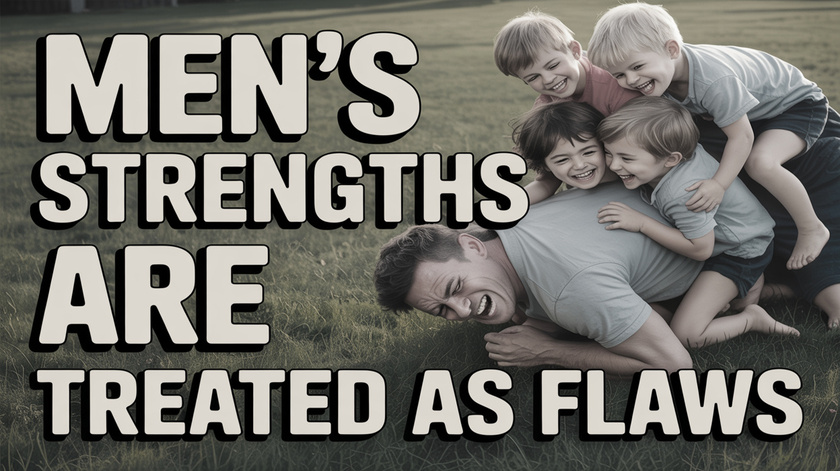
Men's Strengths Are Treated as Flaws
Why the Masculine Way Keeps Getting Misunderstood


Why the Masculine Way Keeps Getting Misunderstood

I’ve been thinking lately about men and the quiet burden they carry in today’s world.
Not just the obvious burdens — responsibility, provision, protection — but something deeper and harder to name.

It’s the burden of being misunderstood in the very places where men are strongest.

And I don’t mean misunderstood in a poetic way. I mean misinterpreted, pathologized, and often dismissed — simply because men do things differently than women.

You see this most clearly with emotions. Men have a distinct, consistent way of handling feelings. It’s not random, and it’s not a flaw — it’s a pattern rooted in biology, social roles, and testosterone. But rather than recognizing these differences, the modern lens tends to treat the male way as “deficient.”

Women talk to process.
Men act or withdraw to process.

Women regulate through expression.
Men regulate through doing.

Yet the male way is almost never acknowledged as legitimate. Instead, it’s measured against a female template — and found wanting.

And once you see this pattern, you start noticing it everywhere.


1. Emotional Life: Men as “Defective Women”

We tell men that their way of dealing with emotion is wrong. Not just different — wrong.

When men get quiet, we call it “shutting down.”
When they problem-solve as a way to soothe themselves, we call it “fixing instead of feeling.”
When they regulate through solitude, we call it “avoidance.”

In other words, men are told they’re unhealthy if they don’t process emotions like women.

The absurdity is breathtaking: the male way of processing emotion works — and has worked across millennia. But because it doesn’t resemble the female way, it’s treated as defective.


2. Fatherhood: The Strengths That No One Sees

The same pattern shows up in fatherhood.

Fathers do certain things instinctively:

  • Rough-and-tumble play

  • Boundary-setting

  • Encouraging independence

  • Pushing challenge and risk in manageable doses

All of these have strong empirical backing as enormously beneficial for children, especially boys.

But fathers rarely get credit. Instead, their natural strengths are reframed as:

  • Too rough

  • Too distant

  • Not nurturing enough

  • Not “tuned in”

  • Toxic

Meanwhile the mothering style — relational, verbal, protective — becomes the default standard, and fathering is viewed as a flawed version of mothering.

But fathering isn’t “mom minus something.”
It’s a different, vital system.


3. Communication: Male Directness Pathologized

Men tend to speak more directly.
Shorter sentences.
Less emotional detail.
More focus on solutions, hierarchy, and efficiency.

This is not inferior communication — it’s optimized communication for male social structure and cooperation.

But in mixed-sex environments it’s often framed as:

  • Cold

  • Abrupt

  • Lacking empathy

  • Emotionally immature

Men’s communication works beautifully in the settings it evolved for — teams, tasks, crisis response, collaboration. But again, the female style becomes the gold standard, and the male style becomes the pathology.


4. Stress Responses: Women “Tend and Befriend,” Men “Fight, Focus, and Fix”

Shelly Taylor described how women handle stress: connect, talk, seek support.

Men, however, tend to:

  • Narrow their focus

  • Move toward action

  • Systemize

  • Get quiet

  • Scan for solutions

This is not emotional deficiency — it’s biology. Testosterone, competition, and precarious manhood all channel men toward action in the face of stress.

And these responses are what make men effective in crisis-intensive fields: firefighting, military, surgery, rescue work, engineering, construction.

But instead of recognizing this, the male stress response is labeled as repression.

Again: men measured by a female template.


5. Moral Psychology: Duty Recast as Toxicity

Men have a moral framework built around:

  • Duty

  • Sacrifice

  • Responsibility

  • Endurance

  • Protection

These are profoundly other-focused values — the moral foundation that keeps families and communities standing.

And yet today, we reframe these as:

  • Stoicism = unhealthy

  • Duty = patriarchy

  • Provision = control

  • Protection = toxic chivalry

The very virtues that once held society together have become targets.


6. Male Social Structure: Hierarchies Seen as Oppression

Male friendship and bonding grow out of:

  • Shared tasks

  • Friendly competition

  • Banter

  • Hierarchies based on competence

  • Cooperative shoulder to shoulder action

These are healthy, functional systems.

But modern culture calls them:

  • Bullying

  • Toxic

  • Aggressive

  • Immature

  • Exclusionary

Even hierarchies — which men rely on to keep group conflict down — are reframed as power structures that must be dismantled.


7. Male Sexuality: Normalized for Women, Pathologized for Men

Women’s sexuality is described as relational, emotional, expressive.

Men’s is described as:

  • Dangerous

  • Primitive

  • Immature

  • Objectifying

Men’s sexual wiring — visual, compartmentalized, spontaneous — is treated as a moral failing rather than a normal biological pattern.

Once again, the female pattern is the normative human pattern.
The male pattern is a deviation from health.


The Pattern Underneath It All

Here’s the core insight:

Any domain where men differ from women is reinterpreted as a domain where men are deficient.

If women communicate one way, that becomes the “healthy” style.
If women grieve one way, that becomes the “healthy” style.
If women bond one way, that becomes the “healthy” style.
If women parent one way, that becomes the “healthy” style.

Men become defective humans rather than fully developed men.

This is gynocentrism at its quietest but most powerful: the female mode becomes the normative template for being a good person, a good partner, a good parent, even a good human.

And anything that lies outside that template is viewed as suspect.


Why This Matters

Because men internalize it.
They feel awkward, confused and even ashamed of the very strengths that once grounded them.

  • The father who plays rough feels judged.

  • The man who gets quiet under stress feels broken.

  • The husband who solves problems instead of emoting feels scolded.

  • The young boy who competes or wrestles is told he’s aggressive.

  • The man who expresses duty is told he’s part of a system of oppression.

The message is everywhere:

“Be less of yourself.”
“Do it the women’s way.”
“Your instincts are suspect.”
“Your strengths are flaws.”

And the result?
Men stop trusting their nature.
And when men distrust their nature, they lose their anchor.

And we all lose something essential.


But Here’s the Truth

Men’s ways are not just legitimate.
They are necessary.

For families.
For communities.
For society.
For children.
For order and safety.
For stability.
For love.

We don’t need men to be more like women.
We need men to be fully and unapologetically men — and to be recognized for the good they bring.

And that starts with saying clearly and without hesitation:

Men’s ways aren’t deficiencies.
They’re strengths — and we should honor them.

Men Are Good!

Read full Article
See More
Available on mobile and TV devices
google store google store app store app store
google store google store app tv store app tv store amazon store amazon store roku store roku store
Powered by Locals