



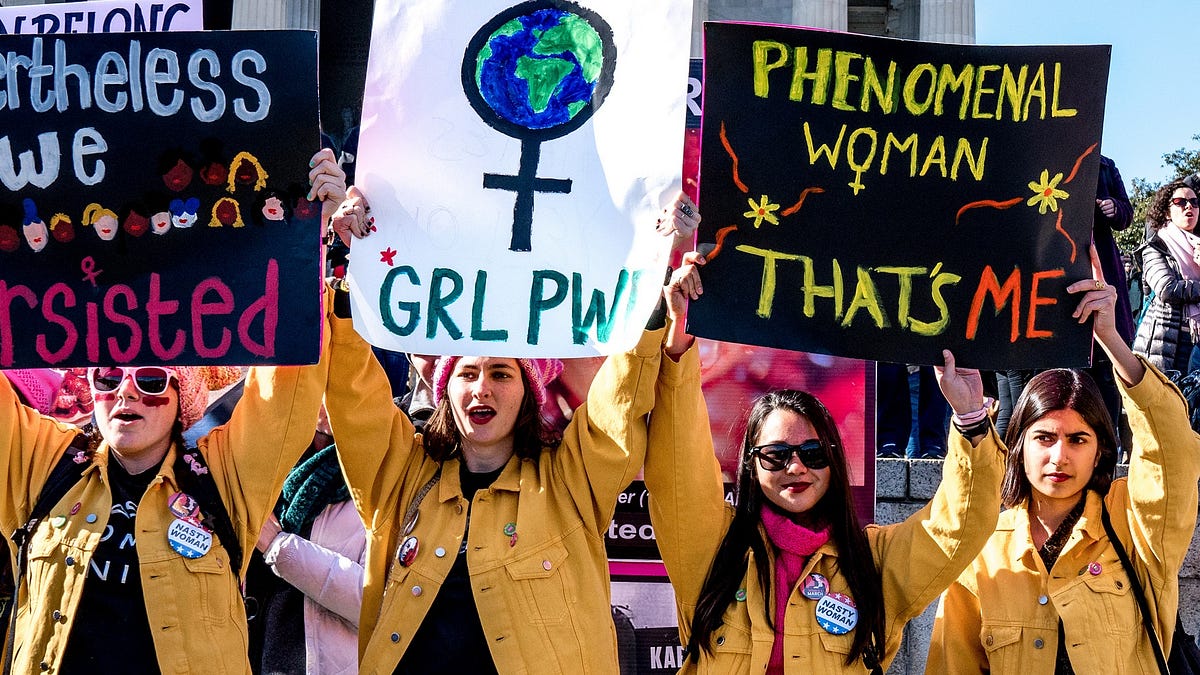
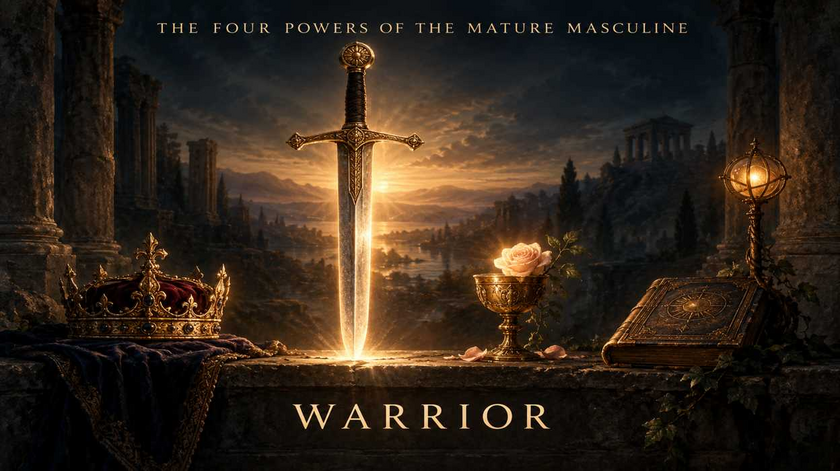
A note from Tom - Moore’s work is especially important today because so much contemporary discussion of masculinity begins—and often ends—with its shadow side. Feminist theories have given us an increasingly thin picture of men, rich in criticism but poor in any understanding of mature masculine strength. Moore never denied masculinity’s capacity for violence, domination, and destructiveness; he simply understood that these distortions cannot be comprehended without also recognizing the healthy power from which they have fallen.
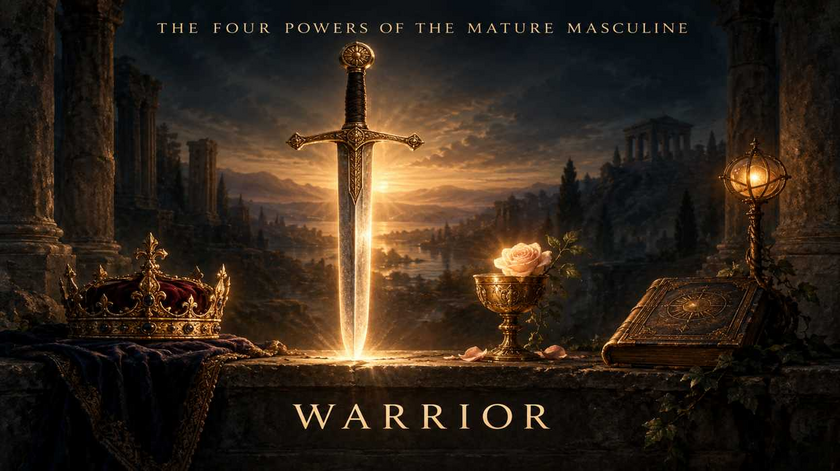
Of Robert Moore’s four masculine archetypes, the Warrior may be the easiest to not understand.
We hear the word and think of violence. We picture a soldier, a prizefighter, an action hero, or perhaps a swaggering man eager to prove that he is tougher than everyone around him. In our current culture, the Warrior is often treated as the embarrassing remnant of an earlier masculinity—something primitive that civilized men should learn to suppress.
Moore believed that this was a serious mistake.
The Warrior is not simply the part of a man that can fight. It is the capacity to act, to endure, to remain loyal, to protect a boundary, to organize resources, to distinguish what matters from what does not, and to place one’s strength in service to something larger than oneself.
Violence is one possible expression of Warrior energy, but it is not its essence. In fact, the man most eager to use force may be possessed by the Warrior rather than mature in it. And the man who insists that he has no aggression may be no safer. His sword has not disappeared. It has simply gone underground.
Moore’s central insight could be put this way:
The mature Warrior is not the violent man. He is the man who has acknowledged his capacity for force, brought it under conscious discipline, and placed it in service to something beyond himself.
The dangerous man is often the one who either worships the sword or insists he has no sword at all.
There Are No Freelance Warriors
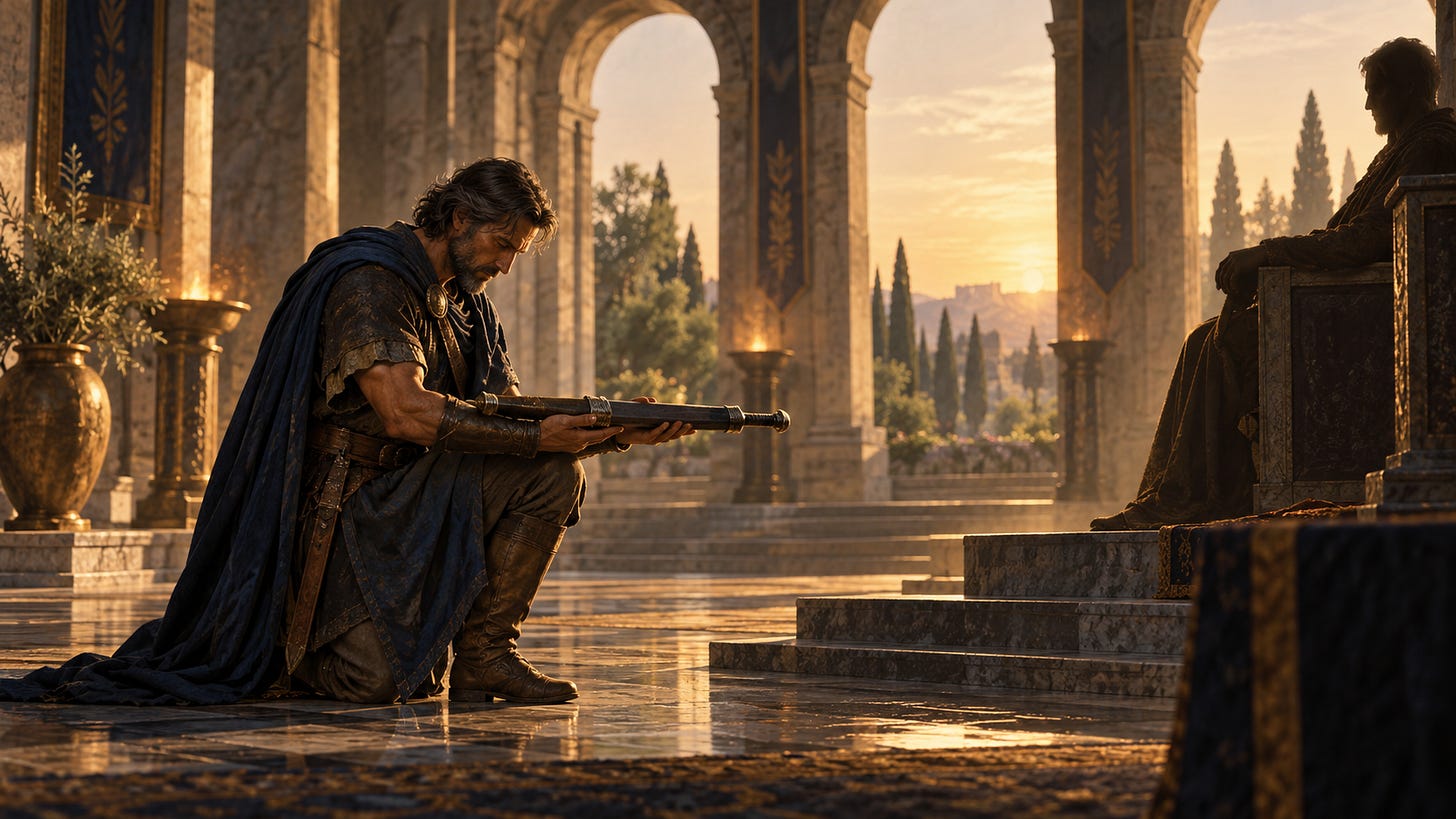
In a previous post, I explored Moore’s understanding of the King. The King creates order, accepts responsibility, blesses life, and establishes the values of the realm.
The Warrior serves that order.
That relationship is crucial. Warrior energy by itself does not know whether a cause is just. It knows how to identify an enemy, formulate a strategy, accept hardship, mobilize resources, and attack an objective. Those capacities can protect a child or terrorize one. They can defend a community or destroy it. The Warrior supplies power, but it cannot by itself decide what that power should serve.
That is the King’s task.
Moore said that there can be mercenaries without a King, but there can be no true Warriors. The mercenary may be highly skilled. He may be brave, disciplined, and effective. But he fights for money, status, excitement, or whoever happens to be paying. The mature Warrior serves a moral order: a community, a sacred obligation, the vulnerable, the future, or a vision of justice larger than his own appetite.
This is one reason Warrior energy cannot be understood simply as aggression. The mature Warrior does not ask only, “Can I win?” He asks, “Whom do I serve? What am I protecting? Under what authority do I act? What will I refuse to do, even to an enemy?”
Power becomes mature when it kneels.
The Sword Is a Responsibility
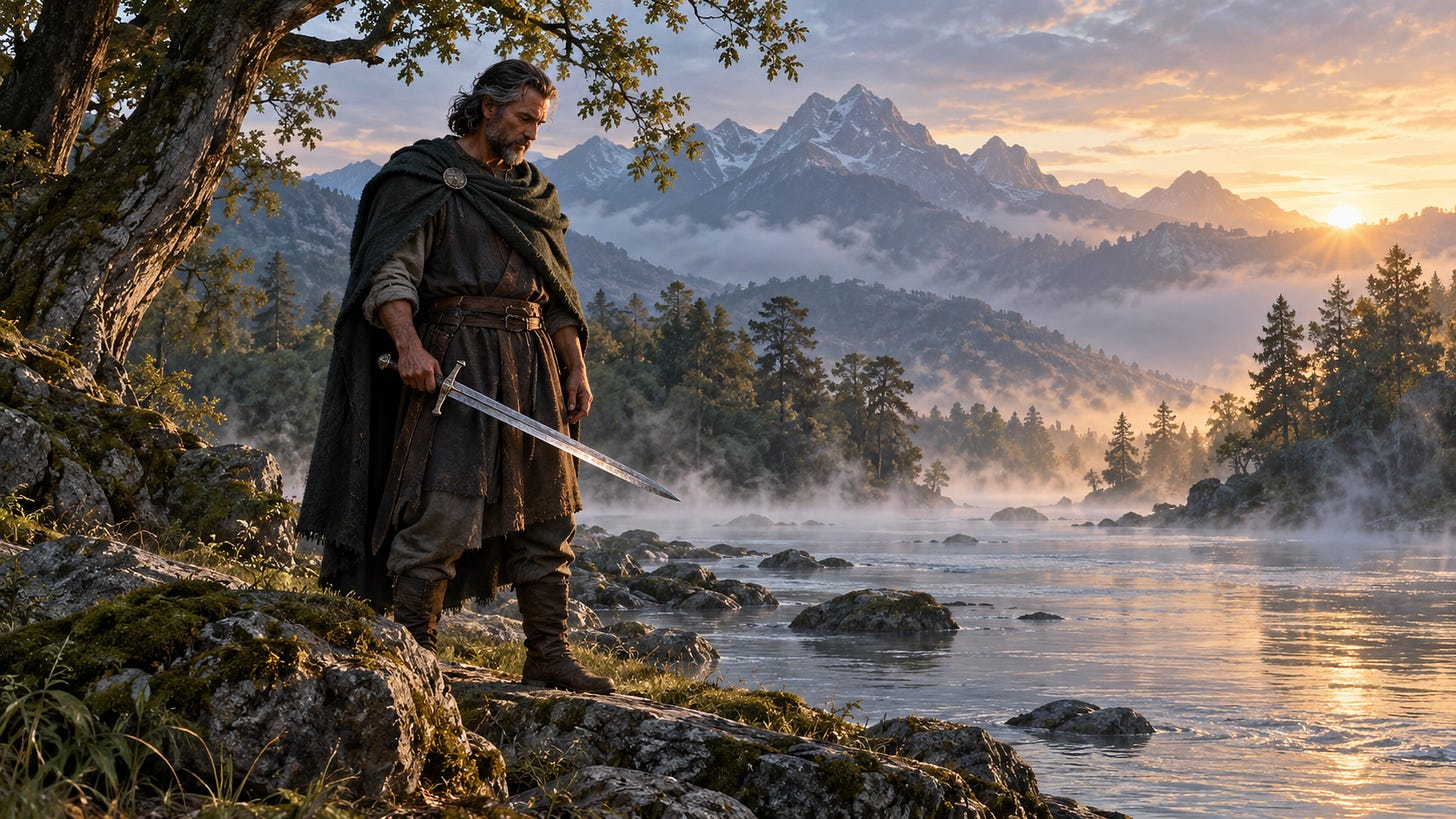
Moore spent considerable time discussing the symbolism of the sword.
The sword represents potency, discrimination, and the ability to cut through confusion. It separates one thing from another. It says yes to this and no to that. It establishes a boundary and makes action possible.
But in the traditional ceremony of knighthood, the candidate does not merely seize the sword and begin swinging it. He kneels beneath it. The sword touches him before he carries it.
This means that the Warrior comes under the authority of the sword. His power is governed by a code. He accepts responsibility for how it will be used and what must never be done with it.
The mature Warrior knows that he can cause harm. He does not pretend to be harmless, nor does he advertise his dangerousness in order to frighten others. His power is acknowledged, visible, disciplined, and accountable.
Moore contrasted the sword with the dagger. The sword is openly carried. The dagger is concealed.
The dagger belongs to the person who says, “I am not angry. I would never hurt anyone. I have no interest in power.” Yet the blade appears through sarcasm, procrastination, chronic criticism, manipulation, helplessness, gossip, obstruction, or the perfectly timed wound delivered from behind.
Just because a person does not show a sword does not mean there is no blade.
Denied aggression does not become love. It becomes unconscious aggression.
Permission to Be Powerful
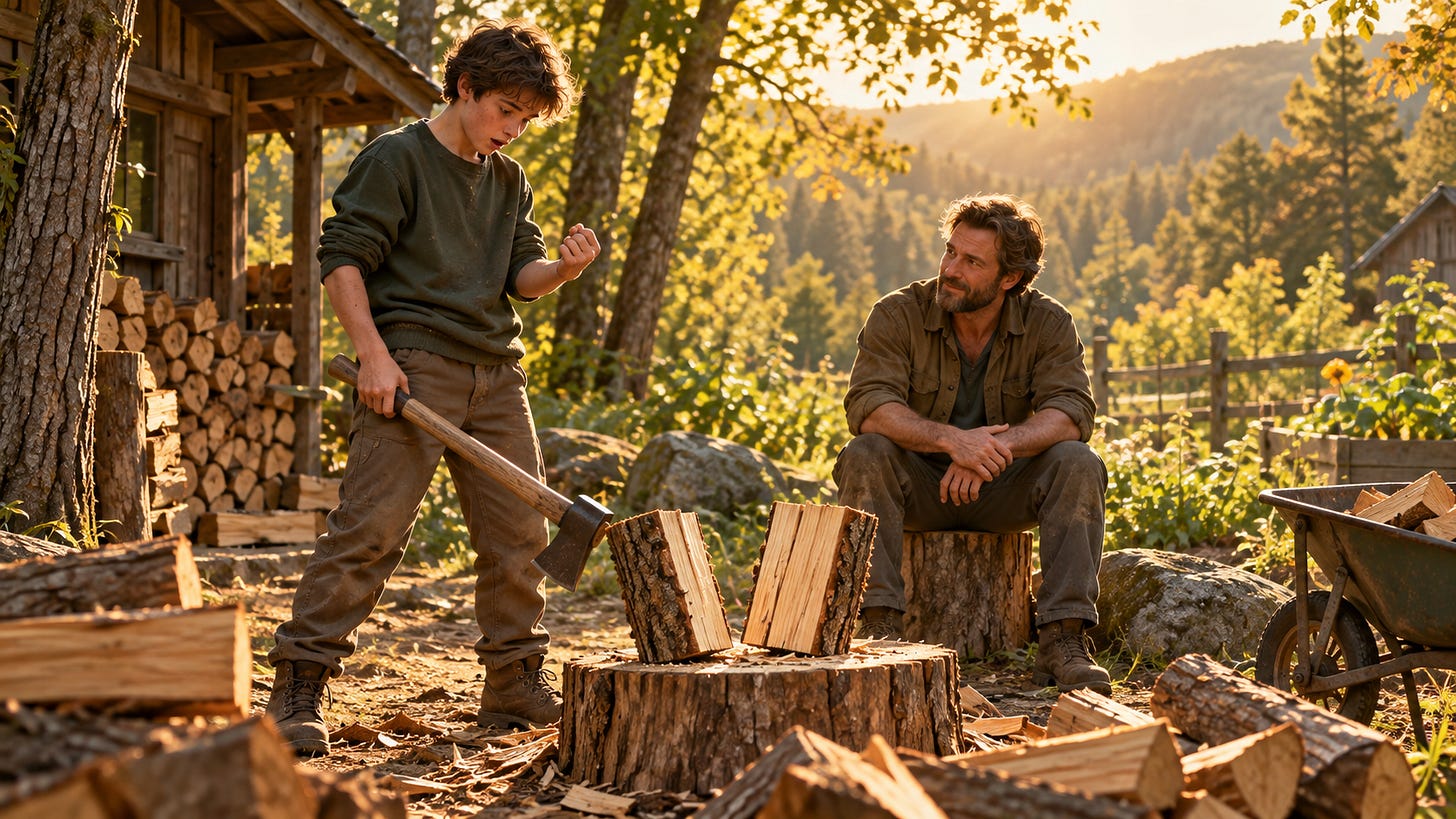
For a boy to develop a healthy relationship with his strength, he needs more than warnings about what not to do. He needs permission to be powerful.
That permission does not mean, “Do whatever you want.” It means, “Your strength is real. It is welcome. It has a place. Let us help you learn what it is for.”
Moore saw the father’s response to the son’s growing power as enormously important. The mature father does not shame the boy for his energy or become threatened when the boy begins to surpass him. He is pleased by the son’s increasing strength. He draws him close, lets him admire, and eventually helps him place that power under discipline and moral purpose.
The shadow father does something very different. He mocks the boy’s awkwardness, treats his energy as dangerous, competes with him, or crushes him before his adult capacities have had time to form. Moore told of a shy, thin adolescent whose father ridiculed his emerging masculinity. The boy later grew into an impressive man, but the wound remained. The father had attacked the unfinished form of something that needed encouragement and time.
Moore pointed to Bull Meechum, the domineering Marine father in Pat Conroy’s The Great Santini, as a vivid portrait of this shadow father. Meechum is a formidable military man—competent and commanding—but emotionally he remains a boy. He can drill, compete, and dominate, but he cannot welcome his son’s emerging strength or bless him as he comes into manhood. What appears to be mature masculinity is largely an impressive uniform wrapped around an uninitiated personality.
A boy who never receives permission to be powerful may grow into a man who fears his own strength. He may become excessively compliant, wait for others to decide, or apologize whenever he takes up space. He may also be vulnerable to sudden eruptions of rage because the Warrior, excluded from ordinary consciousness, returns in a primitive form.
Or he may find someone else to carry his Warrior for him.
The Warrior We Give Away
Moore was particularly good at showing how disowned power becomes projection.
A person who cannot say no may attach himself to someone who says no cruelly. A man who cannot act may idolize a strongman who promises to act for him. A dependent person may wait for a rescuer. A rescuer may go looking for a helpless person and an abusive villain so he can play Sir Galahad. A grandiose leader may surround himself with loyal knights willing to sacrifice themselves for his cause.
In each case, Warrior energy is present. It simply has not been claimed consciously.
This is why Moore refused to define Warrior pathology only as “too much aggression.” Too little conscious Warrior can be equally destructive.
The person who continually says “I can’t” may be projecting agency onto everyone around him. The compulsively nice person may secretly admire people who intimidate and dominate. The chronic complainer has enough Warrior energy to carve at the world but not enough to do anything constructive about it.
Moore’s observation was delightfully blunt: people who complain a great deal often do very little.
Passive aggression is Warrior energy trying to enter through the basement. Procrastination, deliberate incompetence, obstruction, and overcompliance allow a person to attack while preserving the belief that he is innocent.
Imagine a therapist asking a compulsive client to bring in some dreams. The following week the client arrives with forty-two of them. He has obeyed perfectly—and buried the therapist beneath the obedience. The dagger has struck, but no one can accuse him of failing to cooperate.
The healing task is not to make such a man more aggressive. It is to help him become direct.
The Capacity to Act
At its most ordinary and necessary, the Warrior is the part of us that gets things done.
It makes a plan. It identifies the next step. It organizes time and resources. It accepts discomfort. It gets out of bed, makes the telephone call, confronts the problem, keeps the appointment, protects the child, finishes the work, and stays faithful when novelty has disappeared.
The Lover may bring two people together, but the Warrior helps them keep their vows. Attraction is not fidelity. Feeling deeply is not the same as remaining present when a relationship becomes difficult.
The same is true of vocation. Many people can imagine, study, discuss, analyze, worry, and wait. The Warrior acts.
Moore described clients who could spend months exploring their dreams without ever asking what they should do. He began deliberately making room for that question. And he discovered something remarkably practical: people usually already knew.
They knew the conversation they needed to have, the habit they needed to stop, the application they needed to submit, the boundary they needed to set, or the task they had been avoiding. What they lacked was not information. They lacked access to the energy required to act upon it.
Therapy, at that point, could create a space in which the person named the action and received support for the Warrior as he began to do it.
That fits closely with what I have seen in working with men. Insight matters, but insight often needs somewhere to go. Many men begin to move when suffering can be translated into a task—not because action replaces feeling, but because meaningful action gives feeling a form.
The Warrior’s Anesthesia
Warrior energy carries its own anesthesia.
In battle, crisis, emergency, or sustained effort, that can be lifesaving. The Warrior allows a person to continue despite fear, pain, fatigue, and injury. A firefighter cannot stop in the burning building to process every emotion. A father protecting his family may need to act before he has time to feel. A surgeon, police officer, soldier, or trauma worker may temporarily set aside his own reactions in order to do what the situation requires.
But the Warrior does not know when enough is enough.
Moore joked about tanks advancing across the plain until they ran out of gasoline. It is a wonderful image of the workaholic life. The campaign is impressive, the objective is clear, and the forces keep moving—but no one has checked the fuel gauge.
When Warrior energy dominates a personality, a man may not feel tired when he is tired. He may not know he is wounded. He may continue working, fighting, producing, and enduring long after his body or relationships have begun to break down.
The Warrior is not designed to tend the wound. The Magician can recognize it. The Lover can feel it. The King can decide that the welfare of the realm requires rest, repair, or retreat. But the Warrior alone knows only the mission.
This is why Moore never intended any archetype to stand by itself. The pure Warrior is not a complete man. He is a magnificent and terrifying machine.
In Part Two, we will follow Moore’s Warrior through the white, red, and black knights—then examine the Warrior’s relationship to enemies, shadow, admiration, and the difficult passage from raw power to mature service.
Men Are Good.