


When Men’s Grievances Become a Public Health Threat
The Lancet acknowledges men’s suffering, but what happens when men question the causes of that suffering?
In a remarkable article published October 29, 2026, in The Lancet, one of the world’s most prestigious medical journals, authors Sarah Hawkes and Kent Buse make this extraordinary claim:
“The manosphere, a diffuse commercial ecosystem and loose collection of online communities united by shared beliefs about masculinity, misogyny, and male victimisation, is an under-recognised determinant of health harms.”
Think about that. The manosphere is now being described as a public-health harm. Not just a collection of websites where men talk about their problems, but something that supposedly damages people’s health. And as we will see, the authors make this claim while admitting that they have very little solid evidence that the manosphere actually causes these harms.
Something interesting is happening in the way our institutions respond to the problems facing boys and men. For decades, these problems were largely ignored. Boys fell behind in school. Men died by suicide at dramatically higher rates than women. Fathers struggled with family courts and separation from their children. Male victims of domestic violence often found little help. Yet these problems rarely received the attention given to similar difficulties facing women and girls.
But things are changing. The problems facing boys and men have become too obvious to ignore. There is simply too much evidence, and too many people are talking about it.
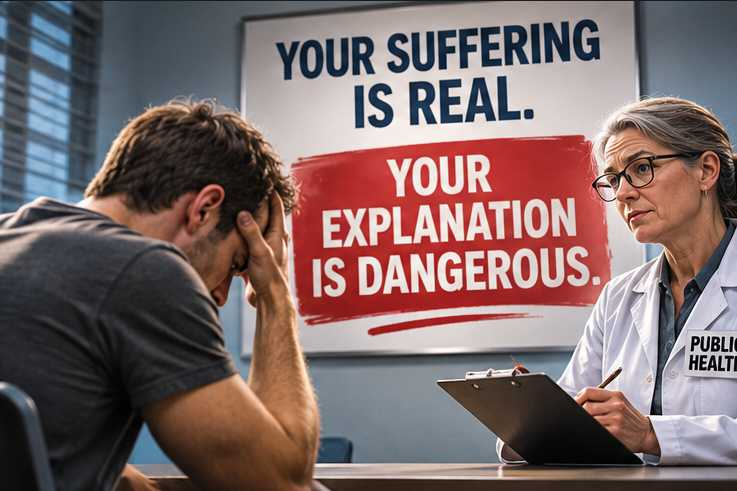
So what happens now? Instead of ignoring men’s problems, institutions are beginning to acknowledge them. But there’s a catch. They seem quite willing to recognize that men are suffering, as long as men don’t question the accepted explanations for that suffering.
The Lancet article is a perfect example. The authors acknowledge boys’ educational difficulties, men’s loneliness, economic insecurity, and social isolation. These are real problems, and the authors recognize them. But when men suggest that feminism or institutional discrimination might have something to do with these problems, things change.
The authors say that misogyny, or hatred of women, is what unites the manosphere. But they also identify criticism of feminism as one of its defining beliefs. This raises a troubling question: Are they treating criticism of feminism as hatred of women? They acknowledge that men have real problems, but when men question whether feminism has contributed to those problems, their complaints risk being treated as part of the very problem the authors want to eliminate.
The article, titled Reframing the manosphere: a public health response to a commercial ecosystem, compares the manosphere to industries such as tobacco. The authors go on to recommend public-health campaigns, government involvement, stronger content moderation, and using algorithms to promote what they consider positive messages.
In other words, they aren’t simply telling us that the manosphere is dangerous. They are proposing ways to change what people see and hear online. And that raises some very serious questions.
They Admit the Evidence Is Scarce
One of the most astonishing passages in the article begins with these words:
“Although rigorous causal evidence is currently scarce”
Read that again. The authors admit that they don’t have much rigorous evidence showing that the manosphere actually causes the harms they are describing.
You might think that would lead them to be cautious. Perhaps they would say more research is needed before reaching conclusions. But that’s not what happens.
Instead, they go on to associate the manosphere with misogyny, violence against women, rape-myth acceptance, sexual aggression, and online harassment. The reader is left with the impression that the manosphere is responsible for a long list of serious problems.
But where is the proof?
Suppose researchers find that men who visit certain websites are more likely to hold negative attitudes toward women. Does that mean the websites caused those attitudes? Or might men who already hold those attitudes be more likely to visit those websites?
Those are two very different possibilities. And there are others. Perhaps men who have experienced rejection, mistreatment, or isolation are drawn to communities where they find people who understand their experiences.
None of this means that genuinely hateful online communities are harmless. But if you are going to claim that something causes a public-health problem, shouldn’t you be able to demonstrate that it actually causes the problem?
Apparently, the authors believe the available evidence is sufficient to begin proposing solutions. And some of those solutions involve regulating what people are allowed to see online.
A “So-Called” Crisis?
The authors describe manosphere communities as being concerned with a “so-called crisis of masculinity.”
Why “so-called”?
That phrase is a subtle way of casting doubt on something without directly denying it. By referring to a “so-called crisis of masculinity,” the authors signal skepticism about the crisis before even examining the evidence.
Boys are struggling in school. Men account for most suicides, workplace deaths, and prisoners. Fathers face serious challenges following family separation, and male victims of violence often struggle to be taken seriously. These problems are real, whether or not someone wants to call them a crisis of masculinity.
The authors also tell us that manosphere communities share the belief that feminism has systematically disadvantaged men.
But what if that belief is true?
Could feminist ideas have influenced policies that disadvantage boys? Could feminist theories of domestic violence have contributed to the neglect of male victims? Could decades of portraying masculinity as toxic or dangerous have affected how boys see themselves?
Why aren’t these possibilities being investigated?
So if you believe feminism has harmed men, does that make you part of a dangerous online movement? Is questioning feminism now evidence of a dangerous ideology?
Men’s Problems Are Real, but Their Explanations Are Wrong
Here is another revealing statement from the article. The authors say that the manosphere redirects blame for men’s problems toward women and feminism rather than the structural and economic forces responsible.
Notice what they are doing.
They acknowledge that men have problems, but they seem quite certain about what is causing them. Economics and social structures are acceptable explanations. Feminism apparently isn’t.
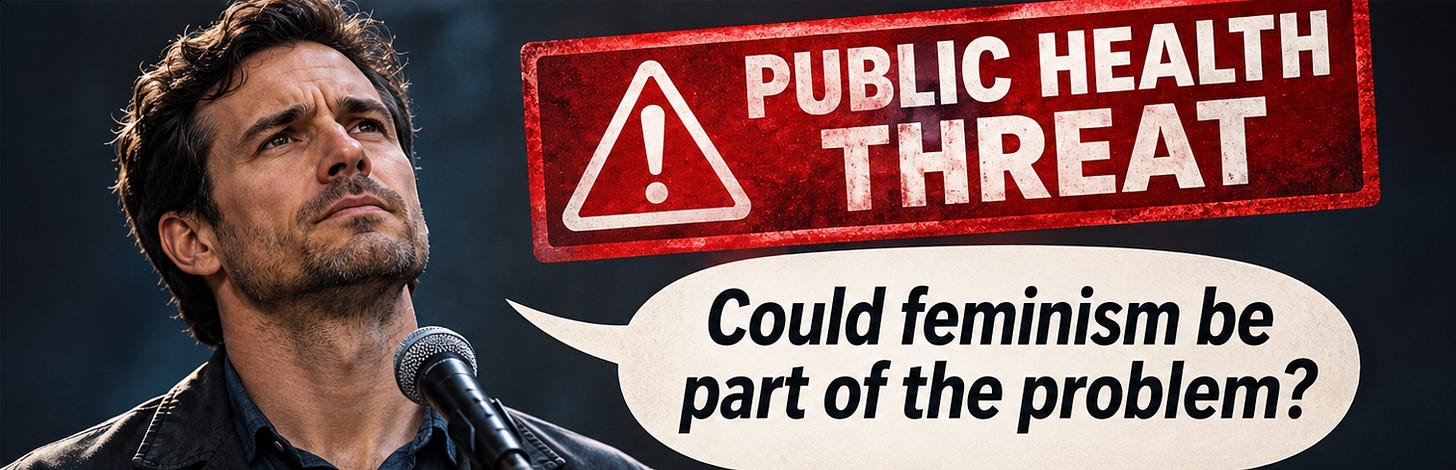
But why can’t feminism be part of those structural forces?
Feminist organizations have influenced laws, government policies, schools, universities, domestic violence services, and the way we think about men and women. These are not minor influences. They are part of the institutions that shape our lives.
Could some of these influences have harmed boys and men? Isn’t that worth investigating?
Of course, blaming women as a group for men’s problems is different from criticizing feminist ideas or policies. But the article does not clearly explain how it separates those two things when discussing the broader manosphere.
And that is a serious problem.
The authors describe men in these communities as trapped in narratives of grievance and hopelessness. But what exactly is wrong with having a grievance?
Women had grievances about discrimination. Black Americans had grievances about segregation. Workers had grievances about unsafe conditions and unfair treatment. Those grievances helped produce important social changes.
Why should men’s grievances be viewed differently?
Surely the question should be whether the grievance is justified, not whether the person expressing it is a man.
Nine Out of Ten People Are Biased Against Women?
Here’s another jaw-dropper.
The authors tell us that nearly nine out of ten people hold at least one fundamental bias against women. That’s an extraordinary number, and it certainly makes the world sound overwhelmingly hostile toward women.
But let’s look at where it comes from.
The source is the United Nations Development Programme’s 2023 Gender Social Norms Index. Researchers used seven measures involving attitudes about political leadership, education, employment, and gender roles. If someone crossed the researchers’ threshold on just one of those measures, that person was counted as having at least one bias against women.
And here’s the part the Lancet authors don’t mention in that passage.
According to the UNDP, approximately 90% of men and 87% of women were classified as holding at least one bias against women.
Yes, you read that correctly. By this measure, almost nine out of ten women also have at least one bias against women.
Does that mean almost every woman is a misogynist?
Of course not. It means the researchers have created a very broad definition of bias. Someone who believes men make better political leaders, or college education is more important to men, or being strongly anti abortion, can each be counted as having at least one bias against women, even though these attitudes are very different and seemingly not so directly connected to bias against women .
The statistic is not made up. But presenting it without explaining what it measures can give readers a very misleading impression. Is this an attempt to frame a narrative or is it just sloppy writing. You be the judge.
And here’s something else worth considering. What would happen if researchers created a similar index measuring negative attitudes toward men?
What percentage of people would be classified as biased against males if they were asked whether men are dangerous, emotionally deficient, less deserving of sympathy, or responsible for society’s problems?
Would we get another enormous number?
We don’t know. But wouldn’t it be interesting to find out?
Even a 2024 UN Women discussion paper recognized important problems with the way gender norms are measured, including unclear definitions and weak links between some measurements and policy recommendations.
The larger point is simple. When researchers present an extraordinary statistic, we need to know exactly what they measured before accepting the story they attach to it.
When Complaining About the System Becomes Suspicious
The authors cite a survey of domestic violence workers who reported that some men expressed ideas associated with the manosphere.
Among those ideas was the belief that the legal system is stacked against men.
Now think about that.
A man complains that the legal system treats men unfairly. Instead of asking whether his complaint might be justified, the researchers include that belief among examples of manosphere-associated thinking.
What if the man has actually experienced unfair treatment?
What if he is a father who believes he was treated unfairly in a custody dispute? What if he is a male victim of domestic violence who could not find help? What if his experiences have given him good reasons to question the system?
Are those experiences evidence of a dangerous ideology?
The survey may tell us what workers reported hearing, but it does not establish whether the men’s complaints were true or false. Nor does it demonstrate that the manosphere caused those beliefs.
Yet this is how a legitimate grievance can begin to look like a symptom of something unhealthy.
Instead of asking whether the system is unfair, we begin asking what is wrong with the man who thinks it is unfair.
That is quite a reversal.
From Ignoring Men’s Pain to Explaining It Away
I have written before about what I see as a change in the way our culture handles male suffering.
For years, the suffering of boys and men was largely invisible. Men were expected to endure difficulties, solve their own problems, and keep going. Their pain simply did not attract the same concern as women’s pain.
I have described this through the idea of gynocentrism, the tendency to place women and their experiences closer to the center of our moral concern.
But something changed as the problems facing boys and men became harder to ignore.
Now we hear much more about boys falling behind in school, men’s loneliness, male suicide, and other disadvantages. That’s good. These problems deserve attention.
But look at how they are often explained.
Boys struggle in school because of restrictive masculinity. Men are lonely because they lack emotional skills. Men die by suicide because they won’t ask for help.
Sometimes these explanations identify real contributing factors. But why do they so often focus on what is supposedly wrong with men?
What about the institutions serving them? What about policies that may disadvantage them? What about the possibility that some feminist ideas have influenced how society responds to male suffering?
The Lancet paper fits this pattern remarkably well.
The authors acknowledge the problems. But when men question whether feminism or institutional discrimination might be contributing to those problems, their explanations become suspect.
The suffering is real. The explanation becomes the problem.
This is a significant change from simply ignoring men’s pain. Now the pain is recognized, but the discussion about what causes it may be steered away from certain possibilities.
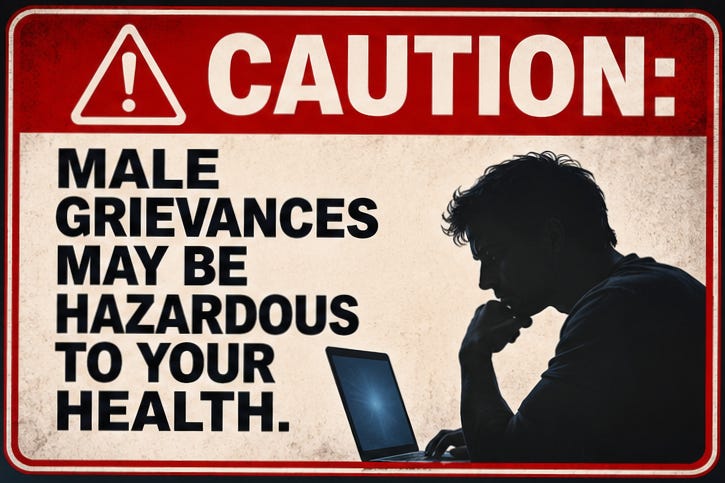
Six Strategies to Combat the Manosphere
Having acknowledged that rigorous causal evidence is scarce, the authors nevertheless propose six priorities for responding to the alleged health harms of the manosphere.
Some of their recommendations are sensible. They want to address boys’ educational problems, loneliness, and social isolation. They even warn against portraying masculinity as inherently toxic.
I welcome those ideas.
But their fourth recommendation is especially troubling.
The authors compare regulating the manosphere to regulating the tobacco industry. They argue that public-health efforts should target the structures and incentives that promote harm rather than simply blaming the people exposed to them.
They acknowledge that the comparison is imperfect. The manosphere is not a single product, its harms are harder to demonstrate, and online communities can serve useful purposes.
Nevertheless, they recommend stronger content moderation and using algorithms to promote positive messages and norms.
Think about what that means.
They want online platforms to do more to limit certain kinds of content while promoting other kinds of content.
But who gets to decide what is harmful and what is positive?
Who Gets to Decide What Men Can Say?
Suppose a man argues that feminist policies have contributed to boys’ educational difficulties. Suppose he believes family courts disadvantage fathers or that male victims of domestic violence receive inadequate support.
Are these legitimate subjects for discussion?
Or are they examples of the harmful grievance narratives the authors want platforms to address?
Now consider someone arguing that patriarchy and toxic masculinity are responsible for men’s problems.
Would that message be treated as harmful? Or would it be promoted as positive and constructive?
The authors don’t explicitly say that criticism of feminism should be censored. That’s important to recognize. Their stated goal is to reduce harmful online environments.
But they also identify criticism of feminism as a central belief within the manosphere, which they describe as a public-health harm.
So where exactly is the line?
There is an enormous difference between threatening women and criticizing feminism. There is an equally enormous difference between encouraging violence and questioning whether institutions treat men fairly.
Any system that fails to make those distinctions risks suppressing legitimate criticism along with genuinely harmful behavior.
And remember, ideas don’t have to be banned to disappear from public view. Algorithms can make some messages more visible and others much harder to find.
If platforms are encouraged to promote approved messages about masculinity while limiting supposedly harmful ones, who decides which ideas deserve to be heard?
That should concern anyone who values open discussion.
What If Feminism Is a Public-Health Harm?
Here is a question the Lancet authors don’t appear to consider.
What if we turned their argument around?
They believe that ideas circulating within the manosphere can contribute to poor mental health, harmful attitudes, and social problems.
Fine. Let’s examine that possibility.
But why not apply exactly the same standards to feminism?
What happens to boys who grow up hearing that masculinity is toxic? What happens to male victims of domestic violence when services are organized around theories that primarily identify men as perpetrators and women as victims? What happens when boys repeatedly encounter messages portraying males as privileged, dangerous, or responsible for society’s problems? What happens to fathers who are unjustly removed from their children’s lives?
Could these messages and institutional practices have consequences for male mental health and well-being?
Why wouldn’t we investigate them?
If researchers believe that ideological environments can damage health, then feminist ideas and institutions should be examined just as carefully as the manosphere.
The authors acknowledge that rigorous causal evidence connecting the manosphere to some of the alleged harms is scarce. Yet they propose a broad public-health response.
Would they support the same level of investigation into the possible harms of feminist-influenced policies and cultural messages?
Or would asking that question itself be considered another example of dangerous manosphere thinking?
That’s the question I would like to see answered.
If the manosphere can be investigated as a possible public-health harm, why should feminism be exempt from the same examination?
What Exactly Is the Manosphere?
Another problem runs through the entire article. What exactly do the authors mean by the manosphere?
The term is used to describe a remarkably broad collection of online communities. A minority may have misogynistic views. Others sell questionable dating advice. Still others discuss fathers’ rights, male victims of domestic violence, boys’ educational difficulties, or men’s mental health.
Are all these groups really the same?
Does a man become part of a dangerous movement because he believes fathers deserve fair treatment in court? Is someone promoting misogyny because he questions a feminist theory? What about a psychologist who believes traditional masculine characteristics can sometimes be healthy and useful?
The label doesn’t tell us whether any of these people are right or wrong.
Yet when very different groups are placed under one negatively charged label, the worst behavior associated with that label can cast suspicion on everyone else.
That’s particularly troubling when researchers begin proposing interventions that could affect what people are allowed to say or how widely their ideas are shared.
Before deciding how to regulate the manosphere, shouldn’t we be clear about what it actually includes?
A Better Way to Help Boys and Men
There is an irony in this Lancet article. The authors recognize that boys and men have serious problems. They acknowledge loneliness, educational difficulties, insecurity, and social isolation. They even warn against treating boys and men themselves as the problem.
Those are welcome observations.
But what if one reason some men turn to online communities is that they believe established institutions are unwilling to listen to them?
What if some of their complaints are justified?
And what happens when researchers describe those complaints as part of a harmful ideology?
Wouldn’t that make some men even less likely to trust the institutions supposedly trying to help them?
A better approach would be to take men’s experiences seriously without requiring them to accept a predetermined explanation for their suffering.
Investigate their complaints. Examine the evidence. Challenge false claims, but don’t assume a complaint is false simply because it criticizes feminism or another influential institution.
From Ignoring Men’s Pain to Managing Men’s Grievances
I think we may be witnessing a new stage in the way our culture responds to the suffering of boys and men.
First, their problems were largely ignored. Then, as the evidence became harder to dismiss, those problems began receiving more attention, but were often explained in ways that placed responsibility back on men themselves.
Now we may be entering a third stage.
Men’s problems are acknowledged, but some of the explanations men offer for those problems are treated as potentially harmful narratives that need to be corrected or controlled.
The Lancet paper is an example of why this development deserves attention.
The authors may genuinely want to help boys and men. Some of their recommendations suggest that they do. But good intentions do not replace solid evidence, and concern about harmful online behavior should not become an excuse to discourage legitimate criticism of powerful institutions.
The question is not whether some corners of the manosphere contain hateful or dangerous material.
The question is whether we can address genuine harm without treating men’s complaints about feminism and institutional unfairness as evidence of something unhealthy.
Men deserve more than acknowledgment of their suffering. They deserve to have their explanations taken seriously, examined fairly, and challenged when the evidence warrants it.
And they deserve the freedom to question the causes of their problems without having those questions treated as a public-health threat.
Sources
Hawkes, S., & Buse, K. (2026). Reframing the manosphere: a public health response to a commercial ecosystem. The Lancet.
United Nations Development Programme. (2023). 2023 Gender Social Norms Index: Breaking Down Gender Biases.
UN Women. (2024). Measuring Social Norms for Gender and Development: Lessons and Priorities.
UN Women. (2025). Women’s Rights in Review: 30 Years After Beijing.