


MenAreGood
MenAreGood is a channel for men, boys, fathers, new fathers, grandfathers and women who want to learn about men and masculinity.  Are you tired of the false narrative of toxic masculinity?  Did you know there is a huge amount of research that shows the positive aspects of men, boys and fathers?  That is what we focus on here, being a source of good information and also a place to connect.   Join us!
Interested? Want to learn more about the community?
April 12, 2024
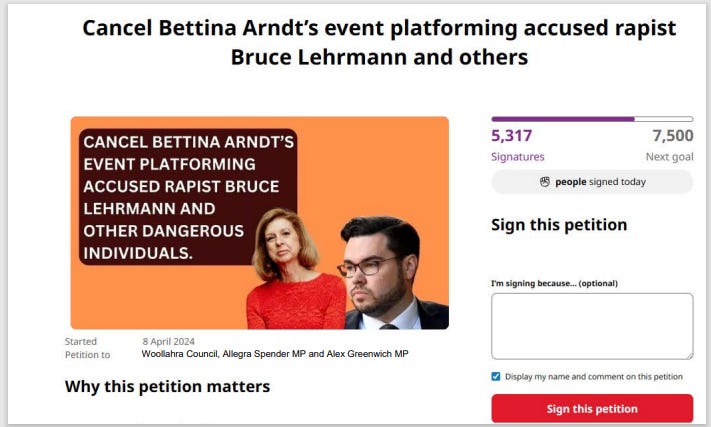
False accusers? Looks like one is getting outed in Australia and the press is not happy! Go Bettina!

Important. Have a look at this link and if you are in Australia go in person! Many thanks to Bettina for her work on this. So critical.

https://open.substack.com/pub/bettinaarndt/p/banning-our-conference?r=ybmah&utm_campaign=post&utm_medium=web

Interested? Want to learn more about the community?
What else you may like…
Videos
Posts
Articles
September 03, 2026
False Allegations - What the Numbers Don't Tell Us

We are getting a head start on International Falsely Accused day on Sept 9th!

How many false allegations of sexual abuse are there? We are often told they are extremely rare—perhaps only one to three percent. But those numbers depend on an extraordinarily narrow definition of what qualifies as a false allegation. They usually count only allegations proven to have been deliberately fabricated. Mistaken identity, contaminated memories, misunderstandings, suggestive interviewing, unsupported accusations and even recanted allegations may not be included.

In this conversation, Janice Fiamengo and I speak with Dr. Felicity Goodyear Smith, a physician, forensic medical examiner and professor at the University of Auckland who has studied wrongful allegations for more than three decades. Felicity explains the many different ways an innocent person can be accused, separating deliberate fabrications from allegations that are sincerely believed but untrue.

We also examine how “believe the victim” has ...

01:09:20
July 15, 2026
The Women's Health Narrative Meets the DATA

What if one of the most common claims in health policy simply isn’t true?

We’ve all heard the refrain: women are underfunded, under-researched, and left behind by the medical establishment. It’s repeated so often that most people never stop to ask for the evidence.

In this roundtable, Jack Kammer, Ed Bartlett, Ed Stephens, Jim Nuzzo, and I compare that narrative with the available data. We examine research funding, clinical trial participation, life expectancy, and the unintended consequences of policies that consistently prioritize one sex while neglecting the other.

This isn’t an argument against women’s health. It’s an argument for evidence, fairness, and a healthier future for everyone.

Link to the Feminist pdf that calls for 20 Billion dollars for women’s health!
https://drive.google.com/file/d/1IKEEZMGXtRNxU4n5K_M1d6k2w-ZP_wVT/view

Jim Nuzzo

The Nuzzo Newsletter on Substack http//jameslnuzzo.Substack.com
X: https://x.com/JamesLNuzzo

Jack Kammer

Jacks Substack Men’s ...

00:35:24
July 11, 2026
Mantoon: A Visit to the Doc

A visit to the Doc.

00:00:14
August 10, 2026
Feminism Cannot Be Reformed: It Must Be Destroyed Root and Branch

Janice Fiamengo’s new book is out, and this excerpt from the Foreword gives you a pretty good idea of what to expect. Janice goes straight to the heart of feminism and gives ample reasons for its demolition.

This is an important book. I hope you’ll get a copy for yourself—and maybe send one to someone who is even a little bit open to seeing the reality of feminism rather than the equality mask presented by feminists and so much of the media.

https://fiamengofile.substack.com/p/feminism-cannot-be-reformed

Well worth watch it’s good seeing men calling out women’s bull shit when the same women are not use to fair honest responses!

https://www.facebook.com/share/v/1JtTnYLC7K/?mibextid=wwXIfr

July 02, 2026
From Shooter to Heroine: The Glorification of Feminist Violence

I recently joined Hannah Spier, Janice Fiamengo, and Jim Nuzzo for a fascinating discussion about one of our culture’s most striking double standards: why violence by women is so often explained, excused, or even celebrated, while violence by men is treated very differently. We examine Valerie Solanas, the attempted murder of Andy Warhol, the SCUM Manifesto, and the film I Shot Andy Warhol, asking what the celebration and romanticizing of Solanas reveals about gynocentrism, empathy, and cultural bias. I think you’ll find it both thought-provoking and eye-opening.

post photo preview
​More Manosphere Madness
How scholars constructed a vast male supremacist ecosystem and then proposed controlling it


I recently read a paper titled Mapping the Neo-Manosphere(s): New Directions for Research, published in Men and Masculinities. It was quite an experience.

The authors—Vivian Gerrand, Debbie Ging, Joshua M. Roose, and Michael Flood—describe what they call the “neo-manosphere,” an enormous collection of online communities, personalities, political views, and self-improvement practices supposedly united by misogyny and male supremacy.

As I read, I kept waiting for the evidence. And waiting.

Where were the statements demonstrating the misogyny being described? Where were the representative quotations? Where were the arguments presented in enough detail that readers could evaluate them for themselves? Where was the distinction between hatred of women, criticism of feminism, advocacy for men, political disagreement, traditional beliefs, and ordinary male self-improvement?

For the most part, those things never appeared.

Instead, the paper offered an intricate academic portrait of a dangerous ideological ecosystem. Nearly every form of male-oriented dissent, vulnerability, or self-help could be positioned somewhere inside it or along its borders. Then, near the end, the authors became quite serious about intervention and control.

That is where the paper becomes much more than a questionable academic exercise.


The Conclusion Appears in the Definition

The paper begins by defining the manosphere as an online ecosystem of anti-women actors. In the introduction, it becomes a collection of anti-feminist and male-supremacist groups.

Those are not conclusions reached after the evidence is presented. They are built into the definition of what is being studied.

This matters because antifeminism is not the same thing as misogyny. A person can disagree with feminist theories, oppose feminist organizations, criticize feminist policies, or document harms produced by feminist advocacy without hating women or believing that men should rule over them.

Yet the paper repeatedly allows these categories to bleed into one another. Anti-feminism becomes adjacent to misogyny. Misogyny becomes adjacent to male supremacy. Male supremacy becomes adjacent to violent extremism. Once this chain has been constructed, a person need not advocate violence or express hatred toward women to be placed somewhere within the threatening manosphere.

The classification does the work that evidence ordinarily would have to do.


A Map With Very Few Exhibits

The paper does refer to some ​q​uestionable material. It mentions Andrew Tate, Nick Fuentes, and deepfake pornography. I can see how some folks might label some of this as misogyny.

But this paper ranges far beyond those examples.

It includes or draws into the orbit of the manosphere men’s rights advocates, Men Going Their Own Way, Christian conservatives, dating coaches, Joe Rogan, Jordan Peterson, Ryan Holiday, Lex Fridman, David Goggins, Jocko Willink, NoFap communities, wellness advocates, evolutionary psychologists, psychotherapists working with boys, tradwives, and female antifeminists.

What particular belief makes all these people part of one male-supremacist ecosystem?

They don’t say.

The authors identified 430 articles about the manosphere published since 2019 and drew upon approximately 100 of them. They say they selected recent publications to keep their map current. But they do not give us a systematic account of why those 100 were chosen, what evidence standards were applied, how conflicting findings were handled, or how the quality of the selected studies was assessed.

Most importantly, the paper seldom brings the primary material into view. Readers are generally told what another scholar concluded about an online community. We are then given a citation to that conclusion.

A citation may tell us where an assertion came from. It does not by itself prove that the assertion is correct.


When Repetition Becomes Evidence

The paper contains an impressive number of references. But citations are not necessarily independent evidence.

Much of the literature comes from scholars working within the same feminist and critical-masculinities framework. They frequently use similar definitions, begin with similar assumptions, and reach similar conclusions. One scholar classifies a community as misogynistic. Another scholar cites that classification. A third cites both papers as evidence that a scholarly consensus has developed.

Eventually, an interpretation acquires the appearance of fact through repetition.

The process works something like this:

  1. A contested interpretation is introduced.

  2. Like-minded scholars cite it approvingly.

  3. Later papers cite the growing literature rather than examining the original material.

  4. Repetition is treated as independent confirmation.

  5. The resulting “consensus” is used to justify intervention.

There is nothing inherently wrong with scholars citing one another. That is how knowledge develops. The problem arises when the scholars share the same ideological premises and rarely test their interpretations against primary evidence or competing explanations.

We see the same process in the news media. One outlet publishes a claim. Other outlets repeat it. Commentators then report that numerous sources have confirmed the story. But when the chain is followed backward, the apparent confirmation may lead to the same original assertion.

​S​ay something often and people will eventually start believing you.

The paper does not so much map the manosphere as map what a network of similar-thinking scholars has said about the manosphere. The difference is enormous.


When Male Suffering Becomes Further Evidence Against Men

One of the most troubling features of the paper is the way it treats male suffering.

The authors describe theories suggesting that some men strategically adopt the language of victimhood and suffering to conceal existing systems of male power. That creates an almost perfect closed system.

If men express confidence or authority, that can be read as male supremacy. If men describe pain or disadvantage, their suffering can be interpreted as a performance designed to restore male supremacy.

What evidence could possibly prove the theory wrong?

Boys’ educational problems, male suicide, fatherlessness, workplace deaths, family-court experiences, loneliness, economic displacement, and men’s loss of social purpose receive little consideration as problems with standing of their own. Male distress matters mainly because dangerous influencers may exploit it.

The possibility that men might have legitimate grievances is never allowed to reorganize the analysis. Their suffering enters the model as another part of the pathway toward misogyny.

Imagine treating women’s suffering this way. Imagine an academic paper arguing that women describe victimization strategically to conceal female power and obtain greater institutional control. The authors would rightly be asked for extraordinary evidence. Not hard to imagine, is it?

Men are granted no such presumption of sincerity.


Self-Improvement Becomes a Radicalization Pathway

The paper is particularly suspicious of male self-improvement.

Physical fitness, discipline, purpose, Stoicism, financial advice, pornography avoidance, and wellness practices are treated as possible entry points into male-supremacist spaces. Even content carrying ordinary labels such as motivation, mindset, and money is described as potentially directing boys toward dangerous material.

Certainly, some influencers exploit insecure followers. Some sell worthless programs, make irresponsible health claims, or deliberately intensify fear to keep an audience engaged. This is hardly unique to men’s media. The internet is overflowing with wellness grifts, financial fantasies, political panic, and products marketed through insecurity.

But the authors do not treat exploitation as a general problem within the attention economy. They construct a particularly male ideological danger. Helping men develop strength, confidence, discipline, and purpose becomes suspect because it might “re-masculinise” them rather than lead them toward the authors’ preferred understanding of masculinity.

The paper even contrasts some evolutionary psychologists and psychotherapists working with boys with approaches grounded in social-constructionist and intersectional principles. The underlying assumption appears to be that social constructionism and intersectionality provide the only legitimate ways to understand men, boys, and the world around us.

That is not a neutral concern about hateful content. It is a dispute over which theory of men should be institutionally approved.


From Description to Control

Near the end, the paper moves from describing the manosphere to proposing what should be done about it.

The authors support educational interventions, disengagement programs, gender instruction, critical digital literacy, and broader structural responses. They then write:

Structural interventions must therefore include policy reforms that address not just content moderation, but also the architecture of virality, algorithmic bias, and platform accountability.

That sentence deserves much more scrutiny than the authors give it.


Architecture of virality

The architecture of virality consists of the systems that allow material to spread: recommendation engines, trending lists, hashtags, reposting, automatic playback, notifications, engagement-based ranking, and monetization.

Changing that architecture can mean slowing the spread of material the platform considers harmful. Content may remain technically available while being excluded from recommendations, search results, trending lists, or monetization. It has not been formally banned. It has merely been made nearly impossible to find.

That is censorship with softer edges and less public accountability.


Algorithmic bias

Algorithms often reward sensational or inflammatory material because outrage generates engagement. Examining that problem is entirely reasonable.

But what counts as the bias, and what would count as its correction?

Within the framework of this paper, the problem appears to be that algorithms recommend material the authors have classified as misogynistic, male supremacist, reactionary, or manosphere-adjacent. Correcting the algorithm would presumably mean turning it away from those ideas and toward content considered inclusive, social-constructionist, and intersectional.

In other words, the algorithm would be adjusted toward the authors’ preferred ideology.

Platform accountability

Platform accountability sounds reassuring. Platforms should enforce clear rules against threats, targeted harassment, doxing, and illegal activity. They should explain their policies and provide meaningful appeals.

But the paper employs categories far more elastic than threats or illegal conduct. What would platforms be held accountable for suppressing? Misogyny? Anti-feminism? Male supremacy? Traditional beliefs? Evolutionary explanations of sex differences? Criticism of feminist organizations? Male-oriented therapy? Stoicism? Advocacy for fathers?

The authors never establish a reliable boundary.

And they never answer the essential question:

Who decides?

Would it be technology companies, government regulators, feminist advocacy organizations, academics, fact-checkers, or privately funded extremism researchers? What evidence would they require? Could their decisions be appealed? Would the standards be public? Would criticism of feminism remain protected? Would identical standards apply to hatred directed toward men?

The paper does not tell us.


Apply the Same Standard to Feminism

The easiest way to expose the problem is to apply the paper’s method to feminism.

Imagine beginning a study by defining feminism as an online ​misandrist ecosystem of anti-male actors. Imagine grouping together radical feminists, mainstream women’s organizations, feminist journalists, gender-studies departments, female separatists, lifestyle influencers, abortion activists, and women who post angrily about dating.

Imagine treating female claims of suffering as strategic performances designed to conceal women’s institutional power. Imagine describing women’s wellness and empowerment content as possible gateways into misandry. Imagine tracing every shared citation, hyperlink, podcast appearance, and social-media recommendation as evidence of ideological cross-pollination.

Then imagine recommending disengagement programs, educational interventions, content moderation, algorithmic correction, and upstream regulation of the digital environment.

The methodology would immediately be condemned as guilt by association.

And yet finding direct expressions of feminist hostility toward men would not be difficult. Many feminist writers and activists have described men as violent, defective, dangerous, unnecessary, or collectively responsible for women’s suffering. Such statements have appeared in books, classrooms, journalism, advocacy, and popular culture. They are often defended as provocative social criticism rather than treated as gateways to extremism.

I am not suggesting that feminist speech should be suppressed. I am asking whether the people demanding controls on male-oriented speech would accept their own rules if those rules were applied evenly.

If they would not, they are not proposing a neutral system for controlling hatred. They are proposing ideological control.


Show Us the Evidence Before You Control the Conversation

There is misogyny online. There are men who say hateful things about women. There are disturbed communities, exploitative influencers, and individuals who encourage violence. Specific threats and specific acts should be confronted directly.

But none of that grants scholars permission to collapse an enormous range of men, beliefs, and communities into a single male-supremacist ecosystem.

Before regulating an ideology, we should require those proposing the regulation to define it clearly, identify who actually holds it, present representative primary evidence, distinguish hatred of women from criticism of feminism, and demonstrate that the proposed intervention targets harmful conduct rather than political disagreement.

This paper does not meet that standard.

It begins with a loaded definition, gathers a network of mutually reinforcing citations, treats male suffering as potentially deceptive, stretches the manosphere across an astonishing range of people and practices, and then invokes the resulting academic consensus to justify intervention into the systems that determine which ideas may spread.

The process is circular but effective:

First create the category. Then fill it with everyone you distrust. Cite colleagues who use the same category. Call the repetition a consensus. Finally, use that consensus to regulate the people placed inside it.

That is not simply mapping an online world.

It is constructing a threat—and then requesting the power to control it.​ Can you sense the desperation?


The paper discussed is Vivian Gerrand, Debbie Ging, Joshua M. Roose, and Michael Flood, “Mapping the Neo-Manosphere(s): New Directions for Research,” Men and Masculinities 28, no. 5 (2025): 443–464. https://doi.org/10.1177/1097184X251350277

Men Are Good.

Read full Article
September 21, 2026
The Four Powers of the Mature Masculine
An introduction to Robert Moore’s King, Warrior, Magician, and Lover


I met Robert Moore only once, but I fell in love with him.

That may sound like an unusual way to introduce a psychological theorist. But anyone who heard Moore teach will probably understand what I mean. He had a strong Southern drawl, an enormous personality, and a gift for taking difficult psychological ideas and making them feel immediate and alive. He would move from Carl Jung to an old myth, from a clinical observation to a story about ordinary life, and then—often enough—to a reference to Jack Daniel’s.

You never had the sense that the archetypes were dry concepts to him. They were living realities. He saw them at work in families, marriages, therapy offices, universities, churches, corporations, political movements, and the private struggles of men trying to grow up.

Many years ago, I purchased a collection of Moore’s audiotapes on the masculine archetypes. I listened to them repeatedly and found them profoundly helpful, both personally and in my work as a psychotherapist. The books Moore wrote with Douglas Gillette—particularly King, Warrior, Magician, Lover—present the basic architecture of the model. But the recordings are different.

Much of this series draws from approximately twenty-seven hours of recordings from Moore’s graduate classes on the masculine archetypes. In those classes he had room to think aloud, answer questions, wander down unexpected paths, tell stories, make jokes, and show how the different parts of his theory fit together. The result is more personal, expansive, and sometimes more revealing than the published books.

These articles are my attempt to introduce that richer Moore to a new audience.

Before we meet the King, Warrior, Magician, and Lover, however, we need to understand what Moore meant by an archetype.


What Is an Archetype?

An archetype is not a personality type.

The four archetypes are not four categories into which men can be sorted. This is not a masculine version of a personality quiz in which you discover that you are “a Warrior” while your friend is “a Lover.” Nor are archetypes prescribed social roles or stereotypes telling men how they are supposed to behave.

An archetype is a deep human pattern—an organizing potential within the psyche that shapes how we perceive, experience, and express a particular form of energy.

The King organizes, blesses, and creates order.

The Warrior acts, protects, establishes boundaries, and gets difficult things done.

The Lover connects, values, grieves, delights, and experiences the world through the senses.

The Magician observes, interprets, understands, and guides transformation.

Every man carries the potential for all four.

We may have easy access to one and very little access to another. One may be welcomed by our family while another is shamed. We may express an archetype maturely in one situation and fall into its shadow in another. We may be disciplined and courageous at work yet unable to establish a boundary with someone we love. We may be a wise guide to other people but incapable of applying the same wisdom to ourselves.

The goal is not to determine which archetype we are. The goal is to develop a conscious relationship with all four and gradually bring their powers into cooperation.

Moore was also careful to distinguish between connecting with an archetype and identifying with it. A man can connect with King energy, but he is not the King. He can draw upon the Warrior, but he is not the archetypal Warrior. These energies are larger than the individual ego.

When a man receives their power while remaining aware of his human limits, the archetype can enlarge his life. But when his ego begins to believe that it is the archetypal power, inflation follows. He may become convinced that he alone knows the truth, that ordinary rules do not apply to him, or that other people exist to admire, obey, or serve him.

Healthy contact with an archetype gives us power. Identification with it makes us grandiose.

Maturity therefore requires more than awakening these energies. It requires learning to contain, balance, and steward them.


Psychology’s Missing Question

As far as I know, Robert Moore is the only major psychological theorist who attempted such a sustained and systematic examination of the mature masculine.

Psychology has produced libraries about what is wrong with men. It has studied male aggression, violence, narcissism, emotional restriction, risk-taking, sexual pathology, criminality, and failure. Some of that work is necessary and valuable. Men, like women, have shadows that must be understood.

But pathology is not a vision of maturity.

It is one thing to tell men what they must stop doing. It is quite another to help them understand what they might become.

Where is the psychological literature describing mature male authority that does not become domination? Where is the account of aggression transformed into courage, discipline, and protection? Where do we find male sexuality joined with wonder, grief, tenderness, and appreciation? Where is knowledge transformed into initiation, healing, and service?

Moore asked these questions.

Instead of beginning with the assumption that masculine power itself was the problem, he asked what each power looked like when it was immature, wounded, inflated, or properly developed. He did not deny the destructive possibilities within men. On the contrary, he examined them closely. But he refused to confuse the shadow of masculinity with masculinity itself.

That distinction is badly needed today.

Years ago, I raised Moore’s work with a group of members of Division 51 of the American Psychological Association—the division devoted to the psychological study of men and masculinities. Not one person present was familiar with it.

I found that astonishing. Here was an extensive psychological model devoted to mature masculine development, and it was largely unknown within the professional organization created to study men.

Perhaps it should not have been surprising. Our culture has become much better at describing harmful male behavior than at giving boys and men a positive image of what their strength, aggression, sexuality, authority, and intelligence are for.

But we cannot help boys grow into mature men if we possess no serious image of mature masculinity.

Moore gave us one.


Four Powers, Not Four Boxes

Moore’s model begins with four basic configurations of masculine energy.

The King is the center that creates order. He offers blessing, holds a vision of the whole, calms chaos, and uses his authority to help others develop. His mature power is not control for its own sake but generativity—the capacity to create a world in which life can flourish.

The Warrior brings disciplined action. He recognizes enemies, establishes boundaries, endures hardship, and places his strength in service of something beyond comfort or self-interest. The mature Warrior is not violent for the pleasure of violence. He knows what must be protected and what is worth sacrificing for.

The Lover awakens us to value. He experiences beauty, pleasure, sorrow, sexuality, nature, music, friendship, and the astonishing particularity of another person. The Lover is the part of us that knows why the world is worth protecting in the first place.

The Magician understands the map. He sees beneath appearances, breaks through denial, interprets symbols, recognizes which energy a situation requires, and helps people move through transformation. At his highest level, knowledge becomes healing and stewardship.

None is sufficient alone.

The King without the Magician may become certain of his own authority and unable to recognize his self-deception. The Magician without the King may see through everything but believe in nothing. The Warrior without the Lover may become brutal, while the Lover without the Warrior may be unable to protect what he loves. The King needs the Warrior’s capacity to act, the Lover’s capacity to value, and the Magician’s capacity to discern.

Maturity does not eliminate the tensions among these powers. It helps us hold them consciously so that each can correct and complete the others.


Every Archetype Has a Shadow

Moore’s work is not a celebration of masculine power without qualification. Each archetype has shadow forms.

The King’s authority may inflate into tyranny or collapse into weakness. The Warrior’s discipline may become cruelty or turn inward as masochistic self-destruction. The Lover’s capacity for connection may become addiction and boundarylessness or disappear into numbness and impotence. The Magician’s insight may become manipulation, cynical detachment, or the denial of knowledge and responsibility.

These opposites are often closer than they appear. The Tyrant may conceal a terrified Weakling. The man who dominates others may feel inwardly powerless. The compulsive Lover may alternate between overstimulation and deadness. The detached Magician may secretly depend upon others to carry the emotional life he refuses to enter.

Moore’s model is therefore not a simple theory of four positive qualities. It is a dynamic system filled with developmental levels, opposing shadows, characteristic inflations, inner conflicts, and relationships among the archetypes.

His understanding also evolved. In the lectures, Moore sometimes questioned earlier formulations, distinguished one archetype from another more carefully, and explored ideas that never received the same space in his books. He was building a map of enormous territory, and he knew the map was unfinished.

This series cannot offer an exhaustive account of that territory. These articles cannot contain the complexity of twenty-seven hours of teaching, much less the larger body of Moore’s work.

What follows is an overview—a way of opening four doors.


The Boy, the Hero, and the Man

One of Moore’s most important distinctions was between boy psychology and mature masculine psychology.

The boy is not bad. Boyhood contains imagination, daring, play, idealism, and enormous potential. But the boy’s energies are not yet organized around adult responsibility. They easily become grandiose: the fantasy that he is invulnerable, uniquely important, exempt from limits, or destined for greatness without apprenticeship and sacrifice.

Moore regarded the Hero as primarily a boyhood pattern. The Hero’s great task is not to remain heroic forever. It is to confront his own grandiosity, accept his limitations, and grow up.

Only then can he become a mature Warrior.

This is a crucial correction to the way these ideas are often simplified. The Warrior is not merely a stronger Hero. The Hero fights in large part to establish himself. The mature Warrior has less need to prove himself because his energy has been placed in service.

The same developmental movement appears in all four archetypes. Immature energy asks, “How powerful does this make me?” Mature energy asks, “What is this power for?”

That question—what is it for?—runs through Moore’s entire model.

Authority is for blessing and creating order. Aggression is for protecting, separating, and acting. Sexual and emotional vitality are for relationship, appreciation, and participation in life. Knowledge is for discernment, initiation, and healing.

Power reaches maturity through stewardship.


Why These Ideas Matter Now

Many men today have been given an extensive vocabulary for their possible defects and almost no language for their healthy development.

They hear about toxic masculinity, male privilege, emotional restriction, dominance, violence, and entitlement. Again, harmful behavior deserves honest attention. But a boy cannot build an identity entirely from instructions about what not to become.

He needs to know what his strength is for.

He needs an image of authority that blesses rather than dominates; aggression that protects rather than abuses; sexuality that connects rather than consumes; knowledge that heals rather than manipulates.

He also needs permission to see these capacities as genuinely masculine without being told that masculinity is either inherently dangerous or merely an arbitrary costume imposed upon him.

Moore offered a language capable of holding masculine power and masculine shadow at the same time. He neither romanticized men nor reduced them to their failures.

That balance may be his greatest contribution.


Entering the Four Rooms

We will begin with the King, because the King supplies the center. Without some connection to calm, blessing, responsibility, and just order, the other energies easily become chaotic or destructive.

We will then meet the Warrior, whose discipline turns intention into action and whose boundaries protect what matters.

Next comes the Lover, who opens the garden of beauty, connection, grief, sexuality, and delight—the world the Warrior is asked to defend.

Finally, we will meet the Magician, keeper of the map and guide to transformation. The Magician brings the fourfold pattern into view and helps us understand how the powers work together.

These articles will include material from Moore’s books, but they will also draw deeply from the recorded classes in which his voice, humor, and humanity are most present. My hope is not merely to summarize his theory. It is to let readers feel something of what I experienced listening to those tapes years ago: the sense that these ancient patterns could illuminate an ordinary life.

Moore helped me see that mature masculinity is not a fixed destination and certainly not a performance of invulnerability. It is an ongoing relationship with powerful inner potentials—each capable of serving life, each capable of falling into shadow, and none capable of maturing alone.

The four archetypes give us a map.

They do not tell us exactly where our journey will lead. But they may help us recognize the room we are standing in, the power we have forgotten, and the next door that needs to be opened.

We will start the series next Monday.

Men Are Good.

Read full Article
September 17, 2026
post photo preview
When One Incel Becomes Ten
How one real threat became evidence of a widespread violent ideology among French youth


One of the great dangers of modern journalism is that a false narrative can acquire the appearance of fact simply by attaching itself to an authoritative source. That is what appears to have happened in a recent Le Monde article about “masculinism.”

The article makes a series of extraordinary claims about boys and men. Its very title announces that masculinism is an “increasingly widespread, violent and popular ideology among French youth.” Throughout the article, male grievance, separated fathers, antifeminism, the manosphere, incels, misogyny and terrorism are placed close enough together that they begin to look like parts of the same phenomenon.


And the claims carry considerable authority because they are presented as flowing from a 260-page French Senate report drawing, in part, on information from the DGSI—France’s domestic security service. That sounds impressive. But then you read what the underlying material actually says. And the story begins to fall apart.

The security evidence is dramatically narrower than the Le Monde narrative built around it. Instead of evidence that a widespread movement of French boys and young men is becoming violent, we find one exceptionally serious case involving a young man identified with incel and Black Pill ideology who was allegedly preparing an attack, along with approximately nine other young people being monitored because authorities considered them susceptible to violent radicalization in connection with the incel milieu.

Those are not the same thing. One boy was allegedly preparing an attack. The others were considered susceptible to radicalization.

Yet watch what happens as this information moves through the story:

One alleged incel attack plot → roughly ten monitored youths → incels → the manosphere → masculinism → a widespread violent ideology among French youth.

At every step the population gets larger. But the word violent travels with it.

That is what makes this more than sloppy wording. When journalism takes evidence about one exceptional case and allows its most frightening characteristics to spread across larger and larger groups, it can create a public narrative that the underlying evidence never established.

And when the people being described are boys and men, the resulting narrative can become deeply misandrist: ordinary male distress starts looking suspicious; male grievance becomes a possible gateway to extremism; fathers’ advocacy can be placed alongside misogyny; and boys searching for help, identity or belonging can appear as the outer edge of a terrorist problem.

So I decided to look more closely at the young men being used to support this narrative. That is when I discovered something remarkable.


One incel had become ten.

Not literally, of course. The other young people did not suddenly adopt his beliefs or actions. Rather, the characteristics of this one serious case began to migrate outward onto other young people for whom the evidence was very different.

The DGSI, France’s domestic security service, reported approximately ten young people under scrutiny because they were considered susceptible to violent radicalization in connection with the incel milieu. That is not the same thing as saying that ten violent incels had been discovered.

One young man was identified with incel/Black Pill ideology and allegedly preparing an attack. The others were being watched because authorities believed they might be susceptible to radicalization. That distinction is crucial.

Susceptibility is not radicalization. Surveillance is not violence. And being considered vulnerable to recruitment into an ideology is certainly not the same thing as personally identifying with that ideology.

At each step the population expands while the frightening characteristic derived from the smallest and most extreme group remains attached. That is the sleight of hand at the heart of this story.


The part of the story we weren’t told

There is another detail that makes the Saint-Étienne case considerably more complicated than the framing suggests. According to the account attributed to the DGSI, the young man’s hostility was directed toward a particular girl whom he believed had falsely accused his friends of rape.

That does not make the alleged plot less serious. Nor does it demonstrate that incel ideology played no role. Both things could have been operating simultaneously. But surely it matters when we are trying to understand motive.

There is a significant difference between a young man wanting to attack women simply because they are women and a young man who embraces incel ideas but is also enraged at a particular person because he believes she seriously harmed his friends. The Le Monde article made no mention of his concerns for his friends.

Perhaps incel ideology intensified that grievance. Perhaps the grievance drove his attraction to the ideology. Perhaps both were important. We don’t know. And that is precisely the point.

The available evidence does not allow us simply to choose among those possibilities. But remove the specific grievance and what remains is a much cleaner story:

Incel hates women and plans attack against girl.

Put the omitted grievance back in and the story becomes more complicated:

A troubled young man immersed in incel/Black Pill material allegedly planned violence against a particular girl whom he believed had falsely accused his friends of rape.

The second description is less convenient. It is also more complete.


One boy carries the weight of the story

This matters because the Saint-Étienne suspect is doing an enormous amount of work in the larger narrative. He is the strongest evidence of the progression the article wants the reader to see:

male grievance → incel ideology → radicalization → violence

But then his characteristics begin to bleed outward onto the other young people.

The Senate report itself is more cautious. It distinguishes cognitive radicalization from behavioral radicalization and acknowledges that the scientific literature does not establish a causal relationship between exposure to masculinist material and violent action. Ideological adherence, it says, does not mechanically lead to violence.

That qualification changes everything. A boy can watch objectionable material without accepting it. He can accept radical ideas without becoming violent. He can be lonely or angry without being radicalized. He can be susceptible to radicalization without actually becoming radicalized. And he can be monitored by a security service without ever having planned an attack.

Those aren’t minor semantic distinctions. They are different evidentiary categories.


How a threat grows on paper

Once you preserve those distinctions, the architecture of the story becomes much easier to see. There are really three very different populations.

The first is a serious case: a young man identified with incel/Black Pill ideology who was allegedly preparing an attack.

The second is a tiny security population: approximately ten young people considered susceptible to violent radicalization in connection with incel milieus.

The third is an enormous and heterogeneous population of boys and men who may watch male-oriented influencers, participate in parts of the manosphere, criticize feminism, favor traditional sex roles, belong to fathers’ groups, struggle with dating, or simply search online for help with loneliness, fitness, money, relationships, or becoming a better man.

Evidence about the first population does not automatically describe the second. And evidence about the second certainly does not describe the third.

But place all three populations close enough together and the reader begins to experience them as points along a single continuum. That is where framing becomes so powerful.

You don’t actually have to say that the lonely fifteen-year-old watching fitness videos is on his way to becoming a terrorist. You merely put him into a narrative that begins with algorithms and male grievance, passes through misogyny and incels, and ends with terrorism.

The reader supplies the arrow.


One attack becomes two

This is also why another discrepancy in the Le Monde article matters so much. The article says that two violent masculinist actions were foiled in 2024 and 2025. But the underlying Senate report identifies one imminent incel terrorist attack foiled by the DGSI—the Saint-Étienne case.

The report discusses other young people who were arrested, referred, investigated, or monitored. But those categories are not interchangeable.

A referral is not an attack. Surveillance is not an attack. Concern about possible radicalization is not an attack. Preparation for an attack is something else entirely.

Unless a second equivalent case can be identified, turning one foiled attack into two “violent actions” isn’t merely a numerical discrepancy. It reinforces the larger narrative by making an extraordinarily small phenomenon appear to be reproducing itself.

And the report itself warns against drawing broad conclusions from these cases. The number is simply too small.

Yet the headline offered to readers was:

“Masculinism, an increasingly widespread, violent and popular ideology among French youth.”

Think about the distance between that headline and the underlying security evidence. One alleged imminent attack. Approximately ten young people being watched because they were considered susceptible to violent radicalization associated with the incel milieu. Only one clearly identified here as an incel/Black Pill adherent preparing an attack.

That is a very different story.


The boys disappear again

There is one final part of this that troubles me. The Senate material describes many of these young people as profoundly vulnerable. Their histories include bullying, social isolation, trauma, sexual victimization, disability, psychiatric difficulties, and dysfunctional families.

Those details should matter. They don’t excuse threats or violence. A young man preparing to hurt someone needs to be stopped regardless of what happened to him.

But imagine encountering a group of troubled girls with those histories. Would our first question be: How dangerous are these girls to men? Or would we ask: What happened to them?

With these boys, their vulnerability seems to become interesting primarily because it may make them susceptible to radicalization. Their suffering becomes a security indicator.

The boy disappears and the potential perpetrator takes his place.

That may be one of the most revealing aspects of the entire story.

The same information could have prompted another set of questions. Why are these boys isolated? Why were some of them bullied? What happened to the sexually victimized ones? Where are their fathers? Where are the male mentors? Why are boys searching online for communities that seem to offer them belonging, identity and meaning? And what could we do to reach them before some negative influencers do?

Those questions don’t require ignoring genuine threats. Quite the opposite. Understanding troubled boys more accurately might be one of the best ways of preventing the tiny number who actually become dangerous from getting there.


A real threat needs no exaggeration

There really was a serious case in Saint-Étienne. French authorities appear to have identified a credible threat and intervened before anyone was hurt.

Good.

That is exactly what security services are supposed to do. And that story needs no exaggeration.

What it does not justify is allowing the characteristics of that one young man to migrate outward—to approximately nine other monitored youths, then to incels generally, then to the manosphere, then to “masculinism,” and ultimately to a broad population of boys and men whose beliefs and behavior bear little resemblance to his.

There is a lesson here that reaches far beyond this particular article. Whenever we hear that some enormous group is becoming “radicalized,” “extremist” or “violent,” we should ask a few simple questions:

How many people actually committed violence? How many actually planned violence? How many were merely being monitored? How many personally identified with the ideology being discussed? And at what point did evidence about a tiny extreme subgroup begin to describe everybody else?

Those questions are especially important when we are talking about boys.

A real threat should lead us to greater precision, not less. One alleged terrorist plot is serious enough.

We shouldn’t need to turn one incel into ten—and ten into a generation.

Men Are Good.

Read full Article
See More
Available on mobile and TV devices
google store google store app store app store
google store google store app tv store app tv store amazon store amazon store roku store roku store
Powered by Locals