




Chapter 9 - Seeing Men Clearly
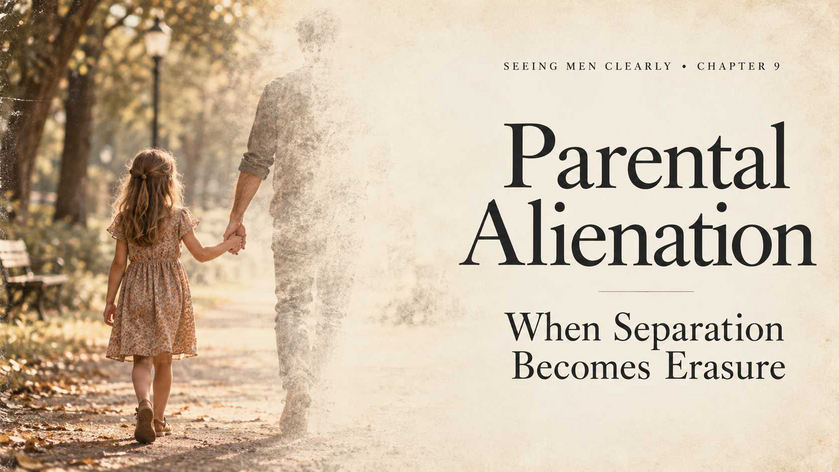
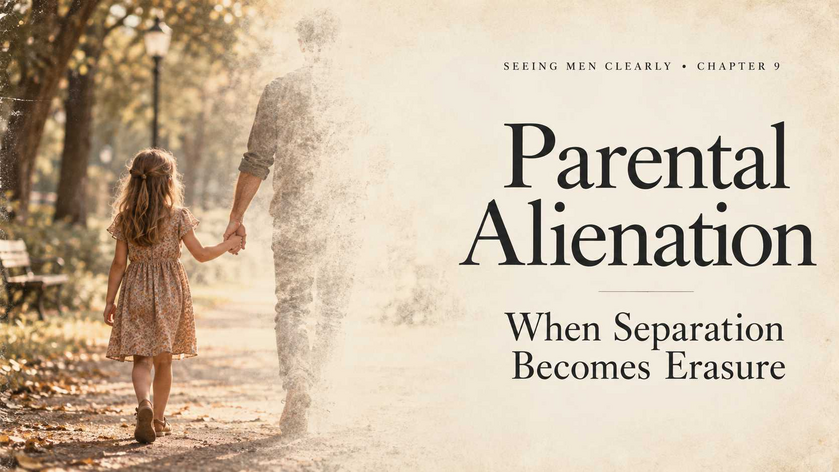
Parental Alienation: When Separation Becomes Erasure
Losing daily contact with a parent is painful. Losing the relationship itself is something else entirely. Most custody disputes involve distance. Parental alienation involves something far more profound: the gradual disappearance of a parent from a child’s emotional world and, ultimately, from the child’s life, often reinforced by physical separation.
A child may still have access to a parent. Phone calls may be available. Visits may be scheduled. Court orders may remain in place. Yet over time the relationship begins to weaken, then fracture, and in some cases collapse. Affection gives way to suspicion. Familiarity gives way to distance. Love is gradually replaced by fear, anger, or indifference.
The Child Who Stops Calling
It often begins subtly. A child becomes reluctant to answer the phone. Conversations become shorter. Visits become strained. The rejected parent is bewildered. Nothing obvious has happened. No abuse. No abandonment. No dramatic betrayal. Yet the relationship appears to be dissolving.
The child begins speaking in language that sounds strangely adult. Old grievances are repeated. Minor mistakes become major offenses. Positive memories fade while negative interpretations multiply. The parent who was once loved becomes viewed almost entirely through a negative lens.
A Relationship Under Pressure
Children naturally want to love both parents. This is one of the most important realities to understand. Children generally do not enter the world looking for reasons to reject a mother or father. Their natural tendency is connection. They want both parents. They need both parents. They identify with both parents.
When children feel pressure to choose between parents, they often experience tremendous internal conflict. To reject a parent is, in some sense, to reject a part of themselves. This is why parental alienation can be so damaging. The child is not merely losing a relationship. The child is often losing a piece of his or her own identity.
The Research Begins to Notice
For many years, professionals paid little attention to the phenomenon. When fathers complained that children were being turned against them, they were often dismissed as bitter ex-spouses unwilling to accept divorce. Gradually, however, clinicians began observing patterns that were difficult to explain away.
Researchers and therapists noticed situations where children displayed extreme hostility toward a parent despite little evidence that the parent had done anything deserving such rejection. The child’s anger often seemed disproportionate, the accusations repetitive, and the thinking unusually rigid. The relationship appeared less like a normal response to parental shortcomings and more like the result of sustained influence.
Over time, the concept of parental alienation emerged as an attempt to describe these situations. Although professionals continue to debate definitions and terminology, few dispute that children can be influenced to fear, reject, or distance themselves from a parent. The question is not whether it happens. The question is how often. And what should be done when it does.
The Invisible Form of Family Violence
One way to understand parental alienation is to imagine a form of family violence that leaves no bruises. No broken bones. No emergency room visits. No police reports. Yet something precious is still being damaged: the bond between a parent and child.
A parent can recover from insults. A parent can recover from financial loss. Many parents never fully recover from losing a child. Not through death. Through rejection. The pain is difficult to describe. It is grief without a funeral. Loss without an end. Presence without relationship.
Why Children Are Vulnerable
Children trust the adults who care for them. That trust is necessary. Without it, childhood would be impossible. Yet the same trust that protects children can also make them vulnerable.
If a trusted adult repeatedly communicates that another parent is unsafe, uncaring, selfish, or unworthy, many children eventually absorb that message—not because they are foolish, but because they are children. The younger the child, the greater the vulnerability. A child has limited ability to independently evaluate competing claims. He relies heavily on the people he trusts. This is one reason parental alienation can be so powerful. It exploits one of childhood’s greatest strengths: trust.
The Father’s Voice
Although either parent can engage in alienating behavior, fathers often describe a particularly painful experience. Many enter court believing that if they remain calm, loving, and patient, the truth will eventually prevail. Instead, they sometimes discover that the relationship deteriorates while they wait.
Phone calls become less frequent. Visits become more tense. Years pass. Children grow older. The bond weakens. By the time anyone recognizes what has happened, much of the damage has already occurred.
One father described it this way: “I wasn’t losing a court case. I was losing my daughter.” That distinction captures the reality more accurately than any legal terminology. The issue is not primarily litigation. The issue is relationship.
The Child’s Loss
The greatest tragedy of parental alienation is often misunderstood. People assume the primary victim is the rejected parent. Certainly that parent suffers enormously. But a powerful and often unnoticed series of losses belongs to the child.
The child loses stories, memories, guidance, connection, identity, half of his history, and half of his family. Sometimes half of himself. Years later, many alienated children begin asking difficult questions. What really happened? Why did I stop seeing my father? Why did I believe those things? What did I miss?
Some find answers. Many do not. The lost years cannot be recovered.
Why We Didn’t Notice
Parental alienation reveals something important about the broader themes of this book. When a child loses contact with a father, many observers assume the father must have done something wrong. The possibility that the relationship itself might be under attack is often considered only much later.
This assumption flows from the same hidden layer we have seen repeatedly. Mothers are often viewed as natural caregivers. Fathers are often viewed as optional caregivers. When a child rejects a father, people frequently assume the father earned that rejection. When a child rejects a mother, people are more likely to ask what happened.
The difference is subtle. Yet it shapes perception. And perception shapes institutions. Just as it has throughout this book.
Men Are Good.