




The Lover Within
Robert Moore and the Courage to Be Fully Alive
Of Robert Moore’s four masculine archetypes, the Lover may be the easiest to reduce to something smaller than it is.
We hear the word lover and think of romance or sex. Those certainly belong to the Lover, but Moore was speaking about something much larger. The Lover is the part of us that responds to beauty, music, touch, food, poetry, friendship, nature, grief, sexuality, creativity, and the sheer strangeness of being alive.
It is the capacity to experience the world not merely as useful, dangerous, or understandable, but as valuable.
The King asks, “How shall I care for this?” The Warrior asks, “What must I do?” The Magician asks, “What does this mean?” The Lover says, “Look at this. Feel this. This matters.”
Moore’s central insight might be put this way:
The Lover is not simply the part of us that falls in love. It is the part that experiences anything as worth loving.
Without the Lover, we may remain productive, responsible, disciplined, and intelligent. We can work, lead, analyze, and endure. But something essential begins to disappear. The world loses its color. Other people become functions. Work becomes obligation. Nature becomes a resource. Intimacy becomes another task to perform.
We are still alive, but we no longer feel fully alive.
The Garden
Moore associated each archetype with a different psychic space. The traditional space of the Lover is the garden.
The garden is not the battlefield, workshop, throne room, office, or classroom. It operates according to another kind of time. The Warrior has a mission and checks the clock. The Magician analyzes what is happening. The King remains responsible for the realm. But the Lover enters a place where nothing must immediately be accomplished.
Moore said simply, “The Lover has time.”
That is a radical statement in a culture organized around production. In the garden, we are not earning, fixing, competing, proving, or even helping. We are present. We taste the food. We hear the music. We notice the face across from us. We allow experience to reach us before deciding what to do with it.
This is why Moore said the Lover is about being rather than doing.
The garden includes sexuality, but it is larger than sexuality. It includes conversation that no one wants to end, working with wood because the grain is beautiful, feeling the soil in one’s hands, hearing a song that opens something inside, grieving someone we loved, laughing until we cannot breathe, or standing before a landscape that makes us quiet.
Eden is a garden, but so is Gethsemane. The Lover does not open us only to pleasure. It opens us to sorrow, longing, betrayal, tenderness, beauty, mortality, and loss. A man who refuses grief because it hurts has not conquered the Lover. He has closed the gate to the same garden in which joy lives.
Appreciative Consciousness
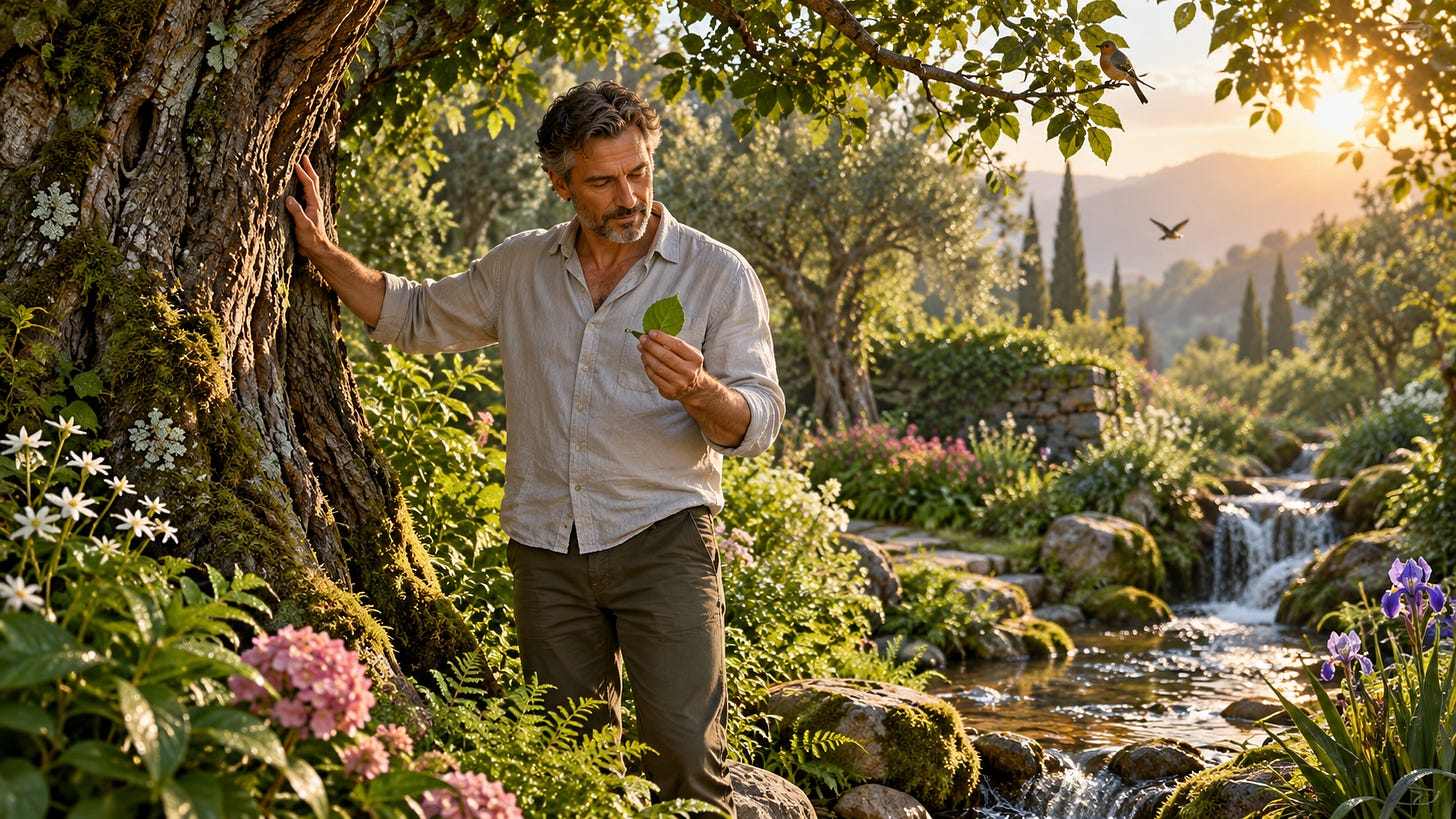
Moore called the Lover’s way of seeing “appreciative consciousness.”
The phrase is important. The Lover does not first approach the world by criticizing, measuring, diagnosing, or deciding how it can be used. It appreciates. That does not mean abandoning judgment. It means allowing value to appear before dissection begins.
Moore observed that the King blesses what he encounters, the Warrior fights it, and the Magician interprets it. The Lover appreciates it.
That form of consciousness can make the world seem luminous. William Blake, Walt Whitman, D. H. Lawrence, and Robert Bly all knew something about it. They could look at an ordinary object, an animal, a human body, or a patch of earth and experience more life than most of us notice.
Moore suggested a simple diagnostic question: How much of the time are you bored?
Boredom can occur even in a frantic life. In fact, Moore pointed out that a person can be both a workaholic and deeply bored. He may be constantly occupied while rarely touched by what he is doing.
The absence of boredom does not require continual entertainment. It comes from the ability to notice. A healed Lover finds more of the world interesting because more of the world is allowed to matter.
The Man Who Cannot Feel—and the Man Who Cannot Stop
Moore repeatedly described two broad Lover problems.
At one pole is the man who appears to have too little Lover energy. He feels wooden, detached, ashamed of his body, frightened by enthusiasm, uncomfortable with beauty, or incapable of resting. He may work continuously, analyze everything, or treat intimacy as another technical problem to solve.
Moore joked about the Warrior who approaches lovemaking like a train making a brief station stop. He is still on the mission. He may even read the manual and learn the proper technique, but he has not entered the garden.
This man may say that there is nothing passionate inside him. Moore thought the opposite was often true. Deadness may be a defense against passion so strong that the man fears it will overwhelm him. He is not empty. He is frightened of what might happen if the door opens.
At the other pole is the man who cannot close the door. He becomes flooded by appetite, infatuation, substances, sex, food, excitement, creativity, or risk. He cannot stop because no experience is ever enough to provide the union he seeks.
Moore used a country-song line to describe it: “Whoever turns you on forgot to turn you off.”
One man cannot feel. The other cannot stop. Both have difficulty maintaining a conscious relationship with the same energy.
For Moore, maturity was neither passionlessness nor permanent ecstasy. It was the growing ability to experience intensity without fleeing it, immediately discharging it, or being consumed by it. He described part of the therapeutic task as helping people learn to “stand their excitement longer.”
That is one of the most useful ideas in these lectures. Many of us have been taught how to suppress excitement or act upon it. Far fewer have learned how to remain present while it moves through us.
Shame and the Fear of Being Seen
Shame is one of the principal forces separating men from the Lover.
Men are often permitted to be useful, strong, successful, or funny. Being beautiful is more difficult. So is dancing without self-consciousness, dressing with flair, giving another man a poem, showing delight, or allowing the body to be seen without apology.
Moore said the Lover moves us from shame toward “passionate play and display.”
He was not recommending exhibitionism that ignores other people’s boundaries. He was describing the healthy capacity to appear—to inhabit one’s body, occupy one’s space, and let enthusiasm become visible.
Moore loved hats. He spoke about walking through the city in his Stetson and receiving puzzled looks from people who had lost any cultural language for male adornment. In many traditional cultures, he observed, men dress boldly. They wear brilliant colors and magnificent headdresses. They dance, perform, and display themselves without assuming that beauty belongs only to women.
“You don’t have to be rich to dress up,” he said, “except in spirit.”
That line contains much of his teaching. The healthy Lover does not require luxury. He requires permission to appreciate and participate in beauty.
The Lover Gives Power a Heart
Moore never intended the four archetypes to live in separate compartments. Each possesses a distinctive gift, but each becomes distorted when isolated from the others.
The Lover gives the King, Warrior, and Magician a heart.
The King without the Lover can organize, govern, and dominate, but he cannot bless. He does not experience the people of the realm as having inherent worth. Responsibility becomes a burdensome job because, as Moore put it, “You don’t steward things you don’t value.”
The Warrior without the Lover becomes a machine. He carries out the mission efficiently but no longer feels the value of the lives affected by it. Moore used The Terminator as his image of the loveless Warrior: focused, relentless, and utterly indifferent to the living world.
When Lover energy informs the Warrior, aggression becomes protection. The mature Warrior does not fight merely to satisfy an appetite for combat. He fights on behalf of something he loves—a child, a community, a principle, a forest, an ocean, or another person’s right to live.
The Magician without the Lover becomes detached. He can diagnose, interpret, invent, and manipulate, but may never ask whether his knowledge serves life. Moore saw this danger in scientists who ignore the moral consequences of their discoveries and therapists who become more interested in diagnosis than healing.
Knowledge alone does not make someone a healer. The Lover provides the wish that the other person actually become well.
For Moore, empathy itself contains Lover energy. It is the capacity to feel one’s way into another person’s experience while remaining ethical enough not to exploit the access.
The Lover therefore does more than provide pleasure. It humanizes power.
What Happens When the Lover Comes Through the Back Door
When the Lover is denied a legitimate room in the psyche, it does not disappear. It enters the other archetypes through what Moore called “the back door.”
In the King, denied desire may become eroticized domination. The leader, parent, teacher, therapist, or priest begins taking emotional or sexual gratification from people he is supposed to serve.
In the Warrior, Eros may become fused with aggression. Moore used Apocalypse Now—the helicopters, Wagner, napalm, surfing during combat, and rock music—to show how battle can become a source of ecstasy. Danger makes the man feel unmistakably alive, and destruction becomes exciting.
In the Magician, the Lover may appear as voyeurism. The person watches, analyzes, records, diagnoses, or lives through the intimate experiences of others while remaining outside embodied relationship himself.
Moore’s point was not that authority, aggression, or knowledge are inherently corrupt. It was that rejected desire seeks covert channels. The respectable persona may remain intact while the shadow arranges another life underneath it.
This is one reason he believed the garden needed to be acknowledged directly. We are less likely to demand unconscious gratification from our power, work, clients, children, or public role when the Lover has an honest place of its own.
Addiction as a Wounded Search for the Garden
Moore’s treatment of addiction was compassionate without being sentimental.
He regarded alcohol, drugs, compulsive sex, overeating, overwork, and other addictions as possible attempts to regulate overwhelming Lover energy. When early relationships have been shaming, rejecting, abusive, or unreliable, the person may never develop the internal structure needed to tolerate powerful feeling.
The substance then becomes a dependable companion. It is available when called. It alters the state of the self. It offers relief, intensity, communion, or oblivion without requiring the risks of a mutual human relationship.
Moore described addiction as a kind of unconscious ritual. It has an object, a sequence, a time, a place, a preparation, and a transformation of consciousness. It is a poor vessel, and often a deadly one, but it may nevertheless be performing a psychological function.
He called psychopathology a “creative compromise.” A destructive symptom may be standing between a person and something even more terrifying—fragmentation, unbearable emptiness, or suicide.
This led Moore to an important clinical caution: do not simply take away the old container until something better is available to perform the function it has been serving.
That does not make the addiction good. It means healing requires more than subtraction. The person needs relationships, structure, ritual, community, spiritual practice, and a gradually increasing ability to bear intensity without immediate discharge.
Moore admired Alcoholics Anonymous for precisely this reason. The meetings, honesty, sponsorship, repetition, steps, and shared recognition of danger create a conscious communal vessel where the solitary ritual of addiction once stood.
The goal is not to extinguish the fire. It is to build a hearth strong enough to hold it.

The Other Three Protect the Lover
Just as the Lover humanizes the other archetypes, the other three make mature love possible.
The King gives the Lover a center.
Moore compared this to balancing a powerful engine. Properly balanced, the engine can generate enormous horsepower at high speed without shaking itself apart. King energy provides the taproot or still point that allows a person to experience great passion without fragmenting.
The Warrior protects the garden.
Moore was emphatic about this: “Without the guards, there’s no garden.” The Lover itself does not love walls. It moves toward union, openness, participation, and the crossing of boundaries. The Warrior establishes the gate and decides what may enter.
That includes protecting time. Moore imagined calling upon an inner General Patton, tanks and all, to defend the weekend from work, appointments, duties, and worthy causes. Unless time for the garden is deliberately set aside, every other demand will invade it.
This is one reason intimacy so often disappears from marriage. During courtship, people will pay almost any price to reach the garden. After marriage, they begin assuming it will remain without protection. Work expands. Children, careers, obligations, and screens fill the available space. The garden does not die because marriage is inherently unromantic. It disappears because no one is guarding the gate.
The Warrior also protects the heart from abuse. Moore believed that men are frequently encouraged to become vulnerable without being taught how to defend themselves. But a man who cannot protect his heart will eventually withdraw from relationship. He may remain physically present while disappearing psychologically.
Moore’s point needs careful wording. Honesty, receptivity, and emotional openness are strengths. Defenselessness is not. Intimacy becomes sustainable when a man trusts that he can remain open and still say, “This treatment is not acceptable.”
Finally, the Magician notices.
The Magician scans the inner territory and asks which room has not been visited. A man may list all he is accomplishing, caring for, and producing while the Magician quietly asks, “Have you noticed what is missing?”
King centers the Lover. Warrior protects it. Magician remembers it. Together they make the garden inhabitable.
Men, Masculinity, and Intimacy
One of Moore’s most important observations was that many men do not need less masculinity in order to become intimate. They need a more secure masculine identity.
A man with a fragile sense of self may experience closeness as engulfment. Another person’s anger, need, or disappointment feels enormous. He fears that if he opens fully, he will disappear.
This can be difficult for women to understand, and Moore thought men were often ridiculed for it. But ridicule only deepens the wound. The man needs enough internal King and Warrior to know that he can remain himself while loving someone else.
This is why Moore distinguished sensitivity from pathological vulnerability. A secure man can be deeply receptive because he trusts his center and his boundaries. He can move toward another person without requiring that person to become an extension of himself.
Mature love recognizes a separate other.
That also means love cannot be possession. Moore spoke bluntly about relationships in which one person wants to keep another against his or her will. If the beloved chooses to leave, the loss may be agonizing. But secure selfhood makes it possible to grieve, offer a blessing, and let the person go.
Love says, “I value you.” Possession says, “I require you to keep me from collapsing.”
Restoring the Lover
Moore did not believe the Lover could be restored through explanation alone. The path back is experiential.
Read poetry. Listen to music. Attend live performances. Learn to dance. Spend time in nature. Cook something slowly. Work with your hands. Wear something that makes you feel more fully present. Protect unhurried time with the person you love. Notice beauty and resist the impulse to explain it immediately.
Moore was especially moved by men giving poems to other men at Robert Bly gatherings. He had received many things from men, he joked, including plenty of grief—but never a poem. In that ritual space, strong men could offer one another words they loved without embarrassment.
Dance mattered for the same reason. The Lover sometimes speaks in poetry or song, but often it does not want to speak at all. It wants to move.
Moore told men who felt disconnected from the Lover that they could spend a great deal of money talking about the problem in therapy—or they could take dance lessons. He was joking, but only partly.
He also recommended active imagination: entering a quiet state, allowing an image of the inner Lover to emerge, and asking what it wants. The ego does not have to obey every answer. In fact, it should not. But it is better to know what has been exiled than to discover it later through an act one cannot believe one has committed.
The larger practice is simple, though not easy: make room, protect the room, and learn to remain there.
The Whales
Moore ended the lectures by reading D. H. Lawrence’s poem “Whales Weep Not!”
It was a brilliant choice.
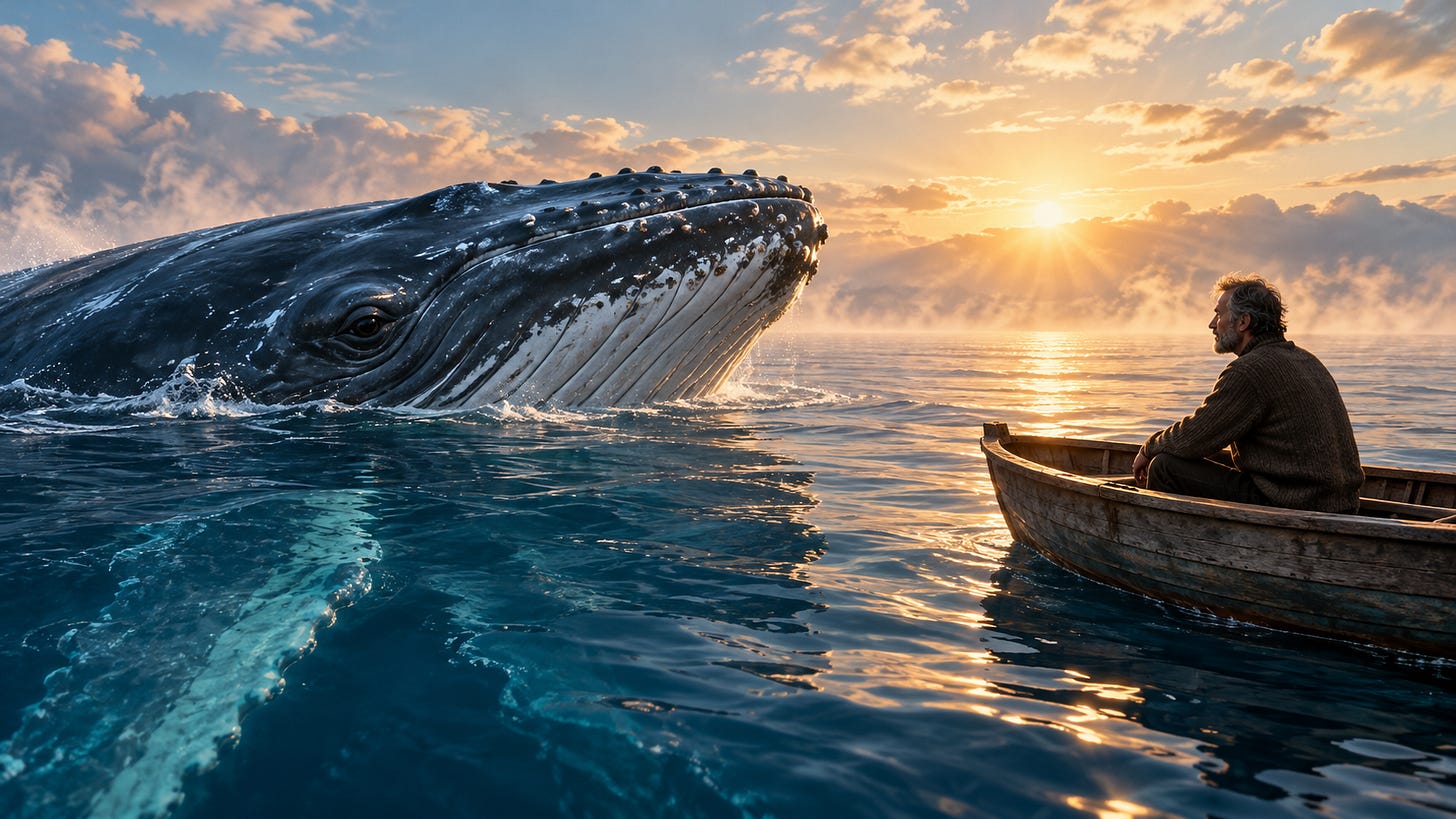
Lawrence’s whales are enormous, sensuous, sexual, playful, parental, and powerful. The mothers nurse their young. The bulls gather around the females and calves when danger threatens. Their strength does not compete with love. It protects love.
The whales bring Moore’s four archetypes together. The Lover supplies delight, sexuality, tenderness, and wonder. The Warrior forms the protective circle. The King preserves the order of life and family. The Magician recognizes the sacred pattern moving through it all.
The poem imagines divinity not as something removed from bodily life but flowing through it. The whales meet, mate, nurture, protect, and move through the great sea in a love beyond human explanation—what Lawrence called love “without words.”
Moore finished the poem and then added, with perfect timing, “That’s why you join Greenpeace.”
The line belongs to the time in which he spoke, and readers may have different opinions about Greenpeace today. But his larger point remains. We do not protect the living world most deeply because a policy tells us to. We protect it because we have learned to experience it as magnificent, vulnerable, sensuous, and valuable in itself.
The Lover makes ecological concern personal. A whale is no longer an abstract representative of biodiversity. It is a living presence—powerful, familial, beautiful, and worthy of protection.
That is the Lover’s final gift. It does not make a man weak. It allows him to feel what his strength is for.
The mature Lover protects the heart without closing it, transmits life without possessing it, and loves the world enough to defend it.
Men Are Good.