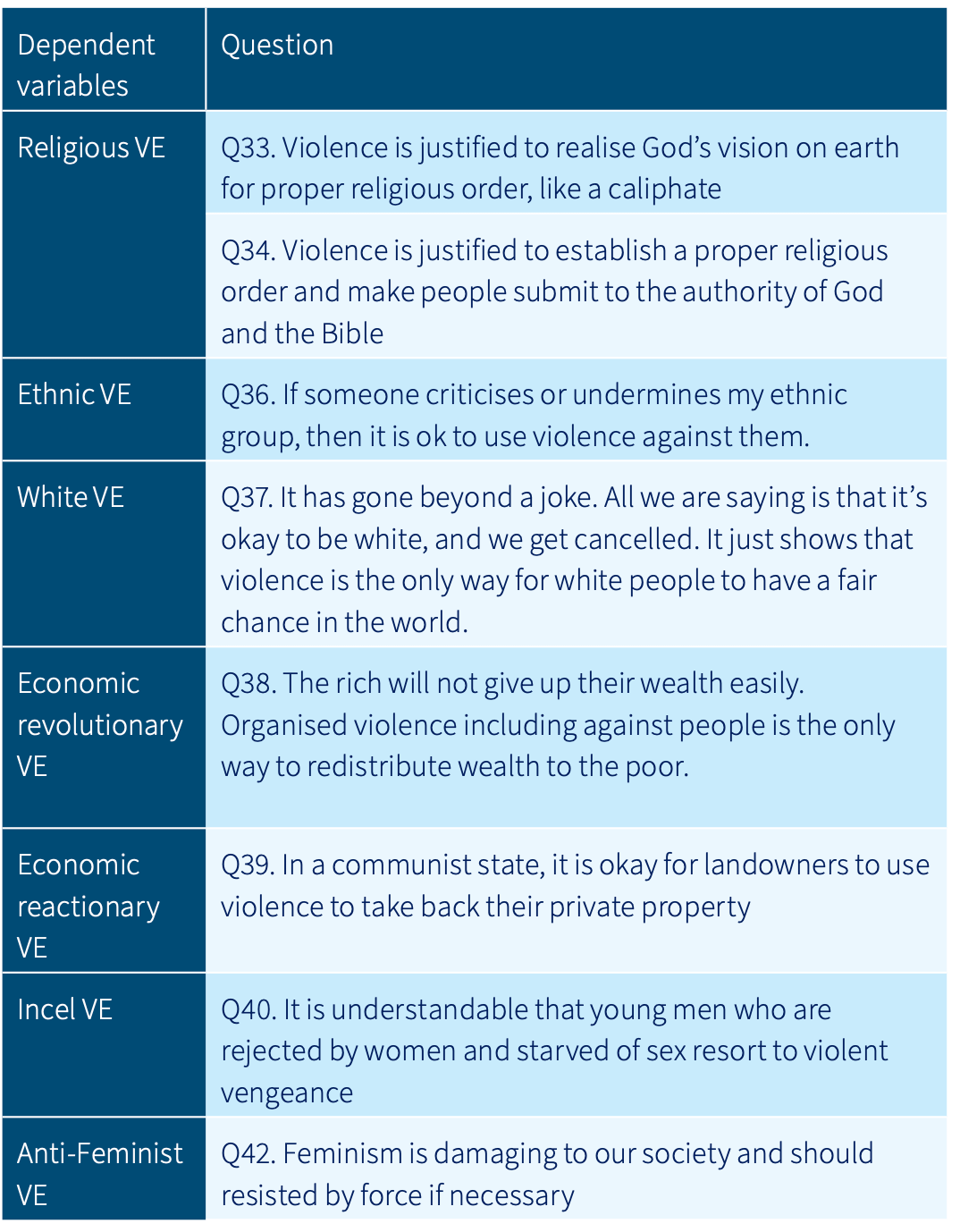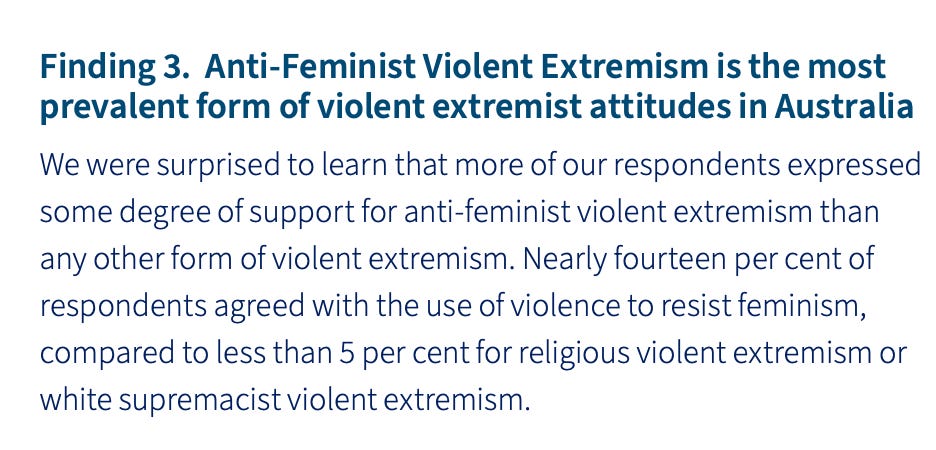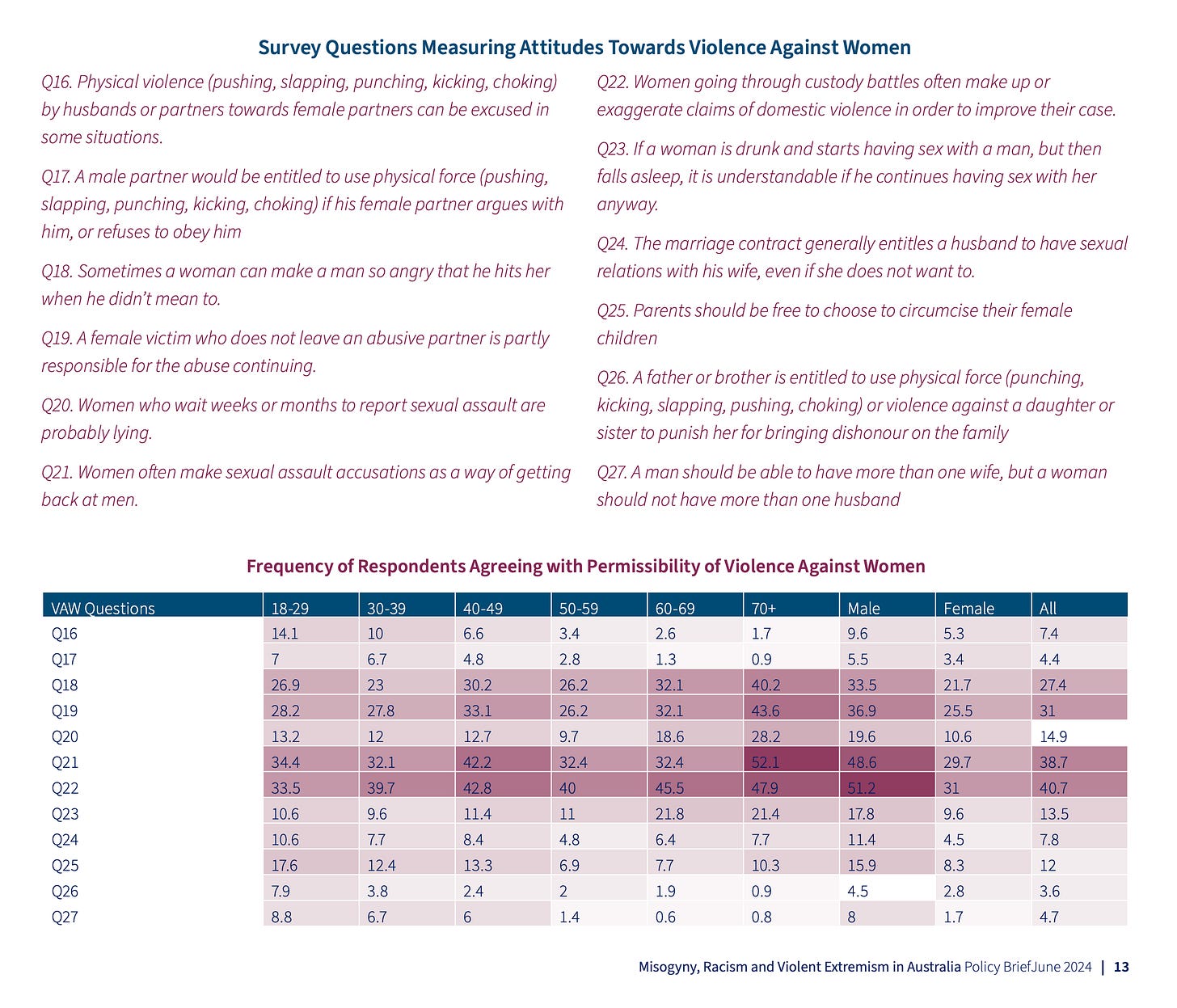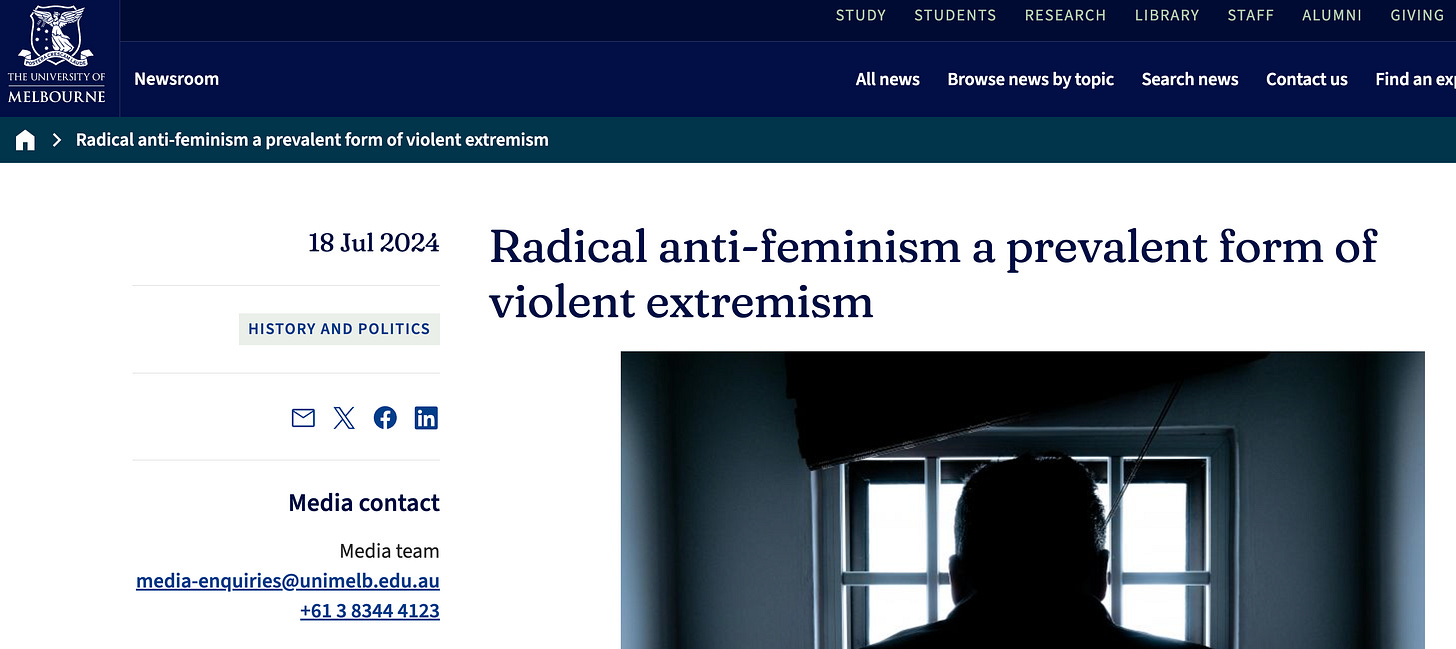





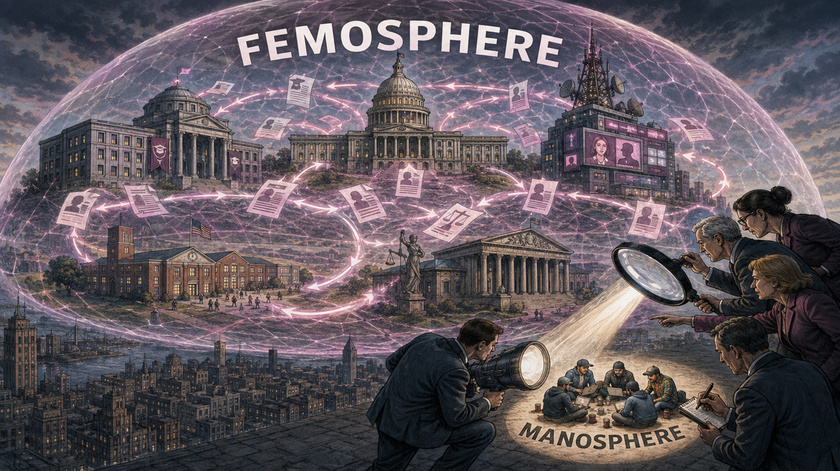
All we hear about these days is a dangerous manosphere that is threatening our young men. Actually the manosphere is a fairly small and widely varied group of male-oriented communities that has been billed as a huge threat. All the while there is something much larger and much more dangerous that is surrounding both the manosphere and our culture. It is embedded in all that we do, I call it the Femosphere. This huge complex contains, academia, education, advocacy organizations, legislatures, government agencies, entertainment, the courts and of course, the media all working together to create and maintain a gynocentric narrative that impacts everyone.
This is the mammoth sphere through which feminist and gynocentric ideas are created, validated, circulated and converted into public policy. It is the invisible system that makes feminist claims seem unquestionably true. This goes on day in and day out and is a huge and destructive machine that no one sees. No one identifies it as ideological or biased in any way. It masquerades as the status quo. If there is a sphere that is dangerous, it is surely the femosphere.
Here’s how it works. A new slogan or concept is created in academia or feminist advocacy and then reinforced by both. The feminist advocates promote it. Journalists print it. The public reads it. Educators teach it. The public learns it. Before you know it, government agencies are incorporating it into trainings and reports. Then the legislators push it into policy and law and the courts follow along using the same ideas that prompted the policies and laws. Unprecedented teamwork, and no one sees it.
Take coercive control as an example. The term was first used by domestic violence advocates who described abuse as an ongoing pattern of control rather than a series of isolated violent acts. Evan Stark pulled these ideas together into a formal theory of coercive control in his book “Coercive Control: How Men Entrap Women in Personal Life (2007)“. (The title states clearly that this was not a gender-neutral theory: men were the oppressors and women were their victims.) Then the feminist advocates promoted it, journalists spread the word, educators and government agencies taught it, and police and courts were trained to use it. Eventually the legislators turned it into law. Hey Presto! The idea of male dominance and men’s violence becomes the default,
There are plenty of other examples like hegemonic masculinity or intersectionality. These all have different paths through the femosphere pipeline but the end product is the same. The specific ideas about male dominance travel from idea to law or common knowledge. The process is similar, an idea about power and male dominance begins in academia or advocacy, moves through the institutions, and eventually gains real social, political and sometimes legal power.
Here’s the tricky part. Each of these groups starts to quote the other groups as proof to the veracity of the original idea. Journalists cite the academics and advocates cite the journalists. Politicians cite both. Then the researchers come along and “study” the reality that has just been created out of thin air and prove it. Then the public hears from these many sources and voila, what started as a theory becomes an accepted reality. Advocacy becomes fact. The public nods unknowingly in agreement.
The manosphere is open season for criticism, targeting, restrictions, and containment. The femosphere is protected by a gynocentric ban on any criticism or even a negative idea in their direction. To expose who has the power just look for who cannot be criticized. That would clearly be the femosphere, women and feminism. In fact, the manosphere is the first public criticism of the femosphere and the response is predictable: Shame it, blame it, and call it pure misogyny. Don’t argue the ideas, attack personally.
This is what we have had for the last 50 years. A slow gynocentric building of a new reality. And what has been the result? Women have been inflated and men have been equally deflated. Ask just about any woman about the last 50 years and she will tell you it is progress. But has it truly been progress—or has it been a one-way transfer of concern, opportunity, and power to women, without any corresponding transfer of responsibility?
And now it is basically impossible to see.
The next time you hear someone complain about the manosphere, ask them when they will be complaining about the real problem, the femosphere.
Men Are Good.