




MenAreGood
MenAreGood is a channel for men, boys, fathers, new fathers, grandfathers and women who want to learn about men and masculinity.  Are you tired of the false narrative of toxic masculinity?  Did you know there is a huge amount of research that shows the positive aspects of men, boys and fathers?  That is what we focus on here, being a source of good information and also a place to connect.   Join us!
Interested? Want to learn more about the community?

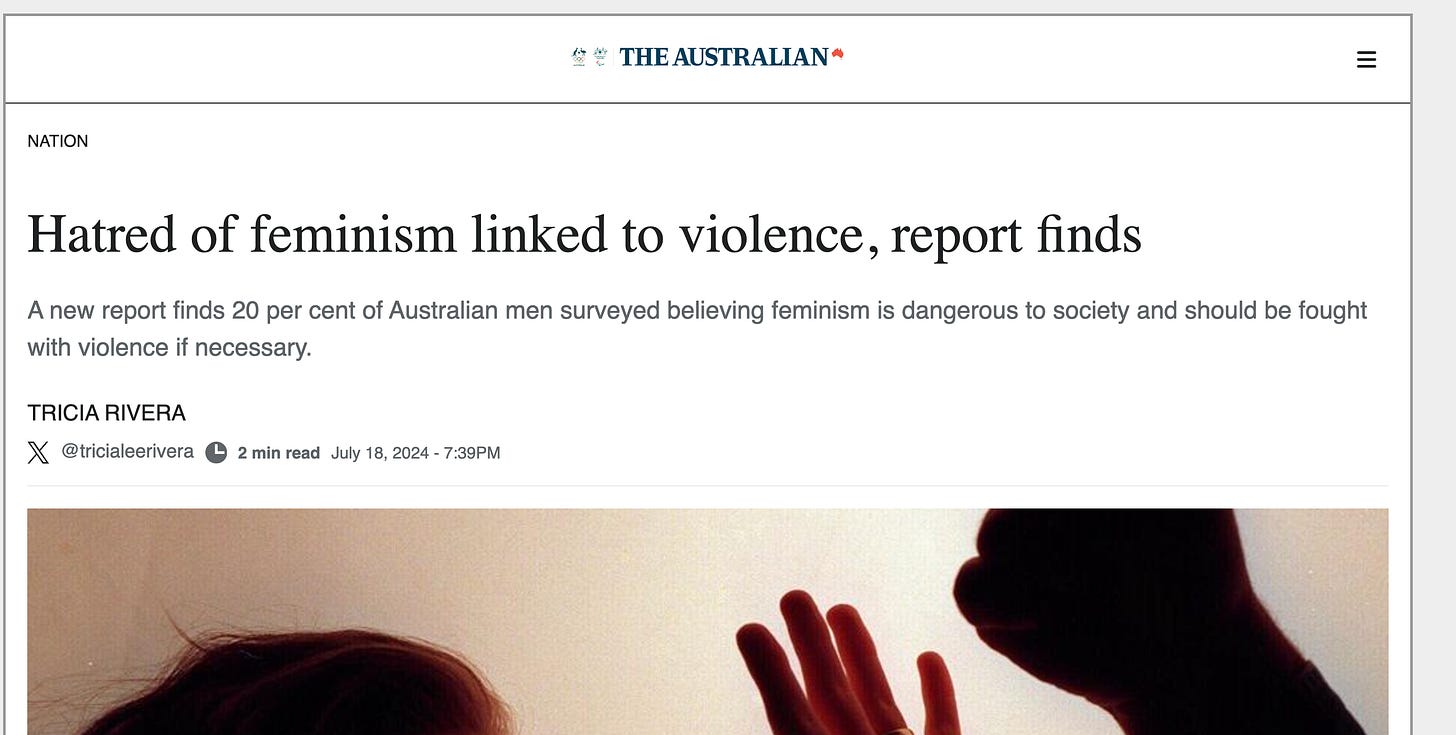
This is a prime example of gynocentrism.
https://www.facebook.com/share/p/1CDbwuPxx2/?

Interested? Want to learn more about the community?
What else you may like…
Videos
Posts
Articles
May 28, 2026
Man Hating Stereotype Debunked? The Tale of Two Hate Studies

The Tale of Two Hate Studies

If you ask feminists whether they hate men, how likely are you to get an honest answer?

That question sits at the center of this discussion. We look at two recent studies that attempt, in very different ways, to measure hatred, misogyny, and misandry. One study examines online communities and finds results that do not fit the usual cultural narrative. The other, titled The Misandry Myth, attempts to reassure us that feminists are not especially hostile toward men.

But the deeper question is not simply whether someone will openly admit to hatred. It is whether contempt, prejudice, dismissal, and “helpful” efforts to correct men can operate under the language of care.

Janice Fiamengo, Hannah Spier, Jim Nuzzo, and I explore how anti-male bias is often hidden in plain sight, why female hostility is routinely excused as justified reaction, and how male suffering is minimized, reframed, or simply erased from public concern.

Men are good, as are you.

01:09:57
April 02, 2026
Are Family Courts at War with the Constitution?

In this conversation, I sit down with longtime scholar and author Stephen Baskerville to take a hard look at modern family courts, no-fault divorce, paternal rights, and the assumptions behind shared parenting. Stephen argues that what many people take for granted in divorce and custody law may be far more troubling than they realize—not only for fathers and children, but for the rule of law itself. Join us in this challenging and thought-provoking discussion that raises questions most people never hear asked.

Stephen's Substack
https://stephenbaskerville.substack.com/

01:02:28
March 30, 2026
Blame it on the Manosphere

This short video takes a humorous look at the current panic among feminists and the media over what they call the manosphere. In reality, the manosphere is one of the places where their false narratives are being exposed. What we are seeing now is the creation of a straw man—something to blame, distort, and use as a distraction from the truth that is coming to light. More and more people are waking up to the game and beginning to see the hostility and self-interest that have been there all along.

(This video was produced largely with AI. I wrote the script, and the music and images were AI-generated.)

Men are Good!

00:03:05
June 04, 2026
Feminism and Liberal Democracy, can liberal democracy survive feminism?

I found this essay both thought-provoking and unsettling. The post examines how ideological capture can occur gradually—not through dramatic political revolutions, but through the accumulation of influence within institutions that are expected to remain impartial. The result is an essay that asks difficult questions about feminism, liberal democracy, and the future of open debate. I think many of you will find it worth your time.

https://critiquingfeminism.substack.com/p/feminism-and-liberal-democracy

I feel heard!! A woman who is honest and blunt. I am going to try to learn more about her

https://www.facebook.com/share/v/1KUgA1NcFj/?mibextid=wwXIfr

Hopefully this cartoonwill become as common as the subject it covers

https://www.facebook.com/share/r/1E37iKw2LX/?mibextid=wwXIfr

post photo preview
New Web Site - thewaymenheal.com
 

For many years, people have asked me essentially the same question:

“Where can I find a simple explanation of how men heal?”

The answer has never been easy.

Over the last three decades I have written books, articles, blog posts, newsletters, and given countless interviews and workshops. The ideas are scattered across many places.

Recently I decided it was time to gather them into one place.

Today I’m pleased to introduce a new website:

TheWayMenHeal.com

The site is not a blog and it is not a therapy website.

Instead, it is an attempt to clearly explain many of the core ideas that have emerged from my work with men, women, boys, girls, grief, trauma, and healing over the past 35 years.

You’ll find sections on:

  • Why men’s emotions are often difficult to see

  • Action-oriented emotional processing

  • Shame and dignity

  • Solitude

  • Grief

  • The masculine side of healing

  • Research related to men’s emotional lives

  • A glossary of important concepts

  • Frequently asked questions

One of the things I have learned over the years is that many people genuinely care about men but often misunderstand how men experience emotional pain.

Men’s healing frequently occurs in ways that are easy to overlook. We tend to notice tears, talking, and emotional disclosure. We are less likely to notice action, responsibility, service, problem solving, solitude, ritual, and purpose.

Yet these pathways are often central to men’s emotional lives.

My hope is that this site will serve as a practical and accessible resource for anyone who wants to better understand men, whether that person is a therapist, parent, spouse, partner, teacher, researcher, or simply someone trying to make sense of their own experience.

The site is still growing and will continue to expand over time.

I invite you to explore it and let me know what you think.

TheWayMenHeal.com

I hope it proves useful.

Here’s an excerpt from the boys and play sectionn
— Tom


Boys, Play, and Development

Research on play, movement, and rough-and-tumble interaction helps explain why boys often need active, physical, socially negotiated forms of learning and emotional regulation.


Many boys learn through their bodies before they learn through words. They move, chase, wrestle, compete, test limits, take small risks, laugh, fall, get back up, and negotiate rules in the middle of action.

To adults who are uncomfortable with active boyhood, this can look like disorder. But research on play suggests that physical play is not merely noise, chaos, or pre-aggression. It can be a crucial part of development.

Rough-and-tumble play, recess, movement, and active peer interaction help children practice self-control, read social signals, manage intensity, test boundaries, and learn how to stay connected while excited.

When normal boyhood energy is treated as a problem, boys may lose one of the natural pathways through which they learn regulation, relationship, and resilience.

Rough-and-Tumble Play Is Not the Same as Aggression

Researchers have long distinguished rough-and-tumble play from real aggression. Rough-and-tumble play may include chasing, wrestling, mock fighting, tumbling, laughing, fleeing, returning, and exaggerated physical movement. Aggression, by contrast, is marked by intent to harm, distress, coercion, or domination.

This distinction is essential.

When adults cannot tell the difference between play fighting and real fighting, boys’ normal play can be misread as dangerous or disruptive. That misreading may lead to unnecessary discipline, restricted movement, and the loss of important developmental experience.

Good supervision matters. Children need boundaries. But eliminating rough play entirely may remove opportunities for boys to learn how to manage strength, excitement, consent, restraint, and repair.

What Boys Learn Through Active Play

Active play teaches lessons that are hard to deliver through lectures.

Through physical play, boys often learn:

  • how hard is too hard,

  • when another child is no longer having fun,

  • how to stop,

  • how to re-enter play after conflict,

  • how to manage winning and losing,

  • how to read faces and body language,

  • how to negotiate rules,

  • how to take turns leading and following,

  • and how to keep excitement from becoming harm.

These are not trivial skills. They are social and emotional regulation skills.

In other words, active play may be one of the ways boys learn empathy, self-control, boundaries, and connection.

Movement as Regulation

Many boys regulate emotion and attention through movement. Sitting still for long periods may be especially difficult for boys who need active engagement in order to organize themselves.

Recess, outdoor play, physical education, and unstructured movement are not luxuries. They can be part of how children reset attention, discharge tension, build social competence, and return to learning.

This connects strongly to the broader theme of action-oriented emotional processing. For many males, from boyhood into adulthood, movement helps emotion and stress become manageable.

Play and the Social Brain

Jaak Panksepp emphasized the importance of play systems in mammalian development. His work suggested that rough-and-tumble play is rooted in ancient brain systems and helps young mammals develop social subtlety, self-regulation, and sensitivity to others.

This perspective is important because it frames play not as an optional extra, but as a biological and social need.

Boys who are drawn to rough physical play may not simply be acting out. They may be seeking developmental experiences their brains and bodies need.

When Schools Misread Boys

Schools often reward quiet, verbal, compliant, sedentary behavior. Those are useful capacities. But when they become the only accepted model of maturity, many boys are placed at a disadvantage.

Boys who need movement may be viewed as disruptive. Boys who learn through action may be viewed as inattentive. Boys who enjoy rough play may be viewed as aggressive. Boys who compete may be viewed as insensitive.

Some boys do need help learning restraint, empathy, and self-control. But those capacities may develop better through guided play than through constant suppression.

When normal active development is treated primarily as pathology, boys may begin to experience themselves as problems.

The Link to Male Emotional Development

Boys’ play is not separate from men’s emotional lives. It is one of the roots.

If boys learn to regulate emotion through movement, competition, risk, humor, physicality, and shared action, then we should not be surprised when adult men continue to process emotion through action, work, exercise, solitude, problem-solving, and side-by-side activity.

The adult masculine side of healing may have developmental roots in boyhood patterns of learning through the body.

This does not mean boys should be left unmanaged or that all rough behavior is healthy. It means boys need adults who can distinguish development from disruption and energy from aggression.

A Humane Interpretation

Boys need language. They need empathy. They need self-control. They need emotional awareness. But they may not always acquire these capacities through stillness and verbal instruction alone.

Many boys need movement, play, risk, contact, competition, laughter, boundaries, correction, and freedom.

A culture that misunderstands boys’ play may later misunderstand men’s emotional lives. The same boy who once needed to run, wrestle, build, and test limits may become the man who needs to walk, work, repair, exercise, drive, or create in order to process emotion.

When we understand boys more accurately, we begin building a more humane understanding of men.


References

  • Pellegrini, A. D. (1989). Elementary school children’s rough-and-tumble play. Early Childhood Research Quarterly, 4(2), 245–260.

  • Scott, E., & Panksepp, J. (2003). Rough-and-tumble play in human children. Aggressive Behavior, 29(6), 539–551.

  • Flanders, J. L., Simard, M., Paquette, D., Parent, S., Vitaro, F., Pihl, R. O., & Séguin, J. R. (2009). Rough-and-tumble play and the regulation of aggression: An observational study of father-child play dyads. Aggressive Behavior, 35(4), 285–295.

  • Panksepp, J. (2008). Play, ADHD, and the construction of the social brain: Should the first class each day be recess? American Journal of Play, 1(1), 55–79.

  • Smith, P. K. (2023). Play fighting (rough-and-tumble play) in children. International Journal of Play, 12(1), 1–20.

Read full Article
June 01, 2026
post photo preview
How Feminists have used Relational Aggression

Physical aggression has rightly been recognized as harmful and unacceptable. We understand that threats, intimidation, and violence can be used to control others, and society has developed powerful norms to discourage such behavior. Relational aggression, by contrast, often remains largely invisible. Instead of fists, it uses shame, exclusion, reputation damage, moral condemnation, and social pressure to influence behavior. While less obvious than physical aggression, it can be equally effective as a tool of manipulation and intimidation. Before examining how some feminists employ these tactics, it is worth understanding the nature of relational aggression itself.


How Feminists have used Relational Aggression

One of the most useful ways to understand feminism is not simply as a political ideology, but as a cultural system that often uses relational aggression to gain compliance.

Relational aggression does not usually rely on physical force. It works through shame, exclusion, reputation damage, social pressure, emotional manipulation, and control of the story. It attacks a person’s standing, belonging, credibility, and right to speak.

At the personal level, we see this in relationships when one partner uses guilt, withdrawal, public shaming, triangulation, or accusations to silence the other. But the same mechanisms can operate at the cultural level. When they do, the target is no longer just one person. The target can become an entire group.

That is what has happened with men.

Radical feminist leaders often begin with a claim of female injury. Some of those injuries are real. Both men and women have suffered in many ways, and no honest person needs to deny that. But the problem begins when female injury becomes the only injury that matters. Once that happens, male suffering is minimized, mocked, or reframed as deserved.

This is where gynocentrism becomes useful. Our culture already has a deep tendency to see women as more vulnerable, more innocent, and more deserving of protection. Feminism did not create that tendency. It learned to use it.

At first, gynocentrism provided moral energy for reform. “Look at women’s suffering,” the movement said. “Look at the ways women have been ignored.” That argument had power because people are naturally moved by female distress.

But over time, that same protective instinct became a weapon. Female suffering became a shield against scrutiny. Male disagreement became evidence of male defect. Questioning the ideology became “misogyny.” Asking about male victims became “derailing.” Defending boys became “protecting patriarchy.”

This is relational aggression scaled up into culture.

The most obvious form is shaming. Men are routinely described with terms such as toxic, fragile, entitled, privileged, dangerous, emotionally stunted, oppressive, and predatory. These are not neutral descriptions. They are moral labels. Their purpose is not merely to describe men, but to lower men’s social standing.

Another form is reputation attack. Men who question feminist narratives are not usually answered directly. They are often labeled. They are called sexist, misogynist, incel, abuser, patriarchal, fragile, or hateful. The accusation becomes the argument. Once the label lands, the man is placed outside the circle of acceptable speech.

Then comes social exclusion. Men are told, directly or indirectly, that they do not get a voice in conversations about family, violence, education, sexuality, fatherhood, divorce, or even masculinity. If they speak, they are accused of centering themselves. If they remain silent, their silence is taken as consent. Either way, their position is controlled.

Feminism also uses narrative control. It defines the moral story in advance: women are harmed; men are harmful. Women are victims; men are agents. Women need protection; men need correction. Once this frame is accepted, every fact is filtered through it. Female aggression becomes trauma. Male distress becomes entitlement. Female fear becomes wisdom. Male fear becomes threat.

This is why male suffering is so often invisible. It does not fit the approved story.

There is also manipulative victimhood. This does not mean that women are not sometimes victims. Of course they are. It means that victimhood can become a source of social power when it is used to end discussion, demand obedience, or shield one group from criticism. In feminist hands, the claim “women are harmed” often becomes “therefore women must not be questioned.”

That is a dangerous move.

In a healthy culture, compassion does not eliminate accountability. But in an ideologically captured culture, compassion for one group can become permission to attack another.

Coalition building is another major tool. Feminist ideas have moved through universities, nonprofits, media, government agencies, HR departments, family courts, professional licensing boards, and therapeutic institutions. Once these institutions adopt the same basic narrative, dissent becomes risky. People learn what can and cannot be said.

The genius of relational aggression is that it rarely requires direct control. It operates through fear. Judges fear being portrayed as sexist. Politicians fear losing votes, donations, or public support. University administrators fear activist campaigns. Journalists fear professional ostracism. Therapists fear licensing complaints. The fear need not be constant; it merely needs to be credible. Once enough people understand the social penalties attached to dissent, most will censor themselves without being asked. Institutions then become amplifiers of the narrative, teaching the public what is acceptable to think and say. The population is not usually controlled through force but through reputational risk. People learn which opinions bring approval and which invite punishment. That is how a relatively small but highly motivated ideological movement can exert influence far beyond its actual numbers.

This is where relational aggression becomes institutionalized. It is no longer simply one activist shaming one man. It is an entire network of institutions, incentives, and reputational pressures signaling that certain questions are unsafe.

Can we talk about female violence?
Can we talk about male victims?
Can we talk about false accusations?
Can we talk about boys falling behind?
Can we talk about father loss?
Can we talk about women’s relational aggression?

Often the answer is no — not because the questions are invalid, but because the questions threaten the protected narrative.

Another powerful tool is emotional blackmail. The message is simple: if you care about women, you must accept the feminist frame. If you question the frame, you must not care about women. This traps good people. Many men and women remain silent not because they agree, but because they do not want to be seen as cruel.

That silence is one of feminism’s greatest victories.

Gaslighting also plays a central role. Men are told that the double standards they see are not real. They are told family courts are fair. They are told male victims have equal support. They are told boys are not being shamed. They are told “toxic masculinity” does not really mean men are toxic. They are told their objections are overreactions.

But many men know what they are seeing. They simply learn not to say it out loud.

The #MeToo movement provides a revealing example of how relational aggression can operate on a societal scale. Some women came forward with genuine experiences of harassment and abuse, and those stories deserved to be heard. But alongside those legitimate concerns emerged a cultural dynamic in which accusation itself often carried extraordinary power. In many cases, the mere allegation of misconduct could trigger immediate reputational damage, job loss, social ostracism, and public condemnation long before any formal investigation occurred. The fear was not simply legal punishment. It was social punishment.

The slogan “Believe Women” (often remembered by critics as “Believe All Women”) illustrates how relational aggression can operate through moral pressure. On the surface, the message appeared compassionate: take women’s reports seriously rather than dismissing them out of hand. But in practice, the slogan often carried a second message: questioning an accusation could itself become evidence of moral failure. Those who expressed skepticism, asked for evidence, or advocated due process risked being portrayed as insensitive, sexist, or complicit in abuse. The social pressure did not merely encourage belief; it raised the reputational cost of doubt. In that sense, the slogan functioned as a powerful relational tool. It shifted attention away from evaluating claims and toward evaluating the character of anyone who hesitated to accept them. The question was no longer simply, “Is this accusation true?” It increasingly became, “What kind of person are you if you do not believe it?” That is one of the hallmarks of relational aggression: using the threat of social condemnation to discourage disagreement and enforce conformity.

What made this dynamic especially powerful was that few institutions wanted to be seen as insufficiently supportive of women. Employers feared public backlash. Universities feared activist pressure. Politicians feared being portrayed as insensitive to victims. Journalists feared appearing unsympathetic. As a result, many organizations responded to accusations with rapid displays of compliance, often treating skepticism as moral failure. The social cost of questioning an allegation could become greater than the social cost of accepting it.

This does not mean all accusations were false. It means the movement demonstrated how powerful reputational threats can become when combined with moral urgency. The lesson is not that victims should be ignored. The lesson is that fear, shame, and public condemnation can become tools of social control when institutions conclude that appearing supportive is more important than careful examination. In that sense, #MeToo revealed how relational aggression can move beyond individual relationships and become a cultural force capable of influencing institutions, public discourse, and individual behavior.

Perhaps the most damaging form of relational aggression is the cultural accusation. A false personal accusation can destroy one man’s reputation, relationships, work, and sense of safety. But a cultural accusation works more broadly. It places a cloud of suspicion over men as a class.

Men are not accused one at a time. They are accused collectively.

Men are told they are privileged, dangerous, oppressive, emotionally defective, sexually suspect, and morally in need of correction. Boys grow up breathing this air. They may not have done anything wrong, but they inherit the accusation.

That has consequences.

A boy who is repeatedly told that masculinity is dangerous may begin to distrust himself. A man who hears constant contempt for men may withdraw. A father who is treated as optional may lose confidence. A husband who is afraid to speak honestly may disappear inside his own marriage.

This is the hidden power of relational aggression. It does not merely silence speech. It reshapes identity.

And yet, many of the people participating in this do not experience themselves as aggressive. They experience themselves as virtuous. They believe they are standing up for women, fighting oppression, protecting the vulnerable, or correcting injustice. That is what makes the pattern so difficult to confront.

Relational aggression often hides behind moral language.

The feminist leader may not say, “I want to silence men.” She says, “Men need to listen.”
She may not say, “I want to shame boys.” She says, “We need to challenge toxic masculinity.”
She may not say, “Male victims do not matter.” She says, “This is not the time to center men.”
She may not say, “Dissent must be punished.” She says, “We must hold people accountable.”

The phrase “toxic masculinity” also functions as a powerful tool of relational aggression. Supporters often argue that the term refers only to specific harmful behaviors, not to men themselves. Yet many men experience the phrase very differently. They hear a cultural message that links masculinity with danger, dysfunction, violence, emotional deficiency, and social harm. The power of the term lies not merely in its definition but in its social effect. Once masculinity is associated with toxicity, men are placed in a defensive position. They are expected to prove that they are not toxic. If they object to the label, their objection is often interpreted as further evidence of the problem. If they ask for clarification, they may be told they are fragile. If they defend traditionally masculine traits such as competitiveness, stoicism, risk-taking, or protectiveness, they risk being accused of supporting harmful norms. In this way, the phrase operates less as a description and more as a moral framing device. It lowers the social standing of the target group while making resistance appear suspect. Rather than encouraging understanding, it often pressures men to distance themselves from their own identity in order to gain social approval. That is a classic feature of relational aggression: using shame and reputational pressure to reshape behavior without the need for direct coercion.

The language sounds moral. The impact is often coercive.

This distinction matters. Many women who repeat these ideas are not consciously trying to hurt men. Many are following the emotional current of the group. In-group bias is powerful. If the women around you all nod at the same slogans, if institutions reward the same language, if dissent risks social punishment, it becomes much easier to go along.

That is not unique to feminism. It is human. Groups protect their stories. Movements defend their moral identities. People prefer belonging to isolation.

But this does not make the harm any less real.

The challenge is to name the pattern without demonizing every person caught inside it. Not all feminists use relational aggression. Not all women accept these ideas. Many women love men deeply and are confused by the cultural hostility they have been taught to absorb.

The real issue is the ideological leadership and the institutional incentives that reward one-sided narratives.

Feminism has been effective not simply because it made arguments, but because it learned to control the social cost of disagreement. It learned how to use shame, exclusion, moral labeling, victim status, and reputational threat to make dissent feel dangerous.

That is relational aggression.

And once we see it, we can begin to understand why so many men remain quiet.

They are not silent because they have nothing to say.
They are silent because they know what happens when they say it.

Men Are Good.

Read full Article
May 25, 2026
post photo preview
The Quiet Work That Changed How We See Male Victims
What Denise Hines and Emily Douglas’s research actually shows—and why it matters

Over the years, many important voices in the field of men’s issues have done careful, courageous, and often overlooked work. Too often, that work receives little public recognition despite the profound impact it has had on understanding the lives of men and boys.

I have been thinking that one small way to help address that is to occasionally highlight and honor some of the researchers, clinicians, writers, and advocates who have contributed meaningful insights to these conversations. Denise Hines and Emily Douglas immediately came to mind.

Their work has helped shine light on areas of male suffering that were too often ignored, minimized, or simply unseen. I hope to continue doing more pieces like this from time to time as a way of acknowledging those who have helped move these conversations forward. Let me know in the comments if you have suggestions for other contributors to highlight.


For many years, the public narrative around domestic abuse was presented with great certainty: women were the victims, and men were the perpetrators. That message became deeply embedded in the media, public policy, academic culture, and even parts of the research world itself. Questioning the narrative was often treated with suspicion or hostility.

What was needed was not outrage or counter-ideology, but careful research. What was needed were solid, research-based indicators showing that male victims were a real and measurable part of the human landscape of domestic abuse.

That is the path Denise Hines and Emily Douglas took. Their work did not rely on slogans or political framing. It relied on careful observation, rigorous methodology, and a willingness to look directly at experiences that much of the culture preferred not to see. Because of that, their work has become some of the most important research we have for understanding male victims—not as abstractions or talking points, but as human beings.

Starting Where Good Research Starts: Who Are These Men?
One of the most important decisions Hines and Douglas made early on was methodological. Instead of trying to infer male victimization from general population surveys—where men often underreport or minimize—they looked directly at men who were actively seeking help for abuse from female partners. That matters because it answers a question that is often left vague: What does male victimization look like when it is serious enough that a man actually reaches out? What they found was not trivial. These were not men complaining about minor conflicts or occasional arguments. These were men reporting patterns of coercive control, physical violence, psychological abuse, and, in many cases, fear. In other words, when men do come forward, they often look much more like what we already recognize as victims.

The Myth of “It Doesn’t Affect Men That Much”

One of the quiet assumptions in the culture has been that even if men are victims, the impact is somehow less. Hines’s and Douglas’s work challenges that directly. Across multiple studies, they found that male victims—especially those who seek help—show significant levels of psychological distress, including symptoms consistent with post-traumatic stress, depression, anxiety, and hypervigilance—the same kinds of responses we would expect in any person exposed to chronic interpersonal harm. This is one of those moments where good research does something very simple but very powerful. It removes the ambiguity. It tells us this is not harmless. It leaves a mark. Once that becomes clear, it becomes much harder to dismiss.

The Hidden Barrier: Trying to Get Help

If there is one area where Hines and Douglas’s work is especially illuminating, it is here. They did not just ask whether men are abused. They asked what happens when they try to get help. The answers are sobering. Men in their studies reported not being believed, being assumed to be the perpetrator, being laughed at or dismissed, being turned away from services, and being told, directly or indirectly, that those services were not for them.This is where the research begins to intersect with something many clinicians quietly observe. It is not just that men hesitate to seek help. It is that they often have good reason to expect that help will not be there. And when that expectation is confirmed even once, it becomes a powerful deterrent.

A System Built With a Different Default
They also looked at the structure of services themselves. What they found was not necessarily overt hostility, but something more subtle and, in many ways, more consequential. Domestic violence services were largely designed with a default image of the victim: a woman, often with children, needing protection from a male partner. That model has helped many people. But it also creates blind spots. When a man walks into that same system, he does not match the template. And when someone does not match the template, systems often do not know what to do with them. Their research shows that male victims can find themselves in a kind of institutional limbo—not fully recognized, not fully excluded, but not truly served.

Severity Matters: This Is Not Just “Mutual Conflict”
Another important contribution of their work is clarity around severity and risk. There has been a long-standing debate in the literature about whether partner violence is symmetrical or asymmetrical, minor or severe, mutual or one-sided. Hines and Douglas cut through much of that by focusing on men who are clearly on the receiving end of serious abuse. While their core studies focus on help-seeking men (rather than general prevalence), their findings align with a larger body of research showing that a meaningful minority of men experience serious partner violence—often bidirectional in milder cases, but with clear patterns of one-sided severe abuse in the cases that reach crisis levels. Their research identifies patterns of coercive control, incidents of severe physical violence, cases involving weapons or threats, and situations where men report fear for their safety. That matters because it shifts the conversation. It is no longer about abstract percentages or ideological positions. It becomes about real cases where the question is not whether something happened, but how serious it was.

The Overlooked Layers: Sexual Victimization, Children, and Legal/Administrative Aggression

Two areas where Hines and Douglas’s work has been especially important, but less widely discussed, are sexual victimization and children’s exposure to abuse in these households. Their research shows that some male victims also report sexual coercion or aggression, something that is rarely acknowledged in public discourse. And in households where men are victims, children are often present and affected. They have also highlighted how some perpetrators use legal and administrative tools—threats of false accusations, restraining orders, or manipulation of child custody—as instruments of control. These “hidden” tactics compound trauma for male victims and have direct consequences for their children. This broadens the frame. It reminds us that when male victimization is ignored, it is not only men who are overlooked.

Recent Milestones
Hines and Douglas’s influence continues to grow. In 2025 they co-edited (along with Louise Dixon) The Routledge Handbook of Men’s Victimization in Intimate Relationships, an international synthesis drawing on contributors from five continents. Hines and Douglas have also led important international comparisons of help-seeking experiences across English-speaking countries. More recently, Hines received a $1 million grant to study male victims from Black and Latino communities—groups that face additional layers of stigma and barriers.

Positive Developments
Encouragingly, their work—along with that of other researchers—has informed training for law enforcement (including FBI sessions) and helped expand awareness. Some regions have begun piloting male-inclusive services, though systemic change remains slow.

What Their Work Does Not Do
This may be just as important. Their research does not argue that men suffer more than women. It does not deny female victimization. It does not rely on inflated or speculative statistics to make its case. Instead, it does something much harder to dismiss. It asks us to look carefully, measure clearly, and report honestly. What emerges is not a counter-narrative so much as a more complete picture.

Why This Matters Now
There is a real temptation, especially in today’s climate, to respond to one-sided narratives with equal and opposite claims. But that path is fragile. When the evidence is stretched, it eventually snaps back. And when it does, the people we were trying to advocate for can be dismissed right along with it. That is why work like Denise Hines and Emily Douglas matters so much. It gives us something solid. It allows us to say that male victims exist in meaningful numbers, that some suffer severe and traumatic abuse, that many face real barriers to being recognized and helped, and that systems are not always equipped to respond to them—without exaggeration, distortion, or apology.

A Different Kind of Clarity
In the end, what their work offers is not outrage. It offers clarity. And clarity, if we are willing to sit with it, has a quiet power of its own. Because once you truly see something, it becomes very hard to go back to not seeing it. We owe Denise Hines and Emily Douglas a real debt of gratitude for having the courage and persistence to help us see more clearly.


Dixon, L., Hines, D. A., & Douglas, E. M. (Eds.). (2025). The Routledge handbook of men’s victimization in intimate relationships. Routledge. https://doi.org/10.4324/9781003144939

Hines, D. A., & Douglas, E. M. (2016). Sexual aggression experiences among male victims of physical partner violence: Prevalence, severity, and health correlates for male victims and their children. Archives of Sexual Behavior, 45(5), 1133–1151. https://doi.org/10.1007/s10508-014-0393-0

Douglas, E. M., & Hines, D. A. (2016). Children’s exposure to partner violence in homes where men seek help for partner violence victimization. Journal of Family Violence, 31, 473–485. https://doi.org/10.1007/s10896-015-9783-x

Hines, D. A., & Douglas, E. M. (2015). Health problems of partner violence victims: Comparing help-seeking men to a population-based sample. American Journal of Preventive Medicine, 48(2), 136–144. https://doi.org/10.1016/j.amepre.2014.08.022

Hines, D. A., & Douglas, E. M. (2009). Women’s use of intimate partner violence against men: Prevalence, implications, and consequences.

Douglas, E. M., & Hines, D. A. (2011). The helpseeking experiences of men who sustain intimate partner violence: An overlooked population and implications for practice. Journal of Family Violence, 26, 473–485. https://doi.org/10.1007/s10896-011-9382-4

Hines, D. A., & Douglas, E. M. (2011). Symptoms of posttraumatic stress disorder in men who sustain intimate partner violence: A study of helpseeking and community samples. Psychology of Men & Masculinity, 12(2), 112–127. https://doi.org/10.1037/a0022983

Read full Article
See More
Available on mobile and TV devices
google store google store app store app store
google store google store app tv store app tv store amazon store amazon store roku store roku store
Powered by Locals