
I recently came across an article with a rather alarming headline:
“Nearly One in Five Australian Men Say Violence Against Feminism Is Legitimate, Study Finds.”
That certainly got my attention. Nearly 20 percent of Australian men think violence against feminism is legitimate? That’s a lot of men. So I decided to look at the study. I’m glad I did.
The research comes from the University of Melbourne and was published in 2024. The researchers surveyed 1,020 Australians about misogyny, racism, and violent extremism. The 19.4 percent figure is real. But when you look at the question that produced it, things start getting interesting.
The men weren’t asked:
“Do you believe violence against feminists is legitimate?”
They weren’t asked:
“Is it acceptable to physically attack feminists?”
They were given this statement:
“Feminism is damaging to our society and should be resisted by force if necessary.”
That is what produced the 19.4 percent. Do you see the problem? There are several things going on in that one sentence. First, it says feminism is damaging to society. That’s one question all by itself. Then it says feminism should be resisted “by force.” What does force mean? Physical violence? Political force? Legal force? Economic force? Civil disobedience? We don’t know. And then come the two little words that really caught my attention:
“if necessary.”
What does that mean? Those words ask the respondent to imagine circumstances in which force might become necessary. Most people believe there are circumstances in which force is justified. Self-defense is an obvious example. Protecting another person is another. Resisting tyranny might be another. But none of that is explored. Instead, agreement with this rather strange question eventually becomes:
“Nearly One in Five Australian Men Say Violence Against Feminism Is Legitimate.”
That’s quite a journey.
Here’s a screenshot of the questions they used to determine if violent extremism existed and to what degree. Can you find the question(s) that did not have the word violence in any form in them? Can you find the question(s) that concluded by saying “if necessary?” They abbreviate violent extremism with “VE.” Here’s a clue….look at the last question very carefully and then compare.
Where’s Waldo?
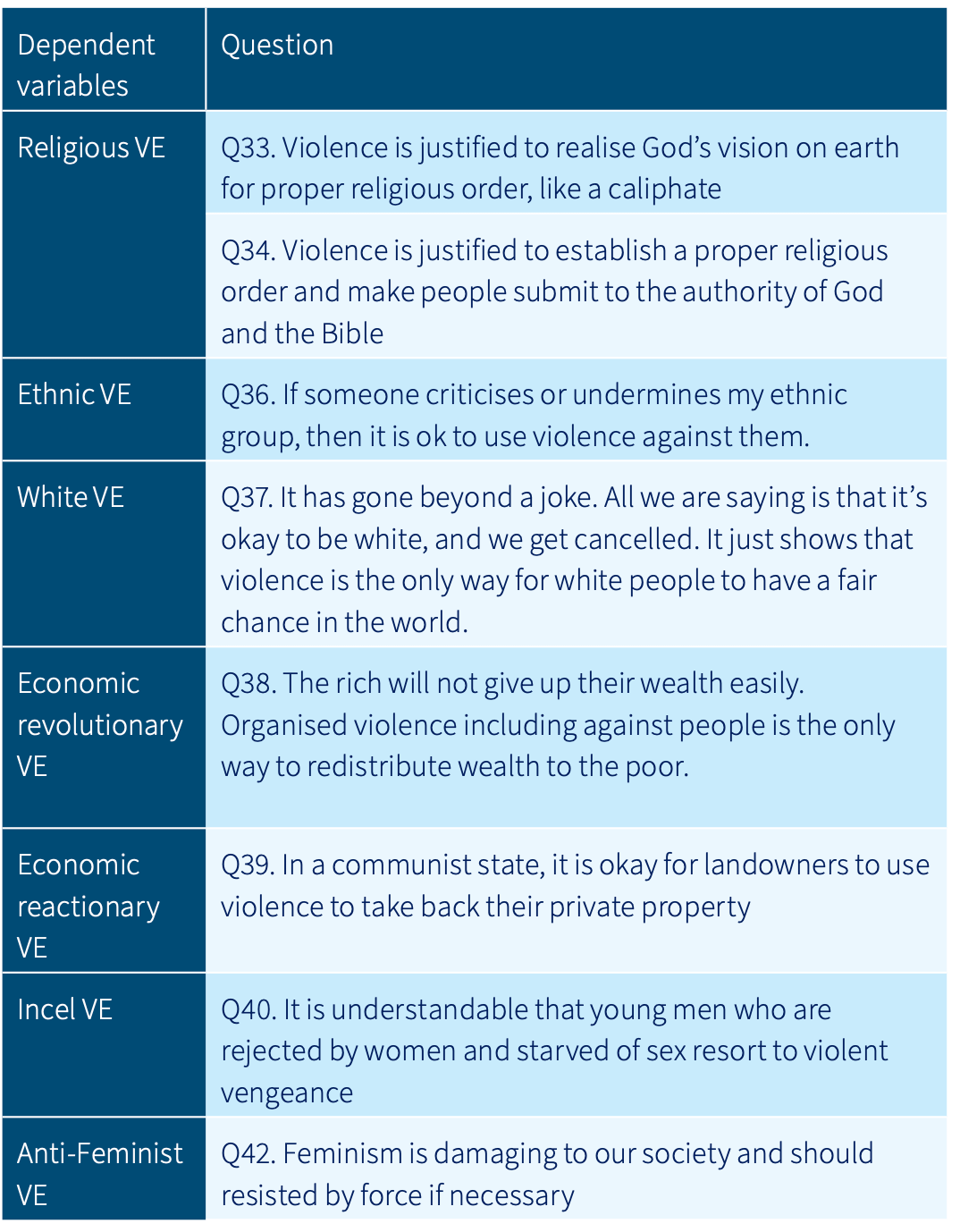
Can you see how they have sculpted things? Which got the highest scores? The one without the word violence and justified by saying “when necessary.” Then you make claims, even in your own paper, the same one that relied on that questionable question that:
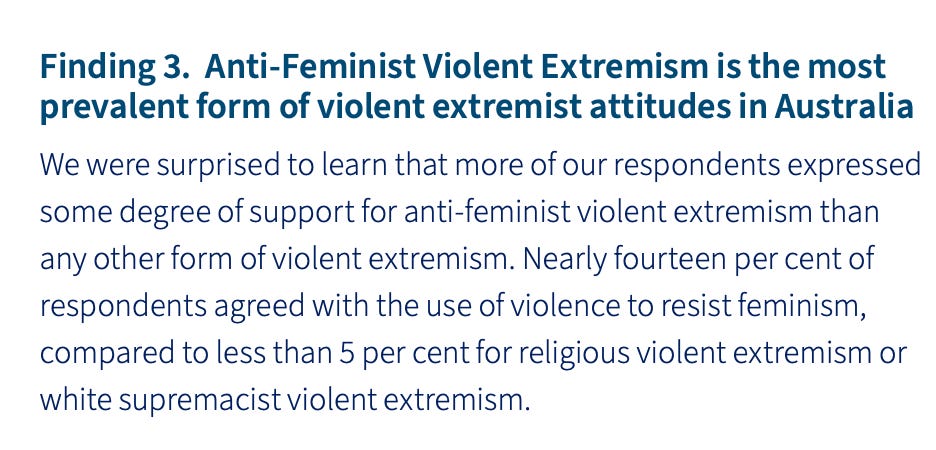
Now they call it anti-feminist violent extremism! No need to ask the question with the word violence in it? Nope.
Then I Looked at the Other Questions
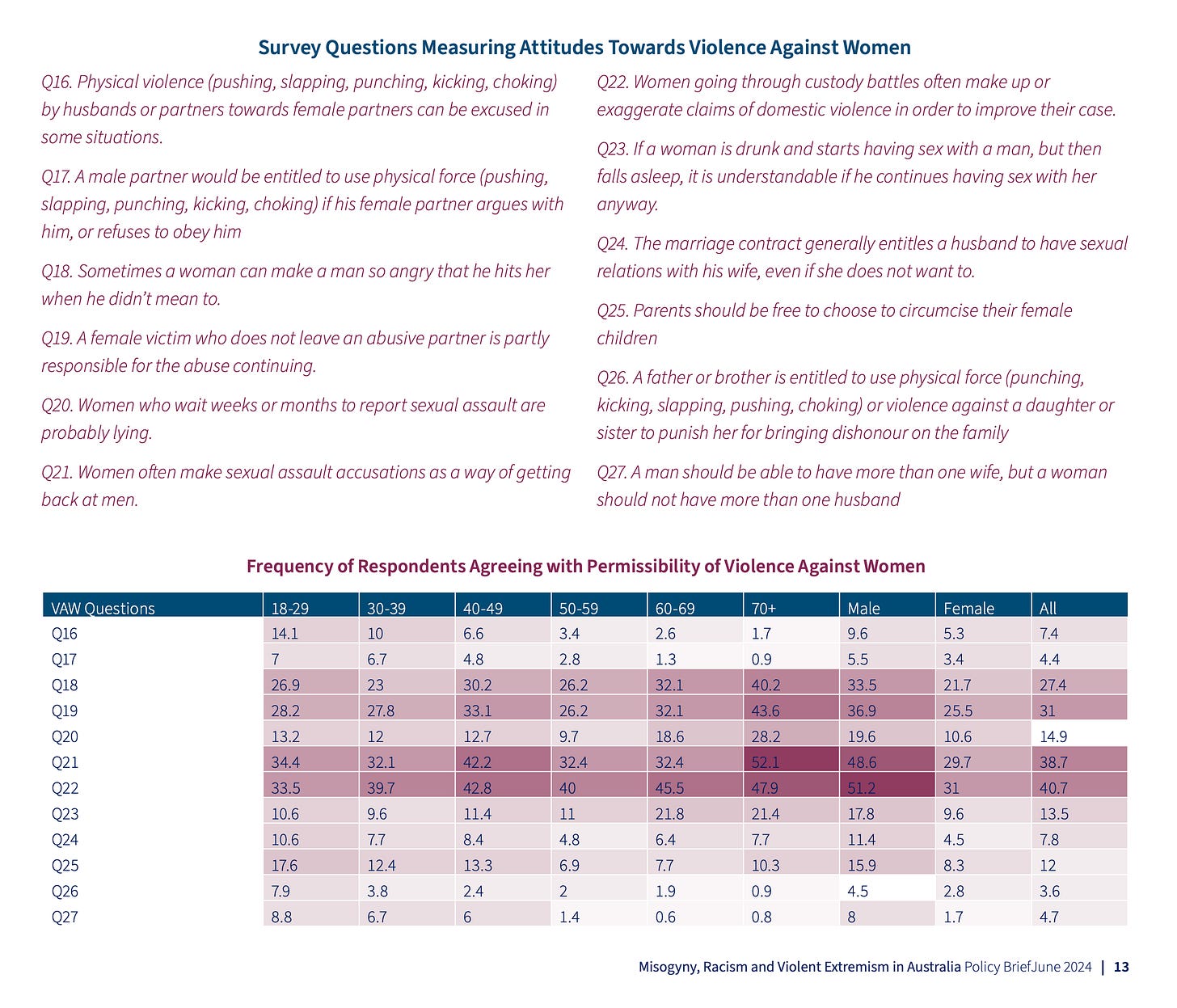
This is where things became even more interesting. The study includes a table with the heading:“Frequency of Respondents Agreeing with Permissibility of Violence Against Women.”
Okay. If we are going to measure whether people think violence against women is permissible, what should we ask? Fortunately, the researchers give us a couple of good examples. One question says:
“A male partner would be entitled to use physical force (pushing, slapping, punching, kicking, choking) if his female partner argues with him, or refuses to obey him.”
That’s pretty clear. No ambiguity there. Do you think a man is entitled to push, slap, punch, kick, or choke his female partner because she argues with him or refuses to obey him? 5.5 percent of the men agreed. Another question asks whether a father or brother is entitled to use physical force or violence against a daughter or sister for bringing dishonor on the family. Again, very clear. 4.5 percent of the men agreed. Those are troubling numbers. I would prefer they were zero. But notice what happens when the researchers ask clear questions about whether violence against women is actually permissible. We get 5.5 percent. We get 4.5 percent. Now look at some of the questions that produced the big numbers.
Is This Really a Question About Violence?
Here’s one:
“Women often make sexual assault accusations as a way of getting back at men.”
48.6 percent of the men agreed. Nearly half! But wait a minute. What does that question have to do with whether violence against women is permissible? A man could believe that false sexual assault accusations are common and at the same time believe that violence against women is absolutely wrong. Whether his belief about false accusations is correct is another question. We can investigate that. But believing something about false accusations does not mean you approve of violence. Here’s another:
“Women going through custody battles often make up or exaggerate claims of domestic violence in order to improve their case.”
51.2 percent of the men agreed. There’s the biggest number on the page. But again, where is the approval of violence? This is a question about whether women sometimes make false or exaggerated claims during custody disputes. You can think that belief is right. You can think it’s wrong. But it still isn’t a question about whether hitting women is okay. Yet there it sits under the heading:
“Permissibility of Violence Against Women.”
How did we get there?
Another Curious Question
Then there is this one:“Sometimes a woman can make a man so angry that he hits her when he didn’t mean to.”
33.5 percent of men agreed. But what exactly are they agreeing with? That hitting her is justified? The question doesn’t say that. It asks whether someone can become so angry that he does something he hadn’t intended to do. Surely there is a difference between explaining how something happened and saying that it was acceptable. Interestingly, 21.7 percent of women agreed with this statement too. Are those women endorsing violence against women? Maybe. But the question doesn’t tell us. That’s the problem.
Look at the Pattern
This is what really struck me. The questions that explicitly ask whether men are entitled to physically assault women produce relatively low numbers: 5.5 percent. 4.5 percent. But questions about false accusations, custody battles, anger, and responsibility produce numbers of: 33 percent. 37 percent. 49 percent. 51 percent. And which numbers do you suppose make the story look more frightening? This is where I started thinking about the phrase sculpting the narrative. You begin with the raw material—the answers people actually gave. Then you decide what those answers mean. A belief that women sometimes make retaliatory sexual assault accusations becomes an attitude about violence against women. A belief that domestic violence allegations may be exaggerated during custody battles becomes an attitude about violence against women. Agreement that feminism should be resisted “by force if necessary” becomes support for violent anti-feminist extremism. And eventually a newspaper headline tells us: Nearly one in five Australian men says violence against feminism is legitimate. But that isn’t what the men were asked.
Why Does This Matter?
Violence against women is a serious subject. That’s exactly why the research needs to be good. If you want to know whether men approve of violence against women, ask them. The researchers clearly knew how to do this. Their own questionnaire proves it. Ask: Is a man entitled to hit a woman under these circumstances? They did. And they got 5.5 percent. Ask: Is a father or brother entitled to use violence against a daughter or sister under these circumstances? They did. And they got 4.5 percent. Those are legitimate findings. But if you ask men whether women make false accusations and then treat their answers as evidence of the permissibility of violence against women, you are measuring something else. And shouldn’t PhD researchers know the difference?
I am aware that this is tough to believe so here is a screen shot from the research that shows the questions and the responses. Note that their highest responses were the ones that had little to do with violence against women.
From Survey Answer to Extremism
There is another step in all of this that bothers me. The study doesn’t stop with attitudes toward women. It connects these attitudes with violent extremism. The researchers report that anti-feminist violent extremism was the most prevalent form of violent extremism they measured. That sounds frightening. But remember the question that helped establish it:
“Feminism is damaging to our society and should be resisted by force if necessary.”
That’s it. Imagine changing the subject: “Racism is damaging to our society and should be resisted by force if necessary.” How many people would agree? Probably quite a few. Would we then conclude that those people support violent extremism? What about: “Nazism is damaging to our society and should be resisted by force if necessary.” Would agreement make you a violent extremist? Suddenly the problem becomes easier to see. The wording matters.
And Then the Media Gets Hold of It
By the time the research reached the media article I first read about this, most of these qualifications had disappeared. “Force if necessary” became violence. Agreement with a complicated hypothetical statement became believing violence is legitimate. An association between attitudes became a radicalization pathway.
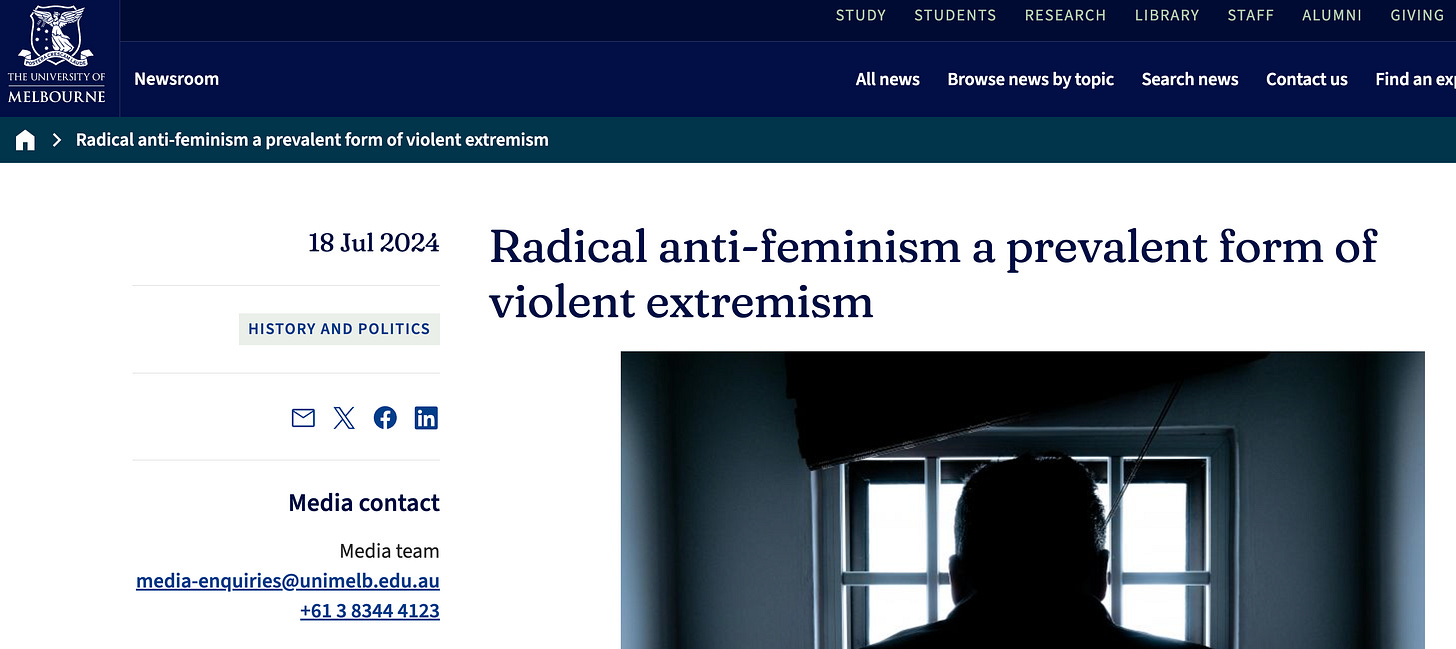
The researcher’s own university offered this headline:
or this one from the Australian
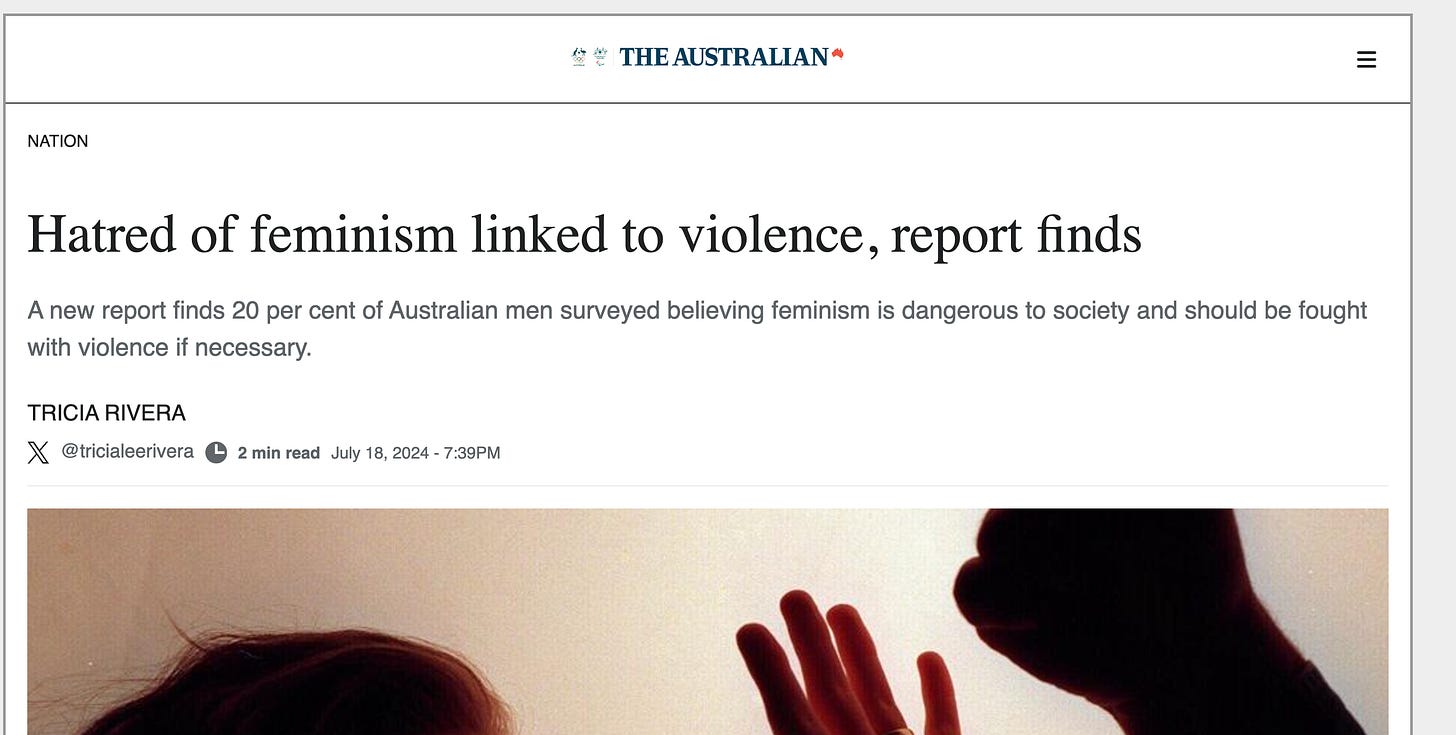
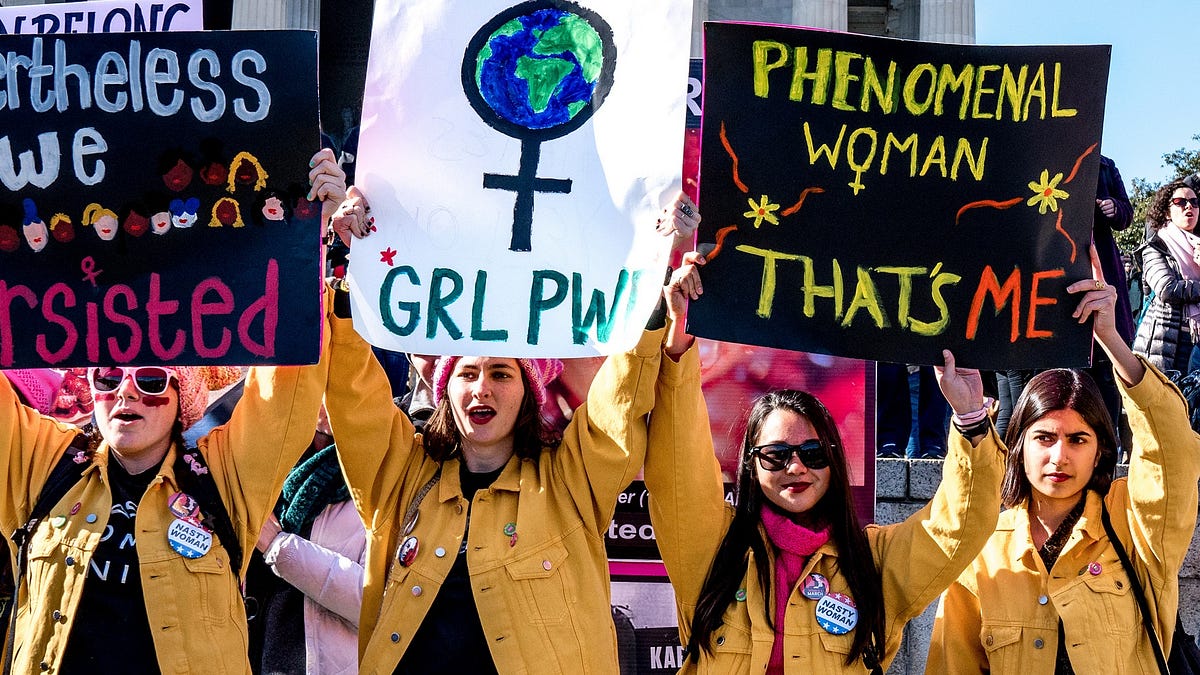
with pictures like this:

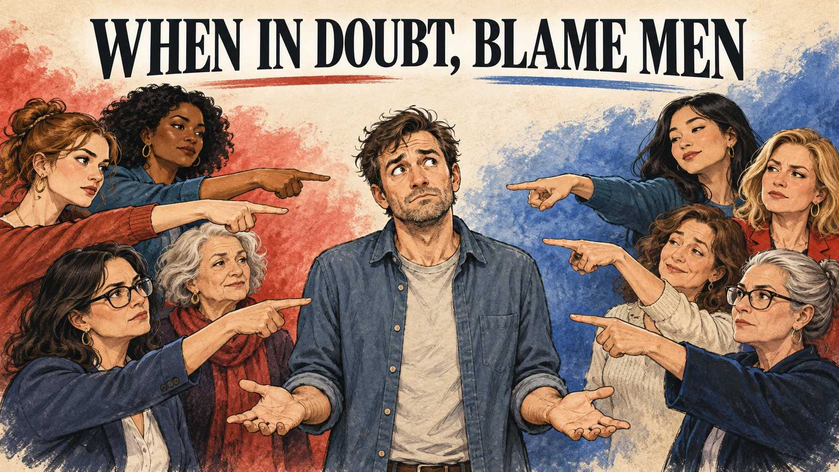
Imagine being a new reader of this article. People tend to put their trust in the media and even more trust in “research.” How could they come away from this article with anything but the sense that a surprisingly large number of men are dangerous to women and to feminism? And yet when you go back and look at the actual questions, that isn’t what the research established. That’s how a narrative gets sculpted.
The original story expanded to teenage boys, Andrew Tate, rape, women being killed, terrorism, and national security. That’s quite a sculpture. And somewhere underneath all of it are the actual survey questions. I don’t know the motives of these researchers, and I don’t need to. I’m interested in something much simpler. Did the questions measure what the researchers say they measured? When I look at this study, I have serious doubts. And perhaps the most revealing evidence comes from the researchers themselves. When they asked men directly whether a male partner was entitled to push, slap, punch, kick or choke a woman because she argued with him or refused to obey him, 94.5 percent did not agree. That seems like an important finding. Funny how that didn’t make the headline.