MenAreGood
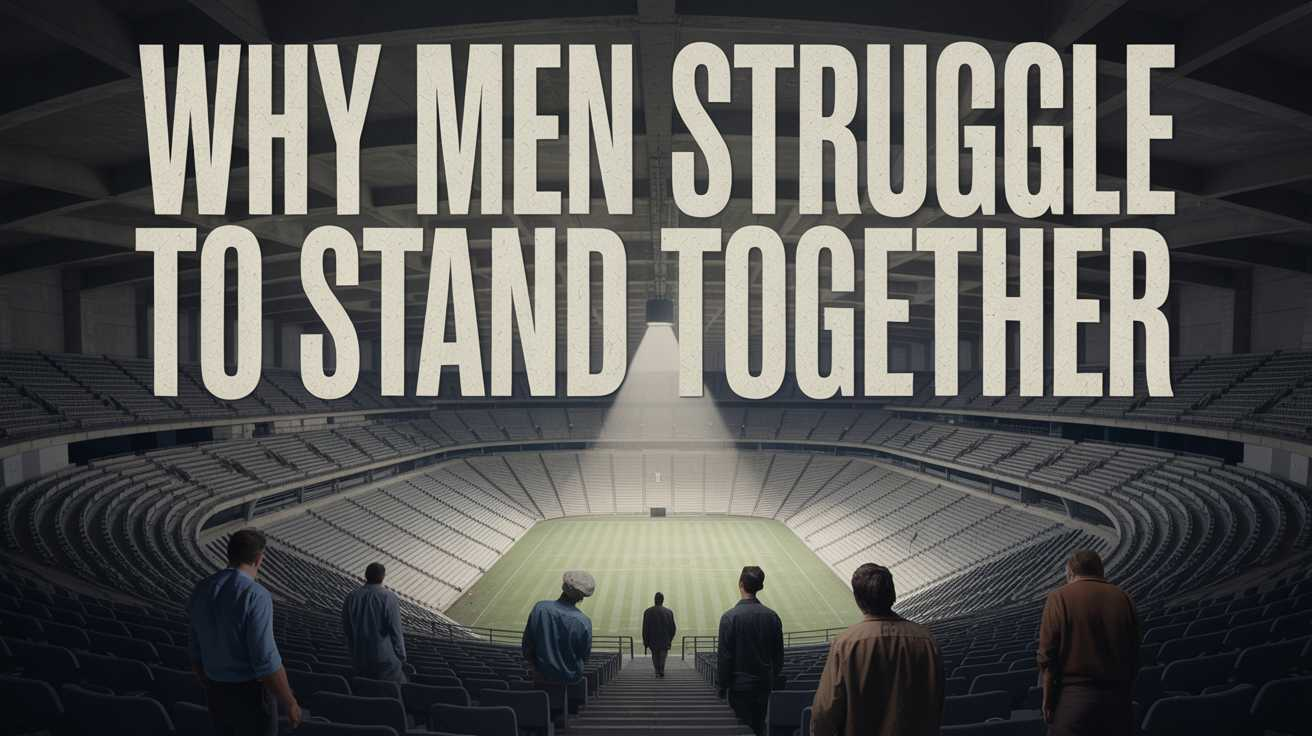
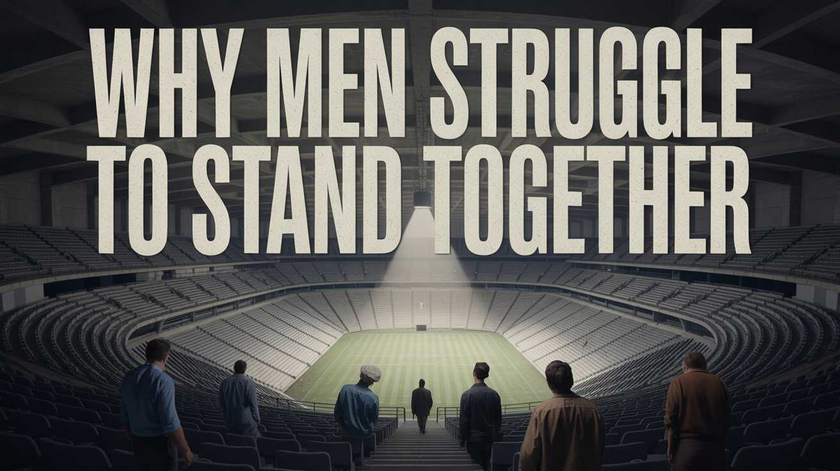
Why Men Struggle to Stand Together
How competition, culture, and gynocentrism keep men from standing together
July 14, 2025
post photo preview

It’s no secret that men and women are different—but one of the lesser-known differences, and one of the most socially consequential, is found in how each sex relates to their own group.

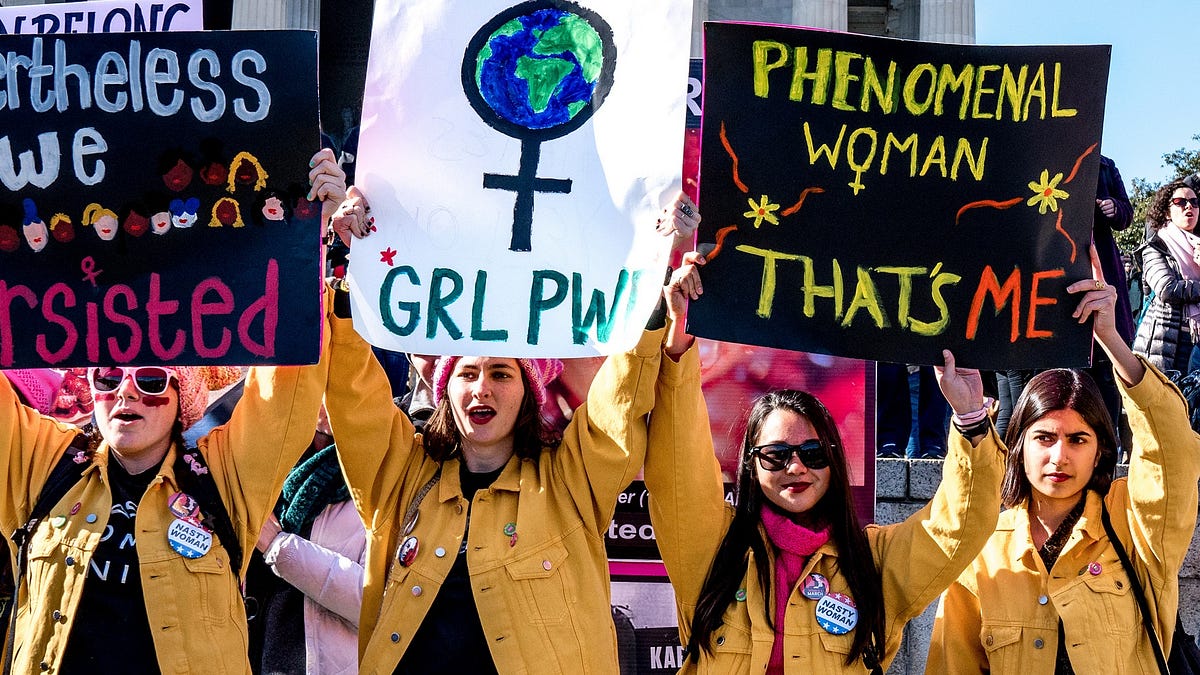
Women consistently show strong in-group bias. They support each other socially, emotionally, and politically. They instinctively identify with the struggles of other women. This solidarity forms the backbone of movements, activism, academic departments, and public policy. When a woman sees another woman being mistreated, her response is often immediate: “That could’ve been me.”

Men, by contrast, tend to show weaker and more conditional in-group bias. Their loyalty to other men is context-dependent, usually tied to shared purpose or external threat. A man will stand with another man on the battlefield, on the job site, or on the basketball court—but outside of those types of goal-oriented bonds, that sense of male unity often fades.

Why is that?

Part of it is biological and evolutionary. For men, life has always been a mix of coalition and competition. Throughout history, men had to work together in tribes or hunting parties—but within those groups, they also competed for rank, dominance, and access to mates. That means male bonding has always existed alongside male rivalry. The result? Male loyalty is real, but fragile.

Even today, many men see other men as rivals first, allies second. If another man struggles—loses his job, breaks down emotionally, or gets mistreated in a custody battle—he may not get support. He may get silence. Or worse, blame. Because in the male psyche, weakness often reads as threat. It disrupts the unspoken expectation that men must be strong, self-reliant, and in control. In male hierarchies, weakness can be seen as a liability—something that drags down the group or exposes it to risk. And for many men, seeing another man suffer can stir up buried shame or fear about their own vulnerabilities, leading them to distance themselves rather than lean in. It’s not cruelty—it’s biology and conditioning.

This fragile in-group bias creates a massive hurdle for any effort to advocate for men. Men’s rights movements, fatherhood initiatives, male mental health campaigns—they all struggle not just because society ignores them, but because men themselves often fail to show up for one another. And this problem isn’t just internal. It’s magnified by something even larger: gynocentrism.


Gynocentrism: The Cultural Blind Spot

Gynocentrism is the cultural tendency to prioritize women’s needs, feelings, and safety—often at the expense of men. It’s not just a personal bias; it’s institutional, ideological, and deeply embedded in our narratives about right and wrong. From early childhood, boys are taught to protect girls, to defer to their emotions, and to take responsibility for female wellbeing. “Never hit a girl.” “Be a gentleman.” “Sacrifice for your wife.” These messages, ​no matter how well-meaning, train boys to associate virtue with serving women. They are rarely taught to protect or serve each other. This conditioning only deepens with age. In politics, education, and media, men gain status by defending women—not by defending men. A man who speaks up for women is seen as noble and progressive. A man who speaks up for men is seen as angry, bitter, or fragile—even by other men.

In a gynocentric culture—where women’s needs are prioritized and viewed through a moral lens—advocating for women is seen as virtuous, while advocating for men is viewed with suspicion or hostility.

🟣
 

“Women’s advocacy is empathy”

When women advocate for women (or when men advocate for women), the culture responds with compassion, validation, and support. It’s framed as morally good, emotionally sincere, and socially necessary. Example: “We need to hear women’s voices.” “Support women’s mental health.” “Believe women.”

“Men’s advocacy is grievance”

When men advocate for men, it’s often framed as whining, resentment, or a push to reclaim lost power. Instead of evoking empathy, it triggers defensiveness, mockery, or accusations of misogyny. Example: “Why are you complaining?” “This sounds like toxic masculinity in disguise.” “You just want to take us back to the 1950s.”

Say the phrases out loud “We need to hear men’s voices“ or maybe “Believe men.“ Can you feel the difference?

⚖️
 

So the double bind is:

  • Women can talk about their pain and gain moral authority.

  • Men talk about their pain and risk losing moral credibility.


    In other words:

    If you advocate for women, you’re seen as compassionate.
    If you advocate for men, you’re seen as angry.

    That’s the trap—the double bind—created by gynocentrism. So male in-group bias—already fragile—is further fractured by gynocentric incentives.


The Costs of Division

This has enormous consequences.

When a man is falsely accused, other men don’t rally to his defense—they distance themselves.

When a father loses access to his children, he’s often blamed rather than supported.

When men talk about depression or suicide, they’re often met with discomfort, not compassion.

Meanwhile, female solidarity flourishes. Women have entire university departments, legal protections, and billion-dollar initiatives devoted to their advancement. And they have what men lack: a deep, culturally accepted instinct to care for each other.

The result is a lopsided world: female pain is collectivized and acted upon; male pain is individualized and ignored. It should now be obvious that working as a men’s advocate, a fatherhood proponent, or in any male-focused cause is an uphill battle—while those promoting women’s causes are coasting downhill with cultural tailwinds, institutional funding, and moral permission at their backs.


Rebuilding Male Solidarity

If men are to thrive—not just as individuals, but as a group—they must begin to reclaim something long buried: a sense of mutual loyalty. A belief that other men are not your enemy. That another man’s pain is not a sign of his failure, but of a culture that has failed us all.

This doesn’t mean abandoning competition or suppressing masculine traits. It means building solidarity around them. Men’s greatest strength has always been in what they can do together—on the battlefield, in a brotherhood, on a team. The challenge now is to transfer that loyalty into emotional and cultural arenas, where men are bleeding quietly in the shadows.

Men don’t need to become women to support each other. They just need to recognize that being on the same team means protecting the players who are getting crushed—by courts, by culture, by silence.

Male pain is real. Male sacrifice is real. Male disposability is real.

But male brotherhood can be real too—if we decide to make it so.

Men Are Good

community logo
Join the MenAreGood Community
To read more articles like this, sign up and join my community today
0
What else you may like…
Videos
Posts
Articles
June 13, 2026
The Feminist Fortune Teller

Can you guess what she will say?

00:00:15
June 11, 2026
False Accusations and the Denial of Men's Emotional Pain

This video explores the enormous challenges men face when they are falsely accused. It also examines our culture’s tendency to overlook or dismiss men’s emotional pain, particularly in situations involving false accusations. From a man's perspective, it looks at some of the many reactions and struggles that can emerge under these circumstances.

Men Are Good.

00:09:39
May 28, 2026
Man Hating Stereotype Debunked? The Tale of Two Hate Studies

The Tale of Two Hate Studies

If you ask feminists whether they hate men, how likely are you to get an honest answer?

That question sits at the center of this discussion. We look at two recent studies that attempt, in very different ways, to measure hatred, misogyny, and misandry. One study examines online communities and finds results that do not fit the usual cultural narrative. The other, titled The Misandry Myth, attempts to reassure us that feminists are not especially hostile toward men.

But the deeper question is not simply whether someone will openly admit to hatred. It is whether contempt, prejudice, dismissal, and “helpful” efforts to correct men can operate under the language of care.

Janice Fiamengo, Hannah Spier, Jim Nuzzo, and I explore how anti-male bias is often hidden in plain sight, why female hostility is routinely excused as justified reaction, and how male suffering is minimized, reframed, or simply erased from public concern.

Men are good, as are you.

01:09:57
July 02, 2026
From Shooter to Heroine: The Glorification of Feminist Violence

I recently joined Hannah Spier, Janice Fiamengo, and Jim Nuzzo for a fascinating discussion about one of our culture’s most striking double standards: why violence by women is so often explained, excused, or even celebrated, while violence by men is treated very differently. We examine Valerie Solanas, the attempted murder of Andy Warhol, the SCUM Manifesto, and the film I Shot Andy Warhol, asking what the celebration and romanticizing of Solanas reveals about gynocentrism, empathy, and cultural bias. I think you’ll find it both thought-provoking and eye-opening.

June 04, 2026
Feminism and Liberal Democracy, can liberal democracy survive feminism?

I found this essay both thought-provoking and unsettling. The post examines how ideological capture can occur gradually—not through dramatic political revolutions, but through the accumulation of influence within institutions that are expected to remain impartial. The result is an essay that asks difficult questions about feminism, liberal democracy, and the future of open debate. I think many of you will find it worth your time.

https://critiquingfeminism.substack.com/p/feminism-and-liberal-democracy

I feel heard!! A woman who is honest and blunt. I am going to try to learn more about her

https://www.facebook.com/share/v/1KUgA1NcFj/?mibextid=wwXIfr

July 09, 2026
post photo preview
“Fairness for Everyone?” Then Why Are Only Boys Being Lectured?
 

“Fairness for Everyone?” Then Why Are Only Boys Being Lectured?

A few days ago, two friends whose judgment I respect, Jim Nuzzo and David Maywald, both wrote on X about a new Australian government publication titled Gender Equity for Early Years Education: Fairness for Everyone. So I downloaded the report.


The subtitle immediately caught my attention: “Fairness for Everyone.” Wonderful. Who could object to that? I expected a thoughtful discussion about helping both girls and boys flourish. Instead, I found something quite different.

The report repeatedly presents girls as the group needing protection while portraying boys as the group needing correction. Educators are encouraged to challenge boys’ privilege, reshape their attitudes, and prevent future violence by changing boys. Yet there is almost nothing about boys’ own vulnerabilities—their struggles in school, developmental differences, higher suspension rates, literacy problems, or the tragic fact that many of these little boys will one day grow into the group with the highest suicide rate.

Then I reached the section recommending children’s songs. Most were fairly harmless, but one stopped me cold. The report recommends a song called Come On Boys, describing it this way: “This song was written to shift the responsibility from girls to boys to address toxic masculinity and gender-based violence.”


Read that sentence again: “shift the responsibility… to boys.” The lyrics make the intention even clearer. “Some boys somehow think that they are strong, if they push a girl or make her feel wrong.” The chorus tells boys, “Come on boys, it’s up to you,” and “Respect, respect, it’s our responsibility.”

Please don’t misunderstand me. I don’t object to teaching boys to respect girls—not at all. I have spent decades encouraging boys and men to speak their truth in a way that can be heard. That is not the problem.

The problem is the asymmetry. Imagine if the government had instead recommended a song called Come On Girls and described it this way: “This song was written to hold girls accountable and address their toxic relational aggression.” The song began, “Some girls spread rumors around… Leave another girl out or put her down.…” and then declared in the chorus, “Come on girls… it’s up to you.” How long would that survive before people accused it of stereotyping girls? How many editorials would condemn it? How many educators would object that most girls don’t behave that way? Those objections would be entirely reasonable.

So why are they not equally reasonable when the target is boys? That is the question this report never asks.

The issue isn’t respect, kindness, or preventing violence. The issue is that one sex is addressed collectively as the moral problem to be corrected while the other is not. That isn’t fairness for everyone—it’s a double standard dressed up as fairness.

The saddest part is that the report almost never stops to ask a different question: What do boys need? Not how do we change boys, not how do we prevent them from becoming harmful men—simply, what do boys need in order to thrive? That question is almost entirely absent.

Until we begin asking it with the same seriousness that we ask about girls’ needs, we will continue producing educational policies that claim to be about fairness while quietly teaching children that one sex deserves understanding and the other deserves correction.

Perhaps the greatest bias in this report is not what it says about boys, but what it never becomes curious enough to understand.

Men and Boys Are Good

Read full Article
July 06, 2026
post photo preview
Why Is Men's Pain So Hard to See?
An excerpt from The Way Men Heal (Second Edition)


Today I’d like to begin sharing portions of The Way Men Heal (Second Edition).


When I wrote Swallowed by a Snake more than thirty years ago, there was remarkably little research explaining why so many men seemed to grieve differently than women. Much of what I understood came from listening carefully to grieving men and from studying grief rituals in cultures around the world.

Since then, an enormous amount of research has emerged. We now know much more about stress, testosterone, moral typecasting, empathy, precarious manhood, and the different ways many men and women respond to emotional pain.

Those discoveries inspired me to revise and update The Way Men Heal. This second edition includes many of those newer insights while remaining true to the simple goal of the original: to help men in crisis—and the people who love them—better understand how many men heal.

Today’s excerpt is available to everyone. Future installments will be reserved for paid subscribers. If you’ve been thinking about becoming a paid subscriber, I hope you’ll consider joining us. Your support allows me to continue researching, writing, and sharing these ideas each week.

I also hope you’ll use the comments section as we go. One of the great advantages of sharing the book here is that we can actually discuss it together. If a chapter raises questions, reminds you of your own experiences, or even if you disagree with something I’ve written, I’d love to hear from you. It’s very helpful to hear your thoughts.

Rather than beginning on page one, I’d like to begin with one of the questions that has fascinated me for decades:

Why is men’s emotional pain so often invisible?


A Man’s Pain Is Taboo

(pages 19-22)
When I first began working with men, I assumed I had no real bias about men and emotional pain. But the longer I worked, the more I came to see that I did have biases, and that they were affecting my work.

Over time I developed a simple exercise that can help people see this bias in themselves.

Imagine you are being seated at your favorite restaurant. As you walk toward your table, you notice a woman in the corner crying, her head in her hands. What is your first reaction?

I have asked this question to thousands of people in my workshops. The most common responses are things like, “She is upset,” “Poor thing,” or “She needs some support.” The woman’s pain is usually read as understandable and worthy of care.

Now erase that image and imagine the same restaurant, the same corner table, but this time it is a man who is crying.

What is your first reaction now?

In my workshops, the responses often shift dramatically. People become wary. “Something is wrong with him.” “He must be drunk.” “I’d stay away from him.” The woman’s pain evokes sympathy. The man’s pain evokes unease, suspicion, or avoidance.

That difference tells us something important.

A woman’s emotional pain is often treated as a call to care. A man’s emotional pain is more likely to be treated as a disturbance, a threat, or a violation of expectation. In that sense, male pain functions almost like a cultural taboo.

Peter Marin captured this problem beautifully in an article about men and homelessness. He wrote, “To put it simply: men are neither supposed nor allowed to be dependent. They are expected to take care of others and themselves. And when they cannot or will not do it, then the assumption at the heart of the culture is that they are somehow less than men and therefore unworthy of help. An irony asserts itself: by being in need of help, men forfeit the right to it.” Marin put his finger on the powerful and often invisible double standard men face around dependency. When women appear dependent, people are more likely to move toward them with care; when men appear dependent, people are more likely to pull back, judge, or devalue them. And it is important to remember that it is nearly impossible to express emotional pain without appearing, at least to some degree, dependent.

Modern psychological research may help explain why my workshop attendees were more likely to respond with compassion to the woman than to the man. One useful concept here is moral typecasting. (See Going Deeper: Moral Typecasting) This research suggests that we tend to cast women more readily as sufferers and men more readily as agents. Women are more easily seen as those to whom bad things happen. Men are more easily seen as those who cause things, control things, or should be able to handle things. When a woman cries, people often see vulnerability. When a man cries, people are more likely to wonder what is wrong with him, what he has done, or whether he is unstable. The moral typecasting studies help explain why men’s grief is so often misread: a grieving man is less likely to be seen simply as someone in pain and more likely to be viewed as someone who should keep himself together, get back to functioning, and ask little of others.

There is also a broader cultural force at work that I would call gynocentrism—a tendency to place women’s needs, suffering, and perspectives closer to the moral center of our concern, while placing men second. John Barry and Martin Seager describe a similar pattern in their research using the term gamma bias: female suffering is more readily magnified, while male suffering is more easily minimized or overlooked. (See Going Deeper: Bias and Perception) Together, these ideas point to the same underlying reality: our culture tends to center women’s pain more readily than men’s, and most people do not even notice they are doing it. These dynamics help explain why male pain is not only hidden by men, but also frequently misread by the culture around them.

Men, of course, are not blind to this. They know, often without consciously thinking about it, that public displays of emotional pain can bring discomfort, judgment, or avoidance rather than comfort. It makes sense, then, that many men would gravitate toward quieter, less visible ways of grieving—toward action and inaction rather than public emotional display. These quieter forms of grieving are often not empty activity at all, but early attempts at meaning-making. Unfortunately, these quieter modes are often judged harshly as men “not dealing with their feelings,” when in fact they may be dealing with their pain in the only way that feels safe.

When something is taboo, people learn to hide it. Men are not simply failing to express pain. Many are doing their best to keep that pain out of sight because they know how it will likely be received.
———————————————————-

if you are looking for the book on amazon be sure this is the cover, The first edition will sometimes pop up when the title is searched link to amazon

 
Read full Article
June 29, 2026
post photo preview
Why Caitlin Clark Became a Target
The overlooked psychology behind one of the biggest stories in sports.


There is an old saying from Australia:

“Tall poppies get cut down.”

The expression refers to the tallest flower in the field. Rather than celebrating its beauty, someone cuts it off so that it is no taller than the rest.

Psychologists have spent decades studying this phenomenon. They have given it several names: Tall Poppy Syndrome, the Black Sheep Effect, female intrasexual competition, and indirect or relational aggression.

Although each focuses on a different aspect of human behavior, they all point toward a similar observation.

Groups do not always reward excellence.

Sometimes they punish it.

Researchers such as Anne Campbell have argued that women historically competed quite differently than men. Physical aggression carried enormous risks for ancestral women, especially during pregnancy and child-rearing. Instead of fists and open confrontation, competition more often took the form of gossip, exclusion, reputation damage, coalition-building, and social isolation.

Tracy Vaillancourt and others have likewise shown that women are especially skilled at what psychologists call indirect​ or relational aggression—forms of competition that damage a rival without requiring physical conflict.

Interestingly, these patterns have been documented across a remarkable range of social settings. Researchers have observed them among schoolchildren, university students, summer camps, workplaces, parent groups, politics, entertainment, and increasingly on social media. The specific behaviors vary, but the underlying dynamic remains strikingly consistent. Wherever social relationships help determine status, competition often takes relational rather than physical forms.

Classic studies by psychologist Ritch Savin-Williams are especially revealing. His summer camp research showed that even groups of adolescents who had just met quickly formed stable dominance hierarchies. Among girls, those hierarchies were maintained largely through verbal and relational tactics rather than physical confrontation. The lesson was clear: human groups naturally establish social rankings, but the methods used to compete for status often differ between the sexes.

Another body of research examines what is known as the Black Sheep Effect. Groups often react more harshly toward members of their own group who violate expectations than toward outsiders. The person who rises too far above the group, receives too much attention, or appears to disrupt the existing social order can become the target of surprisingly intense hostility.

Perhaps the most remarkable feature of relational aggression is not the aggression itself but its invisibility.

Unlike physical violence, relational aggression is often designed to leave little evidence. Gossip is whispered rather than shouted. Social exclusion leaves no bruises. Reputation attacks are disguised as concern. Coalitions form quietly. Each individual act may appear trivial—even accidental—but together they can profoundly alter a person’s standing within a group.

This invisibility may help explain why relational aggression is so often overlooked. Victims know something is happening, yet observers struggle to identify any single event worth condemning. Even authority figures can miss the larger pattern because they evaluate each incident in isolation rather than seeing the cumulative effect.

That brings us to Caitlin Clark.

By any objective measure, Clark has transformed the WNBA.

She fills arenas.

Television ratings have exploded.

Merchandise sales have soared.

Many fans who never watched women’s basketball now tune in specifically to watch her play.

One might expect such a player to be celebrated almost universally.

Instead, she has often been met with unusually hard fouls, dismissive comments, resentment, and a remarkable reluctance among some players ​to acknowledge what she has accomplished.

The fouls themselves are obvious enough, although even the obvious ones often seem to be missed by the referees.

That pattern is typical of relational aggression, which is frequently overlooked by school officials, HR departments, and even informal social groups. Researchers have long noted that women’s relational aggression often goes unrecognized by those in positions of authority.

The fouls against Caitlin Clark are physical, but they also share important characteristics with relational aggression. They are easily hidden within behavior that appears normal: “I play hard basketball. Sometimes it gets rough.” They also come with built-in plausible deniability: “I didn’t mean to do that.” “It’s just a foul.”

The deeper question, then, is not whether these are simply hard basketball plays. It is whether they are better understood as the physical expression of a broader social dynamic.

A hard foul is easy to dismiss. Two hard fouls are still just basketball. But when the same player repeatedly becomes the target of ​v​iolent play, persistent criticism, social distancing, and efforts to minimize her accomplishments, the research suggests we should at least consider the possibility that we are witnessing something larger than ordinary athletic competition.

If so, the referees face a​ tough task. They are trained to officiate individual fouls, not invisible social hierarchies. A referee can call a shove. He cannot call status competition. He can penalize an elbow. He cannot penalize a coalition.

Perhaps Clark is not merely a great player.

She is a tall poppy.

Her extraordinary success has disrupted an existing hierarchy.

The research suggests that when someone suddenly rises far above her peers, she may trigger forms of indirect aggression designed—not consciously in most cases, but socially—to pull her back toward the group.

Again, this is not an excuse.

It is an explanation.

The interesting part comes when we compare this with men’s sports.

Consider Michael Jordan.

Jordan entered the NBA as an extraordinary talent. Opposing teams hit him hard. They challenged him physically. They tried to stop him.

But something else happened.

As his greatness became undeniable, players increasingly admired him. Young athletes wanted to imitate him. Rivals measured themselves against him. He became the standard by which excellence itself was judged.

The competition remained fierce.

The respect grew alongside it.

That difference is fascinating.

Male hierarchies often appear to resolve competition through rank. Once someone proves himself to be the best, others continue trying to defeat him, but they also acknowledge his position.

Female hierarchies often seem to operate somewhat differently. Because relationships and coalition membership play a larger role, someone who rises dramatically above the group may be experienced not simply as the best performer, but as someone disrupting the balance of the group itself.

Human behavior is almost always influenced by multiple factors—personality, cliques, incentives, race, culture, coaching, individual history, and circumstance. It would be a mistake to attribute what we are seeing to any single cause. My suggestion is simply that relational aggression deserves consideration as one contributing factor among many.

What is remarkable is that psychology has spent decades documenting phenomena such as Tall Poppy Syndrome, relational aggression, stable dominance hierarchies, and the Black Sheep Effect, yet almost no one seems willing to ask whether these well-established patterns might help us understand what we are witnessing today.

Sometimes the best way to understand a controversy is not to ask who is good and who is bad.

It is to ask what kind of human behavior we are looking at.

If Caitlin Clark were a man playing in a men’s league, would we be seeing the same social dynamics?

That may be the most interesting question of all.

​Men Are Good.


Tall Poppy Syndrome
N. T. Feather’s classic work: Attitudes towards the high achiever: The fall of the tall poppy.
Also useful: BPS overview on tall poppies, deservingness, and schadenfreude. https://www.researchgate.net/publication/229782141_Attitudes_towards_the_high_achiever_The_fall_of_the_Tall_Poppy

Relational Aggression
Crick & Grotpeter’s foundational 1995 paper: Relational Aggression, Gender, and Social-Psychological Adjustment. https://pubmed.ncbi.nlm.nih.gov/7789197/

Black Sheep Effect
Marques, Yzerbyt & Leyens’ original 1988 paper: The “Black Sheep Effect”: Extremity of judgments towards ingroup members as a function of group identification. https://pubmed.ncbi.nlm.nih.gov/7789197/

Dominance / Status Hierarchies
Good overview: Dominance in humans — useful for distinguishing dominance from prestige/status.
Also relevant: Cheng et al. on dominance and prestige as routes to social status.
https://pmc.ncbi.nlm.nih.gov/articles/PMC8743883/

Hierarchy Stability
Knight & Mehta: Hierarchy stability moderates the effect of status on stress and performance.
https://www.pnas.org/doi/10.1073/pnas.1609811114

Savin-Williams, R. C., & Vrangalova, Z. (2013).
Mostly heterosexual as a distinct sexual orientation group: A systematic review of the empirical evidence.
Developmental Review, 33(1), 58–88.
https://doi.org/10.1016/j.dr.2013.01.001

Read full Article
See More
Available on mobile and TV devices
google store google store app store app store
google store google store app tv store app tv store amazon store amazon store roku store roku store
Powered by Locals