MenAreGood
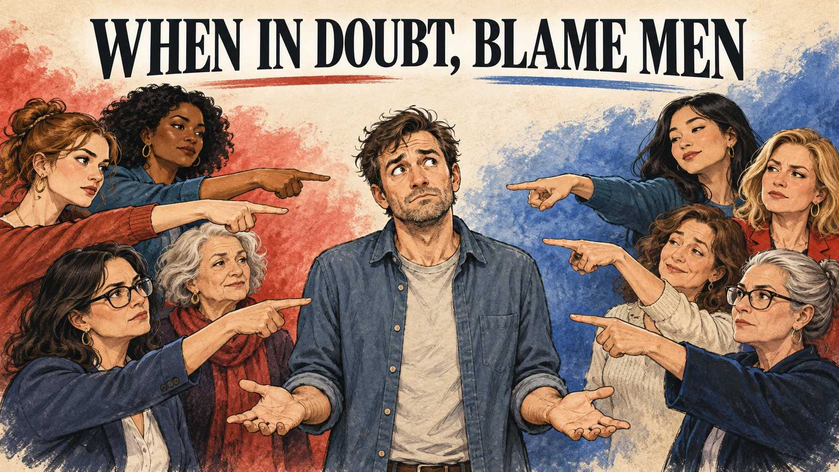
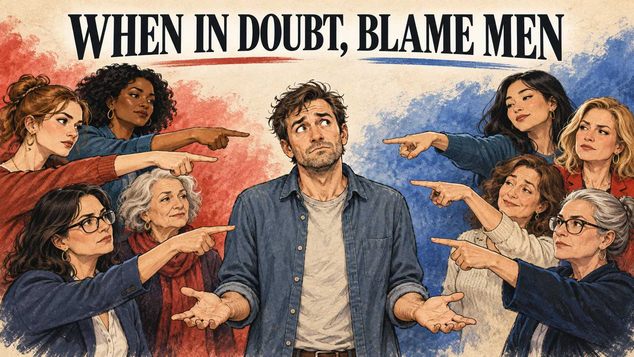
Heterofatalism: or How to Blame Men For Everything
July 25, 2025
post photo preview


This is a response to a recent New York Times article by Jean Garnett titled The Trouble With Wanting Men. The subtitle says it all: “Women are so fed up with dating men that the phenomenon even has a name — heterofatalism. So what do we do with our desire?”

Sometimes, the best response is a little humor while flipping the script. See what you think.


"Heterofatalism: Or How to Blame Men for Everything, Even Our Socks"

Ah, “heterofatalism” — the brand-new term coined for the collective exasperation of women who, after navigating the complex world of dating, come to the conclusion that men are the root of all relationship woes. You see, the issue isn't just that men are occasionally anxious, emotionally distant, or a little too obsessed with their sports teams; no, the real problem is that these poor souls — with all their confusing desires, communication issues, and tendency to occasionally ghost you after a couple of drinks — are making it impossible for women to live happily ever after.

Who needs "old-fashioned man-woman stuff," right? We should really just get rid of men altogether, except... well, hold on. It seems like the author might still enjoy the idea of men, as long as they’re perfectly self-deprecating, emotionally available, not so needy, and able to decode all of her mood swings without missing a beat. Apparently, we’re supposed to be sweet, gentle, and constantly checking in with how she feels — but also not too available, because that would make us “needy.” Are you keeping up, men? No? It’s okay, because we aren’t expected to.

What If We Flipped the Script?

Now, imagine if the shoe was on the other foot. What if a man had these same expectations of you Jean Garnett? What if you had to live up to these impossible standards every time a relationship or date rolled around?

For example, let’s say you’re trying to date someone, and he expects you to be emotionally available all the time, always knowing exactly what he’s feeling, always ready to discuss his feelings — at his convenience. Now imagine if you were the one constantly apologizing for not responding to text messages in 90 seconds flat because you were busy with life, work, or, you know, anything else. Or imagine being told you were "too anxious" to handle a simple conversation because you were stressed over your busy schedule. Does it seem fair that men are expected to always be the ones to “man up” emotionally, while women are allowed to retreat into their own anxiety and demand validation from men?

Also, here’s a fun thought experiment: What if, as a man, you had to hear all the time about how you were the problem in every dating situation? Imagine your date explaining how she loves the “good guy” archetype but constantly finds him lacking because he doesn’t meet every single emotional need immediately. The “good guy” who’s gentle, sweet, and not too self-deprecating — just enough to make you feel like a glorified emotional ATM. It’d be pretty exhausting, wouldn’t it?

Emotional Labor: A Two-Way Street

Let’s get real for a moment. The whole concept of emotional labor often gets pinned solely on men — the idea that women are somehow left to pick up the emotional slack in relationships. But if we take a closer look, we see a different picture. If the standard is that men should always be emotionally available, always interpret every word and gesture in the right way, shouldn’t women also take on the responsibility of understanding the emotional needs of their partners? Isn’t it unfair to expect men to constantly decode the mystery of “how you’re feeling” without giving them the same space to feel confused, anxious, or uncertain about what’s going on in the relationship?

What if men were to complain about the “hermeneutic labor” they had to perform just to keep a relationship afloat? Imagine if men spent every conversation analyzing why you were saying one thing and meaning something else. If men constantly had to decode your emotional signals — every pause, every silence, every hint — would we be quick to dismiss it as just part of being a man? Or would we call it what it is: exhausting?

Isn’t It Time for a Little Empathy?

Now, let’s circle back to that romantic ideal — the “good guy” who wants to be loved, but can’t seem to get it right because he's “too anxious,” “too confused,” or “too emotionally unavailable” when it matters. But what if, just maybe, the problem isn’t his inability to meet her needs, but the sheer weight of the unrealistic expectations placed upon him? Imagine being a man, constantly told that you are too much or not enough at the same time — one minute, you need to be emotionally open, the next you’re told you’re too emotional.

Let’s flip the script.
Imagine you’re the one who needs a little breathing room — just some space to think.
But your partner won’t let it go:
“Why can’t you just communicate like a grown-up? What are you, emotionally stunted?”
And when you finally admit you’re anxious or overwhelmed, you’re slapped with labels like “needy,” “hysterical,” or “too sensitive.”
Then he runs off to his buddies, and they all have a good laugh at your expense:
“Aww, poor little fraidy-cat princess. Guess she ​just can't woman up.”
Sound familiar?
Because that’s exactly what you and your friends did to him.
Doesn’t feel so good when the joke’s on you, does it?

Rewriting the Narrative

Maybe it's time to see men as humans rather than stereotypes. Men don’t exist just to fulfill emotional needs, and relationships should be about mutual respect, not endless demands. If we really want to evolve into better relationships, we need to recognize the emotional labor on both sides and give each other the space to be imperfect — without judgment.

Here’s a radical idea: instead of blaming men for the failures of the modern dating scene, let’s take a step back and realize that maybe we’re all a little messed up. And that’s okay. You don’t need us to “man up” — you just need us to be real, and we need the same from you.

And if we’re not perfect? Well, at least we’re not trying to make every relationship a philosophical debate about what does it mean to love and how can we both be completely vulnerable and emotionally invulnerable at the same time.

Pro tip: next time your man shows up with a little emotional confusion, give him a break. Men are not puzzles to be solved; we’re just humans trying to navigate a world that often doesn’t make sense to any of us.

And for the record: ​Men Are Good.

community logo
Join the MenAreGood Community
To read more articles like this, sign up and join my community today
0
What else you may like…
Videos
Posts
Articles
July 15, 2026
The Women's Health Narrative Meets the DATA

What if one of the most common claims in health policy simply isn’t true?

We’ve all heard the refrain: women are underfunded, under-researched, and left behind by the medical establishment. It’s repeated so often that most people never stop to ask for the evidence.

In this roundtable, Jack Kammer, Ed Bartlett, Ed Stephens, Jim Nuzzo, and I compare that narrative with the available data. We examine research funding, clinical trial participation, life expectancy, and the unintended consequences of policies that consistently prioritize one sex while neglecting the other.

This isn’t an argument against women’s health. It’s an argument for evidence, fairness, and a healthier future for everyone.

Link to the Feminist pdf that calls for 20 Billion dollars for women’s health!
https://drive.google.com/file/d/1IKEEZMGXtRNxU4n5K_M1d6k2w-ZP_wVT/view

Jim Nuzzo

The Nuzzo Newsletter on Substack http//jameslnuzzo.Substack.com
X: https://x.com/JamesLNuzzo

Jack Kammer

Jacks Substack Men’s ...

00:35:24
July 11, 2026
Mantoon: A Visit to the Doc

A visit to the Doc.

00:00:14
June 13, 2026
The Feminist Fortune Teller

Can you guess what she will say?

00:00:15
August 10, 2026
Feminism Cannot Be Reformed: It Must Be Destroyed Root and Branch

Janice Fiamengo’s new book is out, and this excerpt from the Foreword gives you a pretty good idea of what to expect. Janice goes straight to the heart of feminism and gives ample reasons for its demolition.

This is an important book. I hope you’ll get a copy for yourself—and maybe send one to someone who is even a little bit open to seeing the reality of feminism rather than the equality mask presented by feminists and so much of the media.

https://fiamengofile.substack.com/p/feminism-cannot-be-reformed

Well worth watch it’s good seeing men calling out women’s bull shit when the same women are not use to fair honest responses!

https://www.facebook.com/share/v/1JtTnYLC7K/?mibextid=wwXIfr

July 02, 2026
From Shooter to Heroine: The Glorification of Feminist Violence

I recently joined Hannah Spier, Janice Fiamengo, and Jim Nuzzo for a fascinating discussion about one of our culture’s most striking double standards: why violence by women is so often explained, excused, or even celebrated, while violence by men is treated very differently. We examine Valerie Solanas, the attempted murder of Andy Warhol, the SCUM Manifesto, and the film I Shot Andy Warhol, asking what the celebration and romanticizing of Solanas reveals about gynocentrism, empathy, and cultural bias. I think you’ll find it both thought-provoking and eye-opening.

August 13, 2026
post photo preview
What If Schools Are Missing the Brightest Boys?


What If Schools Are Missing the Brightest Boys?

We are starting to hear more these days about boys who struggle in school, boys who can’t sit still, or fall behind in reading. This is bringing to light that all too often schools are not built for boys.

But recently I started thinking about the other end of the spectrum. What if schools aren’t just failing some of the boys who struggle? What if they’re also missing some of the brightest boys?

The Variability Hypothesis

Researchers have pointed out for years what they call the greater male variability hypothesis. What this means is that on average, men and women score about the same on measures of intelligence. But males tend to show greater variability and outnumber women at both the low and high ends. This means you will find more boys with significantly low IQ’s but also more boys with very high IQ’s. This tells us that based on this variability hypothesis, boys are likely to outnumber the girls in the upper regions of IQ.

A School Built for the Average Child

That realization led me to another thought. If boys are naturally more variable, then a school system designed for the average child will fail boys at both ends of the spectrum. Think about it. The struggling boy needs something different from the average classroom. So does the exceptionally gifted boy. Yet schools often become increasingly standardized and focused on bringing everyone toward the middle. The children who are furthest from average—whether below or above—are often the ones who receive less. The boys predominate at both ends.

Why Might Boys Gifts be Overlooked?

People who are gifted often do things that may encourage ordinary teachers to overlook them. Things like:

  • become bored with repetitive work

  • finish assignments quickly and then appear inattentive

  • question teachers

  • refuse busywork

  • focus intensely on a narrow interest while neglecting other subjects

Some of these behaviors may not look like giftedness. They may look like inattentiveness, defiance, laziness, or simply a ​s​tudent who isn’t doing what he is supposed to do.

That got me wondering. If some gifted boys are being overlooked because they don’t necessarily look like the ideal gifted student, would we see any sign of that in who actually makes it into gifted programs?

But What about the numbers?

The next thing I did was check current enrollment in gifted programs. To my surprise, recent national data from the NCES show that girls now slightly outnumber boys in gifted and talented programs in the US. That was a bit of a surprise. Not because girls aren’t gifted. I am sure some are. But if there are more boys with high IQ’s, shouldn’t we expect more boys than girls among the exceptionally gifted? Equal numbers would already raise an interesting question. A female majority raises an even bigger one.

What are the actual differences?

One source I read said that an IQ of 130+ was the point that many gifted programs consider starting. But what is the sex ratio of boys and girls at the 130+ level? Since we find that more girls are in the gifted programs than boys we would expect more girls, right?

Here’s what I found:

One estimate is that boys outnumber girls at the 130+ IQ level at a ratio of 15:10. This means that for every 100 students who have a 130 IQ or higher you will likely have about 60 boys and 40 girls. As you go higher in IQ it leans farther towards boys. When you reach the 170+ range there are nearly 6 times as many males as females. Here’s a chart that shows these estimates: (the estimates are from AI and I chose a very conservative estimate from chatgpt to include here. I will include Grok and Google below)


You can see that boys predominate at the highest genius levels of IQ. Boys and girls are actually quite similar in the normal ranges of IQ, but the boys predominate at both the highest levels and the lowest while the girls cluster more in the middle. But how many boys and girls are likely to have scores above 130?

If we assume the mean to be 100 and a standard deviation of 15 we would expect that about 2.3% of people will have an IQ of 130 or above. Given that estimate at a typical high school that had 1100 students you would likely find about 25 students with 130+ IQ’s. Given our previous estimate of 15:10 we would expect that group to be 15 boys and 10 girls. Clearly more boys than girls.

It is certainly true that there are more factors in choosing students to participate in gifted programs other than iQ, but IQ is a very solid factor and that factor tells us more boys should be included. It does make us wonder about girls outnumbering boys in today’s gifted programs.

Why fewer boys?

Many gifted programs now consider: classroom grades, teacher recommendations, organization, homework completion, classroom participation, work habits, portfolios, and other indicators of academic success. Those are worthwhile qualities but it seems to me that they are indicators of how adjusted someone is to the school and the schoolwork. This is not necessarily the same thing as exceptional cognitive ability. A brilliant boy who is disorganized, restless, bored, inconsistent, or socially awkward may not look gifted inside a modern classroom. Imagine a teacher seeing these sorts of traits, would the teacher see him as gifted? He may simply look difficult. Or distracted. Or immature. His intelligence can easily become hidden behind his behavior. He will likely appear as a problem, not as a candidate for special treatment.

The Question Worth Asking

I do think there is an important question here. Are gifted and talented programs simply not recognizing gifted boys? Are there gifted boys who never get the opportunity offered by these programs? My experience says yes. I remember watching my own children and their friends when in high school. There were numerous special programs for girls including, camps, trips to the NIH, girl only events, and much more, but nothing even close to that for the boys. I watched and saw highly gifted boys who were overlooked for any such treatment. It seems in our attempts to give girls special treatment the boys have suffered.

Perhaps We’ve Been Looking in the Wrong Direction


For years we’ve focused on boys who struggle. We should continue to do that. But perhaps we’ve overlooked another group of boys who also need our attention. The exceptionally gifted. The unconventional thinkers. The boys whose intelligence doesn’t always arrive wrapped in neat handwriting, completed homework, and model classroom behavior. If greater male variability is real—and decades of research say it is—then boys don’t simply present more problems. They also present more extraordinary potential. The challenge for education is not to make every child average. It is to recognize exceptional need wherever it appears. And that includes the children at the very top.

Perhaps the question isn’t whether boys are underrepresented in gifted programs. Perhaps the better question is this: Are today’s schools identifying giftedness—or simply identifying the students who fit school best?

Men are good.

1. Grok
Safe, conservative approximate male:female ratios (drawing primarily from greater male variance with equal or near-equal means, plus notes on the effect of a small mean difference) are in these ranges:
  • Above 140: roughly 1.5–2.3 : 1 (central/safe figure often cited around 2 : 1)

  • Above 150: roughly 1.7–3.1 : 1 (central around 2.5–3 : 1)

  • Above 160: roughly 2.2–4.5 : 1 (central around 3–4 : 1)

  • Above 170: roughly 3–7+ : 1 (central around 4–6 : 1, with high uncertainty)

    1. Google

      1. IQ 130: Approximately 1.5 : 1 to 2 : 1

      1. IQ 140: Approximately 3 : 1 to 4 : 1

      1. IQ 150: Approximately 5 : 1 to 8 : 1

      1. IQ 160: Approximately 10 : 1 to 15 : 1

      1. IQ 170: Approximately 20 : 1 to 30 : 1 [1, 2, 3, 4, 5]

 
Read full Article
August 06, 2026
post photo preview
Maybe It’s Time We Invented a Few Words Too


Maybe It’s Time We Invented a Few Words Too

It is truly remarkable how feminism has been able to create words that bolster their ideology and simultaneously demean men. Some of these have been accepted by the general culture and have even become household terms.

Over the years we‘ve seen mansplaining, manterrupting, bropropriating, himpathy, misogynoir, kyriarchy, toxic masculinity, gender washing, leg hair harassment, and ​many others.

​These words have a double punch. They not only describe a behaviour, they also imply a motivation. For example, mansplaining describes a man who is explaining a phenomenom but it also carries the idea that he is doing this out of sexism, arrogance, or a desire to assert male superiority.

​So these phrases don’t merely describe a beahviour, they shape it.​ And underneath it lies the reality that these phrases are actually relational aggression in a more hidden form. Hurtful words that are easy to deny.

Once a behavior has a ​c​atch phrase ​attached, people begin to notice it everywhere. ​And sometimes it encourages people to agree with the feminist lens of its creator.

So I started wondering...Why ​not create a counterpoint? Perhaps it’s time the rest of us invented a few words of our own. Not because we need more labels​ and not because we revel in using relational aggression. But because satire often reveals something ordinary argument cannot.

Here are a few candidates.


Feministsplaining


the act of a ​f​eminist explaining something to a man in a condescending, overconfident, and often inaccurate or oversimplified manner, without regard to h​is own expertise.


EmpathyGapping


​The act of offering compassion and empathy to everyone...except when it comes to men.


OvaryActing


Finding patriarchy in places where normal people would just call it a bad day.


NarrativeProofing


When all the data, even contradictory evidence proves the narrative is sound.


Herpocrisy


The remarkable ability to spot bad behavior in men while somehow missing the identical behavior in women.


TheoryWashing


When inconvenient facts show up, cover them with enough theory until nobody notices.


Patriarchoscope


A precision instrument used to locate patriarchy in any situation. Batteries never included. Confirmation bias always is.

Examples:

  • Boys failing in school? Patriarchy.

  • Men dying younger? Patriarchy.

  • Men committing suicide? Patriarchy.

  • Men working dangerous jobs? Patriarchy.

  • Men drafted into war? Believe it or not... patriarchy.


Of course, these definitions are satirical.

​Well, maybe....

The interesting thing about satire is that it exaggerates just enough to expose a pattern.

If you ​h​ad a chuckle while reading these, ask yourself why. Is it because the​y are ridiculous? Or because they ​are plausible? That may be the larger point.

The words we invent ​are not simply descriptive—they encourage us to interpret reality in particular ways. Maybe that​ is why creating new ​words has become such a powerful part of modern political and academic movements​?

So here’s my challenge. Can you invent a new satirical term?

Leave it in the comments.

Who knows?

If enough people use it, maybe one day some graduate student will cite it in a journal article.

Men Are Good


Read full Article
August 03, 2026
post photo preview
Seeing Men Clearly - Excerpt - Gynocentrism 2

Last week I shared the opening chapter of Seeing Men Clearly. This chapter introduces the central concept on which the rest of the book is built. My hope is not to assign blame, but to better understand the hidden forces that shape how we think about boys and men. As always, I welcome your thoughts.


What Is Gynocentrism?

The pattern described in the previous chapter has a name: gynocentrism.

The term is unfamiliar to many readers. It is sometimes misunderstood and often assumed to be accusatory.

Properly understood, however, it is neither an accusation nor a criticism.

As used in this book, gynocentrism refers to a cultural tendency to treat female vulnerability as morally primary. It does not mean hatred of men. It does not mean women are favored in all domains. It does not mean women never suffer injustice.

Rather, it describes a reflex—a hierarchy of concern that operates quietly beneath policy debates, media narratives, and social assumptions. When harm occurs, we instinctively ask: “How does this affect women and children?” We are often slower to ask: “How does this affect men?”

That asymmetry is not always conscious. In fact, it rarely is.

Not a Conspiracy—A Reflex

Gynocentrism is not a coordinated plot. It is not an organized agenda. It is not a secret doctrine taught in classrooms. It is a moral reflex that predates modern politics.

Its origins are open to debate. Some argue it reflects evolutionary pressures in which societies that protected reproductive capacity were more likely to survive. Others point to historical realities in which women were more physically vulnerable in violent environments. Still others emphasize psychological empathy biases that lead human beings to respond more strongly to those perceived as vulnerable.

These debates are worth having. But they are not central to this book. The central question is not origin. It is operation. What happens when a reflex becomes institutional default?

From Instinct to Structure

When a bias is widely shared, it begins shaping decisions without requiring coordination. It influences headlines, research questions, funding priorities, policy language, and perceptions of moral urgency. Over time, the reflex becomes structure. And structure often feels neutral. It rarely is.

If female vulnerability is treated as axiomatic, institutions will naturally become skilled at detecting and remedying harms affecting women. Male vulnerability, by contrast, will often require additional explanation before receiving equivalent attention. This does not require malice. It requires only default settings.

The Hierarchy of Urgency

Consider public reactions to harm. When women are victims of violence, the response is often swift and collective. Advocacy groups mobilize. Media attention intensifies. Funding initiatives follow.

When men are victims—even in substantial numbers—the reaction is often more muted. The suffering may be acknowledged, but it is less likely to be framed as a systemic moral emergency. The difference lies not in the worth of individual lives. It lies in the hierarchy of urgency.

Gynocentrism is the cultural gravity that helps create that hierarchy.

Why It Is Difficult to See

The hardest biases to recognize are often those that align with our moral self-image. Most people see themselves as compassionate. We celebrate protection. We admire sacrifice. We view concern for the vulnerable as a virtue.

When a bias appears in the form of kindness, it does not feel like bias. This is one reason gynocentrism often goes unnamed. To question it can feel like questioning compassion itself. But examining a reflex is not the same thing as rejecting it. It is simply asking whether the reflex should remain invisible.

The Question This Book Asks

The purpose of this book is not to argue that women should be protected less. It is to ask what happens when the protection of one group becomes the default moral frame through which all gender issues are viewed.

When that frame becomes embedded within institutions, predictable patterns begin to emerge. Educational practices may assume a single developmental model. Policies may allocate resources asymmetrically. Research may frame male suffering as secondary. Cultural narratives may normalize male disposability. These patterns are not random. They follow from the reflex.

Gynocentrism is not the enemy. Unexamined bias is the problem.

If we are serious about fairness, equality, and moral consistency, we must be willing to examine the hierarchies we have inherited—especially those that feel virtuous. The chapters that follow explore how this reflex operates in modern institutions. Not to inflame. But to illuminate.


We've seen how a hidden moral hierarchy can shape the way we respond to suffering. But how does that hierarchy become embedded in schools, research, laws, and public policy? In the next chapter, we'll explore how a cultural reflex gradually becomes an institutional reality.

Read full Article
See More
Available on mobile and TV devices
google store google store app store app store
google store google store app tv store app tv store amazon store amazon store roku store roku store
Powered by Locals