MenAreGood
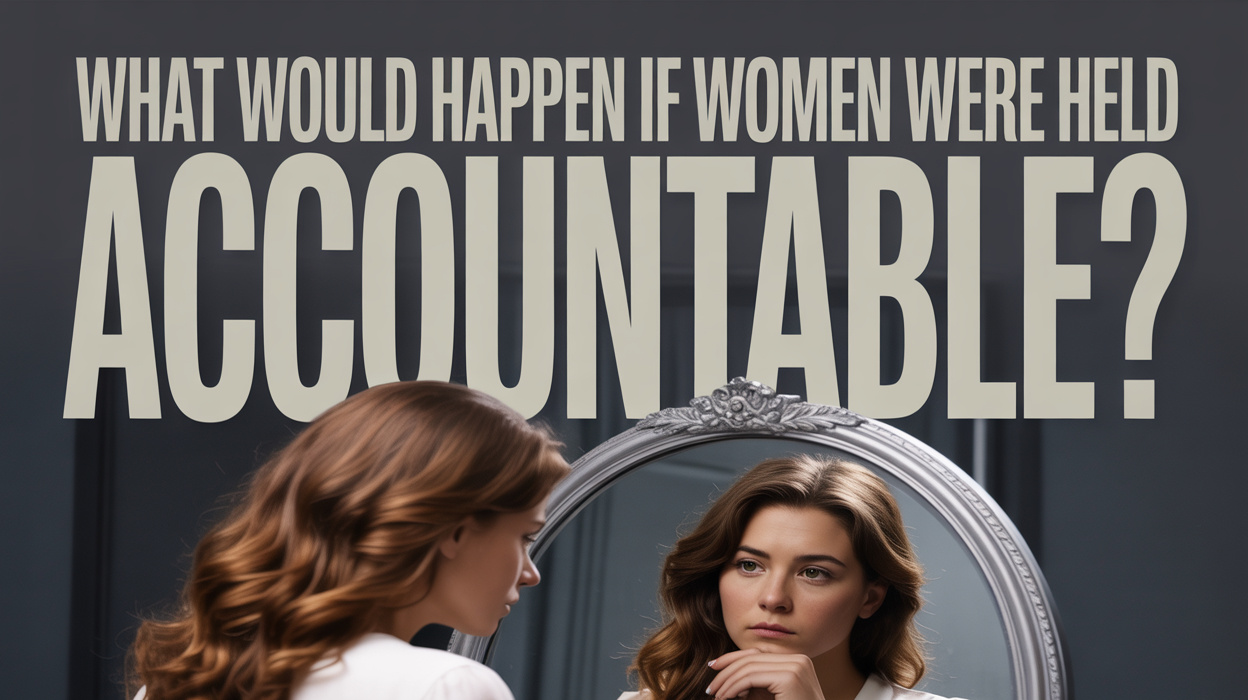
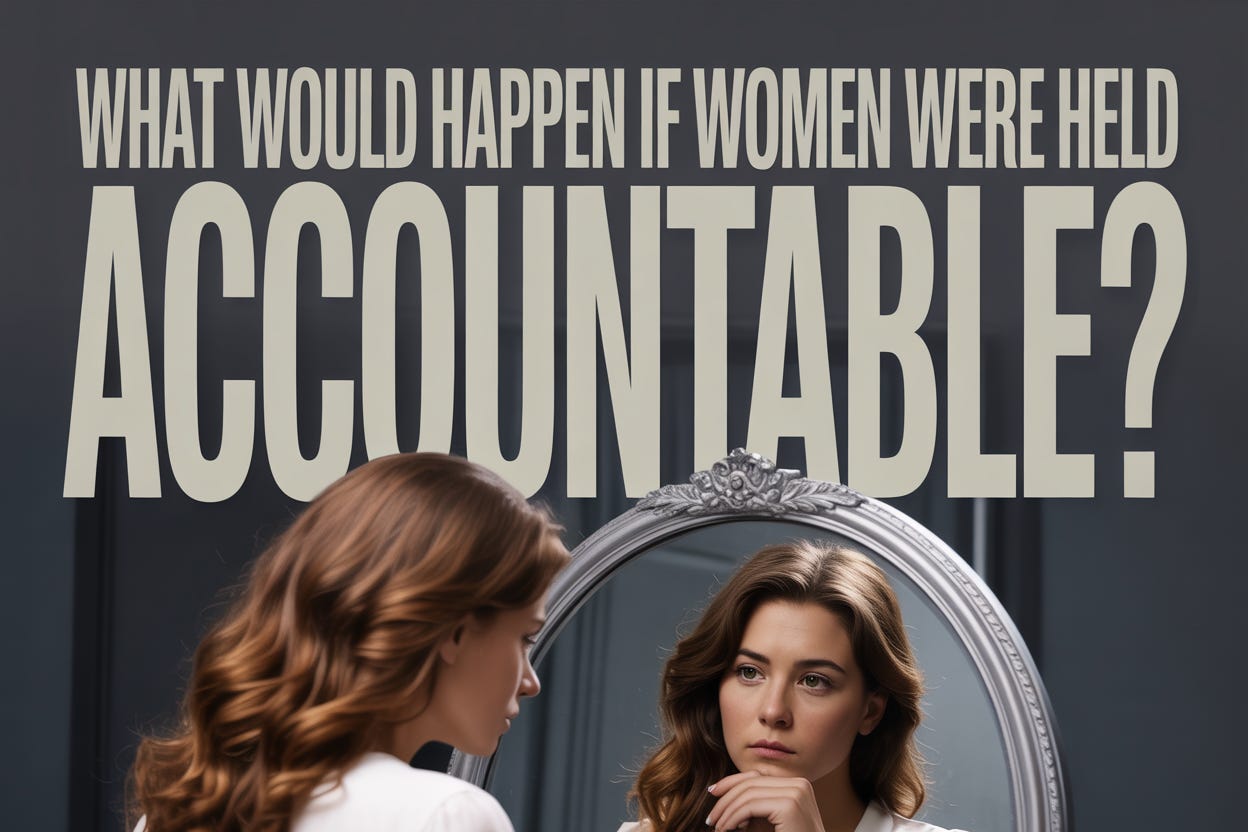
What Would Happen If Women Were Held Accountable?
January 26, 2026
post photo preview


What Would Happen If Women Were Held Accountable?

It’s a provocative question, and one we’re usually not allowed to ask without being accused of hostility or resentment.

But it’s worth asking—not to attack women, and not to excuse men—but because accountability is not evenly distributed, and that imbalance quietly shapes modern culture, relationships, and institutions.

If women were suddenly held accountable in the same way men are, the world wouldn’t become harsher. In many ways, it would become more honest.


The Moral Language Would Change

Much of our moral language today is asymmetrical. Men are expected to explain themselves. Women are often allowed to feel their way out of responsibility.

Emotions matter—but in our current culture, women’s feelings frequently function as moral trump cards. “I felt unsafe.” “I was hurt.” “I was overwhelmed.” These statements don’t just describe an experience; they often end the discussion.

Equal accountability wouldn’t invalidate emotions. It would simply mean that feelings no longer substitute for responsibility. That shift alone would raise the level of adult discourse.


Relationships Would Become More Stable—and Initially More Difficult

Many modern relationships operate on an unspoken rule:

Men must regulate themselves; women must be accommodated.

Men are expected to stay calm, absorb escalation, de-escalate conflict, and tolerate shaming—all in the name of maturity. Women, meanwhile, are often excused from examining how they escalate, provoke, withdraw, or punish.

If women were held accountable for:

  • Escalation

  • Shaming

  • Relational Aggression

  • Double standards

  • Weaponized vulnerability

  • Using social or institutional power to avoid conflict

Relationships would feel more confrontational at first.

But over time, they would become more grounded and more real.

Intimacy requires mutual responsibility. Right now, many men experience intimacy as liability without authority.


Victimhood Would Lose Its Automatic Power

Accountability would force a distinction we currently blur:

Being harmed is not the same thing as being right.

Some women are victims—genuinely.
But victimhood would no longer function as a permanent moral exemption.

This would dramatically reduce:

  • False or exaggerated claims

  • Social pile-ons

  • Casual reputational destruction

  • The quiet fear men carry about being misunderstood or accused

Ironically, real victims would be taken more seriously, not less—because the category would no longer be diluted by misuse.


Institutions Would Have to Grow Up

Many of our institutions—education, therapy, HR, media—are structured around shielding women from accountability while demanding relentless self-examination from men.

If accountability were equalized:

  • Therapy would stop pathologizing male restraint

  • Schools would begin to recognize female aggression and social cruelty

  • Workplace policies would acknowledge relational aggression

  • Media narratives would stop moral typecasting

We would finally be able to talk about female power without pretending it doesn’t exist.


Women Would Become More Free—Not Less

This is the part almost no one acknowledges.

Lack of accountability infantilizes.

When women are shielded from consequences:

  • Growth slows

  • Self-awareness dulls

  • Agency is quietly undermined

Accountability is not punishment. It is recognition of moral adulthood.

Some women would initially resist it.
Many would later feel relieved by it.


Men Would No Longer Be Required to Absorb the Chaos

Men are often expected to:

  • Absorb emotional volatility

  • Take the blame to keep the peace

  • Stay calm while being provoked

  • Be strong without being heard

Equal accountability would mean men are no longer required to be the emotional shock absorbers of modern life.

That change alone would reduce male withdrawal, bitterness, and despair.


The Deeper Truth

A culture that cannot hold women accountable is not pro-woman.

It is gynocentric—and gynocentrism ultimately harms everyone.

Accountability isn’t about blame.
It’s about reality.

And when reality is finally allowed back into the room, it has a way of making everyone more human.


A Brief Vignette

Mark and Lisa come to couples therapy after yet another “blow-up.”

Mark admits he raised his voice during an argument. He’s remorseful, embarrassed, and quickly accepts responsibility. The therapist explores his anger, his triggers, his tone.

Lisa explains that before Mark raised his voice, she had stopped speaking to him for three days. No explanation. No response to his questions. When he tried to reconnect, she cried and told him he was “scaring her.” Later, she told friends she felt emotionally unsafe.

None of this is named as aggression.

The session centers on Mark’s reactivity. Lisa’s silence, tears, and withdrawal are treated as understandable responses to stress. Mark leaves with homework. Lisa leaves affirmed.

Both partners used pressure.
Only one was held accountable.


Relationships Would Acknowledge Female Relational Aggression

In intimate relationships, aggression is still defined almost entirely in male terms.

A man who raises his voice, postures physically, or shows overt anger is quickly flagged as threatening, abusive, or unsafe. His behavior is scrutinized, named, and often pathologized—sometimes appropriately, sometimes reflexively.

Meanwhile, a wide range of female relational tactics pass largely unnoticed, unquestioned, or morally sanitized:

Temper tantrums
Crying as leverage
Withholding affection or sex
The silent treatment
Emotional withdrawal as punishment
Threats of abandonment
Recruiting children, friends, or therapists as allies
Rewriting conflicts to preserve moral innocence

These behaviors are rarely labeled as aggressive at all. They are framed as emotional expression, vulnerability, distress, or simply “how women communicate.”

The result is a profound asymmetry:
Male aggression is visible and condemned.
Female aggression is invisible and normalized.

Equal accountability would mean:

Recognizing that passive and indirect tactics can be just as coercive as overt ones

Naming manipulation regardless of whether it is loud or quiet

Understanding that tears, silence, and withdrawal can be used strategically—not just sincerely

Holding both partners responsible for how they exert power under stress

Couples therapy would stop treating male reactivity as the problem while treating female tactics as background noise. It would help both partners see how each uses pressure, leverage, and avoidance when they feel threatened.

This wouldn’t excuse male intimidation.
It wouldn’t deny female vulnerability.

It would simply acknowledge a truth long avoided:
Healthy relationships require accountability for all forms of power, not just the ones that look masculine.

Men Are Good

Part 2 will be published on Thursday and will examine the accountablity issues in the workplace, the educational system, the media, the courts, the family courts, domestic violence and psychotherapy.


community logo
Join the MenAreGood Community
To read more articles like this, sign up and join my community today
0
What else you may like…
Videos
Posts
Articles
February 12, 2026
A Conversation on Matrisensus — With Warren Farrell, Janice Fiamengo, Lisa Britton, David Shackleton, and Tom Golden

A Conversation on Matrisensus — With Warren Farrell, Janice Fiamengo, Lisa Britton, David Shackleton, and Tom Golden
David Shackleton’s newest book, Matrisensus, is not a small argument.

Matrisensus is not what happens when women are in charge. It is what happens when the family’s moral logic is applied where society’s civic logic should govern. In this sweeping examination, David shows how cultural consensus forms — and how it can come to center women’s experiences, priorities, and moral framing as the unquestioned norm. The mechanism, he argues, polarizes our moral narrative, distributing compassion and accountability not by conduct but by identity. The result is a culture in which designated victim groups are treated as morally untouchable, while those who question the framing are cast as suspect — with profound consequences for law, family, education, and public trust.

So a group uniquely qualified to engage these ideas gathered for this video.

Joining me were Warren Farrell, Janice Fiamengo, Lisa Britton, and of course the...

00:59:58
January 22, 2026
Something Wicked

Today’s conversation is with three women who share something rare: they can see through the fraud of feminism—and they’re willing to say so out loud.

Hannah Spier, M.D. (a psychiatrist from the mental-health world) breaks down how feminist ideology has seeped into therapy culture and quietly turned “help” into a kind of self-worship—often at the expense of families and men.
https://hannahspier.substack.com/

Janice Fiamengo, Ph.D, brings the historical lens, showing that feminism has never really been about “equality,” but about power—and how the story has been rewritten so effectively that even critics sometimes repeat the mythology.
https://fiamengofile.substack.com/

And Carrie Gress, Ph.D., author of Something Wicked (releasing now), lays out the argument that feminism and Christianity aren’t compatible—because feminism functions like a shadow religion: its own moral framework, its own commandments, its own “sins,” and its own sacred cow (female autonomy). ...

01:13:49
December 20, 2025
Bias Against Men and Boys in Mental Health Research

This video is a summary of the three studies we have examined the last three Saturdays. It’s a brief and relaxed look at the high points of those articles. Here’s a summary:

This video examines a pattern I’ve seen repeatedly in psychological research: when data complicates the familiar story of men as perpetrators and women as victims, the data about boys and men often disappears. Using three real studies—on teen dating violence, reproductive coercion, and “masculine norms”—I walk through how boys’ suffering is minimized, misrepresented, or erased as research moves from full reports to media headlines and public policy. What emerges is not just sloppy science, but a troubling bias that shapes how we see boys, men, and masculinity itself.

00:10:31

Another good one describe things extremely well.

https://www.facebook.com/share/v/1BXRPxMeiZ/?mibextid=wwXIfr

Interesting observation about testosterone in men that lines up with what I have seen

https://www.facebook.com/share/v/18J1ySdych/?mibextid=wwXIfr

If only if our society could just acknowledge this and celebrate it more it would be a hudge step in valuing men more!!

February 23, 2026
post photo preview
Where Galoway Stops Short
Calling Men to Rise Without Naming What Pushed Them Down

Where Galoway Stops Short - Calling Men to Rise Without Naming What Pushed Them Down

Something unusual has happened in mainstream culture: a prominent public figure has spoken to men without contempt.

In his widely circulated reflections on masculinity, Scott Galloway tells men things they rarely hear anymore — that discipline matters, that status is real, that no one is coming to save them, and that adulthood still requires effort, competence, and responsibility.

In a culture that often speaks about men as a problem to be managed, he speaks to them as adults.

That alone makes his work a step in the right direction.

But it is only a step.

Because embedded within his message are two assumptions that deserve closer examination.


When Pain Is Treated Like Weather

Galloway acknowledges that many men are struggling. He names loneliness, economic displacement, sexual exclusion, and a growing sense of irrelevance.

But these realities are framed as impersonal shifts — like automation, globalization, or changing markets. The world evolved. Adapt.

There is no villain. No moral accounting. Just conditions.

But much of what men are experiencing did not unfold quietly or accidentally.

It happened in open daylight.

For decades now:

  • Boys have been described as “toxic.”

  • Masculinity has been framed as inherently dangerous.

  • Fathers have been treated as optional.

  • Male ambition has been recoded as domination.

  • Male restraint has been interpreted as emotional deficiency.

These were not subtle cultural breezes. They were institutionalized narratives — repeated in media, education, and public discourse.

Men did not imagine this shift. They lived through it.

To speak about male pain without acknowledging the cultural disdain that preceded it is to ghost the very experience men are trying to make sense of.

If a man absorbs, year after year, the message that his nature is suspect, the shame that follows does not originate inside him.

It is absorbed.

And absorbed shame cannot be healed by discipline alone.


Responsibility Without Reciprocity

The second issue is not that Galloway calls men to responsibility.

Responsibility matters.

Structure matters.

Competence matters.

Men do not need to be rescued from adulthood.

But when responsibility is presented as the sole remedy — without acknowledging cultural injury — it subtly transforms pain into proof of failure.

If you are hurting, you must not have adapted well enough.

If you are struggling, you must not be disciplined enough.

Pain becomes diagnostic of insufficiency.

That may produce functionality.
It does not necessarily produce healing.

And it quietly leaves the culture itself unexamined.


What This Is Not

Let me be clear about something.

This is not an argument for coddling men.

It is not an argument for lowering standards.
It is not an argument for emotional indulgence or endless processing circles.
It is not an argument for turning men into women.

Men do not need to be babied.

They need to be understood accurately.


What Men Actually Need

What is missing from the conversation is something I would call respect-based empathy.

Respect-based empathy does not treat men as fragile.
It does not assume that emotional expression is superior to endurance.
It does not pathologize male withdrawal.

It recognizes that men often heal differently — and that those differences deserve admiration rather than suspicion.

When a man withdraws for a day or two after a setback, that may not be avoidance. It may be integration. When he fixes something, builds something, runs hard, works longer hours, or goes quiet, he may be metabolizing stress in a deeply male way.

For many men, solitude is not escape. It is work.

But in a culture that filters coping through a single emotional style, male processing is easily misread as deficiency.

And that misreading quietly reinforces the very problem we claim to address.


Admiration Is Fuel

Men are fueled by admiration and respect.

Not indulgence.
Not protection.
Respect.

When a man feels respected, he expands.
When he feels perpetually scrutinized or pathologized, he contracts.

The cultural shift that would help men most is not softer expectations.

It is moral clarity.

Clarity that says:

“Yes, some of this pain did not originate inside you.”
“Yes, some of it came from narratives that diminished you.”
“And yes, the way you work through it has dignity.”

Responsibility matters.

But responsibility without acknowledgment of cultural harm becomes another burden.

Strength and suffering can coexist.

Calling men to rise without first admitting that they were pushed down in public view is not maturity. It is amnesia.

And offering responsibility without respect-based empathy risks reinforcing the very isolation we claim to address.

Men do not need coddling.

They need to be seen clearly.

They need standards, yes — but they also need a culture wise enough to recognize the dignity in how they endure.

Until we add that understanding, responsibility alone is not enough.

Men Are Good.

Read full Article
February 19, 2026
post photo preview
Do Men Face Prejudice?
A dissertation that reveals what the APA quietly overlook


Do Men Face Prejudice?

A dissertation that reveals what the APA quietly overlook

The American Psychological Association likes to remind us that psychology should be guided by empathy, cultural awareness, and respect for lived experience. Few would argue with that. These values are written directly into the APA Guidelines for Psychological Practice with Boys and Men, published in 2018.

On paper, the Guidelines sound humane and thoughtful. They urge psychologists to be gender-sensitive, to avoid stereotyping, to understand the social contexts shaping boys’ and men’s lives, and to guard against bias that might harm the therapeutic alliance.

All good things.

But there is an important question we almost never ask:

What happens when those principles are applied fully and consistently to men — including the possibility that men themselves may be targets of prejudice?

A largely unknown doctoral dissertation from 2020 offers a surprisingly clear answer.


A brief introduction most people never received

In 2020, psychologist Aman Siddiqi completed a doctoral dissertation titled A Clinical Guide to Discussing Prejudice Against Men. It was submitted quietly, without media attention or controversy, and has remained largely invisible outside academic circles.

That is unfortunate — because it does something rare.

Rather than arguing politics or ideology, Siddiqi does something very simple and very professional:
He takes the existing psychological science on prejudice and asks whether it applies to men.

Not rhetorically. Clinically.

He does not invent new standards. He does not dismiss women’s issues. Instead, he asks whether psychologists may be overlooking an entire category of harm because it doesn’t fit the dominant narrative.

And in doing so, his work quietly exposes a tension at the heart of the APA Guidelines themselves.


What the APA Guidelines say — and what they assume

The APA Guidelines for Boys and Men emphasize several themes that many clinicians will recognize:

  • Boys and men are shaped by restrictive gender norms

  • Emotional suppression harms mental health

  • Masculinity can be socially reinforced in unhealthy ways

  • Psychologists should challenge stereotypes and build empathy

All of that ​may be true — as far as it goes.

But notice something subtle.

The Guidelines overwhelmingly frame men as:

  • Shaped by norms

  • Socialized into restriction

  • Influenced by expectations

What they almost never frame men as is this:

Targets of prejudice.

This matters more than it might seem.


Why “prejudice” is not the same as “socialization”

Siddiqi’s dissertation makes a distinction that is obvious once you see it — and strangely absent from much of clinical training.

Socialization asks:

“What messages did you absorb growing up?”

Prejudice asks:

“How are you perceived, judged, dismissed, or morally framed by others right now?”

These are not the same thing.

A man may be distressed not only because he learned to suppress emotion — but because when he does express vulnerability, he is:

  • Not believed

  • Seen as dangerous

  • Treated as less worthy of care

  • Assumed to be at fault

The APA Guidelines speak at length about helping men change themselves.
Siddiqi asks whether psychology has done enough to question how men are viewed.

That shift alone is quietly radical.


The empathy gap we don’t name

One of the strongest parts of Siddiqi’s work is his discussion of what he calls the male gender empathy gap — the tendency to respond less sympathetically to male suffering, especially when it conflicts with familiar narratives.

This is not framed as cruelty. It is framed as normalization.

Some prejudices persist not because people hate a group — but because dismissing that group’s suffering has become socially acceptable.

Siddiqi outlines several mechanisms that maintain this acceptability:

  • Trivialization (“It’s not that serious.”)

  • Denial (“That doesn’t really happen.”)

  • Justification (“There must be a reason.”)

  • Intimidation (“You can’t say that.”)

If you’ve worked with men long enough, you’ve heard these dynamics described — often haltingly — in the therapy room.

The APA Guidelines warn clinicians not to invalidate clients.
Siddiqi shows how invalidation happens when male distress falls outside approved frames.


When good intentions become blind spots

Perhaps the most uncomfortable implication of Siddiqi’s dissertation is this:

Clinicians themselves may unintentionally participate in prejudice against men — precisely because their training never gave them a framework to recognize it.

When a man describes feeling:

  • Disbelieved in a conflict

  • Treated as disposable

  • Assumed to be dangerous

  • Morally pre-judged

A well-meaning therapist may instinctively:

  • Reframe the experience

  • Redirect responsibility

  • Minimize the injury

  • Interpret it as defensiveness or entitlement

Not out of malice — but out of habit.

The APA Guidelines urge psychologists to be self-reflective about bias.
Siddiqi asks whether psychology has reflected deeply enough on its gender asymmetries.


A question the Guidelines never quite ask

The APA is comfortable naming androcentrism — male-centered bias — in culture.

Siddiqi raises a quieter question:

What happens when cultural sympathy flows primarily in one direction?

He uses the term gynocentrism not as an accusation, but as a descriptive lens — a way of understanding how concern, protection, and moral framing may cluster unevenly.

Whether one accepts the term or not, the phenomenon it points to is familiar to many men:

  • Female suffering is presumed legitimate

  • Male suffering is often contextualized, explained, or doubted

The APA Guidelines never directly address this imbalance.
Siddiqi does — calmly, clinically, and without rhetoric.


Why this matters now

In recent years, we’ve seen growing concern about:

  • Male loneliness

  • Male suicide

  • Boys disengaging from school

  • Men dropping out of institutions

Many responses still default to:

“Men need to open up.”
“Men need to change.”
“Men need better coping skills.”

Those may help.

But Siddiqi’s dissertation suggests something deeper:

If we never examine how men are seen, we will keep asking men to adapt to environments that quietly misperceive them.

The APA Guidelines aim to help boys and men.
Siddiqi’s work asks what those guidelines truly require — if we apply them without exemptions.


A final thought

This dissertation does not reject psychology’s values.

It takes them seriously.

And in doing so, it reveals a simple, uncomfortable possibility:

We may believe we are being fair to men — while still failing to see them clearly.

That is not an accusation.
It is an invitation.

And it is one psychology would do well to accept.

Read full Article
February 16, 2026
post photo preview
Institutional Sexism: The Bias We’re Not Allowed to See - Part 3 - Conclusion


Institutional Sexism: The Bias We’re Not Allowed to See - Part 3 - Conclusion

If institutional sexism against men is so pervasive, why can’t we see it?
Why can a society capable of diagnosing “microaggressions” and “implicit bias” remain blind to its own structural prejudice against half its citizens?

The answer lies in a deeper psychological bias — one older than feminism and broader than politics. It’s the instinct to center women’s needs first: gynocentrism.

Gynocentrism isn’t hatred of men; it’s compassion with blinders on. It’s the moral reflex that sees women as fragile, men as durable, and suffering as legitimate only when it’s female. It shapes our empathy map from childhood — the little girl who cries is comforted; the boy who cries is told to toughen up. By adulthood, that reflex is baked into the culture.

When feminists in the 1960s began describing institutions as oppressive to women, they were building on this foundation. The public accepted the narrative easily because it fit the moral intuition that women need protection and men need correction. The idea of institutional sexism against women felt right; the idea of institutional sexism against men felt absurd.

But intuition isn’t truth.

Gynocentrism acts like an ideological shield: it protects women from scrutiny while leaving men exposed. When a woman fails, the system failed her; when a man fails, he failed himself.
The result is a self-reinforcing loop — a feedback mechanism that rewards female victimhood and punishes male vulnerability.

Even academia, which claims neutrality, is steeped in this moral reflex.
Gender-studies programs that once promised to challenge inequality now function more as temples of ideological maintenance. Their role is not to question whether men face systemic bias, but to explain away any data suggesting they do. The assumption is always that men hold the power, even when they demonstrably don’t.

That’s not scholarship; it’s theology.

And like all theology, it protects itself by defining heresy. The heretic, in this case, is anyone who points out that compassion has been rationed by sex.


7. The Human Cost

When systems consistently favor one sex’s pain over the other’s, people learn. Boys learn it first.

They learn it in classrooms that scold their energy and reward compliance.
They learn it in media that depicts them as bumbling, violent, or disposable.
They learn it in families where fathers are peripheral, or where mothers wield the quiet authority of assumed virtue.

By adulthood, many men have absorbed the lesson: your feelings are a burden, your needs are negotiable, your failures are proof.

This is how institutional sexism becomes internalized.
Men stop expecting fairness, and worse, they stop expecting empathy. When injustice occurs — in courts, workplaces, or relationships — they don’t see it as systemic. They see it as personal ​failure or weakness.

That resignation is perhaps the cruelest outcome of all.
Because institutions don’t have to oppress loudly when their subjects have already consented to being overlooked.

The emotional toll is enormous but unmeasured. It shows up in statistics — suicide rates, addiction, homelessness — but the deeper wound is existential. When a man realizes that the society he contributes to has little instinct to protect him, something vital in his spirit hardens.

As one father told me after losing custody of his children, “I didn’t just lose them. I lost faith in the idea that fairness even applies to me.”

Institutional sexism isn’t only about policies. It’s about the quiet message that some lives merit more compassion than others. And that message, delivered generation after generation, corrodes our collective sense of justice.


8. Reclaiming the Term

It’s time to reclaim the language.

If systemic bias means patterns of disadvantage embedded in structures, then we must be willing to name those patterns wherever they occur — not just where they fit a fashionable narrative.

Institutional sexism should never have been gendered. It describes a process, not a direction: the way institutions absorb moral assumptions and translate them into policy. Sometimes those assumptions favor men. Increasingly, they favor women. The honest mind must be able to see both.

Reclaiming the term doesn’t mean denying women’s​ or men’s historical struggles. It means applying the same analytical lens to everyone. It means intellectual consistency.

We’ve built a society where calling attention to male disadvantage is considered controversial, while calling attention to female disadvantage is considered virtuous. That asymmetry is itself a form of institutional sexism — the kind that hides behind moral approval.

The first step toward balance is honesty. We must be willing to ask the forbidden question:

If equality truly matters, why are we afraid to see when the system tilts against men?

If we can’t even name institutional sexism when it harms half the population, then the word equality has lost its meaning.

The goal isn’t to replace one victim class with another. It’s to restore integrity to the moral compass of our institutions — to remind them that fairness, by definition, cannot be selective.


Closing Note

Perhaps someday, a university course on “institutional sexism” will examine both sides honestly. Students will study how empathy, once a virtue, became gendered; how compassion was politicized; how language turned from a tool of truth to a weapon of ideology.

Until then, it falls to those outside the institutions — writers, thinkers, fathers, teachers, ordinary men and women — to hold up the mirror.

Because the greatest act of equality is not claiming more compassion for one sex.
It’s extending it, finally, to both.

Read full Article
See More
Available on mobile and TV devices
google store google store app store app store
google store google store app tv store app tv store amazon store amazon store roku store roku store
Powered by Locals