MenAreGood
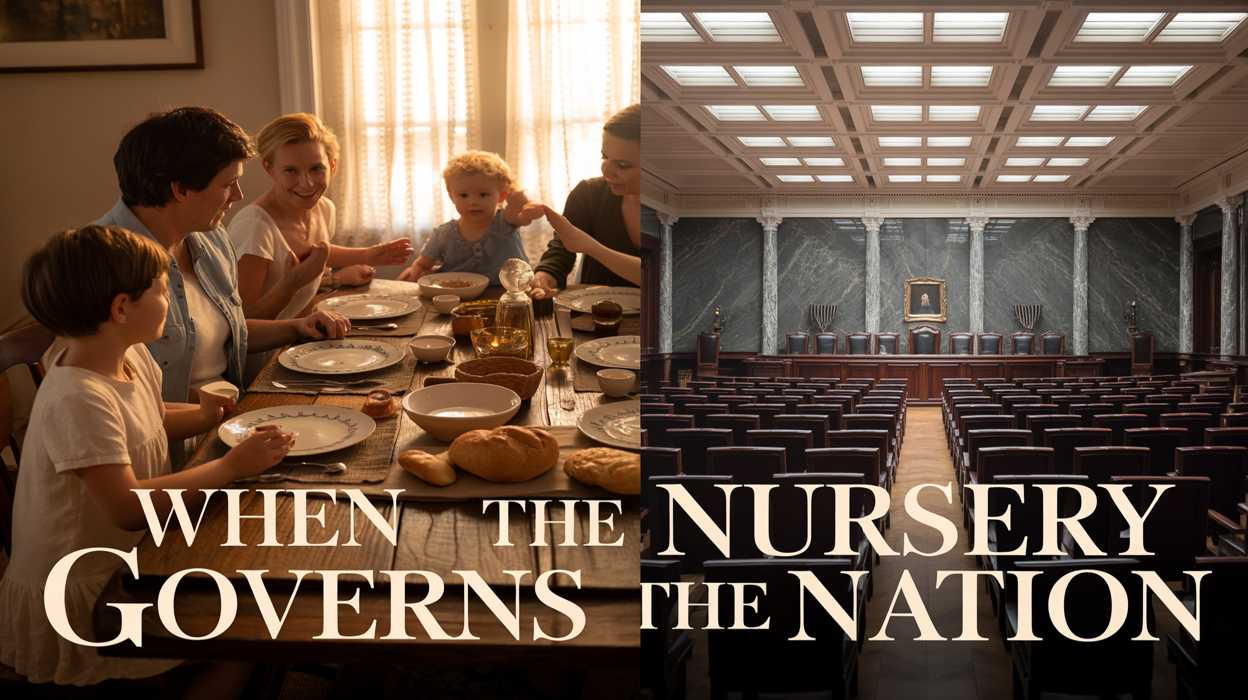
When the Nursery Governs the Nation
February 11, 2026
post photo preview


When the Nursery Governs the Nation

The Harper family lived in a modest two-story house at the end of a quiet street. There was a father, a mother, and three children: 14, 11, and 6.

They were not extraordinary people. They forgot appointments. They argued about screen time. They got tired at the end of long days.

But something about their home felt solid.

There was warmth. There was order. There was a sense that everyone knew where they stood.

Why?

Because they followed rules that make families work.


1. Belonging Came Before Performance

When the six-year-old spilled milk for the third time that week, no one convened a tribunal. She wasn’t asked whether she had “earned” dinner. She was fed because she belonged.

When the 14-year-old slammed a door and shouted something regrettable, there were consequences. But there was no threat of expulsion.

Membership in the family was unconditional.

Belonging preceded merit.


2. The Strong Carried the Weak

The parents worked. The children did not. The younger ones consumed far more than they produced.

No one kept a ledger calculating whether the six-year-old had contributed enough to justify her meals.

That would have been absurd.

Family is not based on reciprocity. It is based on duty and love.

The strong carry the weak—temporarily—so that the weak can grow strong.


3. Feelings Had Moral Weight

If one child was hurt, everything paused. If someone cried, the room shifted.

Emotional pain mattered.

The parents were especially attentive to vulnerability.

The most fragile voice in the room often received the most care.

No one found this unfair. It was simply what families do.


4. Mercy Tempered Justice

Rules existed. But context mattered. “Why did you do that?” was asked before consequences were decided.

Intent mattered.

Fatigue mattered.

Developmental stage mattered.

Justice inside a family is personal, not mechanical.


And because of these principles, the Harper family flourished.

The children grew.
Mistakes were survivable.
Love was assumed.
Authority was trusted.

Now imagine something strange.


The Same Rules Applied to the Whole Town

Suppose the mayor of the town announced:

“We have discovered that the Harper family’s way of operating produces harmony. Therefore, we will run the entire town by the same principles.”

It sounded compassionate.

It sounded humane.

It sounded morally advanced.

And so they tried.


1. Belonging Before Contribution

Citizens were told:

“Your needs come first. Contribution is secondary.” Resources were increasingly distributed according to distress rather than productivity.

Those who expressed greater need received greater priority.

Those who produced more were told not to focus on reward. After all, in a family, the strong carry the weak.

At first, this felt noble.

Over time, effort subtly declined.

Not dramatically. Not all at once.

Just enough.


2. Feelings as Public Authority

Town meetings began centering on emotional harm.

If a policy made someone feel excluded, it was reconsidered.

If a group felt historically wronged, that feeling carried moral authority.

Facts still mattered—but feelings often overruled them.

Gradually, public debate shifted from “What works?” to “Who is hurting?”

And the most distressed voice carried the most influence.


3. Mercy Without Impartiality

In the Harper home, mercy worked because everyone was bound together for life.

In the town, relationships were not intimate. They were institutional.

Yet rules began bending depending on who committed the offense.

Context expanded for some.
Responsibility tightened for others.

The law stopped feeling blind.
Trust began to erode.


4. The Quiet Burnout

At the edge of town lived Daniel.

He owned a small plumbing company.

He worked long hours. Paid his taxes. Trained apprentices. Fixed broken pipes in winter storms.

When policies shifted toward distributing resources based primarily on need, Daniel didn’t complain. He believed in helping people.

But over time he noticed something.

His taxes rose steadily.
Regulations multiplied.
Clients who didn’t pay were increasingly protected.

When he raised concerns, he was told, gently, that others were hurting more.

He kept working.

But something changed.

He stopped hiring apprentices.
He stopped expanding.
He stopped volunteering for civic boards.

He still contributed.

Just less.

Not out of anger.

Out of fatigue.

Multiply Daniel by thousands.

The town did not collapse in flames.

It simply slowed.


5. The Collapse of Incentive

In a family, parents sacrifice because love binds them.

In a town, producers require fairness and predictability.

When contribution no longer reliably led to reward,
and distress reliably led to benefit,
human behavior adjusted.

Not because people were evil—
but because incentives shape action.

Gradually.
Predictably.


Why It Worked at Home But Failed in Public

The Harper family worked because:

  • It was small.

  • It was intimate.

  • It was bound by lifelong loyalty.

  • It operated through asymmetrical responsibility.

  • It suspended strict reciprocity for the sake of development.

The town required something different:

  • Impersonal fairness.

  • Predictable incentives.

  • Equal accountability under law.

  • Reciprocal contribution.

  • Boundaries that protect the whole.

The family is designed to nurture dependency.

Society is designed to transition dependency into responsibility.

The family suspends survival logic so children can grow.

Society must enforce survival logic so civilization can survive.


Both Systems Are Necessary

This is not an argument against families.

Nor is it an argument against compassion.

The family is sacred precisely because it is an exception.

It is the one place where love precedes merit.

And society exists so that families can exist.

Without the productive, disciplined structures of the public sphere, there would be no stable homes to shelter children.

Without the nurturing, sacrificial structures of the family, there would be no mature adults capable of sustaining society.

They are not enemies.

They are interdependent.

But they are not interchangeable.

When the rules of the nursery become the rules of the nation, compassion expands—but accountability weakens.

And when accountability weakens for long enough, even compassion becomes unsustainable.

The tension described in this story is not hypothetical. It is the central argument of David Shackleton’s remarkable new book, Matrisensus: Masculine Collapse and Feminine Shadow.

Shackleton argues that Western society is increasingly governed not by the logic of society, but by the logic of the family — and that this shift carries profound consequences for law, culture, and moral authority.

Tomorrow, I’ll be joined by David Shackleton, Janice Fiamengo, Warren Farrell, and Lisa Britton for a conversation exploring these ideas in depth. If this story resonates with you, you won’t want to miss it.

Men Are Good

community logo
Join the MenAreGood Community
To read more articles like this, sign up and join my community today
0
What else you may like…
Videos
Posts
Articles
April 02, 2026
Are Family Courts at War with the Constitution?

In this conversation, I sit down with longtime scholar and author Stephen Baskerville to take a hard look at modern family courts, no-fault divorce, paternal rights, and the assumptions behind shared parenting. Stephen argues that what many people take for granted in divorce and custody law may be far more troubling than they realize—not only for fathers and children, but for the rule of law itself. Join us in this challenging and thought-provoking discussion that raises questions most people never hear asked.

Stephen's Substack
https://stephenbaskerville.substack.com/

01:02:28
March 30, 2026
Blame it on the Manosphere

This short video takes a humorous look at the current panic among feminists and the media over what they call the manosphere. In reality, the manosphere is one of the places where their false narratives are being exposed. What we are seeing now is the creation of a straw man—something to blame, distort, and use as a distraction from the truth that is coming to light. More and more people are waking up to the game and beginning to see the hostility and self-interest that have been there all along.

(This video was produced largely with AI. I wrote the script, and the music and images were AI-generated.)

Men are Good!

00:03:05
March 23, 2026
From Description to Smear: The Guide to the Manosphere

Today’s video is a lively and revealing conversation with Jim Nuzzo about the growing panic over what the media and academia call “the manosphere.” Together, we take a close look at a new Australian guide for teachers that claims to help schools deal with so-called misogynistic behavior among boys. What we found was not careful scholarship, balanced concern, or genuine curiosity about boys. What we found was a familiar pattern: boys portrayed as the problem, their questions treated as threats, and their frustrations dismissed before they are even heard.

Jim brings his scientific eye to the discussion, and that makes this exchange especially valuable. We talk about the sudden explosion of academic and media attention on the manosphere, the way fear is being used to drive the narrative, and the striking absence of empathy for boys who feel blamed, dismissed, and alienated. We also explore something the guide never seriously asks: why are boys drawn to these spaces in the first ...

00:48:43

Women an they just won’t!

This is on point and even this will be seen as anti woman

March 02, 2026
Men Don't Grieve the Way You Think

I had the good fortune to be interviewed by Jason MacKenzie, who runs the Man Down Substack—a publication dedicated to men and their unique paths to healing.

Many of you may not know that I spent many years working directly with men who were grappling with trauma and loss. Through that experience, it became strikingly clear to me that men and women are often treated very differently after a loss. Those early observations opened my eyes to the broader ways men face discrimination, misunderstanding, and hardship in our society. I hope you find the conversation interesting and worthwhile.

https://www.mandown.tools/p/men-dont-grieve-the-way-you-think?utm_campaign=post&utm_medium=web

14 hours ago
post photo preview
How A Culture Turns a Group into "The Problem"
Why the way we talk about men today follows a pattern we’ve seen before


Years ago I read a book called The Death of White Sociology. It explored the rise of a Black sociological viewpoint and challenged the assumptions of what the authors called “White sociology.” What struck me most was not only the book’s critique of how Blacks had been studied and described, but the way it mapped the machinery by which a culture teaches itself to see a group as lesser.

It showed how prejudice does not survive by hatred alone. It survives through a system of reinforcement. Research, media, public opinion, everyday conversation, and institutional assumptions all work together until a distorted view begins to feel like simple common sense. The result is that the targeted group is not merely disliked. It is interpreted through a lens of defect.

As I read it, I kept having the same thought: there is something here that resembles what men face today.

Let me be clear. This is not an argument that men have endured the same history that Blacks endured. They have not. The suffering is not the same. The legal and social conditions are not the same. But the pattern by which a group is culturally misread, judged by hostile assumptions, and portrayed as inherently flawed can look strikingly similar.

That is the comparison worth making.


How a Culture Teaches Itself to See

The book described three powerful channels through which the myth of Black inferiority was spread: common knowledge, the media, and science. Together, they created a self-reinforcing system. Each one echoed the others until the message became nearly impossible to challenge.

Common knowledge is what people “just know” without thinking. In the period the book described, it was simply accepted that Blacks were inferior. That belief did not feel like prejudice to most people. It felt like reality.

Today, something similar operates in a different direction. It is widely assumed that men, as a class, are the problem—emotionally limited, morally suspect, prone to harm. Not some men. Men.

Once that assumption settles in, everything else begins to orbit around it.


The Media: Then and Now

Media plays a powerful role in teaching people how to see.

In earlier decades, Blacks were often portrayed as immature, unintelligent, and incapable of managing life without guidance. Characters like Stepin Fetchit or Amos and Andy reinforced an image of Blacks as confused, dependent, and lacking competence.

Today, it is difficult not to notice a similar pattern applied to men. The modern version is not as overt, but it is just as persistent. Think of characters like Homer Simpson and countless others—men portrayed as childish, incompetent, emotionally clueless, and in need of a woman to guide or correct them.

The message accumulates:
Men are not fully capable. Men need women to straighten them out.

Over time, that message begins to feel normal.


Science and the Framing of Defect

One of the most troubling aspects described in The Death of White Sociology was how research itself could be shaped by cultural assumptions.

In the early to mid-20th century, much psychological and sociological research was not designed to help Blacks. It was designed to explain what was wrong with them. It cataloged deficits. It emphasized pathology. It framed Blacks as needing to change in order to fit the dominant culture.

That pattern is not entirely gone. It has, in many ways, shifted.

Today, a great deal of research on men begins with a similar orientation. It is often less about understanding men and more about diagnosing them. Masculinity is framed as problematic. Male traits are frequently interpreted as risks rather than resources. The focus is not on how to support men, but on how men must change.

And just as importantly, what does not get highlighted matters.

In earlier times, when research produced findings that challenged the narrative of Black inferiority, those findings were often minimized or ignored. They did not fit the story, so they did not spread.

Today, we see a parallel dynamic. When data shows men as victims—whether in areas like domestic violence, educational decline, or mental health—it is often underreported or downplayed. When men do well, it is frequently reframed as evidence of advantage rather than strength. The result is a public picture that remains lopsided.

When only one side of the story is consistently told, it stops feeling like a story. It starts feeling like truth.


Difference Turned Into Deficiency

Another striking pattern from the earlier era was the assumption that Blacks needed proximity to Whites in order to become more “civilized” or mature. The closer one was to White influence, the better one was assumed to be.

That same structure appears today in a different form.

Men are often seen as needing to become more like women in order to be fully healthy or mature. Emotional styles, communication patterns, and ways of processing experience that are more typical of women are treated as the standard. When men do not match those patterns, they are seen as deficient rather than different.

The message, again subtle but persistent, is this:
Men are better when they resemble women.


Perpetrators, Not Victims

Perhaps the most powerful mechanism described in the book was this:

Blacks were defined as the creators of social problems, not the victims of them.

Once that framing takes hold, something important happens. The suffering of the group becomes harder to see. If a group is the problem, then its pain feels less deserving of attention.

That dynamic is deeply relevant today.

Men are routinely framed as the source of social pathology—violence, war, exploitation, dysfunction. And while individual men certainly do harmful things, the broader cultural narrative often treats men as a class as the problem itself.

As a result, male suffering becomes less visible.

Male loneliness.
Male suicide.
Male educational struggles.
Male victimization.

These are real, measurable issues. But they rarely sit at the center of public concern in the same way that other forms of suffering do.

Selective empathy becomes the norm.


The Psychological Cost

When a culture repeatedly tells a group that it is the problem, that message does not remain external. It gets absorbed.

In the years prior to the 1960s, many Black activists faced a heartbreaking reality. Some Blacks had been so worn down by years of judgment and cultural dismissal that their spirits were deeply damaged. The constant message of inferiority had taken its toll.

The civil rights movement did something powerful in response. It did not only change laws. It worked to restore identity and dignity. Phrases like “Black is Beautiful” were not slogans in the shallow sense. They were acts of psychological repair. They challenged a culture-wide narrative and helped rebuild a sense of worth.


That kind of shift matters.

Today, we should at least be willing to ask whether something similar is needed for men and boys.

If boys grow up hearing that masculinity is toxic, that men are the problem, that their instincts are suspect, it is not hard to imagine the impact. Shame takes root quietly. Identity becomes confused. Confidence erodes.

At some point, a counter-message becomes necessary—not one that diminishes others, but one that restores balance.

A simple one might be enough to start:

Men are good.


Not the Same History—But a Recognizable Pattern

The point of this comparison is not to collapse different histories into one.

It is to recognize a pattern.

A culture can:

  • create a narrative about a group

  • reinforce it through media, research, and conversation

  • filter all new information through that lens

  • and slowly make that narrative feel like reality

When that happens, the group is no longer seen clearly.

It is seen symbolically—as a problem.

We have seen this before.

The people living through it then often could not see it clearly.
It felt normal.
It felt justified.
It felt like truth.

That may be the most unsettling part.

Because if a culture can do that once, it can do it again.

Not the same history.
Not the same wounds.

But a pattern familiar enough that we would be wise—very wise—to recognize it.

Men Are Good, as are you.


The Death of White Sociology https://amzn.to/4dToojz

Read full Article
April 13, 2026
post photo preview
Research: Feminist Hate is Real


I recently read a study titled “Women Who Hate Men: A Comparative Analysis Across Extremist Reddit Communities.” It caught my attention for an obvious reason: it attempts to examine something that is rarely acknowledged in mainstream research—the existence of hostility toward men. That alone makes it worth looking at.

To its credit, the study does arrive at an important conclusion. It finds that gender-based hostility online is not confined to one direction. Both misogynistic and misandric communities show similar patterns of negativity, and in some cases, the levels of expressed “hate” are comparable—or even higher—in feminist spaces. In fact, one of the more striking findings was that the mainstream Feminism subreddit, not the more radical GenderCritical group, showed the highest “hate” levels in the study’s user-level emotional analysis, while the incel group skewed more toward sadness. That’s not a small finding. For years, the dominant narrative has been that hostility flows primarily from men toward women, while negative attitudes toward men are either minimal, reactive, or insignificant. This study quietly challenges that assumption.

But as I read through the paper, I found myself struck by something else. The conclusion may be balanced, but the path getting there is not.


The Framing Is Not Neutral

One of the first things that stood out was how much time the paper spends describing the dangers women face from misogyny. There are detailed references to harassment, violence, abuse of female public figures, and the broader cultural impact of anti-female hostility.

But there is no parallel effort to explore the harms faced by men. There is little discussion of male victimization, little acknowledgment of anti-male stereotypes, and almost no examination of how cultural narratives might shape hostility toward men and boys. So even in a study that claims to look at both sides, the starting point is not neutral. It begins from a familiar position: misogyny is the established problem. Misandry is something newer, something less understood, something that needs to be “added” to the conversation. That framing matters because it subtly positions one form of hostility as primary and the other as secondary.


The “Manosphere” Problem

Another moment gave me pause. The paper describes the “manosphere” as:

“a network of websites and social media groups that promote misogynistic beliefs.”

That’s not a finding. That’s a definition, and definitions matter. If you begin by defining a category as misogynistic, then study that category, you are not really testing whether it is misogynistic. You have already assumed the answer.

Now, to be fair, some spaces within what is often called the “manosphere” are openly hostile. Anyone who has spent time online knows that. But the term itself is broad. It includes a wide range of spaces—some focused on anger, yes, but others focused on fatherhood, men’s mental health, legal concerns, relationships, or simply trying to make sense of a changing world. To define all of that as inherently misogynistic collapses important distinctions. It turns a complex landscape into a single, pre-labeled category, and once that happens, the analysis begins to feel circular.


Reaction or Expression?

As I continued reading, I noticed something more subtle. Feminist spaces in the study are often framed—implicitly—as reacting to misogyny. The idea seems to be that negative attitudes toward men are, at least in part, a response to harm. That may sometimes be true, but it is not something the study actually tests.

Interestingly, the data itself complicates that assumption. When the researchers looked at emotional patterns—particularly expressions of “hate”—the feminist subreddit showed some of the highest levels at the user level. That’s a striking finding, because it suggests that hostility toward men is not always merely reactive. It can be active. It can be sustained. And in some cases, it may be as intense as the hostility it is presumed to respond to. The study reports this, but it does not fully grapple with what it means.


The Problem with Measuring “Hate”

The paper relies heavily on computational tools to measure toxicity and emotion. That’s understandable. Large datasets require some kind of automated analysis. But these tools have limits. They tend to detect what we might call explicit hostility—insults, threats, and dehumanizing language.

What they struggle to capture is something more subtle: generalized suspicion, moral framing, one-sided narratives about harm, and the steady pathologizing of a group. Hatred does not always announce itself clearly, and it does not always use harsh words. Sometimes it sounds like concern. Sometimes it sounds like analysis. Sometimes it even sounds like virtue. And that kind of hostility can be harder to measure—but no less real.


The Charts That Don’t Quite Clarify

I’ll admit something simple as well: the charts didn’t help much. There were clusters of colors, distributions, and visual patterns—but very few clear numbers that would allow a reader to easily compare groups. How much more hate? How much less? It was difficult to say.

The visuals looked scientific, but they didn’t always make the findings clearer. They gave an impression of precision without always delivering clarity.


An Important Step—But Not the Whole Picture

So where does that leave us? I do not think this is a bad study. In some ways, it is an important one. It takes a step that many researchers have been unwilling to take. It acknowledges that hostility toward men exists, that it can be measured, and that it should not be ignored. That matters.

At the same time, the study reflects the broader environment in which it was produced—an environment that still tends to treat men as the default source of harm, and women’s hostility as something more contextual, more explainable, or more justified. Because of that, the analysis feels uneven. The conclusion points toward balance, but the framing leans away from it.

And that, to me, is the most revealing part of all. The study is valuable not only for what it finds, but for what it unintentionally exposes about the culture surrounding the research itself.


The Deeper Issue

In the end, what struck me most is this: we are beginning to see evidence that hostility toward men is real and measurable, but we are still not willing to face it directly—not with the same seriousness, the same clarity, the same moral urgency, or the same willingness to question the stories we have been telling ourselves for decades.

If researchers truly want to understand gendered hostility, they cannot stop with fringe Reddit communities. They need to look at the media, the schools, the therapeutic world, public health messaging, and other major cultural institutions and ask a very simple question: Who is being portrayed as dangerous? Who is being treated as defective? Who is being blamed, pathologized, mocked, feared, or morally downgraded? Men or women?

That would be a far more revealing study. Because the most powerful forms of hatred are not always loud, crude, or obvious, and they are not always found in anonymous online forums. Sometimes they are found in respectable institutions. Sometimes they are taught in classrooms, repeated in headlines, embedded in therapy language, or smuggled into public discourse under the cover of compassion and progress.

And that is precisely what makes them so powerful. When contempt for men is framed as insight, when suspicion of men is framed as wisdom, and when the steady belittling of men is framed as moral sophistication, it becomes very difficult even to name what is happening.

Until we are willing to examine that honestly, we will keep misunderstanding the problem. We will keep measuring only the crudest forms of hate while ignoring the more polished and socially approved forms. We will keep pretending that hostility toward men is mostly reactive, incidental, or harmless, when in many settings it has become normalized.

And when a culture cannot honestly recognize the contempt it directs at half the human race, it does not become more just. It becomes more blind.

Men Are Good, as are you.

Coppolillo, Erica In: Scientific reports, 2025 Apr 22, volume 15, issue 1, page 13952

https://www.nature.com/articles/s41598-024-81567-9

Read full Article
April 09, 2026
post photo preview
Men Aren’t Broken—Just Misread.
And that misunderstanding is damaging marriages, boys, fathers, therapy, and the workplace


For years now, we have been told that men need to become more open about their emotions. They need to talk more, reveal more, cry more, and process more directly. We hear this so often that it has taken on the status of settled truth. But almost no one asks the more unsettling question: what if many men have been emotionally present all along, but in ways our culture has failed to recognize? What if the real problem is not that men lack emotional depth, but that male emotional life is so often judged by female standards?

That question matters far more than most people realize. It matters in marriage, where a good man can be called emotionally unavailable simply because he does not process out loud. It matters in families, where boys are corrected for the very ways they regulate hurt, fear, and stress. It matters in schools, where male behavior is more likely to be treated as a problem to be managed than a difference to be understood. It matters in therapy, where men often discover that healing is quietly defined in ways that fit women better than men. It matters at work, where “emotional intelligence” can become a polished-sounding way of rewarding female-style expression and penalizing male reserve. It matters in the courts as well, where fathers can be misjudged because their love does not always arrive in the approved emotional form.

Again and again, men and boys are judged not by the depth of their feeling, but by the style of its expression. And the style most often treated as healthiest is often simply the female style. That is not a criticism of women. Women have every right to their own ways of feeling and expressing. The problem is that our culture has quietly taken one pattern of emotional life and turned it into the universal standard. Once that happens, men and boys are almost guaranteed to be misunderstood.

A man can love deeply, care intensely, lose sleep over conflict, and still be called emotionally shut down. A boy can feel grief, fear, shame, and tenderness, and still be seen as emotionally underdeveloped because he runs, jokes, wrestles, or goes quiet instead of talking it through. A father can pour his heart into his children through protection, practical devotion, guidance, and steady presence, and still be treated as emotionally secondary because he does not narrate his love in therapeutic language. That is not insight. It is a profound failure of recognition.


The marriage damaged by a false interpretation

I once worked with a couple whose marriage was in serious trouble. The wife was convinced her husband had little real emotional depth. Her evidence was familiar enough: he did not talk much, he did not process in real time, and he often went quiet during arguments. She felt alone, unmet, and unseen. As she described him, he sat there saying very little. To most observers, he would have looked exactly like the stereotype of the emotionally unavailable husband.

But when I got to know him better, a different picture emerged. After their conflicts, he would lie awake at night replaying every word. He worried deeply about her. He thought constantly about how to make things better. He held back in the moment because he knew that speaking too quickly often made the conflict worse. So he retreated inward, trying to understand what he felt before he spoke. He was not emotionally absent. He was emotionally cautious. He was not unfeeling. He was flooded. But because his distress did not take the form she recognized, it was translated into indifference.

This is where many relationships begin to fail. She wants immediate verbal connection because that is how she experiences emotional engagement. He goes inward because that is how he tries to organize emotional overload. She experiences his inward turn as abandonment. He experiences her pursuit as pressure, criticism, or emotional intrusion. The more she pushes, the more he withdraws. The more he withdraws, the more frightened or furious she becomes. Soon both are suffering, and both believe the other is the problem. But sometimes the deepest problem is simpler than that. Male emotional processing is being judged through a female lens, and two decent people end up trapped inside a misunderstanding.


The boy who is pathologized for normal boyhood

The same thing happens to boys, often from a very young age. A boy is energetic, physical, playful, impulsive, competitive, less verbally demonstrative, and inclined to work things out through movement, action, humor, mock conflict, and short cycles of upset and recovery. For most of human history, much of this would have been recognized as ordinary boyhood. Today it is often viewed with suspicion. He is too active, too rough, too defended, too inattentive to feelings, too quick to move on, too external, too much.

But much of the time what adults are seeing is not pathology. It is male-pattern emotional regulation. Many boys process discomfort through movement, challenge, joking, rough-and-tumble contact, temporary withdrawal, activity, and doing. I have seen boys laugh after getting hurt and watched adults interpret that as emotional shallowness, when often the laughter was simply a way of keeping the pain from overwhelming them. I have seen boys respond to disappointment by getting louder, more physical, or more active, only to be treated as if they had no inner life at all.

A girl who cries openly is often seen as emotionally healthy and in touch. A boy who grabs a ball, heads outside, goes silent, gets restless, or hides his distress behind humor is more likely to be seen as avoidant or emotionally blocked. That is not neutral observation. It is interpretive bias. We recognize female forms of distress more readily, and we recognize female forms of self-soothing more readily as well. We are more likely to view those forms as healthy, mature, and emotionally literate. Male forms are more likely to be treated as immaturity, dysfunction, or disorder. The message many boys receive, whether openly or indirectly, is a painful one: not only are your feelings a problem, but the very way you carry your feelings is a problem too. That is a brutal thing to teach a child.


The father whose love is invisible because it is practical

One of the deepest losses in all of this is our failure to recognize male love when it arrives through action. A mother comforts a hurting child with words and empathy, and we call that love, rightly so. A father takes the child for a drive, shows him how to fix something, throws a ball with him, sits beside him quietly, makes the home feel steady, and communicates care through protection, guidance, practical help, and dependable presence. Too often we call that something else. We call it less emotional.

But it is not less emotional. It is simply less verbal and less theatrical. Many fathers love through doing, through steadiness, through creating safety, through shared activity, and through showing up again and again. I have known fathers who worried constantly about their children and barely spoke of it. Fathers who carried heartbreak in silence while remaining steady for everyone around them. Fathers who poured love into daily acts of guidance, support, sacrifice, and reliability. Because they did not present that love in the approved emotional style, much of it went unseen.

That is not wisdom. It is a form of cultural illiteracy. A society that can no longer recognize male love unless it is translated into female emotional language is a society that has lost sight of something vital in fatherhood itself.


The workplace where bias wears the mask of enlightenment

The same dynamic now appears in professional life. “Emotional intelligence” can refer to something real and worthwhile. Self-awareness matters. Awareness of others matters. Emotional self-control matters. None of that is in dispute. But in practice, the term is often used in highly subjective ways. A man may be calm under pressure, perceptive about group tensions, fair-minded, difficult to rattle, and unusually good at maintaining perspective in conflict. Yet he may still be judged as lacking because he is not verbally expressive, not highly demonstrative, or not especially skilled at broadcasting emotional cues in the preferred style.

What is being measured in many workplaces is not emotional intelligence broadly understood. It is emotional style. And the style often being rewarded is more female-typical: visible emotional signaling, relational fluency, warmth display, and verbal processing. That means male restraint can be interpreted as coldness. Male caution can be read as distance. Male steadiness can be mislabeled as lack of empathy. Male problem-solving can be reframed as emotional avoidance. In this way, a cultural preference disguises itself as a moral virtue. A man can be downgraded not because he is interpersonally incompetent, but because he does not perform emotionality in the way evaluators most easily recognize. This is one of the more effective forms of bias because it comes wrapped in the language of progress.


The therapy room where men are taught to distrust their own path

This problem may be most painful in therapy. A man comes to therapy grieving, traumatized, depressed, or overwhelmed. He is already taking a risk. He is already doing something difficult. But often it does not take long before he senses that healing is supposed to look a certain way. He is expected to talk in a certain rhythm, disclose in a certain style, and move toward feeling in a certain order. If he needs silence before words, that may be called avoidance. If he thinks before he speaks, that may be called detachment. If he processes through walking, building, fixing, working, reflecting, or simply being alone for a while, that may be interpreted as resistance rather than understood as his actual path.

I have seen this for years. Many men are willing to heal, but they are often asked to heal in forms that do not fit them. A grieving man may not need to sit face-to-face and narrate everything immediately. He may need to build a memorial bench. He may need to work in his wife’s garden. He may need long walks, long silences, or practical acts that allow feeling to move through him without being forced into premature language. That is not failed grieving. It is often male grieving. But instead of being understood, many men leave therapy feeling that even their attempt to survive is somehow wrong.

Think about how tragic that is. A man comes in already wounded and then receives a second wound: shame about the way he is coping. Many men suffer not only from pain itself, but from the belief that the form their pain takes is itself evidence of deficiency.


The family story that gets told wrong

These misunderstandings often begin inside families. One child is called “the sensitive one” because she cries, talks, and seeks comfort in recognizable ways. Another child, often a boy, is called distant, hard, or difficult because he grows quiet, gets irritable, becomes restless, or disappears into activity. But often the so-called difficult child is feeling every bit as much, sometimes more. He is simply less readable to the adults around him.

So his distress gets mislabeled. He is treated as a behavior problem rather than a hurting person. He is corrected more than understood, managed more than known. And that family story can follow him for life. Not the hurting one. Not the overwhelmed one. Not the child trying desperately to regulate himself in the only way he knows. The difficult one.

There is a quiet cruelty in that. Many men grow up not necessarily feeling unloved, but feeling unseen. People responded to the surface form of their coping and missed the depth of what they were carrying.


What this misunderstanding costs us

When men are misread, the damage spreads everywhere. Good relationships are needlessly broken. Boys are shamed for normal male ways of handling emotion. Fathers are diminished. Men are judged unfairly at work. Therapy alienates the very men it claims to help. Families build false narratives about sons and husbands. And men themselves begin to internalize the accusation. They start to wonder whether they really are stunted, distant, or emotionally deficient, not because they feel less, but because they feel differently.

To be clear, this does not mean every male pattern is healthy. Men can avoid. Men can numb. Men can become defended and unreachable. Of course they can. But that is not the point. The point is that our culture has become so accustomed to treating female-pattern expression as the gold standard that it often cannot distinguish difference from dysfunction. And that confusion is doing immense harm.

Emotional depth and emotional style are not the same thing. A man can care deeply and still need silence. A boy can feel intensely and still recover through movement. A father can love powerfully and still show it more through action than words. A man can be heartbroken and still cope through work, humor, problem-solving, solitude, or responsibility. Those patterns do not automatically reveal emotional poverty. They may reveal a male way of carrying emotional life.


What would change if we finally understood this?

A wife might stop assuming her husband’s silence means he does not care. A mother might begin to see that her son’s joking is not shallowness but self-protection. A teacher might stop mistaking boyhood for pathology. A therapist might stop trying to turn men into women in order to call them healthy. A manager might learn the difference between emotional competence and emotional style. A court evaluator might begin to recognize that a father’s steadiness, reliability, and practical devotion are not lesser forms of love. And men themselves might stop feeling ashamed of the ways they have carried pain all their lives.

That would not be a small change. It would be the beginning of seeing men more clearly. Because until that changes, we will keep damaging good men, good boys, and good relationships. We will keep mistaking difference for deficiency. We will keep confusing female-pattern emotionality with emotional health itself. And we will keep calling that wisdom, when much of the time it is nothing more than ignorance with good manners.

Men and boys are good. As are you.

Read full Article
See More
Available on mobile and TV devices
google store google store app store app store
google store google store app tv store app tv store amazon store amazon store roku store roku store
Powered by Locals