
MenAreGood
They Took Away Recess—And Then Wondered Why Boys Struggled
April 06, 2026
post photo preview


For years, schools have acted as though more learning comes from more sitting, more compliance, more desk time, and more control.

But children do not learn best by being treated like machines.

And boys, especially, often do not thrive when movement, noise, spontaneity, and unstructured play are stripped from the school day.

One of the revealing things about modern education is how casually it has pushed recess aside. What was once understood as a normal and necessary part of childhood is now often treated as expendable—a frill, a reward, or a distraction from the “real work” of school. But the research points in the opposite direction. Recent reviews continue to find that recess is associated with academic and cognitive benefits, behavioral and emotional benefits, physical benefits, and social benefits. The strongest modern claim is not that recess is a magic cure for every school problem, but that it helps children function better and does so without harming academic achievement.

That matters for all children.

But it matters in a special way for boys.

Not because girls do not need recess. They do. But many boys are more movement-driven, more physically expressive, and more likely to regulate themselves through action. A school culture built around prolonged stillness can turn normal boyhood into a problem to be managed. Then, when boys struggle under those conditions, the system acts as though the flaw lies in the boy rather than in the environment. Recent research continues to find sex differences in recess physical activity, with boys on average being more physically active during recess than girls.


Recess Is Not Separate From Learning

One of the most persistent myths in education is the idea that recess takes time away from learning.

The better way to say it is this: recess helps make learning possible.

The brain cannot sustain focused attention indefinitely. Children need a break in cognitive demand. They need contrast. They need a change in setting, activity, and pace in order to come back ready to concentrate again. That is one reason the evidence on recess remains so steady. Newer reviews find positive effects especially in behavior and classroom functioning, while finding either positive or neutral effects on academic outcomes rather than academic harm. The CDC’s current guidance likewise says recess supports students’ mental, emotional, and physical well-being.

That fits ordinary human experience.

Many of us remember exactly what recess did for us. You got outside. You ran. You played. You argued over the rules. You laughed. You blew off steam. Then you came back into the classroom feeling more alive and more ready to focus.

That was not wasted time.

That was recovery time for the brain, and practice time for life.


The Overlooked Power of Unstructured Play

This is the part too many adults miss.

Recess is not valuable only because children move their bodies. It is valuable because, at its best, it gives children unstructured play.

And unstructured play is one of the great training grounds of childhood.

In the classroom, adults set the agenda. Adults decide what matters. Adults define the rules, the timing, the task, the outcome, and the acceptable behavior. In physical education, the same thing usually happens. But during recess, children often have to organize themselves. They have to decide what to play, how to play it, who goes first, what counts as fair, what to do when someone cheats, and how to keep the game going when conflict arises.

That is not trivial.

That is where children learn to negotiate, cooperate, improvise, resolve conflict, advocate for themselves, accept limits, and sometimes lead. Reviews of unstructured play and playground play consistently describe benefits in children’s decision-making, problem-solving, emotional regulation, peer interaction, resilience, and creativity. Even when researchers note that freedom can sometimes bring more visible conflict or disruptive behavior, that is not necessarily evidence against play. It is often part of the process by which children learn how to handle themselves and one another.

In other words, recess is one of the few places left in childhood where children get to practice self-government.

They learn how to make a world with other children in it.

They learn how to form rules, bend rules, defend rules, repair ruptures, and keep a shared activity alive without adults hovering over every move.

That is deeply educational.

In some ways, it is more educational than much of what passes for education now.


Why This Matters So Much for Boys

For many boys, recess is not just pleasant. It is regulatory.

A school day built around silence, sitting, verbal restraint, and passivity fits some children far better than others. Boys who are high-energy, physically expressive, or inclined to think through movement are often treated as though they are defective learners rather than differently wired learners. Recess gives those boys something they genuinely need: a chance to move, reset, experiment, compete, collaborate, and return with a better chance of succeeding in the classroom.

The newer research does not justify saying that only boys benefit from recess, or that every boy benefits more than every girl. That would be too broad. But it does support saying that recess is especially important for many movement-oriented children, and that boys, on average, tend to be more physically active during recess. That alone should make us cautious about cutting away one of the few parts of the school day that so clearly fits the needs of many boys.

And this is where the larger cultural issue enters.

For a long time now, schools have been moving toward a model of childhood that rewards the qualities girls more often display in classroom settings: stillness, verbal compliance, behavioral neatness, and early self-containment. The more schools define those qualities as the norm, the more ordinary boy behavior gets framed as a disruption.

Then schools remove recess, narrow the outlets for movement, and act surprised when boys do worse.

That is not insight.

That is a setup.


High-Performing Systems Do Not All Worship Seat Time

One of the assumptions behind cutting recess is that more time in class must automatically mean more learning.

But that assumption has never been as obvious as administrators pretend.

Countries such as Japan, Korea, and Finland have shown that academic success does not depend on keeping children seated for as many minutes as possible. On PISA 2022, Japan and Korea both outperformed the United States across math, reading, and science, while Finland outperformed the United States in math and science. In some of these countries, children may get as much as fifteen minutes of recess for every hour of instruction. That does not prove recess alone explains their success. Many factors shape educational outcomes. But it does call into question a deeply held assumption—that the way to improve learning is to take movement, play, and reset time away from children.

The deeper point is not that America should copy another country mechanically.

It is that high-performing systems do not all treat children as if the road to excellence is endless confinement.

Some of them appear to understand a truth we have forgotten: children need rhythm. They need intensity and release. Focus and reset. Work and play.


The Case for Recess Is Stronger Than It Looks

One reason recess has been easy to cut is that adults often think of it as optional. It sounds soft. It sounds unserious. It sounds like something schools can sacrifice in the name of rigor.

But the evidence does not point that way.

Recent reviews continue to find benefits in behavior, social functioning, physical activity, and well-being, with either positive or neutral effects on academics. The American Academy of Pediatrics’ policy on recess was reaffirmed in 2023, and it argues that recess should be considered a necessary break in the school day for optimizing a child’s social, emotional, physical, and cognitive development—not something to be withheld for punishment or extra academic drills. CDC guidance likewise continues to support recess and points schools toward evidence-based strategies rather than retreat from it.

That is worth pausing over.

The mainstream evidence base is not saying, “Recess is a luxury, but maybe a nice one.”

It is saying something much closer to this: recess supports healthy child development, improves important aspects of school functioning, and should not be casually taken away.


What We Need to Recover

We need to recover some sanity here.

Children are not improved by endless management.

They are not made healthier, wiser, or more teachable by removing one of the few parts of the day that allows them to move freely, improvise socially, and reset their minds.

And boys should not be treated as defective girls.

If a school system is built in ways that pathologize normal boyhood, then that system should be questioned. If it keeps cutting away the very things that help many boys regulate and engage, then it should not be surprised when boys disengage, resist, or fall behind.

Recess is not a distraction from education.

It is part of education.

Not because it is sentimental.

Because it is developmental.

Because it supports attention, behavior, social learning, and physical well-being.

Because unstructured play teaches things adults cannot easily teach from the front of the room.

And because one of the simplest ways to help boys in school may be to stop taking away one of the few parts of school that still makes sense to them.

Read.
Write.
Arithmetic.
And recess.

That is not a joke.

That is closer to wisdom than much of what passes for reform.

Men are good, as are you.

community logo
Join the MenAreGood Community
To read more articles like this, sign up and join my community today
0
What else you may like…
Videos
Posts
Articles
April 02, 2026
Are Family Courts at War with the Constitution?

In this conversation, I sit down with longtime scholar and author Stephen Baskerville to take a hard look at modern family courts, no-fault divorce, paternal rights, and the assumptions behind shared parenting. Stephen argues that what many people take for granted in divorce and custody law may be far more troubling than they realize—not only for fathers and children, but for the rule of law itself. Join us in this challenging and thought-provoking discussion that raises questions most people never hear asked.

Stephen's Substack
https://stephenbaskerville.substack.com/

01:02:28
March 30, 2026
Blame it on the Manosphere

This short video takes a humorous look at the current panic among feminists and the media over what they call the manosphere. In reality, the manosphere is one of the places where their false narratives are being exposed. What we are seeing now is the creation of a straw man—something to blame, distort, and use as a distraction from the truth that is coming to light. More and more people are waking up to the game and beginning to see the hostility and self-interest that have been there all along.

(This video was produced largely with AI. I wrote the script, and the music and images were AI-generated.)

Men are Good!

00:03:05
March 23, 2026
From Description to Smear: The Guide to the Manosphere

Today’s video is a lively and revealing conversation with Jim Nuzzo about the growing panic over what the media and academia call “the manosphere.” Together, we take a close look at a new Australian guide for teachers that claims to help schools deal with so-called misogynistic behavior among boys. What we found was not careful scholarship, balanced concern, or genuine curiosity about boys. What we found was a familiar pattern: boys portrayed as the problem, their questions treated as threats, and their frustrations dismissed before they are even heard.

Jim brings his scientific eye to the discussion, and that makes this exchange especially valuable. We talk about the sudden explosion of academic and media attention on the manosphere, the way fear is being used to drive the narrative, and the striking absence of empathy for boys who feel blamed, dismissed, and alienated. We also explore something the guide never seriously asks: why are boys drawn to these spaces in the first ...

00:48:43

Women an they just won’t!

This is on point and even this will be seen as anti woman

March 02, 2026
Men Don't Grieve the Way You Think

I had the good fortune to be interviewed by Jason MacKenzie, who runs the Man Down Substack—a publication dedicated to men and their unique paths to healing.

Many of you may not know that I spent many years working directly with men who were grappling with trauma and loss. Through that experience, it became strikingly clear to me that men and women are often treated very differently after a loss. Those early observations opened my eyes to the broader ways men face discrimination, misunderstanding, and hardship in our society. I hope you find the conversation interesting and worthwhile.

https://www.mandown.tools/p/men-dont-grieve-the-way-you-think?utm_campaign=post&utm_medium=web

post photo preview
She Sees the Problem-But Not The Imbalance
The conflict between men and women isn’t just mutual—it’s shaped by a culture that amplifies one narrative and attacks the other.

In a recent piece for The Globe and Mail, Debra Soh takes on a topic that is long overdue for honest discussion: the growing hostility between young men and women, and the role online spaces play in fueling it.

To her credit, she does something that many commentators still avoid. She acknowledges that the problem is not confined to the so-called “manosphere.” She names the existence of a “femosphere” and recognizes that it, too, can promote distrust, manipulation, and even outright hostility toward the opposite sex.

That matters.

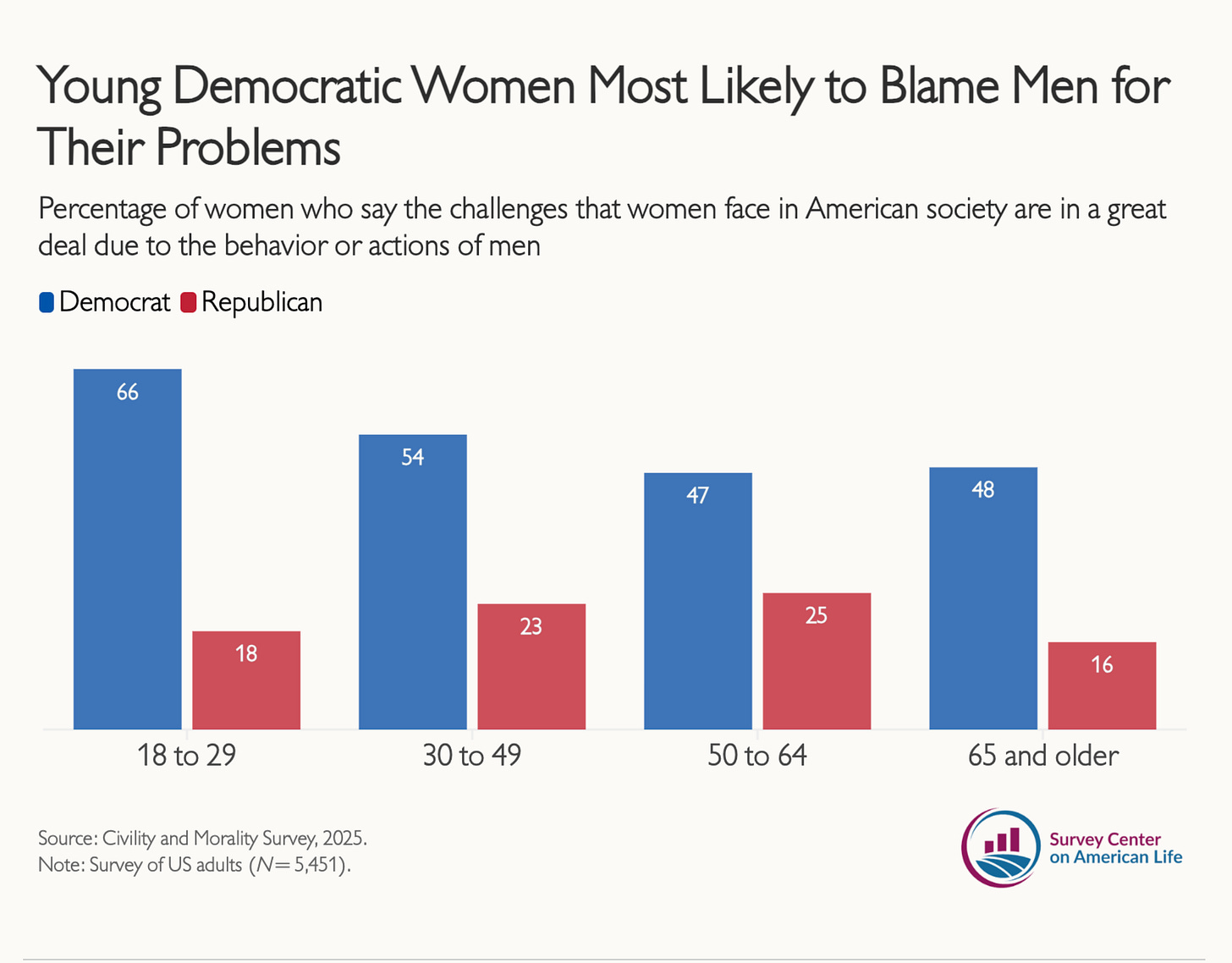
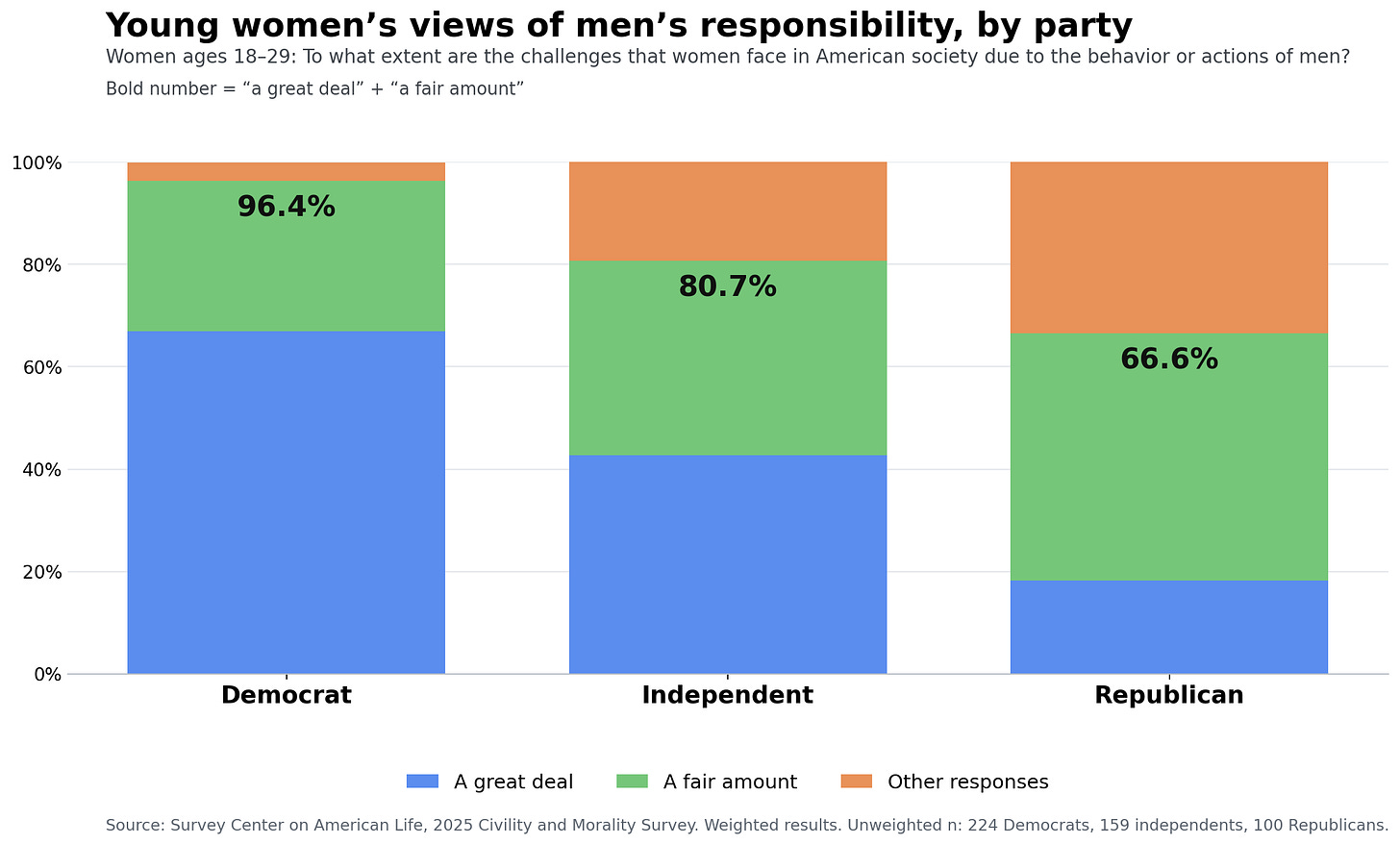
For years, the dominant narrative has been that toxicity flows in one direction—that men are the primary source of gender-based hostility, and women are largely reacting to it. Soh challenges that assumption. She points to polling data showing that young women, in some cases, hold more negative views of men than men do of women. She highlights the cultural double standards that allow anti-male messaging to pass with far less scrutiny than anti-female messaging.

All of this is important. And it takes a certain degree of intellectual independence to say it out loud.

But this is where her analysis stops just short of something deeper.

Soh ultimately frames the problem as a kind of mutual escalation—two sides locked in a feedback loop of resentment, each needing to step back, see the other more clearly, and abandon the worst impulses of their respective online cultures.

It’s a reasonable conclusion. It’s also incomplete.

Because it assumes that these two forces exist on roughly equal footing.

They don’t.

The hostility toward men that Soh describes is not simply emerging from fringe online communities. It is reinforced—often subtly, sometimes explicitly—by the broader culture itself. Media narratives regularly cast men as dangerous, deficient, or morally suspect. Academic frameworks frequently position men as privileged agents and women as vulnerable recipients. Institutional policies are often built on these same assumptions.

Over time, this does something powerful: it transforms a perspective into a kind of cultural default.

It begins to feel less like an opinion and more like reality.

By contrast, the hostility that emerges from the manosphere exists in a very different environment. It is not institutionally reinforced. It is challenged, criticized, and often condemned outright. Again, that does not make it accurate or healthy—but it does mean it operates under constraints that the opposing narrative largely does not.

This creates a playing field that is far from level.

One set of ideas is amplified and legitimized. The other is policed and marginalized.

And that asymmetry matters more than we often acknowledge.

Because when one narrative is embedded in institutions, it shapes not just opinions, but outcomes. It influences how boys are educated, how men are treated in courts, how male suffering is perceived—or overlooked. It becomes part of the background assumptions people carry without even realizing it.

Meanwhile, the reactive spaces that emerge in response—however flawed—are then judged as if they exist in isolation, rather than as downstream responses to an already tilted system.

This is the piece that Soh only partially touches.

She sees the hostility. She sees the polarization. She even sees that anti-male sentiment is more widespread than many are willing to admit.

But she does not fully account for the cultural forces that sustain and legitimize that sentiment.

And without that, the solution she offers—mutual correction—risks placing equal responsibility on two sides that are not equally empowered.

To be clear, none of this is an argument for excusing hostility—whether it comes from men or from women. We need to resist the pull of the worst elements on either side. Dehumanization, wherever it appears, damages everyone involved.

But understanding requires clarity.

And clarity requires us to ask not just what is happening, but where the weight of the culture rests.

Until we do that, we will continue to describe the conflict between men and women as a symmetrical breakdown in understanding—when in many ways, it is something much more lopsided than that.

Men are good, as are you.
Read full Article
April 23, 2026
post photo preview
When Men Fall Behind, We Blame Them

For decades, we’ve been told a simple story: when women fall behind, it’s injustice. When men fall behind, it’s failure.

That may sound exaggerated. But new experimental research suggests it isn’t.

A recent large-scale study involving more than 35,000 Americans found something striking. When participants were presented with a situation in which a worker had fallen behind—earned less, performed worse, or ended up with nothing—people responded differently depending on whether that worker was male or female.

When the low performer was a man, significantly more participants chose to give him nothing. When the low performer was a woman, more participants redistributed support. Even more revealing, participants were more likely to believe that the man had fallen behind because he didn’t try hard enough.

The researchers call this “statistical fairness discrimination.” That is, people infer that disadvantaged men are less deserving because they assume their disadvantage reflects low effort.


The Effort Story

In the study, participants were asked to redistribute earnings between two workers. In some conditions, earnings were based on productivity. In others, earnings were assigned randomly.

Here’s the important part: even when outcomes were random—when effort had nothing to do with it—participants were still more likely to believe that the male who ended up behind had exerted less effort than the female who ended up behind. In other words, even in the absence of evidence, assumptions about effort were not neutral.

In plain language: when men fall behind, people are more likely to assume they did not try hard enough.

That is not data-driven reasoning. It reflects a prior belief. And prior beliefs shape compassion.


The Compassion Gap

The study didn’t just look at small redistribution decisions. It also asked participants about public policy: should the government provide support to people falling behind in education and the labor market?

Support dropped noticeably when the group described as falling behind was male rather than female.

In other words, sympathy is gendered. The willingness to intervene is gendered. The attribution of responsibility is gendered. Importantly, this was not confined to one political or demographic group. The pattern appeared broadly, suggesting that it reflects a shared cultural assumption rather than a narrow ideological position.

When women fall behind, we instinctively look for barriers. When men fall behind, we instinctively look for flaws.


What This Means

This pattern shows up in places many of us already sense it.

When boys fall behind in school, we talk about motivation and behavior. When girls fall behind, we talk about resources and environment. When men leave the workforce, we question work ethic. When women leave the workforce, we look for systemic obstacles. When fathers struggle financially after divorce, we assume irresponsibility. When mothers struggle, we assume hardship.

The study does not use the word gynocentrism, or make the obvious reference to moral typecasting. It stays within the language of behavioral economics and calls the phenomenon “fairness discrimination.” But the mechanism is clear: disadvantage is interpreted through a moral lens—and that lens is not symmetrical.

Women are more readily cast as vulnerable. Men are more readily cast as responsible. And responsibility without context easily becomes blame.


The Quiet Cost

This matters because perception drives policy.

If society believes that male disadvantage is primarily self-inflicted, there will be less urgency to address it. If people assume boys who fall behind simply didn’t try hard enough, we will design fewer interventions. If struggling men are viewed as less deserving, institutions will reflect that belief—often without conscious intent.

No one has to be malicious. All that is required is a background assumption that male failure signals character weakness. Once that belief takes hold, compassion narrows. And when compassion narrows, so does support.


A Hard Question

Here is the uncomfortable question: why are effort assumptions gendered in the first place?

Why do we instinctively read female disadvantage as circumstantial and male disadvantage as dispositional?

The study does not answer that. It simply shows that the pattern exists. But patterns rarely emerge from nowhere. They reflect cultural narratives about men as agents, providers, and actors—people who are expected to overcome adversity. When they do not, disappointment can harden into judgment.

Women, by contrast, are more often framed as relational beings whose setbacks invite protection. Protection invites support.
Men are more often expected to handle adversity on their own. And when they do not, expectation invites scrutiny.


When Men Fall Behind

We are living in a time when boys lag in reading proficiency, when young men withdraw from education, when male labor-force participation declines, and when male suicide rates far exceed those of women.

Yet when men fall behind, the cultural reflex is not alarm. It is evaluation. Did he try hard enough? Did he make better choices? Did he apply himself?

Sometimes those questions are valid. But when they are asked of only one sex, they reveal something deeper than fairness.

They reveal a compassion gap.

And that gap shapes everything—from classrooms to courtrooms to public policy.

When men fall behind, we don’t just measure their outcomes. We measure their worth.

Men Are Good, as are you.



https://academic.oup.com/jeea/article/23/6/2212/8112864
Cappelen, A. W., Falch, R., & Tungodden, B. (2025). Experimental evidence on the acceptance of males falling behind. Journal of the European Economic Association, 23(6), 2212–2240.

 
Read full Article
April 20, 2026
post photo preview
How A Culture Turns a Group into "The Problem"
Why the way we talk about men today follows a pattern we’ve seen before


Years ago I read a book called The Death of White Sociology. It explored the rise of a Black sociological viewpoint and challenged the assumptions of what the authors called “White sociology.” What struck me most was not only the book’s critique of how Blacks had been studied and described, but the way it mapped the machinery by which a culture teaches itself to see a group as lesser.

It showed how prejudice does not survive by hatred alone. It survives through a system of reinforcement. Research, media, public opinion, everyday conversation, and institutional assumptions all work together until a distorted view begins to feel like simple common sense. The result is that the targeted group is not merely disliked. It is interpreted through a lens of defect.

As I read it, I kept having the same thought: there is something here that resembles what men face today.

Let me be clear. This is not an argument that men have endured the same history that Blacks endured. They have not. The suffering is not the same. The legal and social conditions are not the same. But the pattern by which a group is culturally misread, judged by hostile assumptions, and portrayed as inherently flawed can look strikingly similar.

That is the comparison worth making.


How a Culture Teaches Itself to See

The book described three powerful channels through which the myth of Black inferiority was spread: common knowledge, the media, and science. Together, they created a self-reinforcing system. Each one echoed the others until the message became nearly impossible to challenge.

Common knowledge is what people “just know” without thinking. In the period the book described, it was simply accepted that Blacks were inferior. That belief did not feel like prejudice to most people. It felt like reality.

Today, something similar operates in a different direction. It is widely assumed that men, as a class, are the problem—emotionally limited, morally suspect, prone to harm. Not some men. Men.

Once that assumption settles in, everything else begins to orbit around it.


The Media: Then and Now

Media plays a powerful role in teaching people how to see.

In earlier decades, Blacks were often portrayed as immature, unintelligent, and incapable of managing life without guidance. Characters like Stepin Fetchit or Amos and Andy reinforced an image of Blacks as confused, dependent, and lacking competence.

Today, it is difficult not to notice a similar pattern applied to men. The modern version is not as overt, but it is just as persistent. Think of characters like Homer Simpson and countless others—men portrayed as childish, incompetent, emotionally clueless, and in need of a woman to guide or correct them.

The message accumulates:
Men are not fully capable. Men need women to straighten them out.

Over time, that message begins to feel normal.


Science and the Framing of Defect

One of the most troubling aspects described in The Death of White Sociology was how research itself could be shaped by cultural assumptions.

In the early to mid-20th century, much psychological and sociological research was not designed to help Blacks. It was designed to explain what was wrong with them. It cataloged deficits. It emphasized pathology. It framed Blacks as needing to change in order to fit the dominant culture.

That pattern is not entirely gone. It has, in many ways, shifted.

Today, a great deal of research on men begins with a similar orientation. It is often less about understanding men and more about diagnosing them. Masculinity is framed as problematic. Male traits are frequently interpreted as risks rather than resources. The focus is not on how to support men, but on how men must change.

And just as importantly, what does not get highlighted matters.

In earlier times, when research produced findings that challenged the narrative of Black inferiority, those findings were often minimized or ignored. They did not fit the story, so they did not spread.

Today, we see a parallel dynamic. When data shows men as victims—whether in areas like domestic violence, educational decline, or mental health—it is often underreported or downplayed. When men do well, it is frequently reframed as evidence of advantage rather than strength. The result is a public picture that remains lopsided.

When only one side of the story is consistently told, it stops feeling like a story. It starts feeling like truth.


Difference Turned Into Deficiency

Another striking pattern from the earlier era was the assumption that Blacks needed proximity to Whites in order to become more “civilized” or mature. The closer one was to White influence, the better one was assumed to be.

That same structure appears today in a different form.

Men are often seen as needing to become more like women in order to be fully healthy or mature. Emotional styles, communication patterns, and ways of processing experience that are more typical of women are treated as the standard. When men do not match those patterns, they are seen as deficient rather than different.

The message, again subtle but persistent, is this:
Men are better when they resemble women.


Perpetrators, Not Victims

Perhaps the most powerful mechanism described in the book was this:

Blacks were defined as the creators of social problems, not the victims of them.

Once that framing takes hold, something important happens. The suffering of the group becomes harder to see. If a group is the problem, then its pain feels less deserving of attention.

That dynamic is deeply relevant today.

Men are routinely framed as the source of social pathology—violence, war, exploitation, dysfunction. And while individual men certainly do harmful things, the broader cultural narrative often treats men as a class as the problem itself.

As a result, male suffering becomes less visible.

Male loneliness.
Male suicide.
Male educational struggles.
Male victimization.

These are real, measurable issues. But they rarely sit at the center of public concern in the same way that other forms of suffering do.

Selective empathy becomes the norm.


The Psychological Cost

When a culture repeatedly tells a group that it is the problem, that message does not remain external. It gets absorbed.

In the years prior to the 1960s, many Black activists faced a heartbreaking reality. Some Blacks had been so worn down by years of judgment and cultural dismissal that their spirits were deeply damaged. The constant message of inferiority had taken its toll.

The civil rights movement did something powerful in response. It did not only change laws. It worked to restore identity and dignity. Phrases like “Black is Beautiful” were not slogans in the shallow sense. They were acts of psychological repair. They challenged a culture-wide narrative and helped rebuild a sense of worth.


That kind of shift matters.

Today, we should at least be willing to ask whether something similar is needed for men and boys.

If boys grow up hearing that masculinity is toxic, that men are the problem, that their instincts are suspect, it is not hard to imagine the impact. Shame takes root quietly. Identity becomes confused. Confidence erodes.

At some point, a counter-message becomes necessary—not one that diminishes others, but one that restores balance.

A simple one might be enough to start:

Men are good.


Not the Same History—But a Recognizable Pattern

The point of this comparison is not to collapse different histories into one.

It is to recognize a pattern.

A culture can:

  • create a narrative about a group

  • reinforce it through media, research, and conversation

  • filter all new information through that lens

  • and slowly make that narrative feel like reality

When that happens, the group is no longer seen clearly.

It is seen symbolically—as a problem.

We have seen this before.

The people living through it then often could not see it clearly.
It felt normal.
It felt justified.
It felt like truth.

That may be the most unsettling part.

Because if a culture can do that once, it can do it again.

Not the same history.
Not the same wounds.

But a pattern familiar enough that we would be wise—very wise—to recognize it.

Men Are Good, as are you.


The Death of White Sociology https://amzn.to/4dToojz

Read full Article
See More
Available on mobile and TV devices
google store google store app store app store
google store google store app tv store app tv store amazon store amazon store roku store roku store
Powered by Locals