MenAreGood
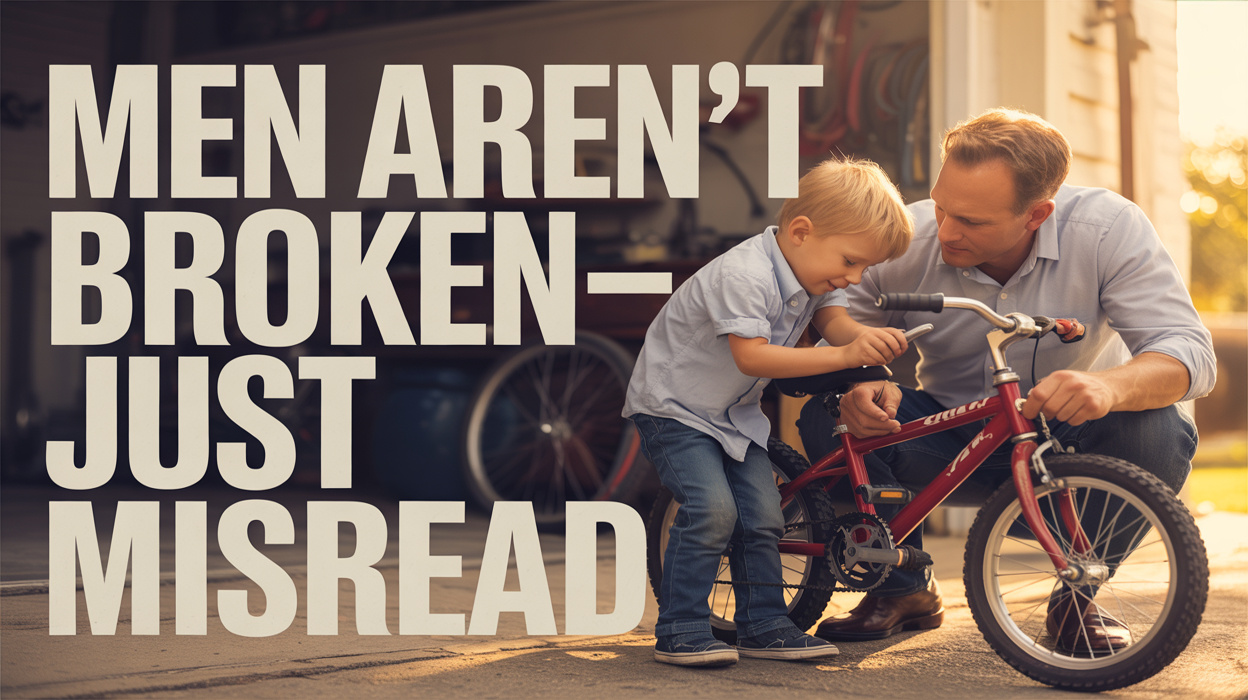
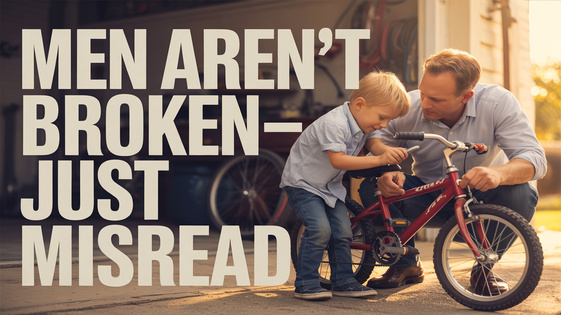
Men Aren’t Broken—Just Misread.
And that misunderstanding is damaging marriages, boys, fathers, therapy, and the workplace
1 hour ago
post photo preview


For years now, we have been told that men need to become more open about their emotions. They need to talk more, reveal more, cry more, and process more directly. We hear this so often that it has taken on the status of settled truth. But almost no one asks the more unsettling question: what if many men have been emotionally present all along, but in ways our culture has failed to recognize? What if the real problem is not that men lack emotional depth, but that male emotional life is so often judged by female standards?

That question matters far more than most people realize. It matters in marriage, where a good man can be called emotionally unavailable simply because he does not process out loud. It matters in families, where boys are corrected for the very ways they regulate hurt, fear, and stress. It matters in schools, where male behavior is more likely to be treated as a problem to be managed than a difference to be understood. It matters in therapy, where men often discover that healing is quietly defined in ways that fit women better than men. It matters at work, where “emotional intelligence” can become a polished-sounding way of rewarding female-style expression and penalizing male reserve. It matters in the courts as well, where fathers can be misjudged because their love does not always arrive in the approved emotional form.

Again and again, men and boys are judged not by the depth of their feeling, but by the style of its expression. And the style most often treated as healthiest is often simply the female style. That is not a criticism of women. Women have every right to their own ways of feeling and expressing. The problem is that our culture has quietly taken one pattern of emotional life and turned it into the universal standard. Once that happens, men and boys are almost guaranteed to be misunderstood.

A man can love deeply, care intensely, lose sleep over conflict, and still be called emotionally shut down. A boy can feel grief, fear, shame, and tenderness, and still be seen as emotionally underdeveloped because he runs, jokes, wrestles, or goes quiet instead of talking it through. A father can pour his heart into his children through protection, practical devotion, guidance, and steady presence, and still be treated as emotionally secondary because he does not narrate his love in therapeutic language. That is not insight. It is a profound failure of recognition.


The marriage damaged by a false interpretation

I once worked with a couple whose marriage was in serious trouble. The wife was convinced her husband had little real emotional depth. Her evidence was familiar enough: he did not talk much, he did not process in real time, and he often went quiet during arguments. She felt alone, unmet, and unseen. As she described him, he sat there saying very little. To most observers, he would have looked exactly like the stereotype of the emotionally unavailable husband.

But when I got to know him better, a different picture emerged. After their conflicts, he would lie awake at night replaying every word. He worried deeply about her. He thought constantly about how to make things better. He held back in the moment because he knew that speaking too quickly often made the conflict worse. So he retreated inward, trying to understand what he felt before he spoke. He was not emotionally absent. He was emotionally cautious. He was not unfeeling. He was flooded. But because his distress did not take the form she recognized, it was translated into indifference.

This is where many relationships begin to fail. She wants immediate verbal connection because that is how she experiences emotional engagement. He goes inward because that is how he tries to organize emotional overload. She experiences his inward turn as abandonment. He experiences her pursuit as pressure, criticism, or emotional intrusion. The more she pushes, the more he withdraws. The more he withdraws, the more frightened or furious she becomes. Soon both are suffering, and both believe the other is the problem. But sometimes the deepest problem is simpler than that. Male emotional processing is being judged through a female lens, and two decent people end up trapped inside a misunderstanding.


The boy who is pathologized for normal boyhood

The same thing happens to boys, often from a very young age. A boy is energetic, physical, playful, impulsive, competitive, less verbally demonstrative, and inclined to work things out through movement, action, humor, mock conflict, and short cycles of upset and recovery. For most of human history, much of this would have been recognized as ordinary boyhood. Today it is often viewed with suspicion. He is too active, too rough, too defended, too inattentive to feelings, too quick to move on, too external, too much.

But much of the time what adults are seeing is not pathology. It is male-pattern emotional regulation. Many boys process discomfort through movement, challenge, joking, rough-and-tumble contact, temporary withdrawal, activity, and doing. I have seen boys laugh after getting hurt and watched adults interpret that as emotional shallowness, when often the laughter was simply a way of keeping the pain from overwhelming them. I have seen boys respond to disappointment by getting louder, more physical, or more active, only to be treated as if they had no inner life at all.

A girl who cries openly is often seen as emotionally healthy and in touch. A boy who grabs a ball, heads outside, goes silent, gets restless, or hides his distress behind humor is more likely to be seen as avoidant or emotionally blocked. That is not neutral observation. It is interpretive bias. We recognize female forms of distress more readily, and we recognize female forms of self-soothing more readily as well. We are more likely to view those forms as healthy, mature, and emotionally literate. Male forms are more likely to be treated as immaturity, dysfunction, or disorder. The message many boys receive, whether openly or indirectly, is a painful one: not only are your feelings a problem, but the very way you carry your feelings is a problem too. That is a brutal thing to teach a child.


The father whose love is invisible because it is practical

One of the deepest losses in all of this is our failure to recognize male love when it arrives through action. A mother comforts a hurting child with words and empathy, and we call that love, rightly so. A father takes the child for a drive, shows him how to fix something, throws a ball with him, sits beside him quietly, makes the home feel steady, and communicates care through protection, guidance, practical help, and dependable presence. Too often we call that something else. We call it less emotional.

But it is not less emotional. It is simply less verbal and less theatrical. Many fathers love through doing, through steadiness, through creating safety, through shared activity, and through showing up again and again. I have known fathers who worried constantly about their children and barely spoke of it. Fathers who carried heartbreak in silence while remaining steady for everyone around them. Fathers who poured love into daily acts of guidance, support, sacrifice, and reliability. Because they did not present that love in the approved emotional style, much of it went unseen.

That is not wisdom. It is a form of cultural illiteracy. A society that can no longer recognize male love unless it is translated into female emotional language is a society that has lost sight of something vital in fatherhood itself.


The workplace where bias wears the mask of enlightenment

The same dynamic now appears in professional life. “Emotional intelligence” can refer to something real and worthwhile. Self-awareness matters. Awareness of others matters. Emotional self-control matters. None of that is in dispute. But in practice, the term is often used in highly subjective ways. A man may be calm under pressure, perceptive about group tensions, fair-minded, difficult to rattle, and unusually good at maintaining perspective in conflict. Yet he may still be judged as lacking because he is not verbally expressive, not highly demonstrative, or not especially skilled at broadcasting emotional cues in the preferred style.

What is being measured in many workplaces is not emotional intelligence broadly understood. It is emotional style. And the style often being rewarded is more female-typical: visible emotional signaling, relational fluency, warmth display, and verbal processing. That means male restraint can be interpreted as coldness. Male caution can be read as distance. Male steadiness can be mislabeled as lack of empathy. Male problem-solving can be reframed as emotional avoidance. In this way, a cultural preference disguises itself as a moral virtue. A man can be downgraded not because he is interpersonally incompetent, but because he does not perform emotionality in the way evaluators most easily recognize. This is one of the more effective forms of bias because it comes wrapped in the language of progress.


The therapy room where men are taught to distrust their own path

This problem may be most painful in therapy. A man comes to therapy grieving, traumatized, depressed, or overwhelmed. He is already taking a risk. He is already doing something difficult. But often it does not take long before he senses that healing is supposed to look a certain way. He is expected to talk in a certain rhythm, disclose in a certain style, and move toward feeling in a certain order. If he needs silence before words, that may be called avoidance. If he thinks before he speaks, that may be called detachment. If he processes through walking, building, fixing, working, reflecting, or simply being alone for a while, that may be interpreted as resistance rather than understood as his actual path.

I have seen this for years. Many men are willing to heal, but they are often asked to heal in forms that do not fit them. A grieving man may not need to sit face-to-face and narrate everything immediately. He may need to build a memorial bench. He may need to work in his wife’s garden. He may need long walks, long silences, or practical acts that allow feeling to move through him without being forced into premature language. That is not failed grieving. It is often male grieving. But instead of being understood, many men leave therapy feeling that even their attempt to survive is somehow wrong.

Think about how tragic that is. A man comes in already wounded and then receives a second wound: shame about the way he is coping. Many men suffer not only from pain itself, but from the belief that the form their pain takes is itself evidence of deficiency.


The family story that gets told wrong

These misunderstandings often begin inside families. One child is called “the sensitive one” because she cries, talks, and seeks comfort in recognizable ways. Another child, often a boy, is called distant, hard, or difficult because he grows quiet, gets irritable, becomes restless, or disappears into activity. But often the so-called difficult child is feeling every bit as much, sometimes more. He is simply less readable to the adults around him.

So his distress gets mislabeled. He is treated as a behavior problem rather than a hurting person. He is corrected more than understood, managed more than known. And that family story can follow him for life. Not the hurting one. Not the overwhelmed one. Not the child trying desperately to regulate himself in the only way he knows. The difficult one.

There is a quiet cruelty in that. Many men grow up not necessarily feeling unloved, but feeling unseen. People responded to the surface form of their coping and missed the depth of what they were carrying.


What this misunderstanding costs us

When men are misread, the damage spreads everywhere. Good relationships are needlessly broken. Boys are shamed for normal male ways of handling emotion. Fathers are diminished. Men are judged unfairly at work. Therapy alienates the very men it claims to help. Families build false narratives about sons and husbands. And men themselves begin to internalize the accusation. They start to wonder whether they really are stunted, distant, or emotionally deficient, not because they feel less, but because they feel differently.

To be clear, this does not mean every male pattern is healthy. Men can avoid. Men can numb. Men can become defended and unreachable. Of course they can. But that is not the point. The point is that our culture has become so accustomed to treating female-pattern expression as the gold standard that it often cannot distinguish difference from dysfunction. And that confusion is doing immense harm.

Emotional depth and emotional style are not the same thing. A man can care deeply and still need silence. A boy can feel intensely and still recover through movement. A father can love powerfully and still show it more through action than words. A man can be heartbroken and still cope through work, humor, problem-solving, solitude, or responsibility. Those patterns do not automatically reveal emotional poverty. They may reveal a male way of carrying emotional life.


What would change if we finally understood this?

A wife might stop assuming her husband’s silence means he does not care. A mother might begin to see that her son’s joking is not shallowness but self-protection. A teacher might stop mistaking boyhood for pathology. A therapist might stop trying to turn men into women in order to call them healthy. A manager might learn the difference between emotional competence and emotional style. A court evaluator might begin to recognize that a father’s steadiness, reliability, and practical devotion are not lesser forms of love. And men themselves might stop feeling ashamed of the ways they have carried pain all their lives.

That would not be a small change. It would be the beginning of seeing men more clearly. Because until that changes, we will keep damaging good men, good boys, and good relationships. We will keep mistaking difference for deficiency. We will keep confusing female-pattern emotionality with emotional health itself. And we will keep calling that wisdom, when much of the time it is nothing more than ignorance with good manners.

Men and boys are good. As are you.

community logo
Join the MenAreGood Community
To read more articles like this, sign up and join my community today
0
What else you may like…
Videos
Posts
Articles
April 02, 2026
Are Family Courts at War with the Constitution?

In this conversation, I sit down with longtime scholar and author Stephen Baskerville to take a hard look at modern family courts, no-fault divorce, paternal rights, and the assumptions behind shared parenting. Stephen argues that what many people take for granted in divorce and custody law may be far more troubling than they realize—not only for fathers and children, but for the rule of law itself. Join us in this challenging and thought-provoking discussion that raises questions most people never hear asked.

Stephen's Substack
https://stephenbaskerville.substack.com/

01:02:28
March 30, 2026
Blame it on the Manosphere

This short video takes a humorous look at the current panic among feminists and the media over what they call the manosphere. In reality, the manosphere is one of the places where their false narratives are being exposed. What we are seeing now is the creation of a straw man—something to blame, distort, and use as a distraction from the truth that is coming to light. More and more people are waking up to the game and beginning to see the hostility and self-interest that have been there all along.

(This video was produced largely with AI. I wrote the script, and the music and images were AI-generated.)

Men are Good!

00:03:05
March 23, 2026
From Description to Smear: The Guide to the Manosphere

Today’s video is a lively and revealing conversation with Jim Nuzzo about the growing panic over what the media and academia call “the manosphere.” Together, we take a close look at a new Australian guide for teachers that claims to help schools deal with so-called misogynistic behavior among boys. What we found was not careful scholarship, balanced concern, or genuine curiosity about boys. What we found was a familiar pattern: boys portrayed as the problem, their questions treated as threats, and their frustrations dismissed before they are even heard.

Jim brings his scientific eye to the discussion, and that makes this exchange especially valuable. We talk about the sudden explosion of academic and media attention on the manosphere, the way fear is being used to drive the narrative, and the striking absence of empathy for boys who feel blamed, dismissed, and alienated. We also explore something the guide never seriously asks: why are boys drawn to these spaces in the first ...

00:48:43

Women an they just won’t!

This is on point and even this will be seen as anti woman

March 02, 2026
Men Don't Grieve the Way You Think

I had the good fortune to be interviewed by Jason MacKenzie, who runs the Man Down Substack—a publication dedicated to men and their unique paths to healing.

Many of you may not know that I spent many years working directly with men who were grappling with trauma and loss. Through that experience, it became strikingly clear to me that men and women are often treated very differently after a loss. Those early observations opened my eyes to the broader ways men face discrimination, misunderstanding, and hardship in our society. I hope you find the conversation interesting and worthwhile.

https://www.mandown.tools/p/men-dont-grieve-the-way-you-think?utm_campaign=post&utm_medium=web

April 06, 2026
post photo preview
They Took Away Recess—And Then Wondered Why Boys Struggled


For years, schools have acted as though more learning comes from more sitting, more compliance, more desk time, and more control.

But children do not learn best by being treated like machines.

And boys, especially, often do not thrive when movement, noise, spontaneity, and unstructured play are stripped from the school day.

One of the revealing things about modern education is how casually it has pushed recess aside. What was once understood as a normal and necessary part of childhood is now often treated as expendable—a frill, a reward, or a distraction from the “real work” of school. But the research points in the opposite direction. Recent reviews continue to find that recess is associated with academic and cognitive benefits, behavioral and emotional benefits, physical benefits, and social benefits. The strongest modern claim is not that recess is a magic cure for every school problem, but that it helps children function better and does so without harming academic achievement.

That matters for all children.

But it matters in a special way for boys.

Not because girls do not need recess. They do. But many boys are more movement-driven, more physically expressive, and more likely to regulate themselves through action. A school culture built around prolonged stillness can turn normal boyhood into a problem to be managed. Then, when boys struggle under those conditions, the system acts as though the flaw lies in the boy rather than in the environment. Recent research continues to find sex differences in recess physical activity, with boys on average being more physically active during recess than girls.


Recess Is Not Separate From Learning

One of the most persistent myths in education is the idea that recess takes time away from learning.

The better way to say it is this: recess helps make learning possible.

The brain cannot sustain focused attention indefinitely. Children need a break in cognitive demand. They need contrast. They need a change in setting, activity, and pace in order to come back ready to concentrate again. That is one reason the evidence on recess remains so steady. Newer reviews find positive effects especially in behavior and classroom functioning, while finding either positive or neutral effects on academic outcomes rather than academic harm. The CDC’s current guidance likewise says recess supports students’ mental, emotional, and physical well-being.

That fits ordinary human experience.

Many of us remember exactly what recess did for us. You got outside. You ran. You played. You argued over the rules. You laughed. You blew off steam. Then you came back into the classroom feeling more alive and more ready to focus.

That was not wasted time.

That was recovery time for the brain, and practice time for life.


The Overlooked Power of Unstructured Play

This is the part too many adults miss.

Recess is not valuable only because children move their bodies. It is valuable because, at its best, it gives children unstructured play.

And unstructured play is one of the great training grounds of childhood.

In the classroom, adults set the agenda. Adults decide what matters. Adults define the rules, the timing, the task, the outcome, and the acceptable behavior. In physical education, the same thing usually happens. But during recess, children often have to organize themselves. They have to decide what to play, how to play it, who goes first, what counts as fair, what to do when someone cheats, and how to keep the game going when conflict arises.

That is not trivial.

That is where children learn to negotiate, cooperate, improvise, resolve conflict, advocate for themselves, accept limits, and sometimes lead. Reviews of unstructured play and playground play consistently describe benefits in children’s decision-making, problem-solving, emotional regulation, peer interaction, resilience, and creativity. Even when researchers note that freedom can sometimes bring more visible conflict or disruptive behavior, that is not necessarily evidence against play. It is often part of the process by which children learn how to handle themselves and one another.

In other words, recess is one of the few places left in childhood where children get to practice self-government.

They learn how to make a world with other children in it.

They learn how to form rules, bend rules, defend rules, repair ruptures, and keep a shared activity alive without adults hovering over every move.

That is deeply educational.

In some ways, it is more educational than much of what passes for education now.


Why This Matters So Much for Boys

For many boys, recess is not just pleasant. It is regulatory.

A school day built around silence, sitting, verbal restraint, and passivity fits some children far better than others. Boys who are high-energy, physically expressive, or inclined to think through movement are often treated as though they are defective learners rather than differently wired learners. Recess gives those boys something they genuinely need: a chance to move, reset, experiment, compete, collaborate, and return with a better chance of succeeding in the classroom.

The newer research does not justify saying that only boys benefit from recess, or that every boy benefits more than every girl. That would be too broad. But it does support saying that recess is especially important for many movement-oriented children, and that boys, on average, tend to be more physically active during recess. That alone should make us cautious about cutting away one of the few parts of the school day that so clearly fits the needs of many boys.

And this is where the larger cultural issue enters.

For a long time now, schools have been moving toward a model of childhood that rewards the qualities girls more often display in classroom settings: stillness, verbal compliance, behavioral neatness, and early self-containment. The more schools define those qualities as the norm, the more ordinary boy behavior gets framed as a disruption.

Then schools remove recess, narrow the outlets for movement, and act surprised when boys do worse.

That is not insight.

That is a setup.


High-Performing Systems Do Not All Worship Seat Time

One of the assumptions behind cutting recess is that more time in class must automatically mean more learning.

But that assumption has never been as obvious as administrators pretend.

Countries such as Japan, Korea, and Finland have shown that academic success does not depend on keeping children seated for as many minutes as possible. On PISA 2022, Japan and Korea both outperformed the United States across math, reading, and science, while Finland outperformed the United States in math and science. In some of these countries, children may get as much as fifteen minutes of recess for every hour of instruction. That does not prove recess alone explains their success. Many factors shape educational outcomes. But it does call into question a deeply held assumption—that the way to improve learning is to take movement, play, and reset time away from children.

The deeper point is not that America should copy another country mechanically.

It is that high-performing systems do not all treat children as if the road to excellence is endless confinement.

Some of them appear to understand a truth we have forgotten: children need rhythm. They need intensity and release. Focus and reset. Work and play.


The Case for Recess Is Stronger Than It Looks

One reason recess has been easy to cut is that adults often think of it as optional. It sounds soft. It sounds unserious. It sounds like something schools can sacrifice in the name of rigor.

But the evidence does not point that way.

Recent reviews continue to find benefits in behavior, social functioning, physical activity, and well-being, with either positive or neutral effects on academics. The American Academy of Pediatrics’ policy on recess was reaffirmed in 2023, and it argues that recess should be considered a necessary break in the school day for optimizing a child’s social, emotional, physical, and cognitive development—not something to be withheld for punishment or extra academic drills. CDC guidance likewise continues to support recess and points schools toward evidence-based strategies rather than retreat from it.

That is worth pausing over.

The mainstream evidence base is not saying, “Recess is a luxury, but maybe a nice one.”

It is saying something much closer to this: recess supports healthy child development, improves important aspects of school functioning, and should not be casually taken away.


What We Need to Recover

We need to recover some sanity here.

Children are not improved by endless management.

They are not made healthier, wiser, or more teachable by removing one of the few parts of the day that allows them to move freely, improvise socially, and reset their minds.

And boys should not be treated as defective girls.

If a school system is built in ways that pathologize normal boyhood, then that system should be questioned. If it keeps cutting away the very things that help many boys regulate and engage, then it should not be surprised when boys disengage, resist, or fall behind.

Recess is not a distraction from education.

It is part of education.

Not because it is sentimental.

Because it is developmental.

Because it supports attention, behavior, social learning, and physical well-being.

Because unstructured play teaches things adults cannot easily teach from the front of the room.

And because one of the simplest ways to help boys in school may be to stop taking away one of the few parts of school that still makes sense to them.

Read.
Write.
Arithmetic.
And recess.

That is not a joke.

That is closer to wisdom than much of what passes for reform.

Men are good, as are you.

Read full Article
March 27, 2026
post photo preview
When Schools Teach Children to Dislike Boys
How healthy male traits get recoded as disruption—and how teachers may help turn classmates against playful boys


When Schools Teach Children to Dislike Boys

How healthy male traits get recoded as disruption—and how teachers may help turn classmates against playful boys

There is a painful possibility that few people want to consider.

What if many boys are not failing school?

What if school is failing boys?

Not because boys cannot learn. Not because boys are less capable. Not because boys are defective.

But because many of the traits most natural to boys are now viewed through a lens of suspicion.

Energy becomes hyperactivity.
Rough play becomes aggression.
Humor becomes immaturity.
Nonconformity becomes pathology.
Spontaneity becomes disruption.

In other words, healthy boyhood is increasingly being interpreted as a problem.

And once that happens, boys do not simply get corrected more often. They get socially downgraded. Their standing falls. Their confidence falls. Their sense of belonging falls. And, as some research suggests, adults may even help teach other children to see them negatively.

That is a very serious matter.


The deeper issue is not just schools. It is culture.

Schools do not invent these attitudes out of thin air. They reflect the broader culture. And for many years now, masculinity itself has been treated as suspect.

Male energy is often spoken of as dangerous.
Male aggression is discussed as if it has no healthy form.
Male spaces have steadily disappeared or been delegitimized.
Fatherhood has been culturally minimized.
Normal male assertiveness is frequently recast as toxicity.

When a culture repeatedly sends the message that masculinity is something to fear, schools absorb that message too.

So when boys show up as boys—active, physical, funny, impulsive, competitive, loud, resistant to passivity—they are not always seen as healthy male children in need of guidance.

Too often, they are seen as little problems to be managed.


Boys are often at a disadvantage before the lesson even begins

The research here is striking.

A broad review of teacher-student relationship studies found that teachers report more conflict with boys than with girls, and that female teachers report less closeness with boys than with girls. That means many boys are entering school environments in which they are more likely to experience friction and less likely to experience warmth. (pubmed.ncbi.nlm.nih.gov)

Another study looking at kindergarten and first grade found that girls experienced more teacher closeness than boys across both school years, while boys with disruptive behavior tended to experience more conflict with teachers than comparable girls. (sciencedirect.com)

That should have set off alarm bells.

Imagine the public reaction if the research had shown that teachers consistently felt closer to boys and more distant from girls. There would have been outrage. But when boys are the ones receiving less closeness and more conflict, the culture mostly shrugs.


The traits many teachers prefer do not sound much like boys

One older but revealing line of research found that teachers tended to prefer students who were described as rigid, conforming, orderly, dependent, passive, and acquiescent. (https://www.jstor.org/stable/20151346)

That list is worth pausing over.

Rigid.
Conforming.
Orderly.
Dependent.
Passive.
Acquiescent.

That is not a portrait of lively development. It is a portrait of easy classroom management.

And it does not sound much like the average healthy boy.

Many boys are more physically restless, more impulsive, more rough-and-tumble, less naturally compliant, and more likely to regulate themselves through movement and action. That does not make them broken. It makes them boys. But if the school environment quietly rewards passivity above vitality, then many boys will end up being treated as if their very nature is inconvenient.


The playful boys study should have changed this conversation

One of the most revealing studies on this issue looked at children identified as especially playful.

These children were not mean, antisocial, or emotionally disturbed. They were marked by five very positive qualities: physical spontaneity, social fluidity, cognitive spontaneity, manifest joy, and a sense of humor. In plain language, they were energetic, socially fluid, imaginative, enthusiastic kids who enjoyed laughing and could take a joke. (frontiersin.org)

And here is what makes the findings so important: other children generally liked these playful kids. They were seen as popular. They were preferred playmates. Their peers did not initially experience them as disruptive or problematic. (frontiersin.org)

There were also equal numbers of playful girls and playful boys.

That matters.

It means the later negative reaction cannot simply be explained by “playfulness” alone. There were playful girls too.

But the teachers did not respond to the boys and girls in the same way.

The playful boys were the ones increasingly seen as disruptive. The playful boys were the ones who acquired the “class clown” label. The playful girls did not receive the same negative response, even though they were equally playful. (frontiersin.org)

That is one of the most important parts of this research because it makes the double standard harder to deny.

The issue was not merely playful behavior.

The issue was playful boys.


The word the researchers used was “antipathy”

The researchers did not use mild language.

They wrote that “one of the most significant discoveries of the study was the antipathy held by teachers for playful boys from the earliest primary grade.” (frontiersin.org)

Antipathy means a deep-seated dislike or aversion.

That is a stunning word to find in research about young boys who were characterized by joy, humor, spontaneity, imagination, and social vitality.

Other children liked them.

The ​teachers often did not.

That should trouble anyone who cares about children.

Because once an adult repeatedly communicates irritation, contempt, or aversion toward a child, the issue is no longer simple discipline. The adult is helping define that child socially. The child begins to feel it. Other children begin to absorb it. A reputation forms. A role gets assigned.

This boy is fun.
This boy is too much.
This boy is a nuisance.
This boy is the problem.

That is how shame begins.


What happened by third grade is chilling

The most disturbing finding came next.

In first and second grade, the playful children were still generally seen positively by their peers. But by third grade, the playful boys experienced a dramatic reversal. The children began drawing a sharp distinction between playful boys and playful girls, and the playful boys came to be seen as the least preferred playmates and as having the lowest social status.

Think about how serious that is.

These boys had not suddenly become cruel.

They had not become dangerous.

They had not changed into bad children.

What changed was the way they were being seen.

And the researchers strongly suspected that teachers had helped cause that shift, directly and indirectly shaping both the boys’ self-perceptions and the perceptions of their classmates.

That means an adult’s bias may have helped take boys who were initially popular and turn them into social liabilities.

That is not a minor classroom issue.

That is the manufacturing of rejection.


This starts to look like relational aggression against boys

I have spent decades as a therapist, and emotionally abusive systems often work in a very particular way: they turn people against one another. They poison perceptions. They shape alliances. They quietly designate one person as the problem and then let the group do the rest.

When I read this research, I see something disturbingly similar.

Teachers do not have to announce their bias openly for children to absorb it. Children are exquisitely sensitive to adult cues. They notice who gets warmth, who gets annoyance, who gets repeated correction, ​who gets eye rolls, who gets labeled, who gets the benefit of the doubt, and who does not.

Over time, children learn how to rank each other accordingly.

So when a teacher repeatedly treats playful boys as irritating or disruptive, the other children are not blind to that. They learn from it. They internalize it. And in this case, they appear to have acted on it.

That is why this is so serious.

The boys were not merely disciplined.

They were socially reclassified.


Boys are too often being judged as defective girls

This is, in many ways, the heart of the problem.

Boys are often measured against a behavioral ideal that fits girls more comfortably, and then penalized when they do not match it.

Need for movement? Problem.
Need for rough play? Problem.
Less verbal style? Problem.
High energy? Problem.
Resistance to passive conformity? Problem.
Humor under pressure? Problem.

At some point we have to ask a basic question:

What if many boys being labeled are not disordered at all?

What if they are simply boys in an environment that has become increasingly unfriendly to boyhood?

That does not mean boys need no discipline. Of course they do. Boys need guidance, structure, accountability, and mentoring. They need adults who can shape their energy, not shame it.

But shaping is not the same as pathologizing.

And guidance is not the same as contempt.


Many men remember exactly when this began

I suspect many men reading this will recognize something here.

They can remember the moment when their energy stopped being seen as vitality and started being seen as trouble.

They can remember the feeling that the girls were “right” and they were “wrong.”

They can remember being funny one year and “disruptive” the next.

They can remember realizing that being a boy felt, somehow, politically incorrect.

A great many boys were not crushed by open cruelty.

They were crushed by chronic misreading.

And that may be one of the most damaging things schools do.

Because once a boy starts to believe that his natural way of being is unwelcome, he often begins to pull back from school, from learning, and sometimes even from himself.


We should stop asking what is wrong with boys and start asking what is wrong with the lens through which we view them

The real issue here is not whether boys need to grow up well. Of course they do.

The real issue is whether adults can still recognize healthy masculinity when they see it.

Can they recognize exuberance without calling it pathology?
Can they recognize roughness without calling it danger?
Can they recognize humor without calling it deviance?
Can they recognize a playful boy without turning him into a problem?

Until we can do that, boys will continue to pay the price for adult confusion.

And many already have.


Research

Barnett, L. A. (2018). The Education of Playful Boys: Class Clowns in the Classroom. This is the playful boys study, including the findings on teacher antipathy, the different treatment of playful boys and playful girls, and the reversal in peer attitudes by third grade. (frontiersin.org)

Spilt, J. L., Koomen, H. M. Y., & Jak, S. (2012). Are boys better off with male and girls with female teachers? This review found that teachers report more conflict with boys, and that female teachers report less closeness with boys than girls. (pubmed.ncbi.nlm.nih.gov)

Horn, E. P., et al. (2021). Trajectories of teacher-child relationships across kindergarten and first grade. This study found girls experienced more closeness with teachers than boys across both school years. (sciencedirect.com)

Schlosser, L. (1980). Sex, Behavior, and Teacher Expectancies. This cites the teacher-preference traits: rigid, conforming, orderly, dependent, passive, and acquiescent. (jstor.org)

Read full Article
March 19, 2026
post photo preview
Father Exclusion: The Invisible Injustice

A note before the article:
Nick O’Hara has written something deeply painful, deeply human, and deeply important.

His essay is not simply the story of one father’s heartbreak. It is also a window into a much larger injustice that far too few people are willing to see, much less name. We hear constant discussion about “absent fathers,” but almost no discussion of fathers who are absent against their will—fathers who love their children, fight for them, and are still pushed out by systems that seem unable, or unwilling, to protect the father-child bond.

That is what makes this piece so powerful. Nick is writing from the raw center of his own experience, but he is also giving language to a reality that many men live in silence. His story is heartbreaking, but it is not merely personal. It raises urgent questions about parental equality, about the invisibility of fathers in family law and public discourse, and about the cost children pay when a loving parent is treated as expendable.

I am sharing this excerpt because I believe his voice deserves to be heard. The full piece is considerably longer, and I hope you will follow the link at the end to read the rest on Nick’s site and help bring more attention to his work.

If we are serious about justice, compassion, and the well-being of children, we must be willing to look at realities that make people uncomfortable. This is one of them.


Father Exclusion: The Invisible Injustice

The search for my abducted child reveals a wider silence on parental inequality

Nick O’Hara

Mar 02, 2026

 
My son in December 2021, the last time I saw him. He was abducted in June 2023, disappearing somewhere in the USA

Your children are not your children

They are the sons and daughters of Life’s longing for itself

They come through you but not from you,

And though they are with you yet they belong not to you

– Kahlil Gibran, The Prophet


My son and I are strangers. He turns seven soon and I’ve never celebrated his birthday with him. I have never read him a bedtime story. I don’t know if he is safe. I don’t even know if he is alive. I am a father needlessly separated from my child, and society makes me invisible. After years of holding my tongue and getting nowhere, I feel compelled to convey what it is like to be completely excluded from your child’s life in a culture that leaves virtually no space for fathers in my position.

We often hear about absent fathers, but rarely about those who are absent against their will: men erased from their children’s lives without justification. I call this “father exclusion”. It’s a term I have coined because I can’t find any official language or descriptor for fathers in my position. Despite impacting many families, it barely registers in our public discourse. No data seems to be collected on father exclusion. No politicians seem interested in addressing it. No one even names the problem.

Father exclusion is not a fringe issue. It is extremely harmful to families and society; a systemic failure so pervasive it becomes invisible. We talk a great deal about irresponsible fathers, but what about those of us fighting with everything we have to be in our children’s lives, only to be systematically shut out? This silence is institutional, cultural and statistical. It has consequences: for children, for fathers like me, for our understanding of parenthood itself.

One goal in sharing my story is to advance a rationale argument in favour of gender equality in parenting, guided by the humanist case for balanced parental rights.

Western culture’s current obsession with “toxic masculinity” prefers to cast men as villains, leaving no room to acknowledge that fathers can be victims of discrimination, or that many are unjustifiably pushed out of their children’s lives. Many people take offence at the suggestion that father absence is detrimental to our children, despite the evidence that it is. So, any attempt to raise fathers’ rights is met with discomfort, defensiveness or even aggression: if it is acknowledged at all. For the main part, it is met with silence.

I know this silence intimately. It helps prevent my son from knowing my love.

When he drew his first breath in Brooklyn seven years ago, I was thousands of miles away in the United Kingdom, unaware of his arrival because his mother had cut off contact with me. What began as a conventional path to fatherhood – ultrasounds, excited plans of being present at the birth – unravelled into a nightmare. Every attempt since then to be part of my son’s life has been blocked, defied or ignored by his mother, enabled by systems that treat paternal bonds as optional, granted or withheld at the mother’s discretion.

I later discovered that my estranged wife had given our son different names to those we’d agreed upon. She omitted my name from his birth certificate and provided a false address to give the impression that she lived in New York; presumably in order to align with her falsified Medicaid forms. In fact, she is a citizen of Trinidad and Tobago and lives there with her two older children, whose father she also denies access.

Or at least, they did live in Trinidad. Almost three years ago, my son was abducted by his mother. To evade the increasing scrutiny of Trinidad and Tobago’s Family Court and Children’s Authority, she disappeared with all three children and is hiding somewhere in America. I do not know if they are safe, in good health or whether they attend school.


When I met my ex, in our initial interactions, she told me her first husband had abused her and their children, claiming serious offences. I felt sympathy and wanted to help. She said she reported each incident to the police, to create a record. Though to what end, I couldn’t figure out: she never wanted to take legal action, only to have a record of complaints.

Her story became increasingly inconsistent and I started noticing contradictions that grew more absurd. When I questioned her, she sometimes responded by suggesting that I was paranoid, other times she insisted I was losing my memory. It was only later that I recognised this as gaslighting.

While married and briefly living in Trinidad, it began to feel that she had only wanted me there so that I could support her and the kids while she continued not to work at all. However, tightening immigration restrictions meant that I couldn’t get a work permit and the strain on our relationship grew. Pregnant with our son, she cut off communication when I returned to the UK to work.

Since then, I’ve been trapped in a nightmare. Parenthood has been an illusory half-reality: I am legally a father but have never been allowed to be one. Despite my indefatigable efforts, I have met my son just twice; his mother has blocked all other access in defiance of multiple court orders. I could detail here a long list of her heartbreaking breaches, but nobody would want to read it.

Life as an excluded father is utterly lonely. I feel cast adrift, like an inconvenience nobody cares about.

With court proceedings stalled by my ex’s disappearance, I have spent two years pursuing an application under the Hague Convention on International Child Abduction. I receive email updates mentioning INTERPOL and U.S. authorities’ efforts to locate my son. The situation is surreal. There are days when it feels less like my life and more like a documentary film that I never agreed to star in. I have needed to write about it to help me survive it, to produce a memoir I might someday share to help others enduring similar ordeals.

My story is highly personal; the international dimension somewhat unusual. However, my general experience is not unique. It reflects a deeper truth: we simply do not value fatherhood highly enough. We are far more comfortable accusing men of abandonment than confronting how and why institutions push them out.

It needn’t be this way. We can acknowledge this systemic exclusion while rejecting the false binary that caring about fathers must come at the expense of mothers. Justice does not require us to diminish one parent in order to elevate the other. Instead, recognising and supporting the vital roles of both mothers and fathers, on equal terms, is how we can best serve the interests of our children. Persistently favouring one parent over the other – as we currently do – undermines not only parental equality, but the well-being of children and the moral coherence of society.

My son was abducted and taken to the U.S. in breach of a court order prohibiting his removal from Trinidad and Tobago. Like the others, the order proved meaningless. Indeed, every directive issued by the court has been breached or ignored by my ex without consequence.

My ex is legally aided, so there is no financial deterrent to obstruction. Three different legal aid-appointed attorneys withdrew their representation of her after realising she was misleading the court. None of this resulted in sanctions; just stronger orders that my ex ignores. She has, effectively, been able to act with impunity.

She has also prevented my son’s siblings – my stepchildren – from seeing their own father since they were infants. Unwittingly, the children’s experience contributes to the often-racist stereotype of Caribbean father absenteeism. But their respective fathers are not absent: we are excluded.

 
My son’s older siblings (and my stepchildren) in Trinidad, 2018. I haven’t seen them in many years, they will look so different now

Despite being represented by one of Trinidad and Tobago’s leading family lawyers (who sadly passed away suddenly last summer), I have felt utterly powerless. Court interventions have been too slow, enforcement mechanisms too weak or non-existent. In the initial years of my matter, the institutional indifference was astonishing. Even evidence of my ex preventing her older children from seeing their father – a relevant pattern of behaviour, one would think – could not be considered, due to family court evidentiary rules. Eventually the authorities did seem to realise what they were dealing with. But by then it was too late, my ex had disappeared with my son.

In fairness, the judge’s hands are tied by inadequate enforcement powers. The court knows that my son is being deliberately repelled from access to his father, without justification. It just isn’t able to actually do much about it. The system appears designed to make fathers give up.

With the disappearance, my attorney advised me to pursue the Hague Convention process. At first, it seemed promising: we received confirmation that my son had been taken to America. He was even, seemingly, located by U.S. authorities, only to vanish again. With the Hague application drawing blanks and family court proceedings stalled, I find myself back where I began. I am sharing my story in the hope that someone, somehow, might help locate my child.

 
Meeting my son for the first time in Trinidad, March 2020

Please share this essay with anyone who might be able to help me locate my child

Share

The wider narrative of absentee fathers is well-known, but how accurate is it? In the United States, more than one in four children live without a father in the home. This is also the generally accepted proportion for the UK, though my own crude maths suggests that it could be higher, with nearly 40 percent of households with dependent children being single-parent families (3.2 million out of the 8.2 million total). Data from the Office for National Statistics show 85 percent of those are headed by mothers (child custody data reporting has it higher, at 89 percent). Statistics for Trinidad and Tobago are harder to obtain, but anyone will tell you the situation is likely similar to the U.S. and UK.

How many of these fathers are missing by choice versus how many, like me, are deliberately excluded? We don’t know the answer, because – and this is a point worth emphasising – nobody publishes that data. There is no government task force. No politicians introducing parental equality legislation. No newspaper headlines.

It’s easier to frame us as absent, easier to perpetuate the ‘irresponsible father’ trope than confront the reality of father exclusion. Doing so would entail acknowledging that men face systemic discrimination in family courts and are relegated to second-class parental status. It’s easier for society not to care.

 
My son in Trinidad, December 2021, on the second of just two 90-minute visits with me that his mother actually brought him to

For the sake of our children, we should care. Active father engagement results in improved child outcomes. In 2016 the UK Department for Work and Pensions hosted a Father Engagement Seminar, which concluded that children with highly involved fathers have greater self-esteem, perform better at school and have fewer behavioural problems.

Conversely, growing up fatherless is highly detrimental to children and society. Children from fatherless homes are exponentially more likely to run away, die from suicide, suffer with substance abuse, become teenage mothers, have behavioural disorders, be sent to prison ... the list goes on. The fact that we have to go back a decade to find such a level of attention (in the UK) to the issue tells its own story.

When I share this information, people often react defensively. One American acquaintance, raised by a single parent, accused me of “blaming single mothers” before I could explain that I, too, grew up in single-parent households (with both my mother and father at different points), and that I was not making a political argument. But I had offended his sensibilities; he wasn’t prepared to even momentarily consider an alternative perspective.

What puzzles me is why acknowledging evidence of poorer average outcomes for children in father-absent homes is so often treated as a moral judgment rather than an empirical observation. Recognising such patterns need not imply blame, nor does it diminish the efforts or sacrifices of single parents. If child welfare is a genuine priority, we should be able to discuss uncomfortable data openly and with nuance, even when it complicates prevailing narratives.

 
Colouring with crayons, Trinidad, December 2021

Being an excluded father feels like living in exile. Some people are sympathetic, but not overly concerned. There is no language for your grief, no place for your story. Father exclusion does not fit into any fashionable social movement. Indeed, it’s allowed to slip through the cracks because it contradicts prevailing assumptions about gender, victimhood and power. Refusal to acknowledge this issue reflects a cultural and legal bias that renders fathers morally disposable.

Link to the full article  Scroll down and look for the above image to continue reading.

Read full Article
See More
Available on mobile and TV devices
google store google store app store app store
google store google store app tv store app tv store amazon store amazon store roku store roku store
Powered by Locals