MenAreGood
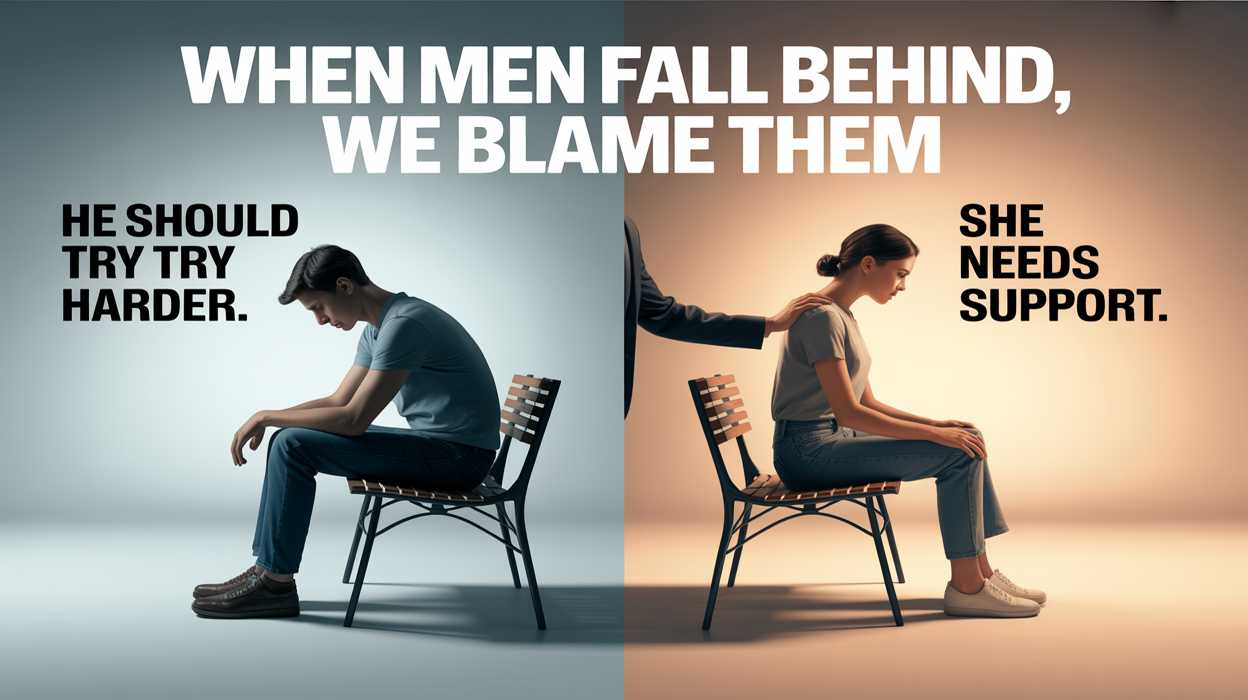
When Men Fall Behind, We Blame Them
April 23, 2026
post photo preview

For decades, we’ve been told a simple story: when women fall behind, it’s injustice. When men fall behind, it’s failure.

That may sound exaggerated. But new experimental research suggests it isn’t.

A recent large-scale study involving more than 35,000 Americans found something striking. When participants were presented with a situation in which a worker had fallen behind—earned less, performed worse, or ended up with nothing—people responded differently depending on whether that worker was male or female.

When the low performer was a man, significantly more participants chose to give him nothing. When the low performer was a woman, more participants redistributed support. Even more revealing, participants were more likely to believe that the man had fallen behind because he didn’t try hard enough.

The researchers call this “statistical fairness discrimination.” That is, people infer that disadvantaged men are less deserving because they assume their disadvantage reflects low effort.


The Effort Story

In the study, participants were asked to redistribute earnings between two workers. In some conditions, earnings were based on productivity. In others, earnings were assigned randomly.

Here’s the important part: even when outcomes were random—when effort had nothing to do with it—participants were still more likely to believe that the male who ended up behind had exerted less effort than the female who ended up behind. In other words, even in the absence of evidence, assumptions about effort were not neutral.

In plain language: when men fall behind, people are more likely to assume they did not try hard enough.

That is not data-driven reasoning. It reflects a prior belief. And prior beliefs shape compassion.


The Compassion Gap

The study didn’t just look at small redistribution decisions. It also asked participants about public policy: should the government provide support to people falling behind in education and the labor market?

Support dropped noticeably when the group described as falling behind was male rather than female.

In other words, sympathy is gendered. The willingness to intervene is gendered. The attribution of responsibility is gendered. Importantly, this was not confined to one political or demographic group. The pattern appeared broadly, suggesting that it reflects a shared cultural assumption rather than a narrow ideological position.

When women fall behind, we instinctively look for barriers. When men fall behind, we instinctively look for flaws.


What This Means

This pattern shows up in places many of us already sense it.

When boys fall behind in school, we talk about motivation and behavior. When girls fall behind, we talk about resources and environment. When men leave the workforce, we question work ethic. When women leave the workforce, we look for systemic obstacles. When fathers struggle financially after divorce, we assume irresponsibility. When mothers struggle, we assume hardship.

The study does not use the word gynocentrism, or make the obvious reference to moral typecasting. It stays within the language of behavioral economics and calls the phenomenon “fairness discrimination.” But the mechanism is clear: disadvantage is interpreted through a moral lens—and that lens is not symmetrical.

Women are more readily cast as vulnerable. Men are more readily cast as responsible. And responsibility without context easily becomes blame.


The Quiet Cost

This matters because perception drives policy.

If society believes that male disadvantage is primarily self-inflicted, there will be less urgency to address it. If people assume boys who fall behind simply didn’t try hard enough, we will design fewer interventions. If struggling men are viewed as less deserving, institutions will reflect that belief—often without conscious intent.

No one has to be malicious. All that is required is a background assumption that male failure signals character weakness. Once that belief takes hold, compassion narrows. And when compassion narrows, so does support.


A Hard Question

Here is the uncomfortable question: why are effort assumptions gendered in the first place?

Why do we instinctively read female disadvantage as circumstantial and male disadvantage as dispositional?

The study does not answer that. It simply shows that the pattern exists. But patterns rarely emerge from nowhere. They reflect cultural narratives about men as agents, providers, and actors—people who are expected to overcome adversity. When they do not, disappointment can harden into judgment.

Women, by contrast, are more often framed as relational beings whose setbacks invite protection. Protection invites support.
Men are more often expected to handle adversity on their own. And when they do not, expectation invites scrutiny.


When Men Fall Behind

We are living in a time when boys lag in reading proficiency, when young men withdraw from education, when male labor-force participation declines, and when male suicide rates far exceed those of women.

Yet when men fall behind, the cultural reflex is not alarm. It is evaluation. Did he try hard enough? Did he make better choices? Did he apply himself?

Sometimes those questions are valid. But when they are asked of only one sex, they reveal something deeper than fairness.

They reveal a compassion gap.

And that gap shapes everything—from classrooms to courtrooms to public policy.

When men fall behind, we don’t just measure their outcomes. We measure their worth.

Men Are Good, as are you.


https://academic.oup.com/jeea/article/23/6/2212/8112864
Cappelen, A. W., Falch, R., & Tungodden, B. (2025). Experimental evidence on the acceptance of males falling behind. Journal of the European Economic Association, 23(6), 2212–2240.


 
community logo
Join the MenAreGood Community
To read more articles like this, sign up and join my community today
0
What else you may like…
Videos
Posts
Articles
June 13, 2026
The Feminist Fortune Teller

Can you guess what she will say?

00:00:15
June 11, 2026
False Accusations and the Denial of Men's Emotional Pain

This video explores the enormous challenges men face when they are falsely accused. It also examines our culture’s tendency to overlook or dismiss men’s emotional pain, particularly in situations involving false accusations. From a man's perspective, it looks at some of the many reactions and struggles that can emerge under these circumstances.

Men Are Good.

00:09:39
May 28, 2026
Man Hating Stereotype Debunked? The Tale of Two Hate Studies

The Tale of Two Hate Studies

If you ask feminists whether they hate men, how likely are you to get an honest answer?

That question sits at the center of this discussion. We look at two recent studies that attempt, in very different ways, to measure hatred, misogyny, and misandry. One study examines online communities and finds results that do not fit the usual cultural narrative. The other, titled The Misandry Myth, attempts to reassure us that feminists are not especially hostile toward men.

But the deeper question is not simply whether someone will openly admit to hatred. It is whether contempt, prejudice, dismissal, and “helpful” efforts to correct men can operate under the language of care.

Janice Fiamengo, Hannah Spier, Jim Nuzzo, and I explore how anti-male bias is often hidden in plain sight, why female hostility is routinely excused as justified reaction, and how male suffering is minimized, reframed, or simply erased from public concern.

Men are good, as are you.

01:09:57
June 04, 2026
Feminism and Liberal Democracy, can liberal democracy survive feminism?

I found this essay both thought-provoking and unsettling. The post examines how ideological capture can occur gradually—not through dramatic political revolutions, but through the accumulation of influence within institutions that are expected to remain impartial. The result is an essay that asks difficult questions about feminism, liberal democracy, and the future of open debate. I think many of you will find it worth your time.

https://critiquingfeminism.substack.com/p/feminism-and-liberal-democracy

I feel heard!! A woman who is honest and blunt. I am going to try to learn more about her

https://www.facebook.com/share/v/1KUgA1NcFj/?mibextid=wwXIfr

Hopefully this cartoonwill become as common as the subject it covers

https://www.facebook.com/share/r/1E37iKw2LX/?mibextid=wwXIfr

June 23, 2026
post photo preview
What the Researchers Missed About Boys
The Boys Sounded Familiar


A recent Australian study examined masculinity attitudes among 650 boys attending an all-boys school. The researchers also surveyed parents and staff in an effort to understand how boys develop their views about masculinity.

The findings were fascinating.

The researchers concluded that many boys continue to embrace traditional masculine ideals. They found that boys valued strength, responsibility, resilience, achievement, protection, provision, and earning respect. They also found that many boys felt pressure to live up to these expectations and were influenced by peers and online voices.

Much of the discussion focused on concerns about “traditional masculinity” and the influence of the manosphere.

Yet as I read the boys’ actual responses, I found myself thinking something unexpected: the boys sounded remarkably familiar.

Many decades ago, when I was growing up, boys worried about many of the same things. They wanted to become strong. They wanted their fathers to be proud of them. They wanted to earn respect, succeed, protect the people they loved, and become dependable.

None of this sounded particularly new.

In fact, many of the boys sounded remarkably similar to the men I have worked with over the past thirty-five years as a therapist. They were wrestling with questions that generations of boys have wrestled with:

  • What does it mean to become a good man?

  • How do I earn respect?

  • What responsibilities do I have toward others?

  • How strong do I need to become?

These are ancient questions.

What struck me was not the boys’ answers. It was the researchers’ inability to hear what the boys were actually saying.

Again and again, boys spoke about responsibility, strength, sacrifice, protection, duty, and earning respect. They described wanting to become the sort of men their fathers and grandfathers would admire. They spoke about carrying burdens, protecting loved ones, and becoming dependable. Many readers will recognize these aspirations immediately. They have echoed through generations of boys and men.

Yet throughout the paper, these aspirations are repeatedly translated into the language of pathology:

  • Protection becomes paternalism.

  • Responsibility becomes hierarchy.

  • Strength becomes dominance.

  • Traditional masculine aspirations become evidence of manosphere influence.

Certainly, some boys expressed troubling ideas. Some comments reflected hostility, bullying, and immaturity, and those deserve criticism. What is remarkable, however, is how often the researchers appear unable to distinguish those attitudes from the far more common aspirations toward duty, courage, sacrifice, and responsibility.

The boys say, “I want to be strong.”

The researchers hear, “I want power.”

The boys say, “I want to protect my family.”

The researchers hear, “I endorse gender hierarchy.”

The boys say, “I want my father to be proud of me.”

The researchers hear, “I have internalized restrictive masculine norms.”

The tragedy is not that the researchers disagree with the boys. The tragedy is that they seem unable to see the beauty in what many of the boys are expressing.

The boys are describing a willingness to carry burdens. They are describing obligations, service to others, and sacrifice. Yet these qualities are so thoroughly filtered through the lens of “toxic masculinity” and “manosphere influence” that the researchers largely fail to recognize them as virtues at all.

This blind spot is revealing.

If members of almost any other group spoke about sacrifice, responsibility, service, and devotion, many academics would immediately recognize these qualities as admirable. When boys express these same aspirations, however, they are often viewed primarily as evidence of social conditioning, patriarchy, sexism, or dominance.

The burden disappears. The sacrifice becomes invisible. The obligation is transformed into power.

Perhaps this is one reason so many boys increasingly feel misunderstood.

One of the most revealing findings in the study was the growing gap between boys and the adults around them. Many boys felt that schools, teachers, and even parents did not understand their views. The researchers interpreted this primarily as evidence of peer influence and online influences.

There may be some truth in that. But there is another possibility worth considering.

Perhaps boys are searching for alternative voices because many institutions no longer speak convincingly to the questions they are asking.

The researchers repeatedly point toward the manosphere as an explanation for boys’ beliefs. Yet many of the beliefs they describe long predate Andrew Tate, social media, and the internet itself:

  • The desire to be strong.

  • The desire to protect.

  • The desire to provide.

  • The desire to earn respect.

  • The desire to become a man worthy of admiration.

These are not inventions of the manosphere. They are aspirations that have appeared in boys and men for generations.

The study may have been intended as an examination of modern masculinity, but what I saw was something far older. I saw boys wrestling with the same questions that many of us wrestled with decades ago.

The language surrounding masculinity may have changed. The questions have not.

And until our institutions learn to recognize both the burdens and the beauty that many boys associate with manhood, they will continue to misunderstand the very people they are trying to help.

Boys and Men are Good.

Read full Article
June 21, 2026
post photo preview
The Invisible Lessons Fathers Teach
Happy Father's Day


On Father’s Day many people find themselves remembering the obvious things their fathers taught them: how to ride a bicycle, throw a baseball, drive a car, bait a fishing hook, or change a tire.

These lessons matter, and they often become cherished memories. But they are not the whole story.

In fact, some of the most important things fathers teach are rarely recognized at all. Many fathers spend years teaching lessons that become so deeply woven into their children’s character that they disappear from view. They become part of who the child is rather than something the child remembers being taught.

The older I get, the more convinced I become that many of the most important gifts fathers provide are largely invisible.

Fathers Teach Children How To Handle Fear

Most children encounter fear long before they have words for it. The tall slide looks scary. The swimming pool looks deep. The first day of school feels overwhelming. The baseball game, dance recital, job interview, or first date all carry a degree of uncertainty.

Many fathers respond to these moments in a similar way: “Go ahead. You can do it.” Not because they want their children to be fearless, but because they want them to discover that fear is survivable.

A father standing beside a bicycle, jogging alongside for those first wobbly rides, is often teaching something much larger than balance. He is teaching courage—not courage because fear is absent, but courage despite fear.

Fathers Teach That Failure Is Survivable

Children naturally want to succeed. They also naturally want to avoid embarrassment, disappointment, and rejection. Yet life guarantees all three.

Every child will eventually fail a test, lose a game, be rejected by a friend, make a mistake, or fall short of a goal. Many fathers instinctively respond to these moments with a simple question: “Okay. What did you learn?”

The lesson is profound. Failure is not the end of the story. Failure is information. Failure is experience. Failure is often the beginning of growth.

Children who learn this lesson early gain a tremendous advantage in life. They stop viewing setbacks as proof of inadequacy and begin viewing them as part of the learning process.

Fathers Teach Emotional Regulation

One of the most misunderstood aspects of fatherhood is the way fathers often teach emotional regulation. In modern culture, emotional teaching is frequently assumed to involve talking. Sometimes it does. But children also learn by watching.

They watch Dad deal with a dead battery. They watch him manage a home repair that doesn’t go as planned. They watch him navigate financial stress, family challenges, illness, disappointment, and loss. They observe how he responds when things become difficult.

The lesson is not that emotions should be ignored. The lesson is that emotions can be felt without being overwhelmed by them. Children learn that frustration, sadness, anxiety, and fear can coexist with action. This is one of the foundations of resilience.

Fathers Teach Children To Enter The Wider World

Researchers who study fathers have often noted that fathers tend to encourage exploration. Children need safety, but they also need someone encouraging them to venture beyond safety—to try, to risk, to explore, and to discover.

Developmental researcher Daniel Paquette described fathers as helping children develop a secure base for exploration. Many fathers instinctively encourage children to test themselves against the world.

Climb a little higher. Try one more time. Speak up. Take the chance.

The goal is not recklessness. The goal is confidence. Children gradually learn that the world is not something to hide from. It is something they can engage.

Fathers Teach Boundaries and Consequences

One of the most valuable lessons children can learn is that actions have consequences. Reality cannot always be negotiated. Gravity works. Deadlines matter. Promises count. Choices have outcomes.

Good fathers often help children understand these realities long before adulthood arrives. While this may not always be popular in the moment, it becomes invaluable later in life. The child who learns responsibility gradually becomes the adult who can be trusted.

Many fathers communicate this lesson through countless ordinary interactions. Finish what you started. Tell the truth. Keep your word. Treat people fairly. The message is simple but powerful: character matters.

Fathers Teach Competence

Perhaps one of the deepest gifts fathers provide is the message: “I believe you can do this yourself.”

Many fathers communicate this not through speeches but through encouragement. Try it. Figure it out. Give it another shot. You’ll get it.

At times, children may interpret this as Dad being demanding. Years later, many realize something different. Their father believed they were capable.

That belief often becomes the foundation of confidence. Confidence does not emerge from hearing that you are wonderful. Confidence emerges from discovering that you can handle challenges. It grows when children face difficulty, persist, and eventually succeed.

Fathers Teach Recovery

Life eventually knocks everyone down. There will be heartbreak, disappointment, loss, and failure. No one escapes these experiences.

Many fathers teach one final lesson that may be the most important of all: get back up.

Not because the pain isn’t real. Not because the loss doesn’t matter. Not because everything will magically work out. But because life continues.

The ability to recover from adversity may be one of the greatest predictors of long-term well-being. It is also one of the most important lessons a father can pass on to his children. A child who learns how to recover from setbacks carries that gift for the rest of life.

The Invisible Lessons

The older I get, the more I appreciate how many of the lessons fathers teach are difficult to see. Children rarely remember the thousands of small moments: the encouraging nod, the hand on the shoulder, the patient coaching, the quiet example, or the belief that they could handle more than they thought they could.

Yet these moments accumulate over time. They shape character. They build resilience. They foster confidence. They prepare children for life.

This Father’s Day, it may be worth remembering that some of the most important lessons fathers teach are not found in dramatic speeches or memorable events. They are found in the ordinary moments—moments so common that they often go unnoticed, yet moments that quietly help children become capable adults.

Perhaps that is one reason fatherhood is so often underestimated. Many of its greatest gifts are invisible.

As a therapist, I have spent decades listening to people’s stories. Again and again, I have been struck by how often the influence of a father appears in ways that neither the father nor the child fully recognized at the time. The confidence to take a risk. The ability to persevere through hardship. The willingness to face fear rather than avoid it. The belief that problems can be solved and setbacks overcome.

These qualities rarely attract attention because they are not dramatic. They emerge gradually, built through thousands of ordinary interactions over many years. Yet they often become some of the most valuable tools a person carries into adulthood.

This Father’s Day, I hope we take a moment to recognize not only what fathers do, but what they quietly teach. Much of their work may go unnoticed, but its effects can last a lifetime.

Happy Father’s Day to the fathers, grandfathers, stepfathers, mentors, coaches, and father figures whose lessons continue to shape lives long after the teaching is done.

Fathers and Men Are Good!

Read full Article
June 18, 2026
post photo preview
The Best Men's Health Intervention Costs Nothing

June is Men’s Health Month.

Each year we are reminded of the importance of exercise, healthy eating, cancer screenings, blood pressure checks, and regular medical care. These are all important. Men continue to die younger than women and experience higher rates of many serious health problems.

But what if one of the most powerful interventions for men’s health costs nothing? What if one of the most important factors affecting men’s health is something we rarely discuss?

What if it is simply being seen?

Not being noticed for what a man produces. Not being valued for what he provides. Not being appreciated only when something breaks and needs fixing. But being seen as a human being whose wellbeing matters in its own right.

Many men grow up absorbing a simple message:

Provide. Protect. Perform. Work hard. Solve problems. Take care of others.

These expectations are not entirely negative. In many ways, they help create responsible fathers, dependable husbands, loyal friends, and productive citizens. The willingness of men to shoulder responsibility has helped build families, communities, and nations.

Yet there is a hidden danger when a man begins to believe that his worth depends entirely on his usefulness.

Over the years, I have sat with countless men who felt valued for what they provided but rarely valued simply for who they were. They were appreciated when they solved problems, earned a paycheck, fixed something that was broken, or carried a burden that others preferred not to carry. Yet many struggled to believe that they mattered apart from those contributions.

One of the healthiest messages a man can hear is this:

You have value not only in your doing, but in your being.

Your worth is not limited to what you produce, provide, fix, earn, or accomplish. You matter because you are a human being. Simple as that.

Ironically, when men lose sight of this truth, the very qualities that make them valuable to others can begin to damage their health. The man who prides himself on being dependable postpones medical care. The man who always puts others first quietly moves himself to the bottom of his own list of priorities. The man who never wants to be a burden carries struggles alone long after he should have asked for help.

Over time, this pattern can become dangerous. Many men delay seeking help, ignore symptoms, and continue carrying burdens long after they should have asked for assistance. Not because they are foolish or incapable of expressing emotion, but because responsibility has become so central to their identity that caring for themselves begins to feel selfish.

The irony is that many of the qualities we most admire in men can also become health risks: duty, sacrifice, persistence, self-reliance, and endurance. These qualities build strong families and strong communities. Yet when taken too far, they can contribute to burnout, isolation, chronic stress, and declining health.

This is one reason loneliness has emerged as such an important public health concern.

When people think about men’s health, they often imagine heart disease, cancer, or diabetes. Far fewer think about loneliness. Yet loneliness affects physical health, emotional wellbeing, sleep, stress levels, and even longevity.

A man can be surrounded by people and still feel unseen. He can be appreciated for what he does while feeling invisible for who he is. He can spend years helping others while quietly wondering whether anyone would notice if he needed help himself.

As a therapist, I have often been struck by how many men carry tremendous responsibility while receiving very little emotional support. They are expected to be strong, yet even the strongest men are strengthened when someone recognizes that they are valued not only for what they do, but for who they are.

The encouraging news is that offering this kind of support does not require special training, expensive programs, or professional expertise. Some of the most powerful interventions are available to all of us.

A phone call. A conversation. An invitation. A friendship. A community group. A neighbor who checks in. A son who asks his father how he is really doing. A wife who notices her husband’s burdens. A friend who reaches out after a divorce, a job loss, or the death of a loved one.

These moments may seem small, but they communicate something profoundly important:

You matter.

Not because of what you provide. Not because of what you accomplish. Not because of what you can do for others. You matter because you are a human being.

During Men’s Health Month, we should certainly encourage men to exercise, eat well, get checkups, and take care of their bodies. But perhaps we should also remember something equally important.

People thrive when they feel seen. People thrive when they feel valued. People thrive when they feel connected.

And sometimes the best intervention for men’s health is simply helping men know that their wellbeing matters too.

So here is a simple challenge.

Today, let a man in your life know that you value him for more than what he does. Not simply for the paycheck he earns, the problems he solves, or the responsibilities he carries.

Let him know that his presence matters. That his life matters. That he matters.

You may never fully know the impact of those few words. But for some men, hearing them may be far more powerful than you imagine.

Men Are Good.

Read full Article
See More
Available on mobile and TV devices
google store google store app store app store
google store google store app tv store app tv store amazon store amazon store roku store roku store
Powered by Locals