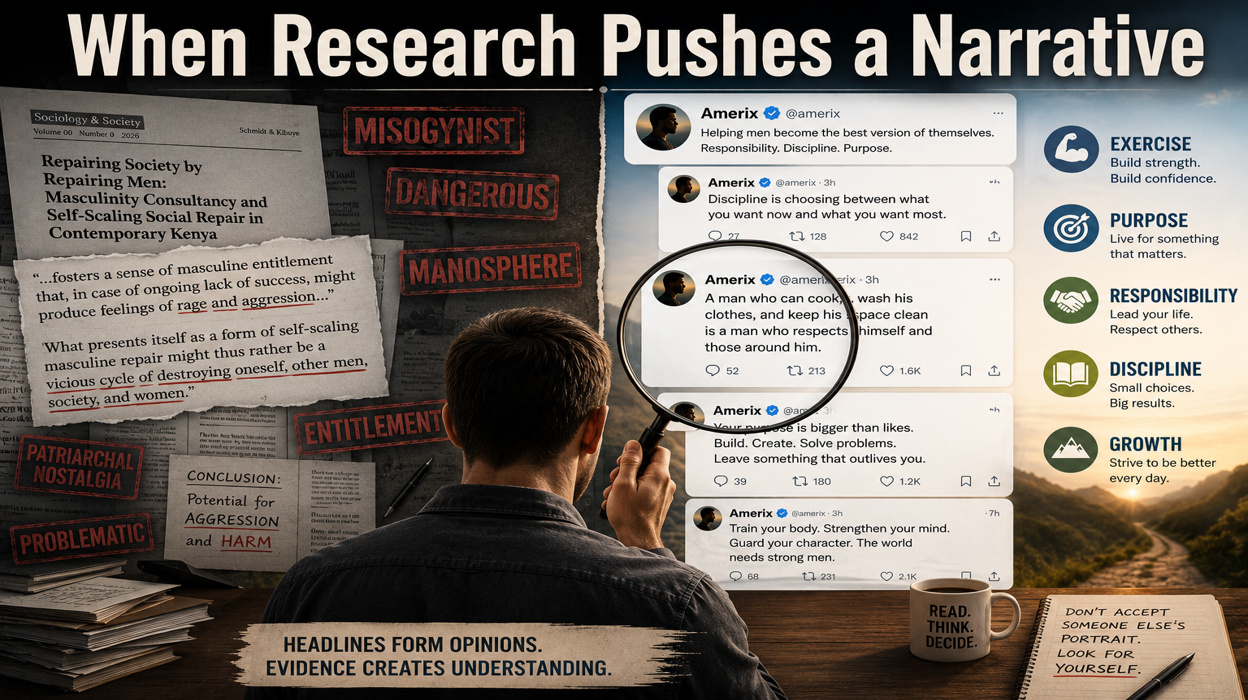
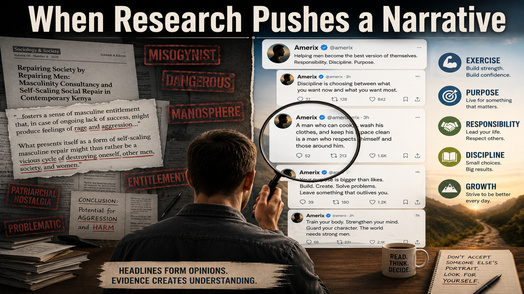
I recently read an article in the journal Men and Masculinities about a Kenyan health care worker and masculinity writer who goes by the name Amerix on X. The paper described him as an influencer with more than two million followers and expressed deep concern about what it saw as his misogyny and harmful influence on men.
I had never heard of Amerix. So before reading any further, I decided to spend some time reading his posts on X for myself. Here are a few:
1. Amerix
It is easy to blame your:
• Childhood
• Parents
• Tribe
• Government
It is much harder to accept responsibility for your own decisions.
The day a man stops looking for someone else to blame is the day he begins taking control of his life.
2. Amerix
Men,
A man who can:
- Cook
- Wash his clothes
- Clean his environment
- Organize his closet
- Mend & sew his clothes
- Budget his moneyCannot be manipulated by women.
Be this man!
3. AmerixMen,
How to be a loser in life:
- Download TikTok,
- Start scrolling mindlessly,
- Ogle at naked women, laugh at shit videos & dumb jokes.If you consume shit, you will become shit.
After reading dozens of posts like these, I found myself wondering if I had somehow landed on the wrong account.
What I found surprised me. I expected to find someone whose main focus was attacking women. Instead, I found someone consumed with challenging men.
Get healthy.
Stop making excuses.
Save your money.
Read books.
Learn a skill.
Exercise.
Build friendships with other men.
Take responsibility.
Become the kind of man others can depend upon.
What I found was a man who thought highly of masculinity and cared deeply about men who were struggling to find their place in a world that openly criticizes men as being toxic. He challenged them to stop making excuses, take responsibility, and work on themselves as men. I can’t remember hearing a comparable message from feminist writers directed toward women. Their emphasis has generally been on the obstacles women face, the ways society has failed them, and their claims of victimhood. Amerix’s message was very different. He held men accountable and urged them to become stronger, healthier, more disciplined, and more capable.
Why would millions of men and boys be drawn to someone like Amerix?
I don’t think it’s much of a mystery.
His message is remarkably simple: You matter as a man. Now get to work.
He challenges men to improve themselves while offering practical guidance on how to avoid the traps that derail so many lives. Beneath that challenge is another message—one many men have rarely heard—that they have value simply because they are men.
In a culture that casually speaks of toxic masculinity while rarely celebrating the positive possibilities of manhood, that message is powerful. Amerix tells men they have value, but he doesn’t stop there. He also tells them they have a responsibility to live up to that value.
Does Amerix talk about women? Absolutely. He has some strong opinions about women and repeatedly urges men to be cautious in their relationships. He encourages men to value themselves, maintain their own purpose, and not lose themselves in trying to satisfy every desire of a partner. I can understand why many feminists would object to some of his views. He is often blunt and sometimes makes sweeping statements about women. But after reading a number of his posts, I simply can’t say that women are the center of his work. They aren’t. Men are. His central project is encouraging men to become stronger, healthier, more disciplined, and more responsible.
Here’s one of his tweets about women:
Men, You are the driver of your bus. The bus is your life and the route is your purpose. A woman is a passenger in your bus. If you are a careless driver, she will alight. Don’t follow her. Improve your skill & keep going. Another passenger will board.
The paper concludes that Amerix’s message is ultimately dangerous. Here’s how the authors summarize their concern:
Amerix’s ideology thereby not only reproduces the experience of pressure, failure, depression and stress caused by the expectation to fulfil the role of the breadwinner (cf Schmidt 2024), but also fosters a sense of masculine entitlement among Kenyan men (cf Kimmel 2019) that, in case of ongoing lack of success, might produce feelings of rage and aggression. What presents itself as a form of self-scaling (Schmidt and Kibuye ) masculine repair might thus rather be a vicious cycle of destroying oneself, other men, society, and women.
I paused when I read that.
This is not merely a criticism of some of Amerix’s ideas about women or relationships. It is a much broader claim. The authors argue that his overall message of masculine self-improvement ultimately becomes “a vicious cycle” that destroys the man himself, other men, society, and women.
That is an extraordinary conclusion.
Extraordinary conclusions deserve equally strong evidence.
What surprised me was how little attention was given to the positive themes that dominate so much of his work—discipline, health, responsibility, purpose, and accountability. Those themes receive relatively little discussion, while the paper concludes that his overall message leads toward entitlement, aggression, and ultimately the destruction of oneself, other men, society, and women.
Then, a few pages later, the paper makes another striking claim: (emphasis mine)
Amerix’s suggested practices of masculine self-repair thus have three important
characteristics differentiating them from other forms of social repair. They are, firstly, not outward-oriented but practices of caring for one’s masculine self. They are, secondly, prone to paranoia because changing their masculine self will cause a change in how men see the world, namely as interlaced with feminist ideology and micro-practices that need to be uncovered and corrected. Lastly, masculine self-repair is considered self-scaling, that is small acts of (re)masculinizing are believed to cause changes in men’s relations to other people as well as cause the world to run according to its masculine nature again. According to Amerix, masculine self-repair therefore leads to a revelation of the fact that men live in a perverted world that can, however, be tilted back onto its masculine trajectory if enough men decide to repair their masculine selves.
Wait a minute.
The authors argue that Amerix’s message makes men “prone to paranoia” because they begin to see feminist ideology woven throughout modern society.
Really?
But that immediately raised another question in my mind.
If encouraging men to see feminist influence throughout society is said to foster paranoia, shouldn’t we also ask whether encouraging women to see patriarchy throughout society might produce a similar effect?
The point is not that either movement is necessarily paranoid.
The point is that the same psychological standard should be applied consistently.
If one worldview is examined for its tendency to heighten suspicion, then competing worldviews deserve the same scrutiny.
That seems reasonable to me.
This also brngs up a related issue. The authors seem upset that Amerix would make sweeping negative generalizations about women, Okay. But if they are going to take that route shouldn’t they also hold the same judgment against all of the sweeping generalizations about men that are made on a daily basis? Men are toxic, men are privileged, etc. I have never heard a feminist or feminist researcher hold themselves accountable in that manner. Have you?
I finished reading Amerix with a more positive impression than I expected.
I finished reading the paper with a more negative impression than I expected. Not because it criticized Amerix. But because I don’t think it gave an accurate representation of him.
Before we criticize anyone, we have an obligation to understand what they are actually trying to accomplish.
After reading both, I came away believing the paper understood Amerix’s most controversial statements. I’m not convinced it understood Amerix himself.
Men Are Good.