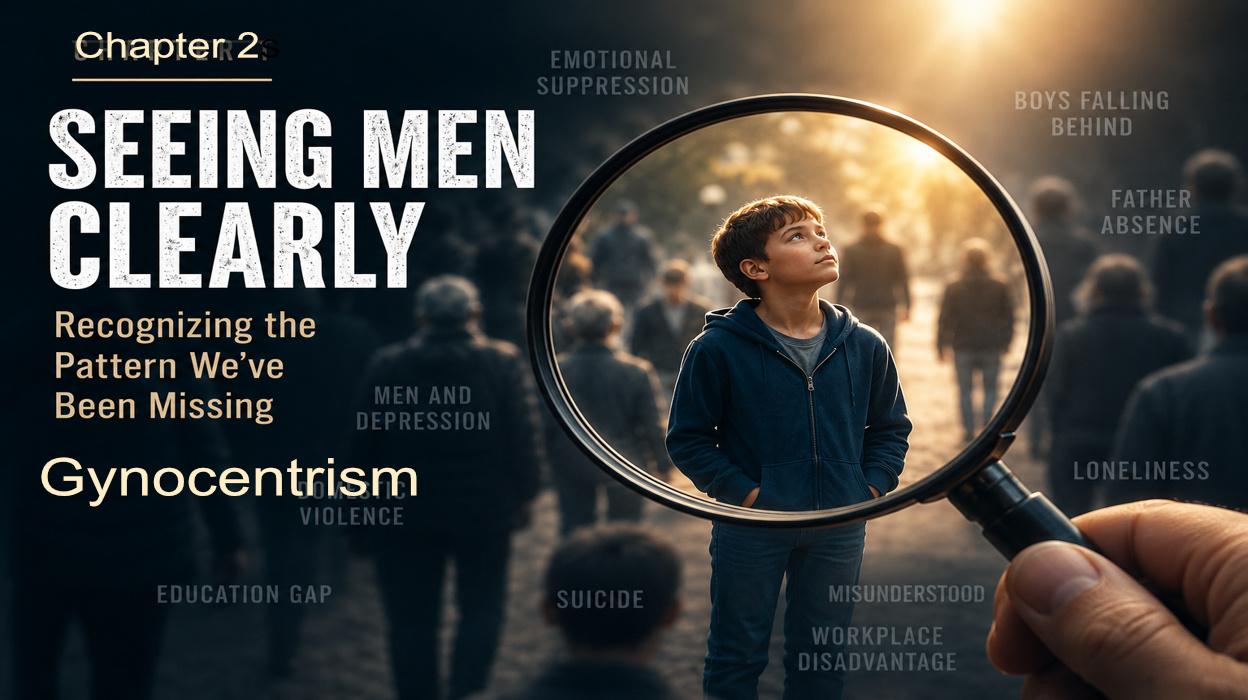
Last week I shared the opening chapter of Seeing Men Clearly. This chapter introduces the central concept on which the rest of the book is built. My hope is not to assign blame, but to better understand the hidden forces that shape how we think about boys and men. As always, I welcome your thoughts.

What Is Gynocentrism?
The pattern described in the previous chapter has a name: gynocentrism.
The term is unfamiliar to many readers. It is sometimes misunderstood and often assumed to be accusatory.
Properly understood, however, it is neither an accusation nor a criticism.
As used in this book, gynocentrism refers to a cultural tendency to treat female vulnerability as morally primary. It does not mean hatred of men. It does not mean women are favored in all domains. It does not mean women never suffer injustice.
Rather, it describes a reflex—a hierarchy of concern that operates quietly beneath policy debates, media narratives, and social assumptions. When harm occurs, we instinctively ask: “How does this affect women and children?” We are often slower to ask: “How does this affect men?”
That asymmetry is not always conscious. In fact, it rarely is.
Not a Conspiracy—A Reflex
Gynocentrism is not a coordinated plot. It is not an organized agenda. It is not a secret doctrine taught in classrooms. It is a moral reflex that predates modern politics.
Its origins are open to debate. Some argue it reflects evolutionary pressures in which societies that protected reproductive capacity were more likely to survive. Others point to historical realities in which women were more physically vulnerable in violent environments. Still others emphasize psychological empathy biases that lead human beings to respond more strongly to those perceived as vulnerable.
These debates are worth having. But they are not central to this book. The central question is not origin. It is operation. What happens when a reflex becomes institutional default?
From Instinct to Structure
When a bias is widely shared, it begins shaping decisions without requiring coordination. It influences headlines, research questions, funding priorities, policy language, and perceptions of moral urgency. Over time, the reflex becomes structure. And structure often feels neutral. It rarely is.
If female vulnerability is treated as axiomatic, institutions will naturally become skilled at detecting and remedying harms affecting women. Male vulnerability, by contrast, will often require additional explanation before receiving equivalent attention. This does not require malice. It requires only default settings.
The Hierarchy of Urgency
Consider public reactions to harm. When women are victims of violence, the response is often swift and collective. Advocacy groups mobilize. Media attention intensifies. Funding initiatives follow.
When men are victims—even in substantial numbers—the reaction is often more muted. The suffering may be acknowledged, but it is less likely to be framed as a systemic moral emergency. The difference lies not in the worth of individual lives. It lies in the hierarchy of urgency.
Gynocentrism is the cultural gravity that helps create that hierarchy.
Why It Is Difficult to See
The hardest biases to recognize are often those that align with our moral self-image. Most people see themselves as compassionate. We celebrate protection. We admire sacrifice. We view concern for the vulnerable as a virtue.
When a bias appears in the form of kindness, it does not feel like bias. This is one reason gynocentrism often goes unnamed. To question it can feel like questioning compassion itself. But examining a reflex is not the same thing as rejecting it. It is simply asking whether the reflex should remain invisible.
The Question This Book Asks
The purpose of this book is not to argue that women should be protected less. It is to ask what happens when the protection of one group becomes the default moral frame through which all gender issues are viewed.
When that frame becomes embedded within institutions, predictable patterns begin to emerge. Educational practices may assume a single developmental model. Policies may allocate resources asymmetrically. Research may frame male suffering as secondary. Cultural narratives may normalize male disposability. These patterns are not random. They follow from the reflex.
Gynocentrism is not the enemy. Unexamined bias is the problem.
If we are serious about fairness, equality, and moral consistency, we must be willing to examine the hierarchies we have inherited—especially those that feel virtuous. The chapters that follow explore how this reflex operates in modern institutions. Not to inflame. But to illuminate.

We've seen how a hidden moral hierarchy can shape the way we respond to suffering. But how does that hierarchy become embedded in schools, research, laws, and public policy? In the next chapter, we'll explore how a cultural reflex gradually becomes an institutional reality.