One of the great dangers of modern journalism is that a false narrative can acquire the appearance of fact simply by attaching itself to an authoritative source. That is what appears to have happened in a recent Le Monde article about “masculinism.”
The article makes a series of extraordinary claims about boys and men. Its very title announces that masculinism is an “increasingly widespread, violent and popular ideology among French youth.” Throughout the article, male grievance, separated fathers, antifeminism, the manosphere, incels, misogyny and terrorism are placed close enough together that they begin to look like parts of the same phenomenon.
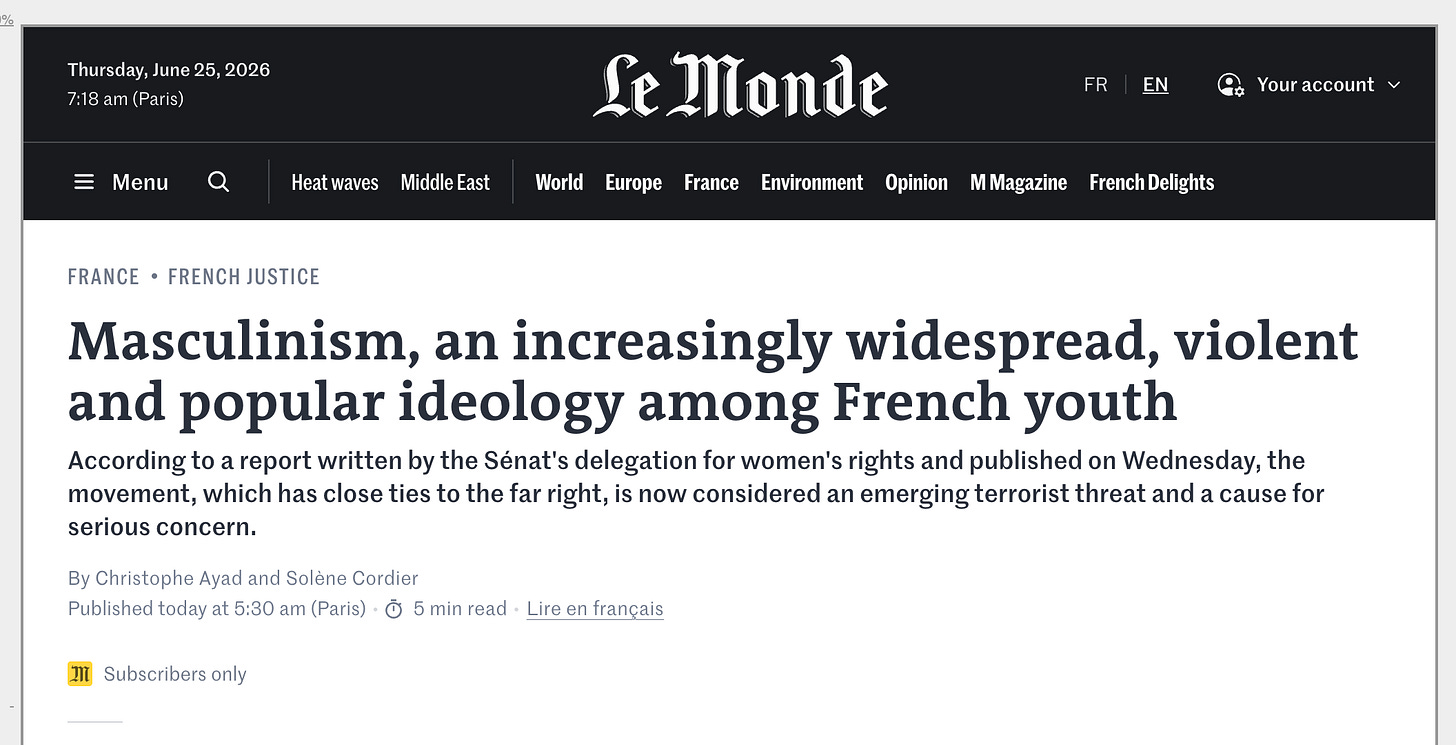
And the claims carry considerable authority because they are presented as flowing from a 260-page French Senate report drawing, in part, on information from the DGSI—France’s domestic security service. That sounds impressive. But then you read what the underlying material actually says. And the story begins to fall apart.
The security evidence is dramatically narrower than the Le Monde narrative built around it. Instead of evidence that a widespread movement of French boys and young men is becoming violent, we find one exceptionally serious case involving a young man identified with incel and Black Pill ideology who was allegedly preparing an attack, along with approximately nine other young people being monitored because authorities considered them susceptible to violent radicalization in connection with the incel milieu.
Those are not the same thing. One boy was allegedly preparing an attack. The others were considered susceptible to radicalization.
Yet watch what happens as this information moves through the story:
One alleged incel attack plot → roughly ten monitored youths → incels → the manosphere → masculinism → a widespread violent ideology among French youth.
At every step the population gets larger. But the word violent travels with it.
That is what makes this more than sloppy wording. When journalism takes evidence about one exceptional case and allows its most frightening characteristics to spread across larger and larger groups, it can create a public narrative that the underlying evidence never established.
And when the people being described are boys and men, the resulting narrative can become deeply misandrist: ordinary male distress starts looking suspicious; male grievance becomes a possible gateway to extremism; fathers’ advocacy can be placed alongside misogyny; and boys searching for help, identity or belonging can appear as the outer edge of a terrorist problem.
So I decided to look more closely at the young men being used to support this narrative. That is when I discovered something remarkable.
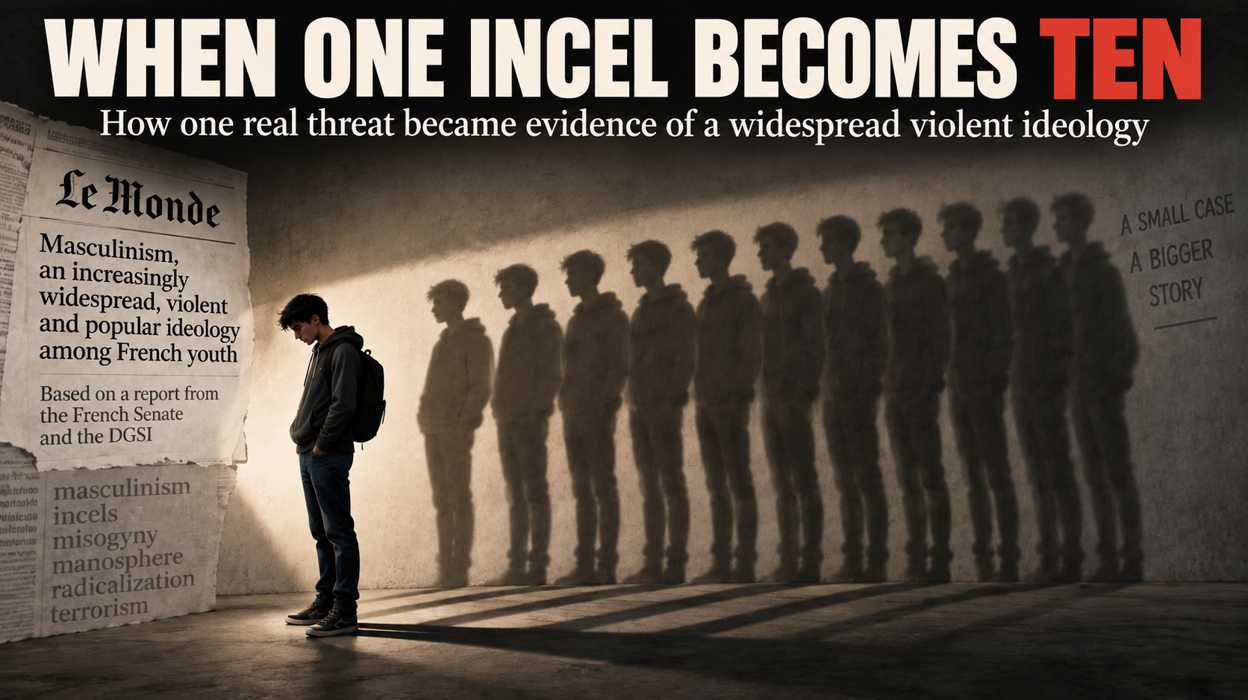
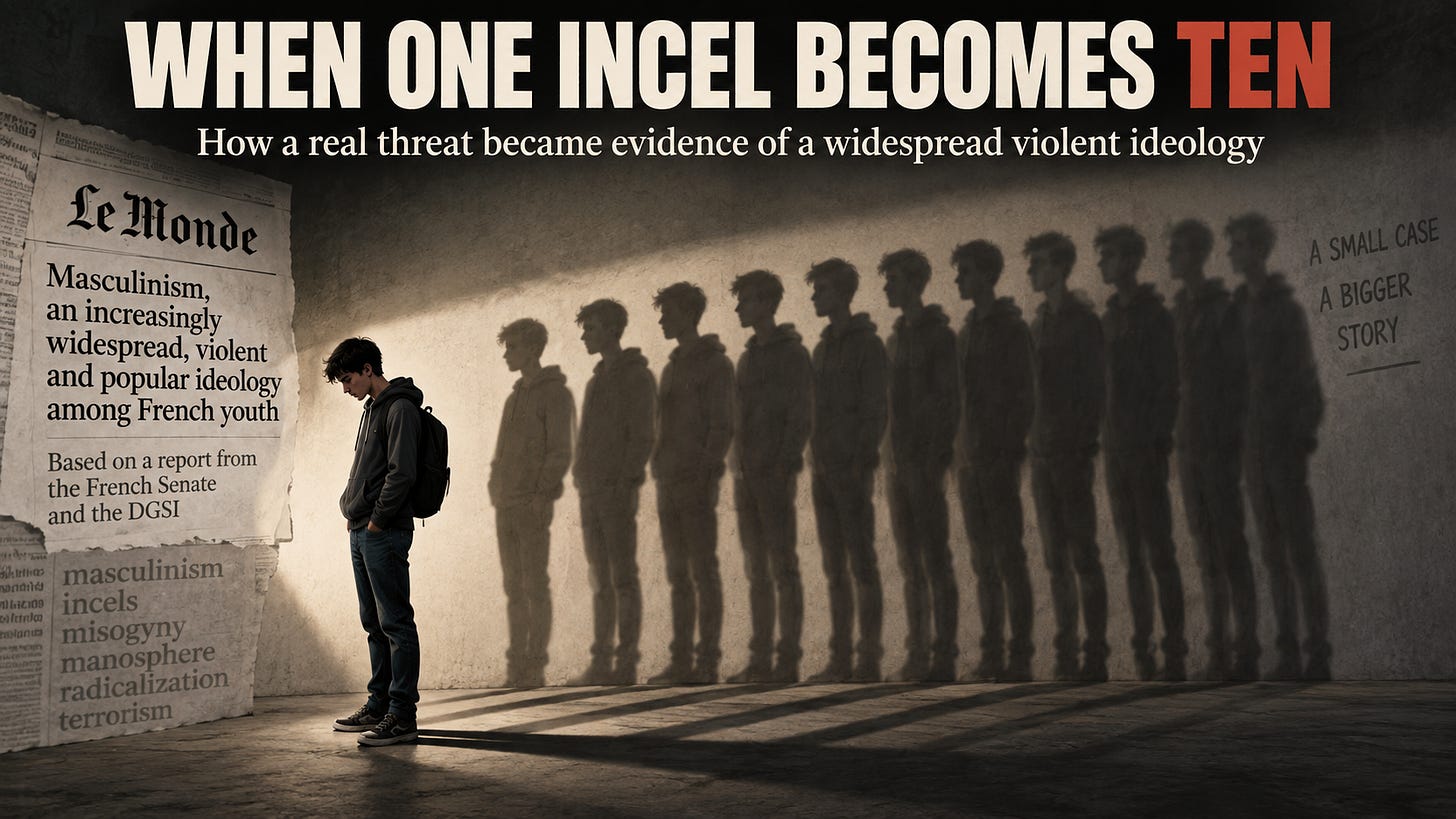
One incel had become ten.
Not literally, of course. The other young people did not suddenly adopt his beliefs or actions. Rather, the characteristics of this one serious case began to migrate outward onto other young people for whom the evidence was very different.
The DGSI, France’s domestic security service, reported approximately ten young people under scrutiny because they were considered susceptible to violent radicalization in connection with the incel milieu. That is not the same thing as saying that ten violent incels had been discovered.
One young man was identified with incel/Black Pill ideology and allegedly preparing an attack. The others were being watched because authorities believed they might be susceptible to radicalization. That distinction is crucial.
Susceptibility is not radicalization. Surveillance is not violence. And being considered vulnerable to recruitment into an ideology is certainly not the same thing as personally identifying with that ideology.
At each step the population expands while the frightening characteristic derived from the smallest and most extreme group remains attached. That is the sleight of hand at the heart of this story.
The part of the story we weren’t told
There is another detail that makes the Saint-Étienne case considerably more complicated than the framing suggests. According to the account attributed to the DGSI, the young man’s hostility was directed toward a particular girl whom he believed had falsely accused his friends of rape.
That does not make the alleged plot less serious. Nor does it demonstrate that incel ideology played no role. Both things could have been operating simultaneously. But surely it matters when we are trying to understand motive.
There is a significant difference between a young man wanting to attack women simply because they are women and a young man who embraces incel ideas but is also enraged at a particular person because he believes she seriously harmed his friends. The Le Monde article made no mention of his concerns for his friends.
Perhaps incel ideology intensified that grievance. Perhaps the grievance drove his attraction to the ideology. Perhaps both were important. We don’t know. And that is precisely the point.
The available evidence does not allow us simply to choose among those possibilities. But remove the specific grievance and what remains is a much cleaner story:
Incel hates women and plans attack against girl.
Put the omitted grievance back in and the story becomes more complicated:
A troubled young man immersed in incel/Black Pill material allegedly planned violence against a particular girl whom he believed had falsely accused his friends of rape.
The second description is less convenient. It is also more complete.
One boy carries the weight of the story
This matters because the Saint-Étienne suspect is doing an enormous amount of work in the larger narrative. He is the strongest evidence of the progression the article wants the reader to see:
male grievance → incel ideology → radicalization → violence
But then his characteristics begin to bleed outward onto the other young people.
The Senate report itself is more cautious. It distinguishes cognitive radicalization from behavioral radicalization and acknowledges that the scientific literature does not establish a causal relationship between exposure to masculinist material and violent action. Ideological adherence, it says, does not mechanically lead to violence.
That qualification changes everything. A boy can watch objectionable material without accepting it. He can accept radical ideas without becoming violent. He can be lonely or angry without being radicalized. He can be susceptible to radicalization without actually becoming radicalized. And he can be monitored by a security service without ever having planned an attack.
Those aren’t minor semantic distinctions. They are different evidentiary categories.
How a threat grows on paper
Once you preserve those distinctions, the architecture of the story becomes much easier to see. There are really three very different populations.
The first is a serious case: a young man identified with incel/Black Pill ideology who was allegedly preparing an attack.
The second is a tiny security population: approximately ten young people considered susceptible to violent radicalization in connection with incel milieus.
The third is an enormous and heterogeneous population of boys and men who may watch male-oriented influencers, participate in parts of the manosphere, criticize feminism, favor traditional sex roles, belong to fathers’ groups, struggle with dating, or simply search online for help with loneliness, fitness, money, relationships, or becoming a better man.
Evidence about the first population does not automatically describe the second. And evidence about the second certainly does not describe the third.
But place all three populations close enough together and the reader begins to experience them as points along a single continuum. That is where framing becomes so powerful.
You don’t actually have to say that the lonely fifteen-year-old watching fitness videos is on his way to becoming a terrorist. You merely put him into a narrative that begins with algorithms and male grievance, passes through misogyny and incels, and ends with terrorism.
The reader supplies the arrow.
One attack becomes two
This is also why another discrepancy in the Le Monde article matters so much. The article says that two violent masculinist actions were foiled in 2024 and 2025. But the underlying Senate report identifies one imminent incel terrorist attack foiled by the DGSI—the Saint-Étienne case.
The report discusses other young people who were arrested, referred, investigated, or monitored. But those categories are not interchangeable.
A referral is not an attack. Surveillance is not an attack. Concern about possible radicalization is not an attack. Preparation for an attack is something else entirely.
Unless a second equivalent case can be identified, turning one foiled attack into two “violent actions” isn’t merely a numerical discrepancy. It reinforces the larger narrative by making an extraordinarily small phenomenon appear to be reproducing itself.
And the report itself warns against drawing broad conclusions from these cases. The number is simply too small.
Yet the headline offered to readers was:
“Masculinism, an increasingly widespread, violent and popular ideology among French youth.”
Think about the distance between that headline and the underlying security evidence. One alleged imminent attack. Approximately ten young people being watched because they were considered susceptible to violent radicalization associated with the incel milieu. Only one clearly identified here as an incel/Black Pill adherent preparing an attack.
That is a very different story.
The boys disappear again
There is one final part of this that troubles me. The Senate material describes many of these young people as profoundly vulnerable. Their histories include bullying, social isolation, trauma, sexual victimization, disability, psychiatric difficulties, and dysfunctional families.
Those details should matter. They don’t excuse threats or violence. A young man preparing to hurt someone needs to be stopped regardless of what happened to him.
But imagine encountering a group of troubled girls with those histories. Would our first question be: How dangerous are these girls to men? Or would we ask: What happened to them?
With these boys, their vulnerability seems to become interesting primarily because it may make them susceptible to radicalization. Their suffering becomes a security indicator.
The boy disappears and the potential perpetrator takes his place.
That may be one of the most revealing aspects of the entire story.
The same information could have prompted another set of questions. Why are these boys isolated? Why were some of them bullied? What happened to the sexually victimized ones? Where are their fathers? Where are the male mentors? Why are boys searching online for communities that seem to offer them belonging, identity and meaning? And what could we do to reach them before some negative influencers do?
Those questions don’t require ignoring genuine threats. Quite the opposite. Understanding troubled boys more accurately might be one of the best ways of preventing the tiny number who actually become dangerous from getting there.
A real threat needs no exaggeration
There really was a serious case in Saint-Étienne. French authorities appear to have identified a credible threat and intervened before anyone was hurt.
Good.
That is exactly what security services are supposed to do. And that story needs no exaggeration.
What it does not justify is allowing the characteristics of that one young man to migrate outward—to approximately nine other monitored youths, then to incels generally, then to the manosphere, then to “masculinism,” and ultimately to a broad population of boys and men whose beliefs and behavior bear little resemblance to his.
There is a lesson here that reaches far beyond this particular article. Whenever we hear that some enormous group is becoming “radicalized,” “extremist” or “violent,” we should ask a few simple questions:
How many people actually committed violence? How many actually planned violence? How many were merely being monitored? How many personally identified with the ideology being discussed? And at what point did evidence about a tiny extreme subgroup begin to describe everybody else?
Those questions are especially important when we are talking about boys.
A real threat should lead us to greater precision, not less. One alleged terrorist plot is serious enough.
We shouldn’t need to turn one incel into ten—and ten into a generation.
Men Are Good.