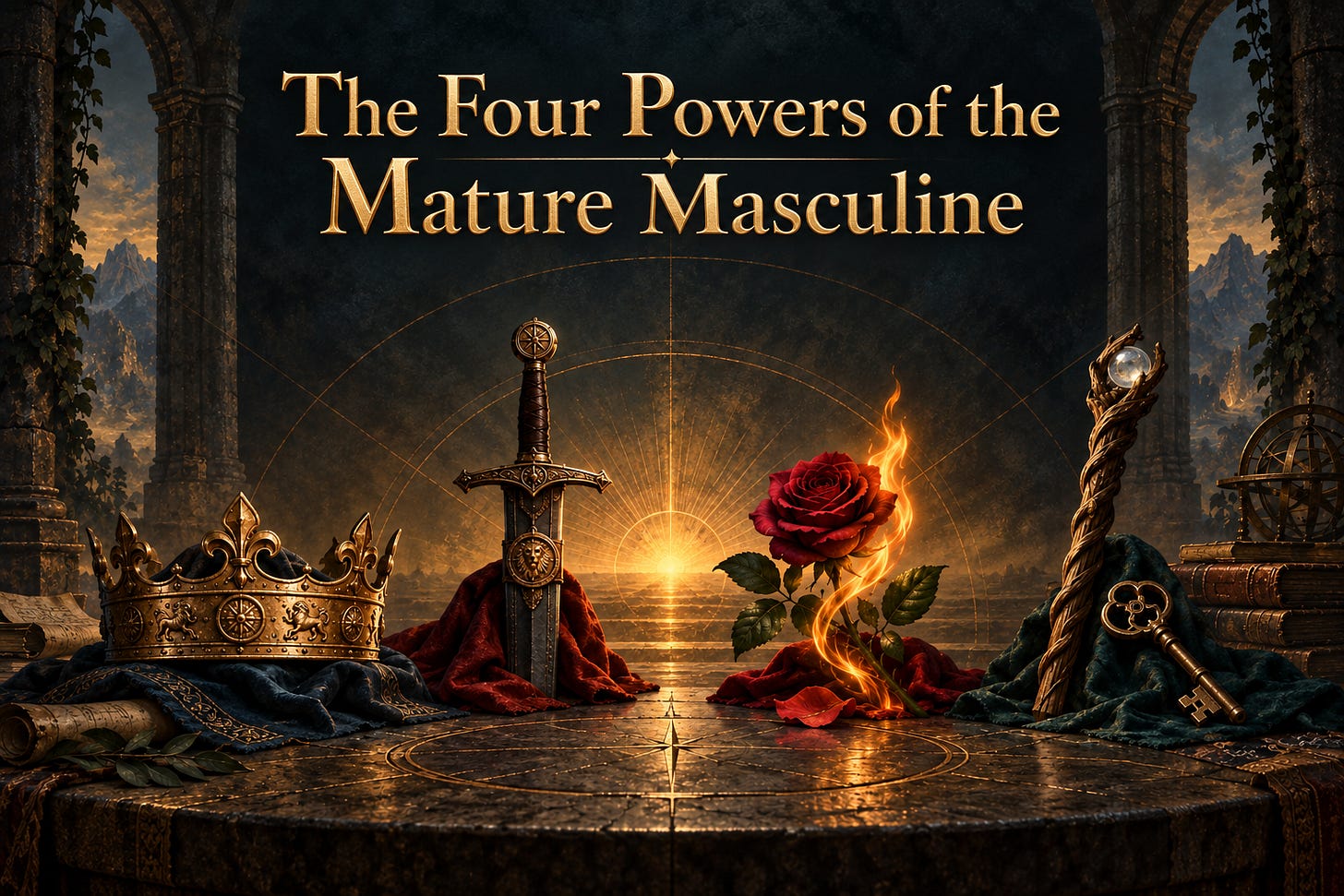
I met Robert Moore only once, but I fell in love with him.
That may sound like an unusual way to introduce a psychological theorist. But anyone who heard Moore teach will probably understand what I mean. He had a strong Southern drawl, an enormous personality, and a gift for taking difficult psychological ideas and making them feel immediate and alive. He would move from Carl Jung to an old myth, from a clinical observation to a story about ordinary life, and then—often enough—to a reference to Jack Daniel’s.
You never had the sense that the archetypes were dry concepts to him. They were living realities. He saw them at work in families, marriages, therapy offices, universities, churches, corporations, political movements, and the private struggles of men trying to grow up.
Many years ago, I purchased a collection of Moore’s audiotapes on the masculine archetypes. I listened to them repeatedly and found them profoundly helpful, both personally and in my work as a psychotherapist. The books Moore wrote with Douglas Gillette—particularly King, Warrior, Magician, Lover—present the basic architecture of the model. But the recordings are different.
Much of this series draws from approximately twenty-seven hours of recordings from Moore’s graduate classes on the masculine archetypes. In those classes he had room to think aloud, answer questions, wander down unexpected paths, tell stories, make jokes, and show how the different parts of his theory fit together. The result is more personal, expansive, and sometimes more revealing than the published books.
These articles are my attempt to introduce that richer Moore to a new audience.
Before we meet the King, Warrior, Magician, and Lover, however, we need to understand what Moore meant by an archetype.
What Is an Archetype?
An archetype is not a personality type.
The four archetypes are not four categories into which men can be sorted. This is not a masculine version of a personality quiz in which you discover that you are “a Warrior” while your friend is “a Lover.” Nor are archetypes prescribed social roles or stereotypes telling men how they are supposed to behave.
An archetype is a deep human pattern—an organizing potential within the psyche that shapes how we perceive, experience, and express a particular form of energy.
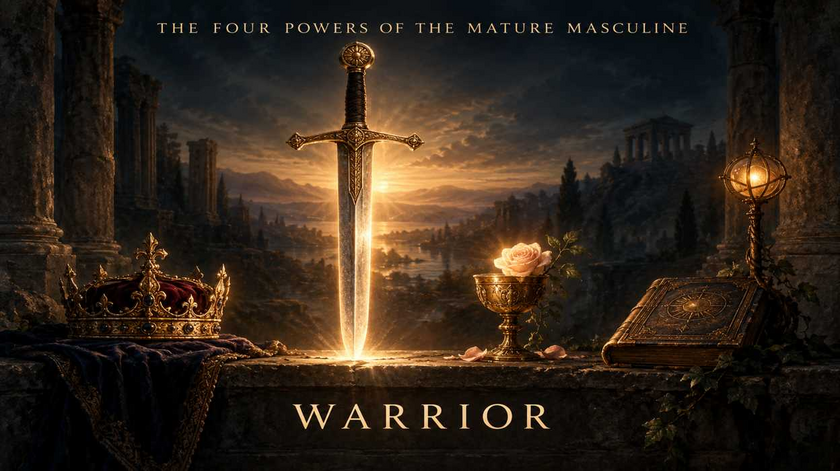
The King organizes, blesses, and creates order.
The Warrior acts, protects, establishes boundaries, and gets difficult things done.
The Lover connects, values, grieves, delights, and experiences the world through the senses.
The Magician observes, interprets, understands, and guides transformation.
Every man carries the potential for all four.
We may have easy access to one and very little access to another. One may be welcomed by our family while another is shamed. We may express an archetype maturely in one situation and fall into its shadow in another. We may be disciplined and courageous at work yet unable to establish a boundary with someone we love. We may be a wise guide to other people but incapable of applying the same wisdom to ourselves.
The goal is not to determine which archetype we are. The goal is to develop a conscious relationship with all four and gradually bring their powers into cooperation.
Moore was also careful to distinguish between connecting with an archetype and identifying with it. A man can connect with King energy, but he is not the King. He can draw upon the Warrior, but he is not the archetypal Warrior. These energies are larger than the individual ego.
When a man receives their power while remaining aware of his human limits, the archetype can enlarge his life. But when his ego begins to believe that it is the archetypal power, inflation follows. He may become convinced that he alone knows the truth, that ordinary rules do not apply to him, or that other people exist to admire, obey, or serve him.
Healthy contact with an archetype gives us power. Identification with it makes us grandiose.
Maturity therefore requires more than awakening these energies. It requires learning to contain, balance, and steward them.
Psychology’s Missing Question
As far as I know, Robert Moore is the only major psychological theorist who attempted such a sustained and systematic examination of the mature masculine.
Psychology has produced libraries about what is wrong with men. It has studied male aggression, violence, narcissism, emotional restriction, risk-taking, sexual pathology, criminality, and failure. Some of that work is necessary and valuable. Men, like women, have shadows that must be understood.
But pathology is not a vision of maturity.
It is one thing to tell men what they must stop doing. It is quite another to help them understand what they might become.
Where is the psychological literature describing mature male authority that does not become domination? Where is the account of aggression transformed into courage, discipline, and protection? Where do we find male sexuality joined with wonder, grief, tenderness, and appreciation? Where is knowledge transformed into initiation, healing, and service?
Moore asked these questions.
Instead of beginning with the assumption that masculine power itself was the problem, he asked what each power looked like when it was immature, wounded, inflated, or properly developed. He did not deny the destructive possibilities within men. On the contrary, he examined them closely. But he refused to confuse the shadow of masculinity with masculinity itself.
That distinction is badly needed today.
Years ago, I raised Moore’s work with a group of members of Division 51 of the American Psychological Association—the division devoted to the psychological study of men and masculinities. Not one person present was familiar with it.
I found that astonishing. Here was an extensive psychological model devoted to mature masculine development, and it was largely unknown within the professional organization created to study men.
Perhaps it should not have been surprising. Our culture has become much better at describing harmful male behavior than at giving boys and men a positive image of what their strength, aggression, sexuality, authority, and intelligence are for.
But we cannot help boys grow into mature men if we possess no serious image of mature masculinity.
Moore gave us one.
Four Powers, Not Four Boxes
Moore’s model begins with four basic configurations of masculine energy.
The King is the center that creates order. He offers blessing, holds a vision of the whole, calms chaos, and uses his authority to help others develop. His mature power is not control for its own sake but generativity—the capacity to create a world in which life can flourish.
The Warrior brings disciplined action. He recognizes enemies, establishes boundaries, endures hardship, and places his strength in service of something beyond comfort or self-interest. The mature Warrior is not violent for the pleasure of violence. He knows what must be protected and what is worth sacrificing for.
The Lover awakens us to value. He experiences beauty, pleasure, sorrow, sexuality, nature, music, friendship, and the astonishing particularity of another person. The Lover is the part of us that knows why the world is worth protecting in the first place.
The Magician understands the map. He sees beneath appearances, breaks through denial, interprets symbols, recognizes which energy a situation requires, and helps people move through transformation. At his highest level, knowledge becomes healing and stewardship.
None is sufficient alone.
The King without the Magician may become certain of his own authority and unable to recognize his self-deception. The Magician without the King may see through everything but believe in nothing. The Warrior without the Lover may become brutal, while the Lover without the Warrior may be unable to protect what he loves. The King needs the Warrior’s capacity to act, the Lover’s capacity to value, and the Magician’s capacity to discern.
Maturity does not eliminate the tensions among these powers. It helps us hold them consciously so that each can correct and complete the others.
Every Archetype Has a Shadow
Moore’s work is not a celebration of masculine power without qualification. Each archetype has shadow forms.
The King’s authority may inflate into tyranny or collapse into weakness. The Warrior’s discipline may become cruelty or turn inward as masochistic self-destruction. The Lover’s capacity for connection may become addiction and boundarylessness or disappear into numbness and impotence. The Magician’s insight may become manipulation, cynical detachment, or the denial of knowledge and responsibility.
These opposites are often closer than they appear. The Tyrant may conceal a terrified Weakling. The man who dominates others may feel inwardly powerless. The compulsive Lover may alternate between overstimulation and deadness. The detached Magician may secretly depend upon others to carry the emotional life he refuses to enter.
Moore’s model is therefore not a simple theory of four positive qualities. It is a dynamic system filled with developmental levels, opposing shadows, characteristic inflations, inner conflicts, and relationships among the archetypes.
His understanding also evolved. In the lectures, Moore sometimes questioned earlier formulations, distinguished one archetype from another more carefully, and explored ideas that never received the same space in his books. He was building a map of enormous territory, and he knew the map was unfinished.
This series cannot offer an exhaustive account of that territory. These articles cannot contain the complexity of twenty-seven hours of teaching, much less the larger body of Moore’s work.
What follows is an overview—a way of opening four doors.
The Boy, the Hero, and the Man
One of Moore’s most important distinctions was between boy psychology and mature masculine psychology.
The boy is not bad. Boyhood contains imagination, daring, play, idealism, and enormous potential. But the boy’s energies are not yet organized around adult responsibility. They easily become grandiose: the fantasy that he is invulnerable, uniquely important, exempt from limits, or destined for greatness without apprenticeship and sacrifice.
Moore regarded the Hero as primarily a boyhood pattern. The Hero’s great task is not to remain heroic forever. It is to confront his own grandiosity, accept his limitations, and grow up.
Only then can he become a mature Warrior.
This is a crucial correction to the way these ideas are often simplified. The Warrior is not merely a stronger Hero. The Hero fights in large part to establish himself. The mature Warrior has less need to prove himself because his energy has been placed in service.
The same developmental movement appears in all four archetypes. Immature energy asks, “How powerful does this make me?” Mature energy asks, “What is this power for?”
That question—what is it for?—runs through Moore’s entire model.
Authority is for blessing and creating order. Aggression is for protecting, separating, and acting. Sexual and emotional vitality are for relationship, appreciation, and participation in life. Knowledge is for discernment, initiation, and healing.
Power reaches maturity through stewardship.
Why These Ideas Matter Now
Many men today have been given an extensive vocabulary for their possible defects and almost no language for their healthy development.
They hear about toxic masculinity, male privilege, emotional restriction, dominance, violence, and entitlement. Again, harmful behavior deserves honest attention. But a boy cannot build an identity entirely from instructions about what not to become.
He needs to know what his strength is for.
He needs an image of authority that blesses rather than dominates; aggression that protects rather than abuses; sexuality that connects rather than consumes; knowledge that heals rather than manipulates.
He also needs permission to see these capacities as genuinely masculine without being told that masculinity is either inherently dangerous or merely an arbitrary costume imposed upon him.
Moore offered a language capable of holding masculine power and masculine shadow at the same time. He neither romanticized men nor reduced them to their failures.
That balance may be his greatest contribution.
Entering the Four Rooms
We will begin with the King, because the King supplies the center. Without some connection to calm, blessing, responsibility, and just order, the other energies easily become chaotic or destructive.
We will then meet the Warrior, whose discipline turns intention into action and whose boundaries protect what matters.
Next comes the Lover, who opens the garden of beauty, connection, grief, sexuality, and delight—the world the Warrior is asked to defend.
Finally, we will meet the Magician, keeper of the map and guide to transformation. The Magician brings the fourfold pattern into view and helps us understand how the powers work together.
These articles will include material from Moore’s books, but they will also draw deeply from the recorded classes in which his voice, humor, and humanity are most present. My hope is not merely to summarize his theory. It is to let readers feel something of what I experienced listening to those tapes years ago: the sense that these ancient patterns could illuminate an ordinary life.
Moore helped me see that mature masculinity is not a fixed destination and certainly not a performance of invulnerability. It is an ongoing relationship with powerful inner potentials—each capable of serving life, each capable of falling into shadow, and none capable of maturing alone.
The four archetypes give us a map.
They do not tell us exactly where our journey will lead. But they may help us recognize the room we are standing in, the power we have forgotten, and the next door that needs to be opened.
We will start the series next Monday.
Men Are Good.