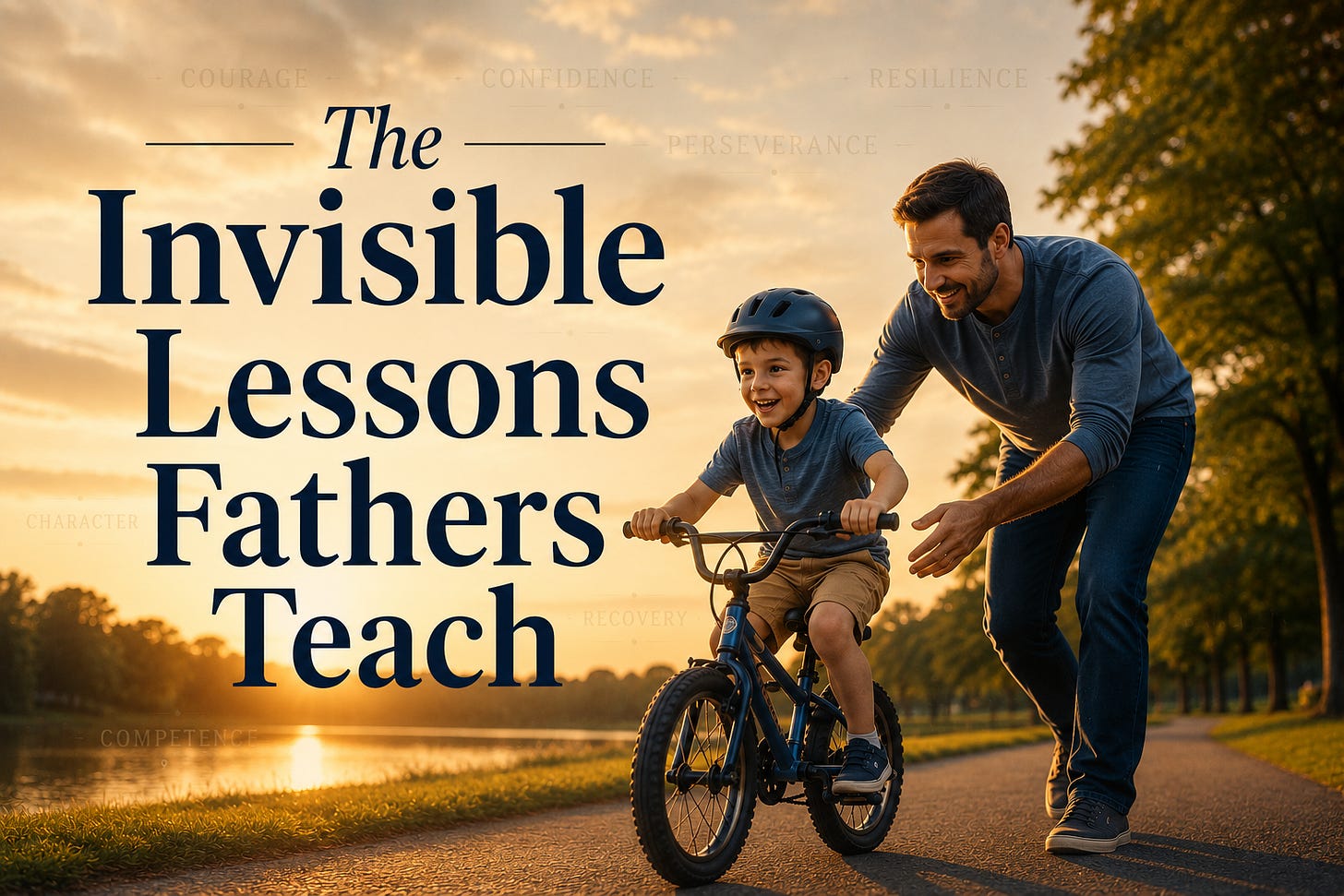
On Father’s Day many people find themselves remembering the obvious things their fathers taught them: how to ride a bicycle, throw a baseball, drive a car, bait a fishing hook, or change a tire.
These lessons matter, and they often become cherished memories. But they are not the whole story.
In fact, some of the most important things fathers teach are rarely recognized at all. Many fathers spend years teaching lessons that become so deeply woven into their children’s character that they disappear from view. They become part of who the child is rather than something the child remembers being taught.
The older I get, the more convinced I become that many of the most important gifts fathers provide are largely invisible.
Fathers Teach Children How To Handle Fear
Most children encounter fear long before they have words for it. The tall slide looks scary. The swimming pool looks deep. The first day of school feels overwhelming. The baseball game, dance recital, job interview, or first date all carry a degree of uncertainty.
Many fathers respond to these moments in a similar way: “Go ahead. You can do it.” Not because they want their children to be fearless, but because they want them to discover that fear is survivable.
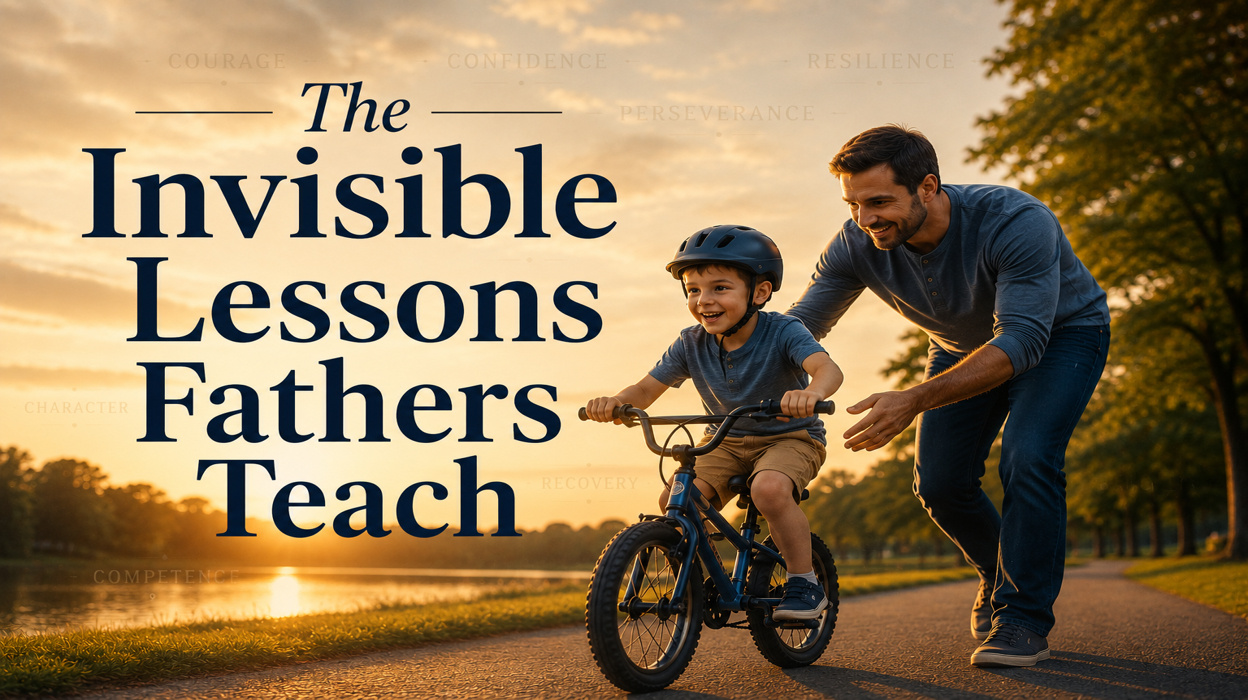
A father standing beside a bicycle, jogging alongside for those first wobbly rides, is often teaching something much larger than balance. He is teaching courage—not courage because fear is absent, but courage despite fear.
Fathers Teach That Failure Is Survivable
Children naturally want to succeed. They also naturally want to avoid embarrassment, disappointment, and rejection. Yet life guarantees all three.
Every child will eventually fail a test, lose a game, be rejected by a friend, make a mistake, or fall short of a goal. Many fathers instinctively respond to these moments with a simple question: “Okay. What did you learn?”
The lesson is profound. Failure is not the end of the story. Failure is information. Failure is experience. Failure is often the beginning of growth.
Children who learn this lesson early gain a tremendous advantage in life. They stop viewing setbacks as proof of inadequacy and begin viewing them as part of the learning process.
Fathers Teach Emotional Regulation
One of the most misunderstood aspects of fatherhood is the way fathers often teach emotional regulation. In modern culture, emotional teaching is frequently assumed to involve talking. Sometimes it does. But children also learn by watching.
They watch Dad deal with a dead battery. They watch him manage a home repair that doesn’t go as planned. They watch him navigate financial stress, family challenges, illness, disappointment, and loss. They observe how he responds when things become difficult.
The lesson is not that emotions should be ignored. The lesson is that emotions can be felt without being overwhelmed by them. Children learn that frustration, sadness, anxiety, and fear can coexist with action. This is one of the foundations of resilience.
Fathers Teach Children To Enter The Wider World
Researchers who study fathers have often noted that fathers tend to encourage exploration. Children need safety, but they also need someone encouraging them to venture beyond safety—to try, to risk, to explore, and to discover.
Developmental researcher Daniel Paquette described fathers as helping children develop a secure base for exploration. Many fathers instinctively encourage children to test themselves against the world.
Climb a little higher. Try one more time. Speak up. Take the chance.
The goal is not recklessness. The goal is confidence. Children gradually learn that the world is not something to hide from. It is something they can engage.
Fathers Teach Boundaries and Consequences
One of the most valuable lessons children can learn is that actions have consequences. Reality cannot always be negotiated. Gravity works. Deadlines matter. Promises count. Choices have outcomes.
Good fathers often help children understand these realities long before adulthood arrives. While this may not always be popular in the moment, it becomes invaluable later in life. The child who learns responsibility gradually becomes the adult who can be trusted.
Many fathers communicate this lesson through countless ordinary interactions. Finish what you started. Tell the truth. Keep your word. Treat people fairly. The message is simple but powerful: character matters.
Fathers Teach Competence
Perhaps one of the deepest gifts fathers provide is the message: “I believe you can do this yourself.”
Many fathers communicate this not through speeches but through encouragement. Try it. Figure it out. Give it another shot. You’ll get it.
At times, children may interpret this as Dad being demanding. Years later, many realize something different. Their father believed they were capable.
That belief often becomes the foundation of confidence. Confidence does not emerge from hearing that you are wonderful. Confidence emerges from discovering that you can handle challenges. It grows when children face difficulty, persist, and eventually succeed.
Fathers Teach Recovery
Life eventually knocks everyone down. There will be heartbreak, disappointment, loss, and failure. No one escapes these experiences.
Many fathers teach one final lesson that may be the most important of all: get back up.
Not because the pain isn’t real. Not because the loss doesn’t matter. Not because everything will magically work out. But because life continues.
The ability to recover from adversity may be one of the greatest predictors of long-term well-being. It is also one of the most important lessons a father can pass on to his children. A child who learns how to recover from setbacks carries that gift for the rest of life.
The Invisible Lessons
The older I get, the more I appreciate how many of the lessons fathers teach are difficult to see. Children rarely remember the thousands of small moments: the encouraging nod, the hand on the shoulder, the patient coaching, the quiet example, or the belief that they could handle more than they thought they could.
Yet these moments accumulate over time. They shape character. They build resilience. They foster confidence. They prepare children for life.
This Father’s Day, it may be worth remembering that some of the most important lessons fathers teach are not found in dramatic speeches or memorable events. They are found in the ordinary moments—moments so common that they often go unnoticed, yet moments that quietly help children become capable adults.
Perhaps that is one reason fatherhood is so often underestimated. Many of its greatest gifts are invisible.
As a therapist, I have spent decades listening to people’s stories. Again and again, I have been struck by how often the influence of a father appears in ways that neither the father nor the child fully recognized at the time. The confidence to take a risk. The ability to persevere through hardship. The willingness to face fear rather than avoid it. The belief that problems can be solved and setbacks overcome.
These qualities rarely attract attention because they are not dramatic. They emerge gradually, built through thousands of ordinary interactions over many years. Yet they often become some of the most valuable tools a person carries into adulthood.
This Father’s Day, I hope we take a moment to recognize not only what fathers do, but what they quietly teach. Much of their work may go unnoticed, but its effects can last a lifetime.
Happy Father’s Day to the fathers, grandfathers, stepfathers, mentors, coaches, and father figures whose lessons continue to shape lives long after the teaching is done.
Fathers and Men Are Good!