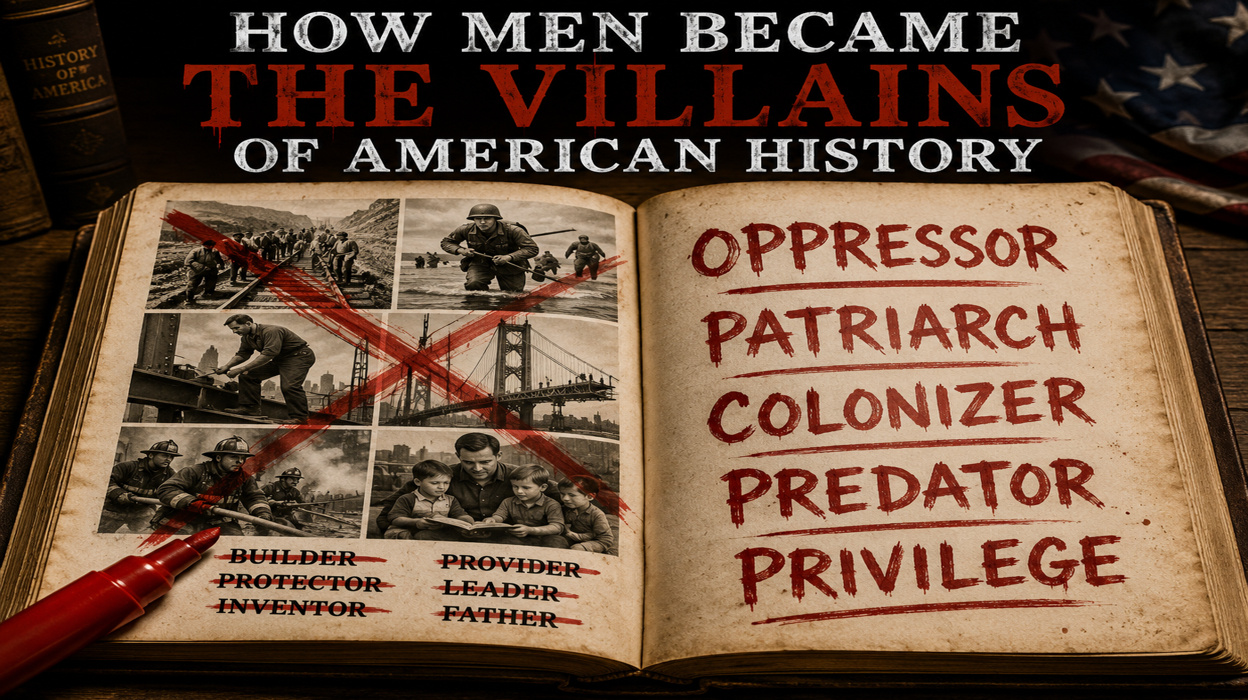
How Men Became the Villains of American History
It did not happen all at once. Each phase built upon the last until an entire generation inherited a version of history in which men were remembered less for what they built than for whom they supposedly oppressed.
American culture did not wake up one morning and decide that men should be remembered mostly as oppressors, predators, colonizers, abusers, and patriarchs. The rewriting happened gradually. It began as a correction, became a framework, hardened into institutional policy, and eventually spread through media, movies, schools, law, and the internet.
The original project was framed as a correction. Feminists argued that women had been systematically excluded from many areas of public life and that traditional histories had overlooked or minimized their contributions. They believed those omissions should be corrected and women’s experiences given greater attention. But somewhere along the way, the project changed. It was no longer simply about recovering women’s history or pursuing equality. Increasingly, it became a project of placing men—and masculinity itself—on trial.
The turning point came in the mid-to-late 1960s. The National Organization for Women was founded in 1966, and second-wave feminism began to frame American life through the language of male power and female oppression. The slogan “the personal is political” encouraged women to reinterpret private pain, disappointment, marriage, sex, motherhood, work, and family life as evidence of larger male-dominated systems.
Then came the 1970s, when the framework entered the institutions.
Women’s Studies began formally at San Diego State in 1970, the first program of its kind in the nation. Ms. magazine followed in 1972, creating a national feminist media platform. Title IX, also passed in 1972, moved sex-discrimination politics directly into education law. These developments helped establish a new moral vocabulary: women were the excluded class, men were the dominant class, and history needed to be reinterpreted through that lens.
This was the first phase: recovery.
The stated goal was to recover women’s lost history. But recovery soon became reframing. Men’s achievements were no longer simply achievements. They became evidence of exclusion. Men’s authority became oppression. Men’s leadership became patriarchy. Men’s protection became control. Men’s provision became privilege.
The second phase was suspicion.
By the mid-1970s, feminist theory had moved deeply into literature, film, and culture. Laura Mulvey’s 1975 essay “Visual Pleasure and Narrative Cinema” helped popularize the concept of the “male gaze.” This was not just a critique of a few movies. It became a way of viewing male creativity, male desire, male spectatorship, and male-created culture as inherently suspect.
The third phase was legal and policy institutionalization.
In the 1980s, the Duluth Model became influential in domestic violence policy. Its framework emphasized men’s use of power and control over women. By the time the Violence Against Women Act passed in 1994, the male-perpetrator/female-victim model had gained enormous legal, cultural, and funding power. It was driven by the erroneous idea that males were the perennial perpetrators and women the sole victims.
This mattered because law does not merely punish behavior. Law teaches culture what to notice. Once male violence was made highly visible while female violence, reciprocal violence, male victims, and children’s need for fathers were minimized, the public absorbed the message: men are the danger, women are the endangered.
No-fault divorce also belongs in this phase. California adopted the first modern no-fault divorce law in 1969, and other states followed over the next decade. The reform was intended to reduce bitterness and eliminate the need to manufacture fault in order to end a marriage. Yet the broader cultural consequences were far-reaching. The reality was that no fault divorce removed accountability and gave an opening for a revolving door of divorce.
Divorce increasingly came to be viewed through an asymmetrical moral lens. A woman who left her marriage was often portrayed as courageous, independent, or finally “finding herself.” The husband she left was more likely to be viewed as the obstacle she had overcome than as a person experiencing one of life’s deepest losses. His grief, his loss of daily contact with his children, his financial upheaval, and the collapse of his identity as husband and father were seldom given comparable attention. This was also the time when the label of deadbeat dads was assigned to fathers and placed on milk cartons.
As divorce became more common, the cultural story shifted. The focus increasingly rested on the woman who was leaving rather than the man and children who were also living through the consequences. The emotional costs borne by fathers—and the developmental costs often experienced by children who lost the daily presence of their fathers—received far less attention than the narrative of female liberation.
This, too, became part of the broader rewriting of men. The father was increasingly remembered not as someone whose presence was vital to family life, but as someone whose absence was often assumed to be manageable—or even beneficial. One of the most profound losses a man can experience became, in many public discussions, almost invisible.
The fourth phase was media popularization.
News media discovered that stories of female victimization and male wrongdoing were emotionally powerful, morally safe, captivating, and easy to package. The suffering of women could be personalized. The suffering of men was usually abstracted or ignored. Dead soldiers, dead miners, dead linemen, dead fishermen, divorced fathers, homeless men, suicidal men, falsely accused men, and alienated fathers rarely fit the preferred narrative.
The fifth phase was cultural saturation.
Movies, television, advertising, and later streaming platforms increasingly repeated the same moral structure: women awakening, women escaping, women resisting, women healing from men. Meanwhile, men were more often portrayed as obstacles, fools, predators, oppressors, or emotionally defective beings needing correction. Again, not always. But often enough that the pattern became familiar.
The sixth phase was internet amplification.
The internet did not create the anti-male frame. It accelerated it. Social media rewarded outrage, simplification, repetition, and moral accusation. Complex history became hashtags. “Patriarchy,” “toxic masculinity,” “believe women,” and “men are trash” could travel farther and faster than any careful discussion of male sacrifice, male duty, male disposability, or male contribution.
The players in this rewriting were not all the same.
Academics supplied the theory. Activists supplied the urgency. Journalists supplied the stories. Legislatures supplied the authority. Filmmakers supplied the images. Social media supplied the enforcement.
And the reasons were not all the same either.
Some wanted genuine correction. Some wanted justice. Some wanted power. Some wanted status. Some wanted revenge. Some wanted to ruin men. Some were working from unresolved pain. Some discovered that portraying women as victims and men as oppressors brought funding, attention, moral authority, and institutional protection.
The Seventh Phase: The End of the Narrative Monopoly
History took an unexpected turn.
The same technology that accelerated the rewriting of men also made it possible to question it.
For nearly three decades, the institutions that shaped public understanding of the sexes had spoken with remarkable consistency. Universities, major newspapers, television networks, publishing houses, Hollywood, and many professional organizations had increasingly adopted the same interpretive framework. There were always dissenting voices, but they rarely possessed comparable influence or access to large audiences. There was very little challenging of the default female-victim mentality.
The internet changed that. The internet giveth and the internet taketh away.
For the first time in generations, ordinary people no longer needed the approval of traditional gatekeepers to reach millions of readers or viewers.
Researchers studying boys found audiences.
Fathers’ organizations shared information that had rarely appeared in mainstream reporting.
Male victims of domestic violence began telling their stories publicly.
Psychologists discussed male depression, shame, grief, and suicide from perspectives that differed from the prevailing narrative.
Independent journalists, writers, and podcasters began asking questions that had received comparatively little public attention.
The conversation itself began changing.
This helps explain why so much attention has been directed toward what is loosely called the “manosphere.”
The label has become so broad that it often obscures more than it explains. It encompasses fathers’ organizations, psychologists, researchers, educators, podcasters, political commentators, men’s advocates, and many others whose views often differ dramatically from one another. Some are thoughtful and evidence-based. Others are not. Some are deeply concerned with helping men and boys. Others spend time exposing the flaws in feminist arguments.
Treating this entire landscape as though it represented one unified movement misses the larger historical development.
The real story is not simply the emergence of new voices.
The real story is that the monopoly over the cultural narrative had begun to disappear. After several decades of the narrative being sung in unison without counterpoint, alternative ideas were suddenly getting airtime. This was a shock for those who had comfortably relied on the exclusive spigot that spouted only one side of the story. These folks found themselves unprepared to deal with these long hidden ideas. They had no experience in having to defend their ideas since they never really needed to when only their narrative was the default. Now they were running up against a nightmare of counterpoint.
For decades, one interpretation of men had dominated most of the institutions responsible for shaping public opinion. The internet did not eliminate that interpretation, but it made it increasingly difficult to prevent competing interpretations from being heard.
History had become a conversation again.
Conclusion
The rewriting of men did not happen overnight, and it will not be undone overnight. But something fundamental has changed. For the first time in decades, the dominant narrative no longer enjoys a monopoly. Alternative voices are being heard. Research that was once ignored is being discussed. Men’s experiences are becoming visible again.
That is precisely why the word manosphere has become such a powerful weapon.
It is no longer used simply as a description. It has become a label designed to end conversations before they begin. Instead of answering uncomfortable facts, critics simply dismiss them as “manosphere talking points.” Instead of debating evidence, they attack the people presenting it. It is an old tactic: if you cannot defeat the argument, discredit the speaker.
Do not let them get away with it.
When someone dismisses an argument because it supposedly comes from “the manosphere,” ask a simple question:
“Which argument is wrong?”
If they cannot answer that question, they are not engaging in debate. They are avoiding it.
Insist that ideas be judged on their evidence, not on the labels attached to the people presenting them. Demand arguments instead of stereotypes. Demand facts instead of slogans. Demand evidence instead of guilt by association.
The same people who spent decades condemning the practice of judging entire groups by the actions of a few are now too often willing to do exactly that with men, men’s advocates, and anyone associated with the so-called manosphere. Reject that double standard.
History is healthiest when no one controls it. Progress is made when ideas compete openly, evidence matters more than ideology, and every claim—whether it comes from feminism, the manosphere, academia, or anywhere else—is expected to stand or fall on its merits.
The goal is not to replace one orthodoxy with another. The goal is something far more difficult—and far more valuable.
Tell the whole story.